Abstract
Technology plays an important role in management decision-making in MSMEs by providing more accurate data, faster analysis, and the development of more effective business strategies. With the help of technology, decision-making becomes faster and more efficient. Despite the many benefits, MSMEs face several challenges in the digitalization process. Some of the main obstacles include limited access to technology, minimal digital literacy, and financial constraints. These conditions will certainly reduce the effectiveness of technology in decision-making and may even degrade the quality of the decisions produced. Therefore, a study is needed to determine the extent to which the effectiveness of technology use affects the quality of managerial decisions made by MSMEs. The study examines the role of digitalization integration in the quality of decision-making by MSMEs. Through a systematic literature review on MSMEs, a comprehensive and useful study will be produced for sustainable development
Keywords
Technology Compatibility Innovation Culture Digitalization Integration Decision Making Quality
1. Introduction
Rapid technological developments do not only affect national or international companies. Micro, small and medium enterprises (MSMEs) must also be able to adapt to technological developments (Bagale et al., 2023). Technology plays a very important role in the development of MSMEs (Oyelaran-Oyeyinka & Lal, 2006). MSMEs can utilize various social media platforms and marketplaces to reach more customers (Bagale et al., 2023). In addition, technology use increases MSME operational efficiency, such as digital cashier applications that help record transactions faster and more accurately (Alfarizi et al., 2024). By utilizing technology, MSMEs can grow faster, more efficiently, and more competitively in the global market (Alfarizi et al., 2024; Bagale et al., 2023).
Technology also plays an important role in managerial decision-making in MSMEs by providing more accurate data, faster analysis, and helping to develop more effective business strategies (Alfarizi et al., 2024). With the help of technology, decision-making becomes faster and more efficient (Bagale et al., 2023). MSMEs can make smarter, data-based, and more efficient management decisions. This helps businesses grow faster, reduce the risk of errors, and increase competitiveness in the market (Oyelaran-Oyeyinka & Lal, 2006). The right technology helps MSMEs improve operations, marketing, and financial management and also helps MSMEs in accelerating data-based decision-making (Alfarizi et al., 2024). With the appropriate technology, business operations become more efficient
MSMEs that have a culture of innovation tend to be more open to new technologies and more effective strategies (Dabić et al., 2019; Prasanna et al., 2019). Without a culture of innovation, MSMEs tend to stagnate, have difficulty adapting to market changes, and are slow to make technology-based decisions (Dabić et al., 2019). A culture of innovation also encourages the use of data to make faster, more effective decisions. MSMEs that implement technology but do not have a culture of innovation tend to only use technology as a tool, without optimizing its full potential in decision-making (Prasanna et al., 2019). With a culture of innovation, it plays a role in encouraging the courage of MSMEs to continue to develop and try new strategies, so that decision-making by MSMEs can be more competitive (Dabić et al., 2019).
During the period 2015 to 2024, research on the integration of digitalization in Micro, Small, and Medium Enterprises (MSMEs) has shown significant progress. The digital transformation of MSMEs is the main focus in efforts to improve operational efficiency, expand market access, and increase competitiveness in the digital era. In Indonesia, the adoption of digital technology by MSMEs has increased rapidly. As of July 2024, 25.5 million MSMEs have transformed and entered the digital ecosystem (antaranews.com, 2024). This transformation involves optimizing the use of e-catalogs, social media, and local e-commerce platforms to market their products. In addition, around 32 million merchants have registered as QRIS users, of whom 95% are MSMEs. A study conducted by Bank Indonesia in August 2024 indicated that digitalization can increase added value by 25% and productivity by 17% for MSMEs (Antaranews.com, 2024).
Digital technology enables MSMEs to optimize business processes, reduce operational costs, and reach wider consumers through online platforms. Despite the many benefits, MSMEs face several challenges in the digitalization process. Some of the main obstacles include limited access to technology, minimal digital literacy, and financial constraints. These conditions will certainly reduce the effectiveness of the use of technology for decision-making, and can even reduce the quality of the decisions produced (Rusko, 2019). Therefore, research is needed to determine the extent to which the effectiveness of technology use affects the quality of managerial decisions made by MSMEs.
2. Literature Review and Concept Development
Technology Compatibility
Technology compatibility plays a crucial role in the success of digitalization integration in Micro, Small, and Medium Enterprises (MSMEs) (Alfarizi et al., 2024). The use of appropriate technology enables automation of business processes, reduces manual errors, and increases operational efficiency (Trueba-Castañeda et al., 2024). The integration of appropriate technology can reduce operational costs by optimizing resources and time. Compatible technology also enables MSMEs to reach a wider market through digital platforms such as e-commerce and social media (Telukdarie et al., 2022). Adoption of appropriate technology encourages MSMEs to innovate in products and services, increasing added value for customers (Abu Hasan et al., 2022). Compatible technology also facilitates integration with existing systems and enables adjustments to meet the needs and growth of MSMEs. Appropriate technology enables MSMEs to provide more responsive and personalized services to customers (Oyelaran-Oyeyinka & Lal, 2006).
Innovation Culture
Innovation culture also plays a crucial role in the success of digitalization integration in Micro, Small, and Medium Enterprises (MSMEs) (Dabić et al., 2019). Innovation culture encourages MSMEs to be more open and responsive to technological developments, facilitating the adoption of digital tools and platforms more efficiently (Prasanna et al., 2019). Innovation culture encourages MSMEs to create or modify products and services that suit the needs of the digital market, increasing competitiveness in the digital era (Rujirawanich et al., 2011). With an innovative spirit, MSMEs can offer additional digital services, such as online customer service or e-commerce sales. Digitalization integration supported by a culture of innovation enables automation of various business processes, reduces operational costs and increases efficiency (Dabić et al., 2019). By utilizing digital technology, MSMEs can collect and analyze data in real-time, supporting more appropriate and strategic decision-making (Ramdan et al., 2022). MSMEs with a culture of innovation tend to be more proactive in establishing partnerships with technology providers or digital platforms, accelerating the digitalization integration process (Dabić et al., 2019; Prasanna et al., 2019; Ramdan et al., 2022). A culture of innovation encourages collaboration between MSMEs to share knowledge and resources in implementing digital technology (Prasanna et al., 2019; Rujirawanich et al., 2011). To optimize digitalization integration, MSMEs need to build and foster a culture of innovation through training, skills development, and creating a work environment that supports creativity and adaptation to technological change (Arsawan et al., 2022; Hairunisya et al., 2024).
Digitalization Integration
Digitalization at some point, has changed the way MSMEs manage their businesses, including in the managerial decision-making process (Radicic & Petković, 2023). Integration of digital technology enables faster, more accurate, and data-based decisions (Pourmorshed & Durst, 2022). With digitalization, MSMEs can access real-time data from various sources such as sales, stock, customer behavior, and finance (Abu Hasan et al., 2022). In addition, through digitalization, MSMEs can analyze various trends and determine an effective strategy for development (Radicic & Petković, 2023). Digitalization also enables automation of various administrative tasks, so that managers can focus on strategic decisions (Abu Hasan et al., 2022). With digital integration, MSMEs respond more quickly to changes in market trends and customer demand (Pourmorshed & Durst, 2022). Digitalization is also useful for reducing human error by using technologies such as AI and Machine Learning to process data more accurately, allowing managers and teams to work in a more structured manner (Telukdarie et al., 2022). Through the adoption of digital technology, MSMEs can be more competitive and develop in the digital economy era (Abu Hasan et al., 2022; Carpinetti et al., 2007). The integration of digitalization in MSMEs provides great benefits in managerial decision-making, getting faster and more accurate decisions through real-time data analysis (Pourmorshed & Durst, 2022). On the other hand, strategic managerial decisions are more flexible and easier to make because of the availability of accurate, up-to-date information (Gilmore & Carson, 2000)
Decision-Making Quality
Digitalization has become a transformative force in decision-making processes across various sectors, particularly in micro, small, and medium enterprises (MSMEs), public organizations, and the manufacturing sector. The integration of information technology, big data, AI, and data-driven systems has enabled faster, more accurate, and more responsive decision-making processes. Numerous studies have been reviewed to evaluate how digitalization and data-driven approaches have impacted decision-making quality. Digitalization provides access to real-time data, enabling evidence-based decisions and reducing reliance on intuition alone. Examples of implementation are seen in the use of IoT (Tien, 2017), AI (Cardoso et al., 2024), and integrated digital systems (Gupta & Barua, 2016). Shrestha et al. (2019) show that digitalization promotes flatter organizational structures, accelerates information flow, and enables collective and decentralized decision-making. Furthermore, the appropriate use of technology can also reduce cognitive biases in decision-making, such as the gambler's fallacy (Chen et al., 2016), and increase transparency through digital product passports (Jensen et al., 2023). Approaches such as the Best-Worst Method (Gupta & Barua, 2016) and MCDA (Mühlbacher & Kaczynski, 2016) enrich the evaluation of decision alternatives under complex, uncertain conditions.Research by Javed et al. (2022) shows that consumer decisions are heavily influenced by digital content and influencers. This underscores the importance of digital strategies in influencing external decision-making. Meanwhile, Lepri et al. (2017) emphasize that while data can strengthen decisions, without ethical and governance principles, decision-making can become manipulative or non-inclusive. Digital integration has been shown to improve decision-making quality across sectors. This is achieved through data utilization, bias reduction, decentralization, and multi-criteria decision-making modeling. However, the success of digital transformation in decision-making is also determined by organizational readiness, human resource digital literacy, and ethical and data privacy management.
3. Materials and Methods
Research Design
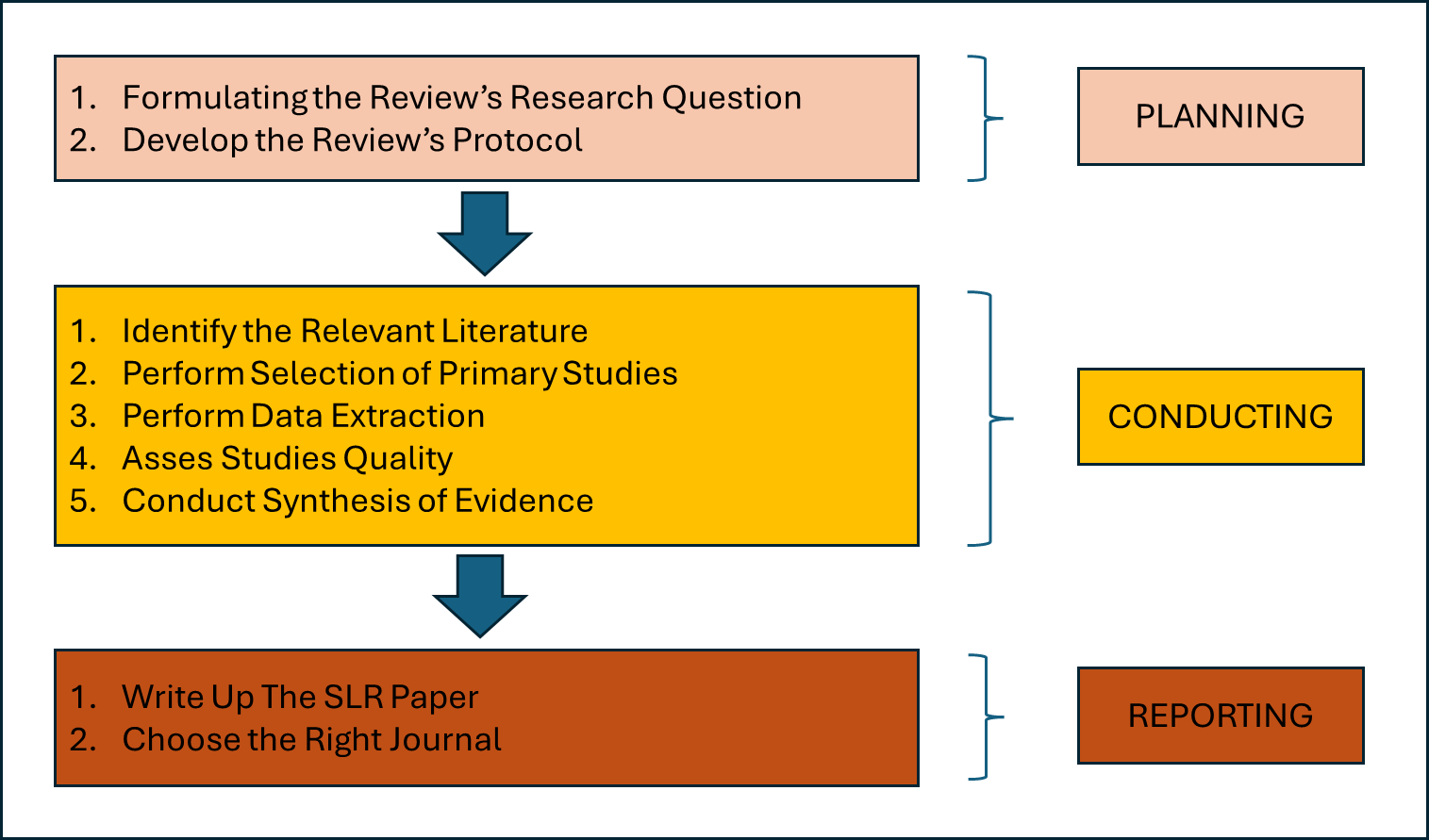
This article will use a systematic review to generate propositions on the relationship between digitalization and decision-making quality in MSMEs. A systematic review is a systematic, transparent, and structured literature review method used to identify, assess, and analyze the results of various studies relevant to a specific topic or research question. The primary purpose of a systematic review is to provide a reliable and unbiased summary of all available evidence. The most commonly used SLR procedure is the protocol from Kitchenham (2013) or the PRISMA (Preferred Reporting Items for Systematic Reviews and Meta-Analyses) standard. Broadly speaking, the stages are divided into three phases: Planning, Conducting, and Reporting. It takes eight step for this study: 1. Formulating a research question using explicit research questions in the field, 2. Developing a review protocol that includes the study objectives, inclusion/exclusion criteria, database sources, and search strategy. 3. Literature search using reliable databases such as Scopus, PubMed, Web of Science, ERIC, and Google Scholar. 4. Study selection was conducted in two stages: title and abstract screening and full-text review. 5. Study quality assessment using the Joanna Briggs Institute (JBI) Checklist, 6. Data extraction using a table recording the authors and year, study design, sample size, and main results, 7. Data synthesis using qualitative synthesis, grouping the data thematically and explaining them narratively. 8. Reporting results using the PRISMA Statement (Preferred Reporting Items for Systematic Reviews and Meta-Analyses) guidelines (Egger et al., 2022; Roberts H Petticrew M, 2008). About 100 articles were searched for each theme at the beginning of the research. These articles were then screened according to the theme.The following image shows the stages of using SLR for this research.
4. Result and Discussion
The results of the screening and synthesis using the systematic review method resulted in 25 suitable articles. These 25 articles were reviewed again to generate several propositions derived from the research questions
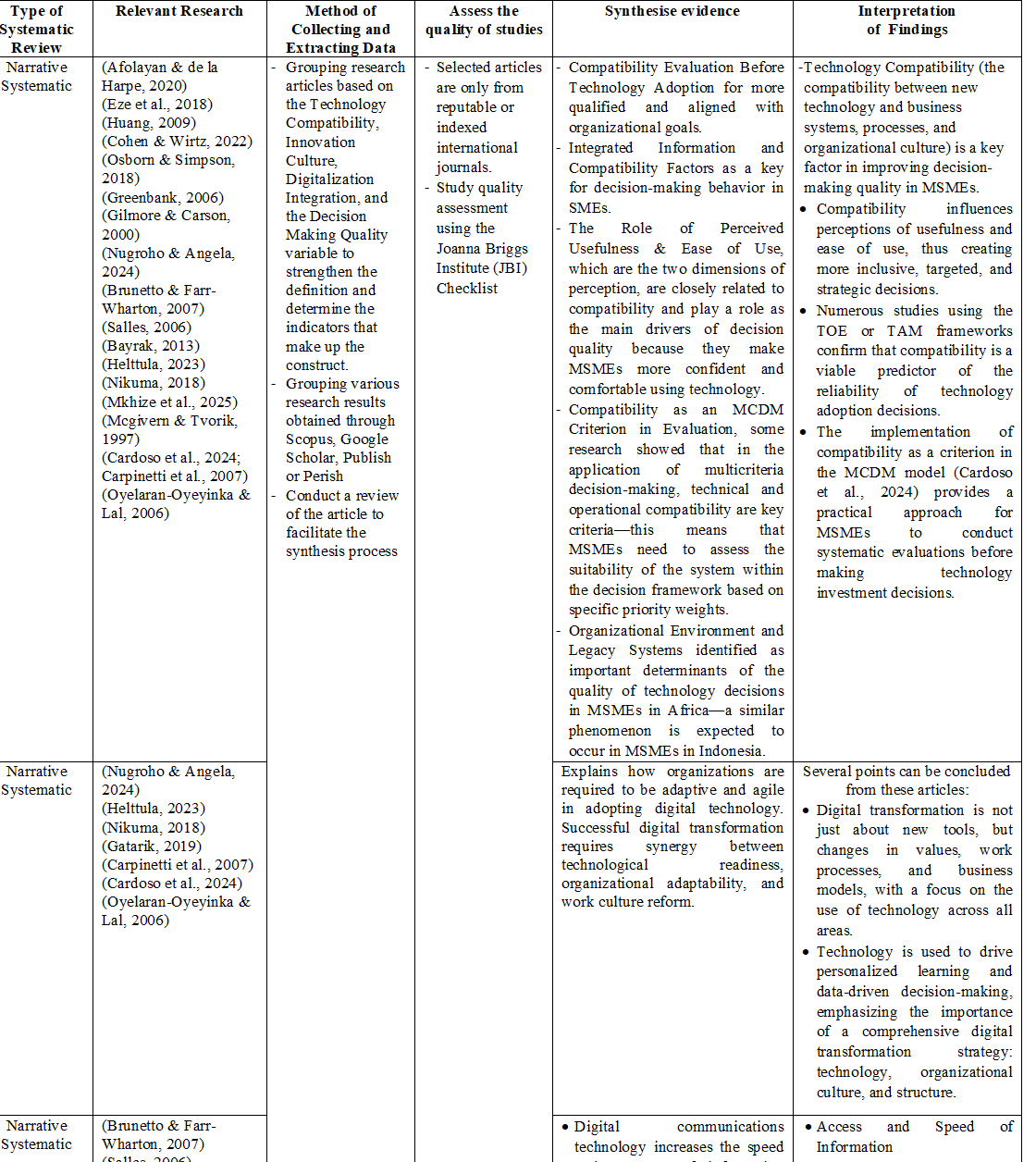
Digitalization integration has a significant impact on the quality of decision-making in Micro, Small, and Medium Enterprises (MSMEs). With a digital system, MSMEs can access financial and operational data in real time, enabling faster and more accurate decision-making (Meier, 2023; Rusko, 2019). Digital technology enables MSMEs to analyze consumer behavior and market trends, assisting in strategic planning and adjusting products or services according to market needs (Abu Hasan et al., 2022; Meier, 2023). Digitalization enables automation of various business processes, reduces manual errors, and increases operational efficiency, which in turn supports more effective decision-making (Alfarizi et al., 2024; Trueba-Castañeda et al., 2024). Through digital platforms, MSMEs can reach wider markets, increase visibility, and compete with larger companies(Carpinetti et al., 2007; Martins, 2023; Meier, 2023). Digital accounting systems help MSMEs monitor cash flow, manage inventory, and ensure compliance with financial regulations, thereby supporting more informed financial decision-making (Rusko, 2019). By adopting digitalization, MSMEs can improve the quality of decision-making through better access to information, in-depth data analysis, and higher operational efficiency(Alfarizi et al., 2024; Prasanna et al., 2019; Trueba-Castañeda et al., 2024). Therefore, this study will develop a comprehensive model on the role of digitalization in improving the quality of decision-making in MSMEs. The model was developed with several hypotheses based on the results of previous studies on digitalization in MSMEs.
The success of technology adoption depends on the suitability between technological features and organizational needs (fit-viability) (Afolayan & de la Harpe, 2020). MSMEs need infrastructure, HR readiness, and external support for digital technology compatibility (Eze et al., 2018). Therefore, technology integration requires an evaluation system and process interoperability in order to facilitate business decisions (Cardoso et al., 2024; Carpinetti et al., 2007). On the other hand, technology must be in accordance with the level of technological readiness that is developing locally to increase company productivity (Oyelaran-Oyeyinka & Lal, 2006). Meanwhile, in an innovation culture, several things that are worth studying further are regarding several approaches by MSMEs, often in innovation, both through research and personal experience(Greenbank, 2006). The culture of innovation in MSMEs is more non-formal, creative, and relationship-based, therefore requiring innovative behavior in organizations supported by openness to change and risk management (Cohen & Wirtz, 2022; Gilmore & Carson, 2000). Organizations with an innovative culture tend to be more flexible in structure and strategy, through social support and collective values in MSMEs, it will strengthen community-based innovation (Mcgivern & Tvorik, 1997; Mkhize et al., 2025)
Digitalization, as a concept that integrates various technological advances to improve company performance, requires several factors to strengthen its internal environment. This is because digitalization can support more organized data-driven decision-making (Bayrak, 2013; Helttula, 2023). Several digital platforms have even been able to support operational efficiency in the public sector and MSMEs (Alfarizi et al., 2024). Digitization in the communication process with the use of digital communication also accelerates the flow of information and strengthens organizational collaboration, which also strengthens the digital system and is even able to reach grassroots users for policy participation (Bagale et al., 2023; Brunetto & Farr-Wharton, 2007; Nikuma, 2018; Salles, 2006). Digitalization in various sectors, such as the education sector, also expands access to information and improves the quality of campus policies (Nugroho & Angela, 2024). In Decision-making quality, artificial intelligence and data-based systems help to improve accuracy and prediction in decision-making, while speed and accuracy of information increase the effectiveness of decisions (Brunetto & Farr-Wharton, 2007; Cardoso et al., 2024; Salles, 2006). Digitalization expands participation and transparency in the decision process and supports increased decision quality when based on participatory data and monitoring systems (Helttula, 2023; Nikuma, 2018; Nugroho & Angela, 2024). On the other hand, Inclusive decision structures produce outputs that are more adaptive to external dynamics (Gatarik, 2019).
Based on the synthesis of several studies on technology compatibility, innovation culture, digital integration, and decision-making quality, several points can be considered to measure these constructs. For technology compatibility, measurement may use technology compatibility in a company, including system compatibility with business processes, infrastructure, and HR readiness, as well as technical and institutional support. For innovation culture, these indicators can be considered to measure in an organization, especially MSMEs, such as openness to change, tolerance for risk, employee participation, diversity of ideas, collaboration, and innovative leadership. For digital integration, several indicators can be used to measure success, including the availability of digital platforms, the use of real-time data, automation, technology-enabled participation, and data security and privacy. For decision-making quality, there are several indicators that can be considered, such as accuracy and speed of decisions, availability of relevant information, transparency and accountability, participation in the decision process, and the Impact of decisions on performance.
| Measurements | Reference |
| Operational Compatibility | |
| The technology can be integrated with the existing system | Brunetto & Farr-Wharton (2007); Cardoso et al. (2024); Carpinetti et al. (2007); Bayrak (2013 |
| The technology does not require major infrastructure changes | |
| The new system works well with old applications/devices | |
| Process Business Alignment | |
| The technology aligns with current business processes | Afolayan & de la Harpe (2020); Eze et al. (2018) |
| The technology supports daily workflow without disruption | Huang (2009); Osborn & Simpson (2018) |
| The technology helps simplify decision-making processes | |
| The technology fits the organization’s work culture. | Cohen & Wirtz (2022); Nugroho & Angela (2024) |
| Perceived Usefulness & Ease of Use | |
| The technology improves the speed of decision-making | Greenbank (2006); Gilmore & Carson (2000) |
| The technology is easy to use to access information. | Bayrak (2013) |
| Confident in using the technology for making decisions. | McGivern & Tvorik (1997) |
| Employees feel comfortable using the technology | Brunetto & Farr-Wharton (2007) |
| The technology is easily accepted by team members. |
| Measurements | Reference |
| Organizational Support for Innovation | |
| The organization encourages innovative approaches to work. | Helttula (2023); Nugroho & Angela (2024); Gatarik (2019) |
| Management provides room for technological experimentation. | |
| Leaders support digital transformation initiatives. | |
| Learning & Knowledge Sharing Culture | |
| Employees are encouraged to learn digital technologies. | Oyelaran-Oyeyinka & Lal (2006); Carpinetti et al. (2007) |
| Employees can easily share digital knowledge with colleagues. | |
| The organization provides training related to digitalization. | |
| Openness to Change & Adaptability | |
| The organization adapts quickly to new technologies. | Nikuma (2018); Helttula (2023) |
| Employees are open to changes in work processes. | Cardoso et al. (2024) |
| The organizational structure is flexible for digital innovation. | |
| Technology-driven Work Culture | |
| Technology is consistently used in decision-making. | Nugroho & Angela (2024); Bayrak (2013) |
| Digital data use is part of the work culture. | |
| Organizational decisions are based on analysis rather than intuition. |
| Measurements | Reference |
| Information Access & Speed | |
| The digital system enables me to access information quickly. | Brunetto & Farr-Wharton (2007); Bagale et al. (2023) |
| Information is available in real time. | Alfarizi et al. (2024) |
| Digitalization improves my responsiveness. | |
| Digital dashboards support real-time performance monitoring. | Bayrak (2013) |
| System Integration & Data Flows | |
| Digital systems are well integrated. | Salles (2006); Bayrak (2013) |
| Data flows across units without obstacles. | Cardoso et al. (2024) |
| System integration improves decision accuracy. | |
| Use of Analytical Tools & AI | |
| The organization utilizes analytics/AI to predict the impact of decisions. | Cardoso et al. (2024); Helttula (2023) |
| Digital data is used to evaluate decision alternatives. | Bayrak (2013) |
| Transparency & Collaboration | |
| Digitalization increases decision-making transparency. | Helttula (2023) |
| Technology facilitates collaboration across units. | Brunetto & Farr-Wharton (2007) |
| Digital systems increase participation in decisions. | |
| Efficiency & Decentralization | |
| Digital tools accelerate work processes. | Salles (2006); Alfarizi et al. (2024) |
| Units can make decisions faster through digital systems. | Bagale et al. (2023) idem |
| Digital information enables the delegation of decisions without losing control. |
| Measurements | Reference |
| Decision Accuracy & Rationality | |
| The decisions are based on accurate information. | Bayrak (2013); Cardoso et al. (2024) |
| Using rational analysis when making decisions. | McGivern & Tvorik (1997) |
| Considering multiple alternatives before deciding. | Bayrak (2013) |
| Timeliness of Decisions | |
| Technology enables employees to make informed decisions on time. | Brunetto & Farr-Wharton (2007); Salles (2006) |
| Digitalization accelerates decision-making processes. | |
| Confidence & Satisfaction | |
| Confident that the decisions they make are the best ones. | Greenbank (2006); Gilmore & Carson (2000) |
| Satisfied with the quality of the decisions that were made | Nugroho & Angela (2024) |
| Technology increases confidence in making decisions. | |
| Decision Effectiveness | |
| The decisions consistently yield outcomes that align with organizational goals. | Osborn & Simpson (2018) |
| The decisions effectively solve problems. | Bayrak (2013) |
| The decisions improve organizational performance. | Cardoso et al. (2024) |
Digital integration has been proven to improve decision-making quality across sectors. This is achieved through data utilization, bias reduction, decentralization, and multi-criteria decision modeling. However, the success of digital transformation in decision-making is also determined by organizational readiness, human resource digital literacy, and data ethics and privacy management. Based on the literature review, the following propositions can be quantitatively tested for future research agenda :
Proposition 1: The higher the level of technology compatibility, the higher the quality of decision-making within the organization.
Proposition 2: The higher the level of culture of innovation, the higher the quality of decision-making within the organization.
Proposition 3: Digital integration directly impacts decision-making quality by increasing the speed of data access.
Proposition 4: The effectiveness of digitalization in decision-making is higher if the effect of technological compatibility dan innovation culture mediated by digital integration.
5. Conclusion
The success of innovation and organizational transformation depends on the synergy between internal capacities (technology, human resources, structure), efficient process management, and systemic support from the innovation ecosystem. Digitalization facilitates decision-making by providing rapid access to relevant data, enabling more responsive, adaptive decisions across both organizational and external dynamics. The use of analytical technology and AI helps decision-makers analyze scenarios more comprehensively and accurately. This encourages a shift from intuition to evidence-based decision-making. Digitalization also encourages collaboration between departments and creates a more open environment for participation in decision-making. This increases the legitimacy and trust in decisions made. The use of digital tools also enables the decentralization of decisions without sacrificing control, as information can be monitored in real time. This improves operational efficiency. From the aforementioned findings, it can be concluded that digital integration plays a crucial role in improving decision-making quality by increasing access to information, leveraging analytical data, fostering cross-unit collaboration, and enabling responsible decentralization. Technology not only speeds up processes but also increases the precision, accuracy, and legitimacy of decisions. It explains how organizations are required to be adaptive and agile in adopting digital technology. Successful digital transformation requires synergy between technological readiness, organizational adaptability, and work culture reform. Digital transformation is not just about new tools; it involves changes in values, work processes, and business models, with a focus on the use of technology across all areas. Technology is used to drive personalized learning and data-driven decision-making, underscoring the importance of a comprehensive digital transformation strategy, robust technology, and strong organizational culture and structure.
References
- Abu Hasan, N., Abd Rahim, M., Ahmad, S. H., & Meliza, M. (2022). Digitization of Business for Small And Medium-Sized Enterprises (SMEs). Environment-Behaviour Proceedings Journal, 7(19), 11–16. DOI ↗ Google Scholar ↗
- Afolayan, A. O., & de la Harpe, A. C. (2020). The role of evaluation in SMMEs’ strategic decision-making on new technology adoption. Technology Analysis and Strategic Management, 32(6), 697–710. DOI ↗ Google Scholar ↗
- Alfarizi, M., Widiastuti, T., & Ngatindriatun. (2024). Exploration of Technological Challenges and Public Economic Trends Phenomenon in the Sustainable Performance of Indonesian Digital MSMEs on Industrial Era 4.0. Journal of Industrial Integration and Management, 9(1), 65–96. DOI ↗ Google Scholar ↗
- Arsawan, I. W. E., Koval, V., Rajiani, I., Rustiarini, N. W., Supartha, W. G., & Suryantini, N. P. S. (2022). Leveraging knowledge sharing and innovation culture into SMEs sustainable competitive advantage. International Journal of Productivity and Performance Management, 71(2), 405–428. DOI ↗ Google Scholar ↗
- Bagale, G. S., Vandadi, V. R., Singh, D., Sharma, D. K., Garlapati, D. V. K., Bommisetti, R. K., Gupta, R. K., Setsiawan, R., Subramaniyaswamy, V., & Sengan, S. (2023). RETRACTED ARTICLE: Small and medium-sized enterprises’ contribution in digital technology. Annals of Operations Research, 326(s1), 3–4. DOI ↗ Google Scholar ↗
- Bayrak, T. (2013). A decision framework for SME Information Technology (IT) managers: Factors for evaluating whether to outsource internal applications to Application Service Providers. Technology in Society, 35(1), 14–21. DOI ↗ Google Scholar ↗
- Brunetto, Y., & Farr-Wharton, R. (2007). The moderating role of trust in SME owner/managers’ decision-making about collaboration. Journal of Small Business Management, 45(3), 362–387. DOI ↗ Google Scholar ↗
- Cardoso, A., Pereira, M. S., Sá, J. C., Powell, D. J., Faria, S., & Magalhães, M. (2024). Digital Culture, Knowledge, and Commitment to Digital Transformation and Its Impact on the Competitiveness of Portuguese Organizations. Administrative Sciences, 14(1). DOI ↗ Google Scholar ↗
- Carpinetti, L. C. R., Gerolamo, M. C., & Galdámez, E. V. C. (2007). Continuous Innovation and Performance Management of SME Clusters. Creativity and Innovation Management, 16(4), 376–385. DOI ↗ Google Scholar ↗
- Cohen, L., & Wirtz, P. (2022). Decision-making style in entrepreneurial finance and growth. Small Business Economics, 59(1), 183–210. DOI ↗ Google Scholar ↗
- Dabić, M., Lažnjak, J., Smallbone, D., & Švarc, J. (2019). Intellectual capital, organisational climate, innovation culture, and SME performance: Evidence from Croatia. Journal of Small Business and Enterprise Development, 26(4), 522–544. DOI ↗ Google Scholar ↗
- Egger, M., Higgins, J. P. T., & Smith, G. D. (2022). Systematic Reviews in Health Research: An Introduction. In Systematic Reviews in Health Research: Meta-Analysis in Context: Third Edition. DOI ↗ Google Scholar ↗
- Eze, S. C., Olatunji, S., Chinedu-Eze, V. C., & Bello, A. O. (2018). Key success factors influencing SME managers’ information behaviour on emerging ICT (EICT) adoption decision-making in UK SMEs. Bottom Line, 31(3–4), 250–275. DOI ↗ Google Scholar ↗
- Gatarik, E. (2019). The value of knowledge sharing in decision-making and organisational development: A model-theoretic systemic analysis of an intervention in an Austrian S.M.E. Economic Research-Ekonomska Istrazivanja , 32(1), 148–167. DOI ↗ Google Scholar ↗
- Gilmore, A., & Carson, D. (2000). The Demonstration of a Methodology for Assessing SME Decision Making. Journal of Research in Marketing and Entrepreneurship, 2(2), 108–124. DOI ↗ Google Scholar ↗
- Greenbank, P. (2006). Starting up in Business. The International Journal of Entrepreneurship and Innovation, 7(3), 149–159. DOI ↗ Google Scholar ↗
- Hairunisya, N., Arifin, S., Endayani, F., & Puspasari, M. (2024). The Influence of Motivation and Training Entrepreneurship on The Performance of SME Entrepreneurs Modulated by Organizational Culture. Journal of Entrepreneurship and Business, 5(2), 140–153. DOI ↗ Google Scholar ↗
- Helttula, M. (2023). Enabling data-driven decision-making for a Finnish SME: a data lake solution. DOI ↗ Google Scholar ↗
- Huang, X. (2009). Strategic decision making in Chinese SMEs. Chinese Management Studies, 3(2), 87–101. DOI ↗ Google Scholar ↗
- Martins, A. (2023). Dynamic capabilities and SME performance in the COVID-19 era: the moderating effect of digitalization. Asia-Pacific Journal of Business Administration, 15(2), 188–202. DOI ↗ Google Scholar ↗
- Mcgivern, M. H., & Tvorik, S. J. (1997). Determinants of organizational performance. Management Decision, 35(6), 417–435. DOI ↗ Google Scholar ↗
- Meier, A. (2023). Impacts of Digitalization on Small- And Medium-Sized Enterprises - Framework Development Based on a Systematic Review of the Literature From Two Decades. International Journal of Innovation and Technology Management, 20(1). DOI ↗ Google Scholar ↗
- Mkhize, A., Mokhothu, K. D., Tshikhotho, M., & Thango, B. A. (2025). Evaluating the Impact of Cloud Computing on SME Performance: A Systematic Review. Businesses, 5(2), 23. DOI ↗ Google Scholar ↗
- Nikuma, D. B. (2018). Ciências Sociais e Humanas Information Systems for supporting decision- making process in SME : a Systematic Literature Review Dedicatory. DOI ↗ Google Scholar ↗
- Nugroho, D., & Angela, P. (2024). The Impact of Social Media Analytics on SME Strategic Decision Making. IAIC Transactions on Sustainable Digital Innovation (ITSDI), 5(2), 169–178. DOI ↗ Google Scholar ↗
- Osborn, E., & Simpson, A. (2018). Risk and the Small-Scale Cyber Security Decision Making Dialogue - A UK Case Study. Computer Journal, 61(4), 472–495. DOI ↗ Google Scholar ↗
- Oyelaran-Oyeyinka, B., & Lal, K. (2006). Learning new technologies by small and medium enterprises in developing countries. Technovation, 26(2), 220–231. DOI ↗ Google Scholar ↗
- Pourmorshed, S., & Durst, S. (2022). The Usefulness of the Digitalization Integration Framework for Developing Digital Supply Chains in SMEs. Sustainability (Switzerland), 14(21). DOI ↗ Google Scholar ↗
- Prasanna, R. P. I. R., Jayasundara, J. M. S. B., Gamage, S. K. N., Ekanayake, E. M. S., Rajapakshe, P. S. K., & Abeyrathne, G. A. K. N. J. (2019). Sustainability of SMEs in the competition: A systemic review on technological challenges and SME performance. Journal of Open Innovation: Technology, Market, and Complexity, 5(4), 1–18. DOI ↗ Google Scholar ↗
- Radicic, D., & Petković, S. (2023). Impact of digitalization on technological innovations in small and medium-sized enterprises (SMEs). Technological Forecasting and Social Change, 191(September 2021). DOI ↗ Google Scholar ↗
- Ramdan, M. R., Aziz, N. A. A., Abdullah, N. L., Samsudin, N., Singh, G. S. V., Zakaria, T., Fuzi, N. M., & Ong, S. Y. Y. (2022). SMEs Performance in Malaysia: The Role of Contextual Ambidexterity in Innovation Culture and Performance. Sustainability (Switzerland), 14(3), 1–18. DOI ↗ Google Scholar ↗
- Roberts H Petticrew M. (2008). Systematic Reviews In The Social Sciences: A Practical Guide By Mark Petticrew PDF : Systematic Reviews In The Social Sciences: A Practical Guide By Mark Petticrew Doc : Systematic Reviews In The Social Sciences: A Practical Guide By Mark Petticrew ePub : A Practical Guide By Mark Petticrew, 1–10. DOI ↗ Google Scholar ↗
- Rujirawanich, P., Addison, R., & Smallman, C. (2011). The effects of cultural factors on innovation in a Thai SME. Management Research Review, 34(12), 1264–1279. DOI ↗ Google Scholar ↗
- Rusko, R. (2019). Is coopetitive decision-making a black box? Technology and digitisation as decision-makers and drivers of coopetition. Technology Analysis and Strategic Management, 31(8), 888–901. DOI ↗ Google Scholar ↗
- Salles, M. (2006). Decision making in SMEs and information requirements for competitive intelligence. Production Planning and Control, 17(3), 229–237. DOI ↗ Google Scholar ↗
- Telukdarie, A., Dube, T., Matjuta, P., & Philbin, S. (2022). The opportunities and challenges of digitalization for SME’s. Procedia Computer Science, 217(2022), 689–698. DOI ↗ Google Scholar ↗
- Trueba-Castañeda, L., Somohano-Rodríguez, F. M., & Torre-Olmo, B. (2024). Does digitalisation enable small and medium-sized enterprises to become more sustainable? Corporate Social Responsibility and Environmental Management, August 2023, 4893–4909. DOI ↗ Google Scholar ↗