Abstract
This tracer study explores the demographic profile and self-efficacy levels of graduates from the Philippine College Foundation (PCF). Education is recognized as a fundamental tool for securing employment and achieving success, and this research assesses whether PCF graduates have effectively gained and applied the knowledge and skills provided by the institution. Results reveal that a significant portion of graduates are self-employed, with most employed in the private sector under various job contracts. Importantly, graduates exhibit very high self-efficacy levels, demonstrating strong confidence in adapting to challenges, pursuing career goals, and collaborating effectively in teams. Practical experiences and institutional support were identified as key factors driving this confidence. Although communication skills scored slightly lower, they were still rated very satisfactory. These findings highlight the effectiveness of PCF’s hands-on curriculum and support programs in preparing graduates for professional success.
Keywords
Demographic Profile Self-Efficacy Tracer Study
Introduction
One of the most important gifts that parents can give to their children is education. Education provides children with the opportunity to succeed in the future and obtain stable employment. Most people gain their most significant and novel life lessons in school, which comes in second. Education helps individuals establish their career paths, leading to a brighter future. Earning a college degree enhances employment opportunities and contributes to career success. According to Little (2011), educated people are valued more highly and are employed in modern society than those without an education. This indicates that most employers prefer to hire college graduates over recent high school graduates.
The Philippine College Foundation, Incorporated, is an established institution. Its development includes expanding its academic programs not only in basic education but also in the offerings of tertiary education and in training the children of the marginalized sector of society. PCFI has withstood the test of time. It is committed to helping improve the quality of life of the less privileged sectors of society as its service to humanity. The hardworking, diligent, and indigent students who became successful through the help of PCFI have inscribed it in their minds and hearts.
This research aimed to determine whether graduates of the Philippine College Foundation, Incorporated, obtained the knowledge and skills that the institution provided, such as the seminars and trainings they participated in during their studies, whether they were able apply the knowledge and skills in their current occupations and positions, and whether they possess the efficiency and self-assurance required in their respective professions. Furthermore, this research also examined whether PCFI graduates are productive in their particular fields of work. Specifically, it assessed the graduates’ level of self-efficacy. As Bandura (2001) defined, self-efficacy is the assessment or conviction in one’s own capacity to finish a career and build strong connections with experts in a relevant field. The study also sought the demographic profile and the level of self-efficacy of the graduates. The findings of this study are expected to contribute to the enhancement of institution’s curriculum and facilities, thereby benefiting future students and graduates.
Framework of the Study
This study was anchored on Albert Bandura's Social Cognitive Theory. It is a psychological theory that highlights observational learning—the process by which people pick up knowledge by watching others. It asserts that an individual's conduct, their surroundings, and personal characteristics (such as beliefs and self-efficacy) interact dynamically and reciprocally to form their behavior. Self-efficacy, observational learning, and the notion that people have agency and are capable of self-regulation are important ideas (Nickerson, 2025).
Statement of The Problem
This research focused on determining the demographic profile and the level of self-efficacy of the graduates. Specifically, it sought to answer the following questions:
1. What is the demographic profile of the graduates of Philippine
College Foundation in terms of the following?
a. Job Status
b. Employment sector
2. What is the level of self-efficacy of the graduates?
Review Of Related Literature And Studies
This chapter presents reviews of literature, studies, and local and international studies conducted concerning the present study. The related literature describes and explains the demographic profile and self-efficacy of the graduates.
Demographic Profile and Self-Efficacy
Graduates secured employment and most hold contractual positions. Some alumni were unemployed due to a lack of job experience, health issues, or limited job opportunities in their field of study. Graduates who found employment had been working for less than two years. Higher education institutions need to continually evaluate their programs and provide graduates with the necessary tools and resources to secure long-term employment opportunities. Finally, the authors recommended conducting another tracer study with graduate employers or supervisors is recommended to assess the graduates' job competitiveness (Cubero, Pingcas, & Geraman, 2024).
Most graduates are gainfully employed in government agencies and IT companies and are regular employees or hold permanent status. At the same time, other respondents are either temporary or casual employees (Verecio et al., 2022).
In the study of Abdulgani (2025), the majority of graduates were employed, while 15.1% remained unemployed. Most were employed in government agencies, private institutions, and non-governmental organizations, with a considerable percentage holding contractual or job-order positions. Graduates earned less than ₱10,000 per month, while only a few reached higher salary brackets. Additionally, 32.1% of the graduates found employment within a month, but some took over a year to secure a job.
Self-efficacy is a person's belief in their abilities and skills. Perceived self-efficacy can be either high or low due to its distinct self-evaluative dimension. Individual variations in perceived self-efficacy have been demonstrated to be more reliable indicators of performance than prior accomplishment or aptitude, and they appear to be especially significant when people encounter hardship, such as during challenging academic situations or when facing obstacles in their studies. Students showed more academic resilience in the face of vicarious adversity than when facing personal adversity, and ASE was both associated with and a significant predictor of academic resilience (Cassidy, 2015). It is important to note that graduate students must have a strong sense of self-efficacy to demonstrate greater motivation, effort, and perseverance in completing a variety of challenging academic writing assignments. Mbato and Wijaya (2020) emphasized that when it comes to academic writing, students with higher levels of self-efficacy are more likely to perform effectively.
Robinson, Perez, Levatuch, and Garcia (2020) examined the roles of two competence beliefs –self-efficacy for scientific tasks and science academic self-efficacy, during the final year of college. A structural equation model was used to examine science research self-efficacy and science academic self-efficacy as predictors of post-graduation science career intentions and life satisfaction; prior achievement was also included as a predictor of competence beliefs and post-graduation outcomes. Findings indicated that both types of self-efficacy predicted career intentions and life satisfaction. To better understand the processes that contribute to gender gaps in certain science careers, gender differences in mean levels of self-efficacy and in the structural relations among the variables of interest were examined using multi-group analyses. Female students reported lower academic self-efficacy, despite having similar levels of prior achievement and outcomes. Moreover, structural relationships varied by gender. These results extended the theoretical understanding of the roles of two distinct forms of self-efficacy and the potential mechanisms that explain gender gaps in science fields.
Salifuh et al. (2023) revealed that except for years of work experience and the type of university which failed to predict research and service efficacies, the rest of the demographic variables significantly predicted all three self-efficacy domains. The authors suggested that ensuring self-efficacy in teaching, research, and service activities among university teachers is crucial because of its positive impact, particularly among those with lower qualifications, ranks, and experience. Graduates of teacher education programs demonstrated a strong passion for the teaching profession. Many graduates received honors and awards, passed the licensure examinations for teachers, attended advanced studies for professional development, and became employable. Furthermore, the graduates' college preparation was relevant to their current employment (Pentang, Cuanan, Perez, & Recla, 2022).
Graduates’ scientific discipline, parents’ level of education and undergoing internships during higher education were also related to self-efficacy. Overall, the study contributed to a better understanding of the development of self-efficacy beliefs and their importance in the job-seeking process and adaptation to work (Paulos, Valadas, & Almeida, 2021). Self-efficacy and academic performance served as chain mediators in predicting the effect of achievement motivation on the employability of college students. After controlling for gender and family residence, achievement motivation still had a significant and positive impact on the employability of college students (Li, Pu, & Phakdeephirot, 2022).
Methodology
This chapter describes how the study investigated the demographic profile and self-efficacy of graduates. It also includes a discussion of the research setting, research design, the participants of the study and the sampling procedure, the research instruments, the data gathering procedure, methods of data analysis, the validity and reliability of the instruments, and the statistical techniques.
Research Setting
The Philippine College Foundation Incorporated is an established institution. Its development includes expanding academic programs not only in basic education but also in the offerings of tertiary education, and training the children of the marginalized sector of society. PCFI had withstood the test of time. It is committed to helping improve the quality of life of the less privileged sectors of society as its service to humanity. The hardworking, diligent, and indigent students who became successful through the help of PCFI have inscribed it in their minds.
Research Design
This study used a descriptive quantitative research design. Descriptive research is an appropriate choice when the research aims to identify characteristics, frequencies, trends, categories, percentages, and mean.
The descriptive method was used to describe the variables present in the study, such as the demographic profile and the self-efficacy of the graduates.
Participants
The participants in the study were the graduates of Philippine College Foundation, Incorporated.
Research Instruments
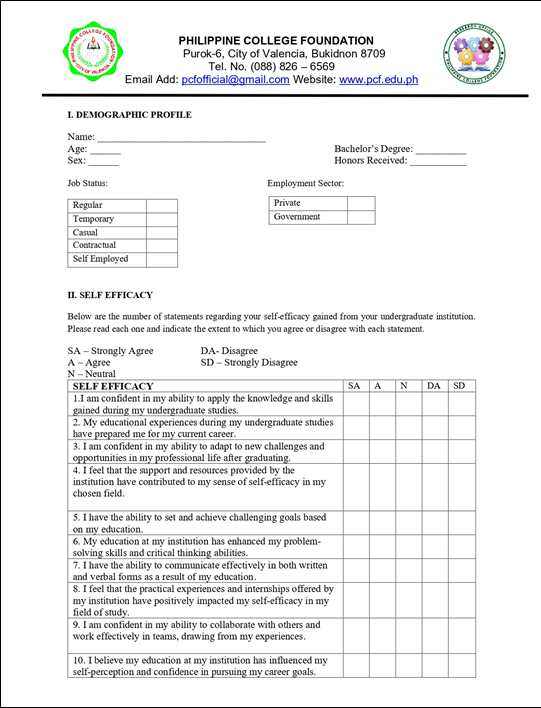
The data were collected through a survey questionnaire to determine the graduates’ level of self-efficacy. The questionnaire items were measured using a five-point Likert scale. A Likert scale is a rating scale used to measure opinions, attitudes, or behaviors (Thein et al., 2013).
Scoring Procedure
The data were analyzed using the mean and standard deviation. The following scale ranges were
I. Self-Efficacy
| Scale | Range | Description | Interpretation |
| 5 | 4.51 – 5.00 | Strongly Agree | High |
| 4 | 3.51 – 4.50 | Agree | Very High |
| 3 | 2.51 – 3.50 | Neutral | Moderate Self-Efficacy |
| 2 | 1.51 – 2.50 | Disagree | Poor |
| 1 | 1.00 – 1.50 | Strongly Disagree | Very Poor |
Validity and Reliability of the Instruments
To assess the reliability of the research instrument, the researchers conducted a pilot test involving a sample of 30 students who were not part of the actual study. The participants completed the questionnaire, and the researchers analyzed the data obtained from the pilot test to determine the internal consistency of the instrument. The data generated from the pilot test were then submitted to a statistician for reliability testing and item analysis.
Data Gathering Procedure
The researchers administered the research instrument to the participants after securing the necessary permissions and approvals. Prior to the administration of the questionnaire, the participants were given a brief orientation and instructions on how to accomplish the instrument. The debriefing session for 5 – 10 minutes was also conducted to ensure that the participants clearly understood the directions for answering the questionnaire. The gathered data were immediately and carefully examined for data analysis and interpretation.
Statistical Techniques
The study utilized a survey instrument to collect the data. The data were tabulated, coded, and analyzed using the Statistical Package for the Social Sciences (SPSS). Descriptive statistics such as the mean and standard deviation, were employed to describe the study variables. Specifically, the mean and standard deviation were used to answer Research Question 2.
Presentation, Analysis, And Interpretation Of Data
This chapter presents the results of the statistical computations of the data collected through a survey questionnaire from the graduate participants. These results are necessary since they served as bases in answering the specific problems of this study. This study aimed to determine the demographic profile in terms of job status and employment sector, and self-efficacy of the graduate students of Philippine College Foundation.
Problem 1. What is the demographic profile of the graduates of Philippine College Foundation Incorporated in terms of job status?
Table 1 presents the demographic profile in terms of job status.
| Employment Status | Frequency (n) | Percentage (%) |
|---|---|---|
| Regular | 20 | 17.39% |
| Temporary | 24 | 20.87% |
| Casual | 9 | 7.83% |
| Contractual | 21 | 18.26% |
| Self-Employed | 41 | 35.65% |
| Total | 115 | 100% |
The data indicates that 41 graduates were self-employed, representing the largest single category in the study. The remaining graduates were distributed across various employment statuses: Twenty (20) graduates held regular positions, indicating permanent employment with long-term security and benefits. Twenty-four (24) graduates held temporary positions, while 21 graduates were employed on contractual appointments, representing a combined total of 45 graduates in non-permanent employment. Nine (9) graduates held casual positions which indicates that this group has the least job security, often working on an "as-needed" basis.
This supports the study of Cubero, Pingcas, and Geraman (2024) which found that graduates secured employment, with the majority holding contractual positions. Some alumni were not employed due to lack of job experience, health issues, or limited job opportunities in their field of study. Graduates who found employment had been working for less than two years. Higher education institutions need to continually evaluate their programs and provide graduates with the necessary tools and resources to secure long-term employment opportunities.
Problem 2. What is the demographic profile of the graduates of Philippine College Foundation Incorporated in terms of employment sector?
Table 1 presents the demographic profile in terms of employment sector.
| Sector | Frequency (n) | Percentage (%) |
|---|---|---|
| Private | 79 | 68.7 % |
| Government | 36 | 31.3 % |
In this table, the data reveals a significant disparity between private and government sector employment. Specifically, 79 graduates (approximately 68.7%) were employed in the private sector, while 36 graduates (approximately 31.3%) were employed in the government sector.
These findings are consistent with the study of Abdulgani (2025), which found that the majority of graduates were employed, while 15.1% remained unemployed. Most of the employed graduates worked in government agencies, private institutions, and non-governmental organizations, with a considerable percentage holding contractual or job-order positions.
Problem 3. What is the level of self-efficacy of the graduates?
| Indicators | Mean | Standard. Deviation | Verbal Interpretation |
| I am confident in my ability to apply the knowledge and skills gained during my undergraduate studies. | 4.43 | 0.06 | High Self-Efficacy |
| My educational experiences during my undergraduate studies have prepared me for my current career. | 4.42 | 0.06 | High Self-Efficacy |
| I am confident in my ability to adapt to new challenges and opportunities in my professional life after graduating. | 4.59 | 0.06 | Very High Self-Efficacy |
| I feel that the support and resources provided by the institution have contributed to my sense of self-efficacy in my chosen field. | 4.41 | 0.06 | High Self-Efficacy |
| I have the ability to set and achieve challenging goals based on my education. | 4.46 | 0.06 | Very High Self-Efficacy |
| My education at my institution has enhanced my problem-solving skills and critical thinking abilities. | 4.41 | 0.07 | High Self-Efficacy |
| I have the ability to communicate effectively in both written and verbal forms as a result of my education. | 4.36 | 0.06 | High Self-Efficacy |
| I feel that the practical experiences and internships offered by my institution have positively impacted my self-efficacy in my field of study. | 4.55 | 0.06 | Very High Self-Efficacy |
| I am confident in my ability to collaborate with others and work effectively in teams, drawing from my experiences. | 4.52 | 0.06 | Very High Self-Efficacy |
| I believe my education at my institution has influenced my self-perception and confidence in pursuing my career goals. | 4.58 | 0.05 | Very High Self-Efficacy |
| Overall Mean | 4.47 | 0.05 | High Self-Efficacy |
Legend:
ScaleRangeVerbal Interpretation
5 4.51 – 5.00Very High Self-Efficacy
43.51 – 4.50High Self-Efficacy
32.51 – 3.50Moderate Self-Efficacy
21.51 – 2.50Poor
11.00 – 1.50Very Poor
The data show that the highest mean score (M= 4.59, "Very High") was obtained for graduates’ confidence in their ability to adapt to new challenges and opportunities in professional life. This was followed by a mean score of 4.58 ("Very High”), which indicated the extent to which education had influenced the graduates’ self-perception and confidence in pursuing career goals.
The results further indicate “Very High” level of self-efficacy among the graduates, particularly in the domains of experiential learning and interpersonal collaboration. The mean score of 4.55 for the impact of practical experiences and internships suggests that the institution’s hands-on curriculum contributed significantly to graduates’ confidence. Likewise, the graduates obtained a mean score of 4.52 (“Very High”) regarding their ability to collaborate and work effectively in teams. This reflects a high level of "collective efficacy"—a group’s shared belief in its conjoint capabilities to organize and execute the courses of action required to produce given levels of attainments.
Furthermore, the students obtained a mean score of 4.43 ("High") regarding their ability to apply knowledge and skills gained during undergraduate studies. The data also show a mean score of 4.41 for the role of institutional support and resources in contributing to self-efficacy. The lowest mean score, although still interpreted as "High," was 4.36, which pertained to effective communication in both written and verbal forms.
The data presented in Table 3 are consistent with the study of Cassidy (2015), which reported a high level of perceived self-efficacy among the students. The mean score ranging from 4.36 to 4.59 suggest that the graduates possess a strong sense of self-efficacy, which is essential for the transition from an academic environment to professional practice. According to Bandura’s Social Cognitive Theory, high levels of self-efficacy are not merely reflections of past performance but are active predictors of future success, as students with high efficacy are more likely to view difficult tasks as challenges to be mastered rather than threats to be avoided.
Conclusions
The findings of this tracer study revealed a diverse employment status among graduates of the Philippine College Foundation, Incorporated, with a significant proportion being self-employed and others engaged in various types of employment sector, predominantly in the private sector. The graduates demonstrated very high levels of self-efficacy, particularly in adapting to challenges, pursuing career goals, experiential learning, and teamwork. Although communication skills obtained the lowest mean score among the self-efficacy indicators, they were still rated “High” indicating that the graduates possessed a satisfactory level of confidence in this area while still having opportunities for further development.
Overall, the study underscores that the educational experiences and institutional support provided by Philippine College Foundation, Incorporated, contributed to the graduates’ confidence and preparedness to meet the demands of the workplace.
Recommendations
Based on the insights and conclusions derived from the findings of the study, the following are recommended:
-
Enhance Communication Skills Training: Although communication skills received the lowest mean score among the self-efficacy indicators, they remained at a high level. The institution may strengthen programs that focus written and verbal communication skills to further improve graduates’ effectiveness in professional settings.
-
Support for Self-Employed Graduates: Given the considerable number of graduates who are self-employed, the institution may offer specialized workshops or resources on entrepreneurship, business management, and financial literacy to better support this group’s success.
-
Strengthen Industry Partnerships: To increase opportunities for regular and long-term employment, the institution should strengthen partnerships with both private and government sectors, facilitating internships and job placements aligned with the graduates’ skills and career goals.
-
Provide Career Guidance and Counseling: The institution may continue providing career guidance, employment assistance, and alumni support services to help graduates navigate diverse employment arrangements, including temporary, contractual, and casual work, ensuring they can make informed decisions about their career decisions.
By implementing these recommendations, the Philippine College Foundation, Incorporated, can further empower its graduates to excel in their careers and adapt to the evolving demands of the labor market.
References
- Abdulgani, M. A. (2025). Tracer Study on the Employability and Career Outcomes of Bachelor of Science in Information Technology (BSIT) Graduates. Psychology and Education, 573-586. DOI ↗ Google Scholar ↗
- Cassidy, S. (2015). Resilience Building in Students: The Role of Academic Self-Efficacy. Frontiers in Psychology. Google Scholar ↗
- Cubero, G., Pingcas, D., & Geraman, S. (2024). Graduate's Employability: A Tracer Study for Second Batch of Graduates in Davao de Oro State College - New Bataan Branch. Psyc Educ. DOI ↗ Google Scholar ↗
- Li, X., Pu, R., & Phakdeephirot, N. (2022). The influence of achievement motivation on college students’ employability: A chain mediation analysis of self-efficacy and academic performance. Frontiers in Psychology. Google Scholar ↗
- Mbato, C., & Wijaya, K. (2020). Graduate Students’ Perceptions on their Self-Efficacy in Writing Academic Papers. ELT Worldwide Journal of English Language Teaching. Google Scholar ↗
- Paulos, L., Valadas, S., & Almeida, L. (2021). Transition from University to the Labour Market: The Impact of Personal Variables in Graduates’ Perceptions of Self-Efficacy. Multidisciplinary Digital Publishing Institute. DOI ↗ Google Scholar ↗
- Pentang, J., Cuanan, K., Perez, D., & Recla, M. (2022). Tracer Study of Teacher Education Graduates of Western Philippines University - Puerto Princesa Campus: Basis for Curriculum Review and Revision. International Journal of Multidisciplinary Applied Business and Education. Google Scholar ↗
- Robinson, K., Perez, T., Levatuch, A., & Garcia, L. (2020). Gender Differences and Roles of Two Science Sel-Efficacy Beliefs in Predecting Post-College Outcomes. National Library of Medicine. Google Scholar ↗
- Salifu, I. & Odame, E. (2023). Examining Demographic Variables as Predictors of Self-Efficacy among University Teachers in Ghana. Issues in Educational Research, 33. 352-368. Google Scholar ↗
- Verecio, R., Las, J., Caluza, Cinco, J., Dalan, R., Gotardo, M., . . . Turco, D. (2022). Professional and Personal Whereabouts of Information Technology Graduates: a Graduate Tracer Study of Leyte Normal University. International Journal of Multidisciplinary and Current Education Research, 288-295. Google Scholar ↗
Appendix
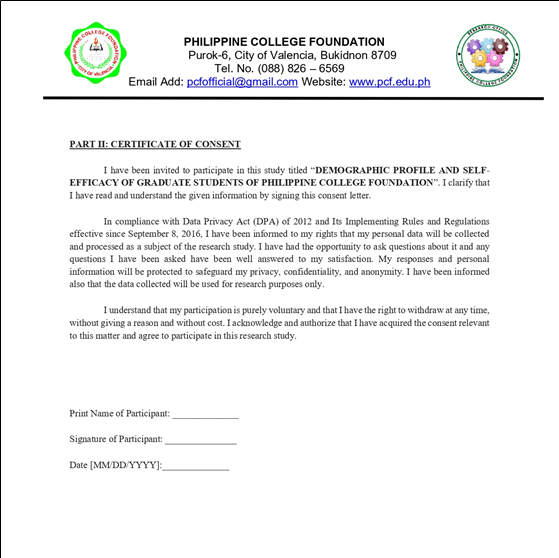
A. Informed Consent Form for Participants

Informed Consent Form for Participants

Informed Consent Form for Participants
B Research Questionnaire