Abstract
This study aims to investigate gender differences in self-concept and learning motivation, the relationship between self-concept and learning motivation, the combined influence of gender and culture, and the effect of self-concept on students’ learning motivation. This survey study involved 256 pupils from three state junior high schools in Sleman Regency, selected using a cluster random sampling technique based on the accreditation levels of secondary schools in Sleman Regency. The research instruments comprised a chemistry self-concept questionnaire, a learning motivation scale, and a measure of the pupils’ socio-cultural background. The data were analysed using simple linear regression, t-tests, correlation tests, and two-way ANOVA. The results of this study show that the Mann-Whitney U test revealed a significant difference in learning motivation and self-concept based on gender (p < 0.05), whilst Spearman’s rho correlation test (r = 0.742; p < 0.001) further supports the strength of the positive relationship between these two variables. A two-way ANOVA analysis revealed that the interaction between gender and culture had a significant effect on learning motivation (p = 0.010), although the individual effects of each variable were not statistically significant. Furthermore, a simple linear regression analysis showed that self-concept has a highly significant influence on pupils’ motivation to learn chemistry (B = 0.964; p < 0.001), with a coefficient of determination of 57.7% (R² = 0.577). This means that the higher a pupil’s self-concept, the greater their motivation to learn chemistry.
Keywords
Self-concept motivation to learn gender culture and chemistry.
1. Introduction
Chemistry, as a branch of science, occupies a strategic position within the upper secondary school (SMA) curriculum. In education, self-concept is one of the affective factors that plays a major role in determining pupils’ academic success. Self-concept, defined as an individual’s perception of their own abilities and worth in a particular field, is formed through learning experiences, self-assessment and social interaction (Muliaman et al., 2025;Rüschenpöhler & Markic, 2020b; Wibowo & Ariyatun, 2020) . A grasp of chemical concepts and the development of a positive attitude towards the subject are also key indicators in assessing pupils’ readiness to face global challenges. Meanwhile, Indonesian pupils’ science literacy stands at just 396, according to the results of the Programme for International Student Assessment (PISA) 2018, well below the OECD average, which stands at 489 (PISA, 2019) These findings reflect the students’ weak cognitive abilities, but also indicate their low affective engagement with science, which is largely rooted in low motivation to learn. This situation highlights the importance of understanding the factors that contribute to motivation to learn in chemistry lessons.Motivation to learn is one of the fundamental psychological constructs that plays a major role in determining pupils’ academic success. In the context of formal education, motivation is not only an initial trigger for pupils’ engagement in the learning process, but also a key determinant in sustaining their effort, perseverance and resilience when faced with academic challenges. Various findings in the field indicate that pupils’ motivation to learn, particularly at upper secondary school (SMA) level, remains relatively low, especially in science subjects. The effects of these symptoms—such as a lack of motivation, a tendency to get bored easily, low self-confidence and a lack of interest in chemistry—are a cause for considerable concern (Frailich et al., 2009; Stieff, 2019; Kit et al., 2012).(Pratomo et al., 2025; Rüschenpöhler et al., 2025) explains that the main obstacles students face in understanding chemistry lie not solely in cognitive aspects, but also in affective aspects such as a weak sense of self-efficacy in chemistry. Self-concept is a person’s mental representation of their own abilities in a particular field. In chemistry education, a positive self-concept has been shown to enhance students’ motivation to learn and their academic achievement (Rüschenpöhler & Markic, 2020).This is supported by research (Benites et al., 2025) (Paul R. Pintrich and Elisabeth V. De Groot, 1990) explains that pupils’ self-concept plays an important role in the academic learning process. Within the theoretical framework they have developed, self-concept—or academic self-concept—forms part of the expectancy component, namely an individual’s belief in their own ability to complete learning tasks. These beliefs subsequently have an impact on students’ levels of motivation, their use of learning strategies, and their engagement with learning. Pupils with a positive self-concept tend to have high self-efficacy, which ultimately makes them more motivated to learn, set goals and manage their own learning process.Although self-concept in science and physics has been extensively studied, our understanding of students’ self-concept in chemistry remains limited, particularly in relation to gender, cultural background and the social context of learning (Rüschenpöhler & Markic, 2020). It is therefore clear that self-concept is shaped by a long and complex process of social interaction. The family environment, school, learning experiences and cultural values instilled from an early age all influence how a pupil perceives their own abilities. (Fiedler et al., 2024; Yu & Wang, 2023) emphasises that social support and positive learning experiences will strengthen pupils’ self-perception in the field of science. One of the external factors that has a significant influence on the formation of self-concept is gender. A study by (Rüschenpöhler & Markic, 2020b; Veloo et al., 2015) indicates that male students are more likely to have a high self-concept in chemistry than female students, although in terms of academic achievement they do not always outperform them.According to Rüschenpöhler dan Markic (2020), Pupils with a high sense of self-efficacy in chemistry are more likely to engage actively in the learning process, demonstrate greater perseverance in completing chemistry tasks, and adopt a more positive attitude towards complex academic challenges. A high sense of self-worth acts as an internal motivator that encourages pupils not to give up easily, to be brave enough to try new problem-solving strategies, and to view failure as part of the learning process. However, the formation of self-concept does not take place in a vacuum; it is significantly influenced by external factors such as gender and culture.As for societal attitudes towards science, developments across various cultures have contributed to undermining women’s self-confidence in science subjects. (Steegh et al., 2021) states that the representation of female students in science activities, such as chemistry Olympiads, remains low due to the influence of these gender stereotypes. In addition to gender, culture also makes a significant contribution to the formation of pupils’ self-concept. Rüschenpöhler et al. (2024), A comparative study of German and Chinese pupils found that Chinese pupils demonstrated a higher sense of self-efficacy in chemistry, even though their academic performance was comparable. This suggests that cultural values and societal expectations regarding science lessons also shape the way pupils view themselves in the learning process.(Master & Meltzoff, 2020; Merayo & Ayuso, 2023) reveals that in many cultures, science is regarded as a field more suited to men than to women. This has led to an academic identity crisis amongst female students, who lack the confidence to engage with science lessons. On the other hand, support from family is also vital in shaping a positive self-concept. (Master & Meltzoff, 2020; Mickelson et al., 2025; Rüschenpöhler dan Markic 2020) It was argued that the concept of ‘chemistry capital’ encompasses all forms of support and influence relating to the world of science—particularly chemistry—that pupils receive at home, such as scientific discussions with parents and access to books. Consequently, chemistry capital is directly linked to a more positive sense of self in relation to chemistry.Within the framework of social-cognitive theory, self-concept also plays a major role in influencing pupils’ academic achievement. It is therefore clear that pupils’ self-concept is of great importance in the science education process. (Jansen et al., 2019) suggests that self-concept in science lessons can have a greater impact on pupils’ achievement than intellectual factors such as IQ. This indicates that affective variables such as self-concept make a significant contribution to science education.This is supported by research (Paul R. Pintrich and Elisabeth V. De Groot, 1990) explains that pupils’ self-concept plays an important role in the academic learning process. Within the theoretical framework they have developed, self-concept—or academic self-concept—forms part of the expectancy component, namely an individual’s belief in their own ability to complete learning tasks. These beliefs subsequently have an impact on students’ levels of motivation, their use of learning strategies, and their engagement with learning. Pupils with a positive self-concept tend to have high self-efficacy, which ultimately makes them more motivated to learn, set goals and manage their own learning process.This research is important not only from an academic perspective, but also from a strategic perspective for the development of equitable education. By understanding how gender and culture influence the formation of pupils’ self-concept, educators and policy-makers can design more inclusive learning strategies and educational policies. Learning strategies such as project-based learning and inquiry-based learning have been shown to enhance pupils’ motivation to learn chemistry when tailored to their affective characteristics and sociocultural backgrounds (Rüschenpöhler et al., 2025; Steegh et al., 2021).This research can also be used to develop a chemistry curriculum that is more responsive to differences in pupils’ characteristics. An adaptive and humanistic curriculum enables pupils to feel more accepted and motivated to achieve, regardless of differences in gender or cultural background. In a theoretical context, this study broadens the scope of the literature on chemistry education by incorporating affective variables such as self-concept and learning motivation, which have so far been under-represented in conventional teaching approaches.The aim of this study is to analyse the relationship between students’ self-concept in chemistry and their level of motivation to learn, and to identify differences based on gender and cultural background. A quantitative approach was chosen because it allows for an objective analysis of the relationships between variables using statistical methods, and produces findings that can be generalised. The research instruments will include a questionnaire on self-concept in chemistry, a learning motivation scale, and a measure of students’ socio-cultural background. Consequently, the researcher is interested in conducting a study to be outlined in the title “High School Students’ Self-Concept in Chemistry: A Gender- and Culture-Based Analysis and Its Impact on Learning Motivation”.
2. Method
The type of research used was quantitative research employing a survey method. In this procedure, the study collected quantitative data using a questionnaire on chemical self-concept, a questionnaire on learning motivation, and questionnaires on gender and cultural background. The aim of this study is to collect data to answer the research questions concerning secondary school pupils’ self-concept in chemistry, based on gender and culture, and its impact on their motivation to learn. This study was carried out in Year 11 science classes at state senior secondary schools in Sleman Regency, selected on the basis of accreditation data.The population for this study comprises all Year 11 students on the Natural Sciences (IPA) programme at state senior secondary schools in Sleman Regency. There are 17 schools in total, with a total of 16,275 pupils. The minimum sample size to be used in this study is between 350 and 500 pupils. The sampling technique used in this study was purposive sampling. The data collection method used in this study was a questionnaire. Three questionnaires were used, namely 1) Chemistry self-concept, 2) Motivation to learn, 3) Gender and cultural background. The questionnaire used in this study contained 10 statements per questionnaire, in line with the indicators. The questionnaire includes statements relating to chemical concepts, motivation to learn, gender and cultural background. The scale used in this study is a Likert scale comprising items adapted from the Chemistry Self-Concept Inventory (CSCI), the Science Motivation Questionnaire II (SMQ-II), and the Gender and Cultural Background scale. The response options were: Strongly Agree (SS), Agree (S), Somewhat Disagree (KS), Disagree (TS), and Strongly Disagree (STS).The content validity of the questionnaire on self-concept in chemistry, learning motivation, gender and cultural background involves expert judgement. The validity coefficients for the questionnaires on Chemistry Self-Concept, Learning Motivation, Gender and Cultural Background fell within the moderate and valid categories. The reliability coefficients for the Chemistry Self-Concept Inventory (CSCI) questionnaire were calculated at a Cronbach’s alpha value of 0.91, for the Science Motivation Questionnaire II (SMQ-II) at 0.89, and for the cultural background questionnaire at 0.639. This indicates that the questionnaire on chemical self-concept, learning motivation, gender and cultural background is considered reliable, in accordance with the statement by R. (Toma, 2021) that a reliability test is accepted if it meets the minimum standard of 0.60.The data analysis technique used in this study was quantitative statistics, as all the data collected were numerical in nature and derived from a Likert scale. The analysis focused on senior secondary school pupils’ self-concepts regarding gender and culture, and the impact of these on their motivation to learn.
3. Result
This sub-chapter describes the findings of a study of Year 11 pupils at a state senior secondary school in Sleman Regency, focusing on senior secondary school pupils’ self-concepts regarding gender and culture, and the impact of these on their motivation to learn. The detailed results of the study are set out in
| N | Minimum | Maximum | Mean | Std. Deviation | |
| Self-Concept | 256 | 21 | 42 | 30.71 | 4.674 |
| Cultural Background | 256 | 19 | 38 | 28.64 | 4.108 |
| Motivation to Learn | 256 | 19 | 45 | 30.72 | 5.930 |
| Valid (listwise) | 256 |
Table 1 shows that, based on the results of the descriptive analysis of 256 pupils, the average score for pupils’ self-concept in chemistry was 30.71 with a standard deviation of 4.674, indicating a fairly good and relatively even level of self-concept. Meanwhile, the cultural background had a mean of 28.64 with a standard deviation of 4.108, indicating that the influence of culture on learning is moderate. Motivation to study chemistry showed the highest average score, namely 30.72, with a standard deviation of 5.930, indicating considerable variation in students’ motivation. Overall, the data for the three variables showed a stable distribution and were suitable for further analysis.
Description of the Concept of Self
The critical thinking test administered to 256 Year 11 pupils at state senior secondary schools in Sleman Regency comprised 10 statement-based questions (positive and negative). This item measures the extent to which pupils have a positive self-concept regarding their own abilities. The frequency and percentage of pupils are presented in Table 2.
| Num | Strongly agree | Agree | Somewhat Disagree | Disagree | Strongly disagree | Total | ||||||
| F | % | F | % | F | % | F | % | F | % | F | % | |
| 1 | 6 | 2,3 | 68 | 26,6 | 165 | 64,5 | 7 | 6,6 | 0 | 0 | 256 | 100 |
| 2 | 2 | 0,8 | 127 | 49,6 | 120 | 46,9 | 7 | 2,7 | 0 | 0 | 256 | 100 |
| 3 | 3 | 1,2 | 86 | 33,6 | 123 | 48 | 43 | 16,8 | 1 | 0,4 | 256 | 100 |
| 4 | 1 | 0,4 | 62 | 24,2 | 142 | 55,5 | 50 | 19,5 | 1 | 0,4 | 256 | 100 |
| 5 | 5 | 2 | 61 | 23,8 | 136 | 53,1 | 45 | 17,6 | 9 | 3,5 | 256 | 100 |
| 6 | 1 | 0,4 | 76 | 29,7 | 140 | 54,7 | 36 | 14,1 | 3 | 1,2 | 256 | 100 |
| 7 | 0 | 0 | 23 | 9 | 117 | 45,7 | 97 | 37,9 | 19 | 7,4 | 256 | 100 |
| 8 | 0 | 0 | 60 | 23,4 | 155 | 60,5 | 41 | 16 | 0 | 0 | 256 | 100 |
| 9 | 7 | 2,7 | 50 | 19,5 | 161 | 62,9 | 35 | 13,7 | 3 | 1,2 | 256 | 100 |
| 10 | 0 | 0 | 26 | 10,2 | 170 | 66,4 | 56 | 21,9 | 4 | 1,6 | 256 | 100 |
Based on Table 2, the results of the analysis measuring students’ self-concept in chemistry generally showed that the majority of students exhibited self-concept levels ranging from low to moderate.
This is reflected in the predominance of responses in the ‘Somewhat Disagree’ category. For item P1, which measures confidence in understanding chemical concepts, 64.5 per cent of pupils stated they ‘disagreed’ and only 2.3 per cent ‘strongly agreed’, indicating a weak perception of their mastery of the concepts. Although there was a more positive trend for item P2 (confidence in answering chemistry questions), with 49.6 per cent of pupils agreeing, the majority remained uncertain, with only 0.8 per cent strongly agreeing. Items P3 and P4, which relate to confidence in solving problems and understanding required to study chemistry in depth, also showed a negative trend, with more than 70 per cent of pupils not expressing strong agreement with these two aspects. Even on P5, P6 and P7—which assess confidence in conducting experiments and confidence in solving problems—more than half of the pupils stated that they somewhat disagreed. This suggests that the majority of pupils do not rate themselves as being better than their classmates in chemistry, which further reinforces their low self-concept. Meanwhile, the ability to understand the teacher’s explanations in chemistry lessons (P8) was also considered low by the majority of pupils, with 60.5 per cent of respondents stating that they ‘somewhat disagreed’. Furthermore, for item P9, a small proportion of pupils (2.7 per cent) were very certain that chemistry lessons are extremely boring. Furthermore, for item P9, a small proportion of pupils (2.7 per cent) were very certain that chemistry lessons are extremely boring. And the most striking finding was in P10, where as many as 66.4 per cent of pupils felt that chemistry was not a subject suited to them, showing signs of discomfort and feeling anxious when the chemistry lesson was about to begin.
Description of the Cultural Background
A cultural background test was administered to 256 Year 11 pupils at a state senior secondary school in Sleman Regency, comprising 10 statement-type questions (positive and negative). This question assesses the extent to which pupils’ cultural background influences their learning in the school environment or at home. The frequency and percentage of pupils are presented in Table 3.
| Num | Strongly agree | Agree | Somewhat Disagree | Disagree | Strongly disagree | Total | ||||||
| F | % | F | % | F | % | F | % | F | % | F | % | |
| 1 | 0 | 0 | 28 | 10,9 | 131 | 51,2 | 86 | 33,6 | 11 | 4,3 | 256 | 100 |
| 2 | 19 | 7,4 | 103 | 40,2 | 113 | 44,1 | 20 | 7,8 | 1 | 0,4 | 256 | 100 |
| 3 | 0 | 0 | 60 | 23,4 | 154 | 60,2 | 42 | 16,4 | 0 | 0 | 256 | 100 |
| 4 | 1 | 0,4 | 65 | 25,4 | 154 | 60,2 | 33 | 12,9 | 3 | 1,2 | 256 | 100 |
| 5 | 1 | 0,4 | 33 | 12,9 | 80 | 31,3 | 91 | 35,5 | 51 | 19,9 | 256 | 100 |
| 6 | 3 | 0,4 | 14 | 31,6 | 157 | 61,3 | 14 | 5,5 | 3 | 1,2 | 256 | 100 |
| 7 | 0 | 0 | 23 | 9 | 187 | 73 | 44 | 17,2 | 2 | 0,8 | 256 | 100 |
| 8 | 0 | 0 | 7 | 2,7 | 51 | 19,9 | 136 | 53,1 | 62 | 24,2 | 256 | 100 |
| 9 | 0 | 0 | 35 | 13,7 | 204 | 79,7 | 15 | 5,9 | 2 | 0,8 | 256 | 100 |
| 10 | 0 | 0 | 12 | 4,7 | 158 | 61,7 | 84 | 32,8 | 2 | 0,8 | 256 | 100 |
Based on Table 3, the frequency distribution of items P1 to P10—which represent the influence of culture on the formation of students’ self-concept and learning motivation—shows that the majority of respondents still hold attitudes ranging from neutral to low towards statements relating to cultural aspects in chemistry learning. For almost all items, the ‘somewhat disagree’ response was the most common. In P3, P4, P6, P9 and P10, more than 60 per cent of pupils selected ‘somewhat disagree’’, indicating that cultural influence is not yet fully perceived as a factor driving motivation or strengthening self-concept in the context of chemistry lessons.
In particular, for Question 9, 79.7 per cent of pupils answered ‘somewhat disagree’, indicating that their cultural background has not yet significantly shaped their positive perceptions of their own abilities in chemistry. Item P8 stood out particularly clearly, with 53.1 per cent answering ‘disagree’ and 24.2 per cent ‘strongly disagree’, indicating that the majority of pupils felt that discussing science with their parents did not support their interest in learning. Item P8 stood out particularly clearly, with 53.1 per cent answering ‘disagree’ and 24.2 per cent ‘strongly disagree’, indicating that the majority of pupils felt that discussing science with their parents did not support their interest in learning. Similarly, for P5 and P7, the proportion of negative responses exceeded 70 per cent, reinforcing the suggestion that local language and culture in this context (cultural differences amongst pupils) have not yet provided a strong incentive for pupils to learn chemistry effectively. As a result, pupils show no interest in discussing science with their parents. For item P2, pupils’ responses were more positive (40.2% ‘agree’ and 7.4% ‘strongly agree’); however, overall, the proportion of such responses remains limited and is not sufficient to counter the general trend that the role of language and culture in shaping self-concept and motivation to learn chemistry remains weak and is not yet optimal.
Description of Motivation to Learn
A learning motivation test was administered to 256 Year 11 pupils at state senior secondary schools in Sleman Regency, comprising 10 statement-type questions (positive and negative). This question measures the extent to which pupils are highly motivated to learn. The frequency and percentage of pupils are presented in Table 4.
| Num | Strongly agree | Agree | Somewhat Disagree | Disagree | Strongly disagree | Total | ||||||
| F | % | F | % | F | % | F | % | F | % | F | % | |
| 1 | 7 | 2,7 | 56 | 21,9 | 146 | 57 | 46 | 18 | 1 | 0,4 | 256 | 100 |
| 2 | 32 | 12,5 | 85 | 33,2 | 134 | 52,3 | 5 | 2 | 0 | 0 | 256 | 100 |
| 3 | 46 | 18 | 136 | 53,1 | 72 | 28,1 | 2 | 0,8 | 0 | 0 | 256 | 100 |
| 4 | 4 | 1,6 | 77 | 30,1 | 131 | 51,2 | 43 | 18,8 | 1 | 0,4 | 256 | 100 |
| 5 | 4 | 1,6 | 55 | 21,5 | 138 | 53,9 | 55 | 21,5 | 4 | 1,6 | 256 | 100 |
| 6 | 1 | 0,4 | 47 | 18,4 | 89 | 34,8 | 74 | 28,9 | 45 | 17,6 | 256 | 100 |
| 7 | 0 | 0 | 26 | 10,2 | 105 | 41 | 105 | 41 | 20 | 7,8 | 256 | 100 |
| 8 | 3 | 1,2 | 30 | 11,7 | 90 | 35,2 | 111 | 43,4 | 22 | 8,6 | 256 | 100 |
| 9 | 1 | 0,4 | 37 | 14,5 | 173 | 67,6 | 42 | 16,4 | 3 | 1,2 | 256 | 100 |
| 10 | 28 | 10,9 | 88 | 34,4 | 111 | 43,4 | 28 | 10,9 | 1 | 0,4 | 256 | 100 |
Table 4 indicates that the statements measuring pupils’ motivation to learn chemistry suggest their motivation levels remain moderate to low, although there are some positive indications on certain items. The majority of students responded ‘somewhat disagree’ to most of the statements: P1 (57 per cent), P4 (51.2 per cent), P5 (53.9 per cent) and P9 (67.6 per cent), indicating that many students have not yet demonstrated strong confidence in their motivation to learn chemistry. Even for item P6, the combined proportion of ‘strongly disagree’ and ‘disagree’ responses reached 46.5 per cent, reinforcing the impression that some pupils do not yet feel engaged in chemistry lessons. In P3, 53.1 per cent of pupils answered ‘agree’ and 18 per cent ‘strongly agree’, indicating that motivation to learn in certain areas (possibly relating to their interests or the subject’s value) is quite high. A similar pattern was observed in P10, where 34.4 per cent of pupils answered ‘agree’ and 10.9 per cent ‘strongly agree’, indicating a belief that chemistry lessons are important and relevant to some pupils.
Prerequisite Test
These prerequisite tests include a normality test to ensure that the data distribution is approximately normal, as well as a homogeneity of variances test to check for equal variances across groups. The results of this preliminary testing have been applied to the variables of self-concept, gender, culture and motivation to learn.
a. Tests for Normality and Homogeneity
1) Uji Independent Samples t-test
The normality test in this study used the Kolmogorov–Smirnov method. The results of the sample statistics for this study are shown in Table 5.
| Variabel | Normalitas | Homogenitas | ||
| Sig. | Description | Sig. | Description | |
| Self-Concept | 0,022 | Tidak normal | 0,876 | Homogen |
| Motivation to learn | 0,007 | Tidak normal | 0,491 | Homogen |
Table 5 shows that the results of the normality tests based on the Kolmogorov–Smirnov and Shapiro–Wilk tests indicate that the data for both gender groups are not normally distributed for either the self-concept or motivation to learn chemistry variables. This is indicated by significance values of less than 0.05 in almost all the tests. The Shapiro-Wilk statistic for self-concept among men was 0.970 (p = 0.031), and for women 0.955 (p = 0.000), indicating that the distribution was not normal. The same pattern was also observed for the learning motivation variable, with a p-value of less than 0.05 for both groups. Consequently, the assumption of normality is not met, and a non-parametric analysis is more appropriate. Although the data distribution is not normal, the results of Levene’s Test of Homogeneity of Variance indicate that the variances between the male and female groups are homogeneous for both the self-concept and learning motivation variables. This is evidenced by the relatively high significance values, namely p = 0.876 for self-concept and p = 0.491 for learning motivation, all of which are above the 0.05 threshold. Therefore, although the data are not normally distributed, the variances between groups can be considered equivalent.
2) Correlation Test
The normality test in this study used the Kolmogorov–Smirnov method. The results of the sample statistics for this study are shown in Table 6.
| Variabel | Normalitas | |
| Sig. | Description | |
| Self-concept | 0,000 | Abnormal |
| Motivation to learn | 0,000 | Abnormal |
Based on Table 6, it can be seen that the results of the Kolmogorov–Smirnov normality test indicate that the data for the variables ‘self-concept’ and ‘learning motivation’ are not normally distributed. This is indicated by the Kolmogorov–Smirnov significance values, all of which are below 0.05 (p = 0.000), for both the self-concept and learning motivation variables. Consequently, the data distribution does not satisfy the assumption of normality, which means that the use of non-parametric statistical tests is more appropriate in order to avoid bias in the analysis results.
3) Uji Two Way ANOVA
The Kolmogorov–Smirnov test was used to assess the normality of the residuals in this study. The results of the sample statistics for this study are shown in Table 7.
| Variabel | Normalitas | Homogenitas | ||
| Sig. | Description | Sig. | Description | |
| Gender | 0,095 | Normal | 0,646 | Homogen |
| Culture | ||||
| Motivation to learn |
Based on Table 7, the results of the one-sample Kolmogorov–Smirnov test indicate that the residual data follow a normal distribution, with an asymptotic significance value of. Sig. = 0.095, which is greater than 0.05. This indicates that the data satisfy the assumption of normality and can therefore be used for further parametric analyses such as ANOVA or regression. Furthermore, a standard deviation of the residuals close to 1 also indicates that the distribution of the residuals is fairly ideal in the context of inferential statistics. Moreover, the results of Levene’s Test of Equality of Error Variances yielded a p-value of 0.646, which also exceeds the 0.05 threshold. This indicates that the residual variance across groups is homogeneous, meaning there are no significant differences in data variability across cultural and gender groups. Thus, the two key assumptions in the analysis—namely, normality and homogeneity of variances—have been met, thereby strengthening the validity of the inferential test results used in the model.
4) Simple Linear Regression Test
The Kolmogorov–Smirnov test was used to assess the normality of the residuals in this study. The results of the sample statistics for this study are shown in Table 8.
| Variabel | Normalitas | |
| Sig. | Description | |
| Self-Concept | 0,191 | Normal |
| Motivation to learn |
Based on Table 8, the results of the one-sample Kolmogorov–Smirnov test indicate that the residuals from the regression model are normally distributed, with an asymptotic significance value of. Sig. = 0.191, which is considerably greater than the significance threshold of 0.05. This means that the assumption of normality of the residuals is satisfied, and the regression model can therefore be validly used to draw statistical conclusions. The Z-value of 1.084 and the absolute extreme difference of 0.068 also support the conclusion that the deviation of the data from a normal distribution is not significant. Consequently, the results of the regression analysis relating to self-concept and motivation to learn can be interpreted as valid, as they satisfy one of the basic assumptions of parametric tests.
b. Linearity Test
1) Simple Linear Regression Test
A linearity test was carried out to determine whether there was a significant, linear relationship between two or more of the variables under investigation. The results of the sample statistics for the study are shown in Table 9.
| Sum of Squares | df | Mean Square | F | Sig. | |||
| Motivation to Learn* Self-Concept | Beetwen Grups | (Combine) | 5503.981 | 20 | 275.199 | 18.682 | .000 |
| Linearity | 5173.121 | 1 | 5173.121 | 351.174 | .000 | ||
| Defiation-linearity | 330.860 | 19 | 17.414 | 1.182 | .274 | ||
| Within grup | 3461.769 | 235 | 14.731 | ||||
| Total | 8965.750 | 255 |
Based on Table 9, the results of the ANOVA indicate that there is a significant relationship between students’ self-concept and their motivation to learn chemistry. The F-value of 18.682 with p = 0.000 in the Between Groups section indicates that the mean scores for learning motivation differ significantly between groups based on self-concept level. These findings suggest that pupils with a higher self-concept tend to have high levels of motivation to learn, supporting the main hypothesis of the study. Furthermore, the ‘Linearity’ section of the ANOVA table shows an F-value of 351.174 with a p-value of 0.000, indicating that the relationship between self-concept and learning motivation is linear, very strong and statistically significant. This means that an improvement in self-concept is consistently accompanied by an increase in motivation to learn, in line with the direction of the relationship assumed in the theoretical model. Meanwhile, the results in the ‘Deviation from Linearity’ section show a p-value of 0.274, which is not significant. This means that there is no significant deviation from a linear relationship; therefore, the model used to describe the relationship between self-concept and motivation to learn is indeed valid for linear modelling. Overall, these findings reinforce the view that self-concept is a strong predictor of learning motivation, and that the relationship between the two can be accurately explained using a simple linear regression model.
2) Correlation Test
A correlation test was carried out to examine whether there is a significant, linear relationship between two or more of the variables under investigation. The results of the sample statistics for this study are shown in Table 10.
| Sum of Squares | df | Mean Square | F | Sig. | |||
| Motivation to Learn* Self-Concept | Beetwen Grups | (Combine) | 5503.981 | 20 | 275.199 | 18.682 | .000 |
| Linearity | 5173.121 | 1 | 5173.121 | 351.174 | .000 | ||
| Defiation-linearity | 330.860 | 19 | 17.414 | 1.182 | .274 | ||
| Within grup | 3461.769 | 235 | 14.731 | ||||
| Total | 8965.750 | 255 |
Based on Table 10, the results of the ANOVA test indicate that there is a significant difference in learning motivation according to students’ levels of self-concept. This is indicated by the significance value for the Between Groups analysis, which is p = 0.000 with an F value of 18.682, suggesting that, overall, groups of students with different levels of self-concept also exhibit significantly different levels of motivation to learn. The linearity test also yielded a highly significant result (p = 0.000), with F = 351.174, indicating that the relationship between self-concept and motivation to learn is linear. Meanwhile, the results for ‘Deviation from Linearity’ show a p-value of 0.274, which is not significant. This reinforces the finding that the relationship between self-concept and learning motivation is indeed linear and does not deviate substantially from the regression line.
Hypothesis Testing
a. Uji-t (Independent Samples t-test)
In this independent samples t-test, the test was used to examine whether there was a significant difference between two groups of students (boys and girls) in terms of their self-concept in chemistry and their motivation to learn chemistry. However, unfortunately, the independent samples t-test could not be carried out, as the data did not meet the classical assumptions of the test, namely the normality assumption. The analysis was therefore continued using the Mann-Whitney test (non-parametric). The statistical results of the study are shown in Table 11.
| Self-Concept | Motivation to Learn | |
| Mann-Whitney U | 6286.000 | 6223.000 |
| Wilcoxon W | 19816.000 | 19753.000 |
| Z | -2.218 | -2.327 |
| Asymp. Sig. (2-tailed) | .027 | .020 |
| a. Grouping Variable: Gender |
Based on Table 11, which presents the test results following the identification of a violation of the normality assumption, a non-parametric Mann-Whitney U test was conducted to examine differences in self-concept and learning motivation by gender. The results of this test indicate a statistically significant difference between male and female pupils. For self-concept, the Mann-Whitney U value was 6286.000 with an asymptotic significance (two-tailed) of 0.027, whilst for learning motivation, the U value was 6223.000, with p = 0.020. This confirms that there is a significant difference in the perception of self-concept and the level of motivation to learn chemistry between male and female students, although the direction and magnitude of these differences require further interpretation through the mean or median values. These results indicate that gender is a factor that distinguishes pupils’ perceptions of self-concept and motivation to learn in chemistry lessons, even though the data distribution is not normal. Teachers and schools should therefore consider adopting a teaching approach that is more sensitive to affective needs based on gender differences.
b. Correlation Test
The product-moment correlation test was used to examine whether there is a relationship between self-concept in chemistry and motivation to learn. However, unfortunately, the product-moment correlation test could not be carried out. Because it does not satisfy the classical assumptions of the test, namely the normality and linearity tests. The analysis was therefore continued using Spearman’s correlation test (non-parametric). The results of Spearman’s correlation test are presented in Table 12.
| Correlations | ||||
| Konsep Diri | Motivasi Belajar | |||
| Spearman's rho | Konsep Diri | Correlation Coefficient | 1.000 | .742** |
| Sig. (2-tailed) | . | .000 | ||
| N | 256 | 256 | ||
| Motivasi Belajar | Correlation Coefficient | .742** | 1.000 | |
| Sig. (2-tailed) | .000 | . | ||
| N | 256 | 256 | ||
| **. Correlation is significant at the 0.01 level (2-tailed). |
Based on Table 12, the results of the correlation test using Spearman’s rho provide a clear indication of the relationship between students’ self-concept in chemistry and their motivation to learn. With a correlation coefficient of 0.742 and a p-value of 0.000, this relationship can be classified as strong and statistically significant at a 99 per cent confidence level. This means that the higher students’ perception of their own ability in chemistry, the greater their internal drive or motivation to learn. This correlation shows a consistent pattern even though the data are not normally distributed, meaning that non-parametric tests such as Spearman’s correlation remain valid for use with this data. Furthermore, these findings reinforce the fundamental assumptions of motivation theory and educational psychology, particularly self-concept and self-determination theories, which state that a positive self-concept is a key predictor of pupils’ engagement and academic performance. In the context of chemistry learning, a strong sense of self helps pupils tackle the challenges posed by complex and abstract subject matter, thereby making them more motivated to engage actively and consistently with their learning. It is important for educators to realise that motivation to learn does not depend solely on teaching methods or teaching materials, but is also greatly influenced by how pupils assess their own abilities. Teachers should therefore create a supportive classroom environment, provide constructive feedback, and encourage positive reflection on academic achievement. Consequently, a pedagogical approach that helps to strengthen pupils’ self-concept is believed to be an effective strategy for improving motivation and academic achievement, particularly in chemistry, a subject often considered difficult. Finally, these findings make an important empirical contribution to the fields of science education and pupils’ affective responses, emphasising that self-concept is not merely a personal psychological aspect, but rather a key driver in the overall dynamics of learning. Interventions focused on improving self-concept can serve as a starting point for improving learning outcomes and fostering students’ character development more comprehensively.
c. Two-Way ANOVA
This test is used to analyse the effect of two categorical independent variables, namely gender (male and female) and culture (e.g. Javanese, Minangkabau, Batak, etc.) on one numerical dependent variable, namely pupils’ motivation to learn chemistry. Before conducting the two-way ANOVA, a normality test of standardised residuals and a homogeneity test will be carried out as prerequisites. The results of the two-way ANOVA hypothesis testing are presented in Table 13.
| Dependent Variable: Standardized Residual | |||||
| Source | Type III Sum of Squares | df | Mean Square | F | Sig. |
| Corrected Model | 16.066a | 5 | 3.213 | 3.390 | .006 |
| Intercept | .011 | 1 | .011 | .012 | .914 |
| Budaya | 4.139 | 2 | 2.069 | 2.184 | .115 |
| Gender | .053 | 1 | .053 | .055 | .814 |
| Budaya * Gender | 8.943 | 2 | 4.471 | 4.718 | .010 |
| Error | 236.934 | 250 | .948 | ||
| Total | 253.000 | 256 | |||
| Corrected Total | 253.000 | 255 | |||
| a. R Squared = .064 (Adjusted R Squared = .045) |
Based on Table 13, ‘Results of Tests of Between-Subjects Effects’, the overall model was found to be significant (F = 3.390, Sig. = 0.006), indicating that at least one combination of independent variables has an effect on the standardised residuals. Although the cultural variable was not statistically significant on its own (Sig. = 0.115) and gender was also not significant (Sig. = 0.814), the interaction between the two (Culture × Gender) showed a statistically significant effect (Sig. = 0.010). This means that the influence of gender and culture on learning motivation (represented in this context by the residuals) varies depending on the students’ cultural background. Finally, the R² value of 0.064 indicates that approximately 6.4 per cent of the variation in the residuals can be explained by the model, whilst the remainder is influenced by factors other than culture, gender and their interaction. Although this figure is relatively low, the significance of the interaction indicates the presence of complex sociocultural dimensions in the formation of students’ learning motivation or self-concept, which warrants further investigation in subsequent research or context-based interventions.
d. Simple Linear Regression Test
This test was used to determine the direct effect of self-concept in chemistry (variable X) on motivation to learn chemistry (variable Y). The results of the linear regression test are presented in Table 14.
| Coefficientsa | ||||||
| Model | Unstandardized Coefficients | Standardized Coefficients | t | Sig. | ||
| B | Std. Error | Beta | ||||
| 1 | (Constant) | 1.124 | 1.608 | .699 | .485 | |
| Self-Concept | .964 | .052 | .760 | 18.613 | .000 | |
| a. Dependent Variable: Motivation to Learn |
Based on Table 14, the results of the simple linear regression analysis show that the self-concept variable has a significant effect on students’ motivation to learn chemistry. The unstandardised regression coefficient (B) of 0.964 indicates that every one-unit increase in self-concept is associated with a 0.964-unit increase in motivation to learn, assuming all other variables remain constant. This coefficient has a significance value of 0.000 (p < 0.05), which means that the effect is highly statistically significant.
Furthermore, the value of t = 18.613 indicates that self-concept is a very strong predictor of motivation to learn. The standardised beta coefficient (β = 0.760) indicates that self-concept makes a significant contribution to the variation in learning motivation compared with other predictors that might be tested in a more complex model. It can therefore be concluded that the higher a student’s self-concept in chemistry, the greater their motivation to study chemistry.
The R-squared values for this test are presented in Table 15 below.
| Model Summary | ||||
| Model | R | R Square | Adjusted R Square | Std. Error of the Estimate |
| 1 | .760a | .577 | .575 | 3.864 |
| a. Predictors: (Constant), Self-Concept |
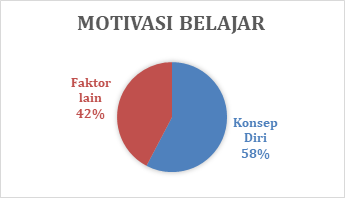
Based on Table 15, the results of the regression analysis show that the relationship between self-concept and motivation to learn chemistry is strong, with a correlation coefficient (R) of 0.760. This indicates a strong positive relationship between the two variables. The R-squared value of 0.577 indicates that 57.7 per cent of the variation in motivation to learn chemistry can be explained by students’ self-concept. The remaining 42.3 per cent is influenced by other factors that have not been investigated in this study. A pie chart showing the percentages is presented in Figure 1 below.
Meanwhile, the Adjusted R-squared value of 0.575 confirms that the model remains robust and stable despite being adjusted for the number of variables and sample size. With a standard error of the estimate of 3.864, the prediction error of this regression model is relatively low, meaning that the model is fairly accurate in predicting levels of learning motivation based on self-concept.
Conclusion
Based on the research findings, the conclusions are as follows: (1) There is a statistically significant difference in chemistry self-concept between male and female students. This is evidenced by the Mann-Whitney U value for chemistry self-concept of 6286.000 with an Asymp. Sig. (2-tailed) of 0.027. This confirms that there is a clear difference in self-concept perceptions between male and female students. (2) There is a statistically significant difference in learning motivation between male and female students. The U value for learning motivation was 6223.000, with an Asymp. Sig. (2-tailed) of 0.020. This confirms that there is a significant difference in the perception of learning motivation between male and female students. (3) There is a strong relationship between students’ self-concept in chemistry and their learning motivation, with a correlation coefficient of 0.742 and Sig. = 0.000. This relationship can be categorised as strong and statistically significant at a 99 per cent confidence level. This means that the higher students’ perception of their own ability in chemistry, the greater their internal drive or motivation to learn. (4) There is a combined influence of gender and culture on learning motivation. The interaction between the two (culture and gender) shows a statistically significant effect (Sig. = 0.010). This means that the influence of gender and culture on learning motivation is important in the learning process, particularly in subjects that require a high level of learning motivation (chemistry). (5) There is a significant influence of students’ chemical self-concept on their learning motivation. This coefficient has a significance value of 0.000 (p < 0.05), which means that students’ chemical self-concept has a significant effect on learning motivation. Furthermore, the R-squared value of 0.577 indicates that 57.7 per cent of the variation in learning motivation can be explained by students’ chemical self-concept.
References
- Benites, R. M., Fonseca Díaz, G. M., Benites Fonseca, D. G., & Benites Fonseca, D. A. (2025). Influence of self-concept and self-esteem on academic achievement. Salud, Ciencia y Tecnología - Serie de Conferencias, 4(1), 632. DOI ↗ Google Scholar ↗
- Fiedler, I., Buchholz, S., & Schaeper, H. (2024). Does Gender Composition in a Field of Study Matter? Gender Disparities in College Students’ Academic Self-Concepts. Research in Higher Education, 65(7), 1491–1513. DOI ↗ Google Scholar ↗
- Frailich, M., Kesner, M., & Hofstein, A. (2009). Enhancing students’ understanding of the concept of chemical bonding by using activities provided on an interactive website. Journal of Research in Science Teaching, 46(3), 289–310. DOI ↗ Google Scholar ↗
- Jansen, M., Schroeders, U., Lüdtke, O., & Marsh, H. W. (2019). The dimensional structure of students’ self-concept and interest in science depends on course composition. Learning and Instruction, 60(November 2018), 20–28. DOI ↗ Google Scholar ↗
- Kit, P., Dari, P., Sekam, L., Pada, P., Bentuk, M., & Kelas, M. (2012). Jurnal inovasi pembelajaran kimia. (1), 6–10. Google Scholar ↗
- Master, A., & Meltzoff, A. N. (2020). Cultural Stereotypes and Sense of Belonging Contribute to Gender Gaps in STEM. International Journal of Gender, Science and Technology, 12(1), 152–198. Google Scholar ↗
- Merayo, N., & Ayuso, A. (2023). Analysis of barriers, supports and gender gap in the choice of STEM studies in secondary education. International Journal of Technology and Design Education, 33(4), 1471–1498. DOI ↗ Google Scholar ↗
- Mickelson, R. A., Allen, D. D., Bottia, M., Stearns, E., Dancy, M., & Moller, S. (2025). Pre-collegiate factors contributing to the choice of a chemistry major: the role of science capital. Chemistry Education Research and Practice, 26(4), 909–925. DOI ↗ Google Scholar ↗
- Muliaman, A., Dewi, U. M., & Harahap, L. K. (2025). Volume 17 Number 2 Dec 2025. 17(2), 76–82. Google Scholar ↗
- Paul R. Pintrich and Elisabeth V. De Groot. (1990). Motivational and Self-Regulated Learning Components of Classroom Academic Performance. Journal of educational psychology, 82, 33–40. DOI ↗ Google Scholar ↗
- PISA. (2019). PISA 2018 Results. In OECD Publishing: III. https://www.oecd.org/pisa/publications/pisa-2018-results-volume-iii-acd78851-en.htm Google Scholar ↗
- Pratomo, H., Fitriyana, N., Wiyarsi, A., & Marfuatun. (2025). Mapping chemistry learning difficulties of secondary school students: a cross-grade study. Journal of Education and Learning, 19(2), 909–920. DOI ↗ Google Scholar ↗
- Rüschenpöhler, L., Gong, X., Wang, C., & Markic, S. (2025). Secondary school students’ attitudes towards chemistry: a cultural comparison between Germany and China. International Journal of Science Education, 47(11), 1381–1400. DOI ↗ Google Scholar ↗
- Rüschenpöhler, L., & Markic, S. (2020a). How the home environment shapes students’ perceptions of their abilities: the relation between chemistry capital at home and students’ chemistry self-concept. International Journal of Science Education, 42(12), 2075–2094. DOI ↗ Google Scholar ↗
- Rüschenpöhler, L., & Markic, S. (2020b). Secondary school students’ chemistry self-concepts: Gender and culture, and the impact of chemistry self-concept on learning behaviour. Chemistry Education Research and Practice, 21(1), 209–219. DOI ↗ Google Scholar ↗
- Steegh, A., Höffler, T., Höft, L., & Parchmann, I. (2021). First steps toward gender equity in the chemistry Olympiad: Understanding the role of implicit gender-science stereotypes. Journal of Research in Science Teaching, 58(1), 40–68. DOI ↗ Google Scholar ↗
- Stieff, M. (2019). Improving Learning Outcomes in Secondary Chemistry with Visualization-Supported Inquiry Activities. Journal of Chemical Education, 96(7), 1300–1307. DOI ↗ Google Scholar ↗
- Toma, R. B. (2021). Measuring children’s perceived cost of school science: Instrument development and psychometric evaluation. Studies in Educational Evaluation, 70, 101009. DOI ↗ Google Scholar ↗
- Veloo, A., Hong, L. H., & Lee, S. C. (2015). Gender and Ethnicity Differences Manifested in Chemistry Achievement and Self-Regulated Learning. International Education Studies, 8(8). DOI ↗ Google Scholar ↗
- Wibowo, T., & Ariyatun. (2020). Analysis of Attitute towards Chemistry Profile of Students in Senior High School. Journal of Physics: Conference Series, 1594(1). DOI ↗ Google Scholar ↗
- Yu, Z., & Wang, L. (2023). Gender-Moderated Effects of Academic Self-Concept on Achievement, Motivation, Performance, and Self-Efficacy: A Systematic Review. Frontiers in Psychology, 14(1136141), 1–15. doi: DOI ↗ Google Scholar ↗