Abstract
In today's digital economy, financial knowledge is indispensable for each individual and organization. The financial literacy of Vietnamese youth does not only stop at the fact that young people have financial knowledge, but also involves how that knowledge is applied and expressed in financial behavior and financial attitudes, from which young people can have personal provisions, consume for necessary needs, invest, save and manage finances for the future, minimizing financial risks. Recognizing the important role of financial literacy among young people, the following article has provided some relevant theoretical foundations as well as concepts and analysis of the current situation of the problem, thereby consulting with survey opinions of representative subjects to propose and recommend measures to improve young people's understanding of finance in the digital economy in Vietnam today.
Keywords
knowledge youth finance digital economy Vietnam
1. Overview of research problem
According to the Digital Economy Report of the United Nations Trade and Development Forum (UNCTAD), the digital economy currently accounts for 15% of global GDP, this proportion for the US is 21%, and China is 30%. According to assessments by international organizations, Vietnam's digital economy is developing rapidly and has many prospects. (tapchicongthuong.vn, 2023)
Digital Economy Digital Economy is an economic system in which all production, distribution, exchange and consumption activities are supported or carried out through digital platforms and digital technology. Understood from an academic perspective, digital economy is not simply the application of technology to economic activities but also a comprehensive transformation of business processes and market models, through three main elements: data, digital technology and innovation. (apd.edu.vn, 2026)
In recent times, the digital economy has played an important role in the socioeconomic development of every country and is increasingly popular, becoming an inevitable trend in most countries around the world. To promote digital economic development, one of the important tools used is financial policy. (tapchikinhtetaichinh.vn, 2024)
Finance is a concept in the economic category, expressing the relationship of managing and using one's money in a scientific way, meeting the needs of socioeconomic entities. For example, investing, saving, borrowing, lending… (vib.com.vn, 2023)
The rapid development of digital technology in recent years has dramatically changed the way people approach and manage finances.
In that context, young people have become an early adopter group that is easy to adapt to and widely use digital financial tools. However, a lack of financial knowledge can make them vulnerable to risks such as uncontrolled spending, erroneous investments or online fraud. Therefore, equipping young people with financial knowledge plays an important role and is a key factor in empowering them to make the right financial decisions in the digital era and develop economic autonomy. (quanlynhanuoc.vn, 2026)
Therefore, it is extremely necessary to research the current state of financial knowledge of Vietnamese youth in the context of digital economic development in order to have suggestions and recommendations to enhance financial knowledge training for these subjects in the coming time.
2. Research method
To serve the research, the authors used two methods including desk research (reviewing documents published in the media) and conducting sociological surveys (collecting questionnaires)
Using the desk research method, the authors review documents researching financial theories, financial understanding of young people such as concepts, characteristics, benefits and evaluation criteria for young people's financial knowledge and generalizations about the context of the digital economy
To carry out a sociological survey, the authors formed a Survey Form to search for information, through investigating all subjects as most conveniently possible.
The survey was built with the following contents to ask:
-
General information section
-
Understanding the digital economy
-
Financial knowledge
-
Financial Behavior
-
Financial Attitude
-
Proposalsection
Data collection method conducted by the research team is based on convenience sampling method. The survey was built on Google Drive, and the survey was conducted using the link: https://forms.gle/3NKs9T5fzfH2g1gW9
The survey forms were sent to survey subjects via social media such as: Facebook, Zalo, Email... in many areas. The total number of survey questionnaires collected was 300 (with 5 invalid ballots). Each question has answers for survey subjects to choose from (one answer or multiple answers, or choose 1 level/5level scale with level 1 being the lowest and level 5 being the highest)
Data processing method: The research team collected survey data from 295 valid questionnaires, then compiled the data using Excel software, thereby analyzing and demonstrating the research problem.
The survey subjects were nearly 80% female, the age range was mainly over 16 years old to 35 years old (84.7%) were young people, while 10.2% were people over 36 years old who were not the subject of the survey (temporarily paused the survey). Survey subjects under the age of 36 will continue to answer survey questions: understanding of the digital economy, financial knowledge, financial behavior, financial attitudes and suggestions and recommendations for measures to improve financial knowledge for Vietnamese youth.
3. Theoretical basis related to financial literacy in the digital economy
3.1. Theory of Human Understanding
From a philosophical and epistemological perspective, there are empiricism and rationalism, which complement each other when studying the nature of knowledge.
An Essay Concerning Human Understanding is John Locke's work on the basis of human understanding and knowledge. It was first known in 1689 (although it is believed to have appeared in 1690) under the title An Essay Concerning Humane Understanding. He rejected birth, describing the human mind at birth as a "blank slate" (empty, not attached to the spirit inside), and is gradually filled through practical experience, acquired through feeling and reflection.
According to the knowledge hierarchy model (DIKW tower, 1980), to quantify understanding in relation to data, knowledge management scientists often use the DIKW model (Data – Information – Knowledge – Wisdom). That is, the nature of understanding lies at the boundary between Information and Knowledge, which is the ability to connect discrete information chains to see the overall picture, understand the cause effect and operating rules of things.
Thus, human understanding is not a static state but a changing process. It is a combination of the receiving ability of the senses, the processing and storage of neural structures, and the ability to link raw data into meaningful knowledge to adapt to the living environment.
3.2. Theory of the birth and development of finance
According to economic and financial theory, finance can only appear when two basic economic and social premises are met: the birth and development of commodity production and currency, along with the birth of the state.
Over the course of history, finance has developed from a purely state tool (public finance) into a lifeline system running throughout the entire global economy.
The development of finance goes through many stages: from classical public finance (mainly the state budget revenue and expenditure system) to corporate finance and bank credit system and to modern financial markets and derivatives.
In the 21st century, the peak development of finance is associated with technology and mathematics to eliminate risks and improve financial efficiency.
Portfolio Theory by Harry Markowitz (1952) proved that finance is not just about making profits but optimizing profit and risk through diversification.
Efficient Market Theory of Eugene Fama (1970) argues that asset prices fully reflect all available information.
Black Scholes Merton's Capital Asset Pricing and Option Pricing Model (1973) argued that finance developed rapidly with derivatives separating risk from the original asset for trading and insurance.
3.3. Concepts and assessment of financial literacy
To date, there is still no complete consensus on a common definition of financial literacy, but is often adjusted or changed depending on the research of different authors or each implementation program of each organization. Lusardi & Mitchell (2014) consider financial literacy as an individual acquiring financial knowledge and understanding and applying this understanding to make financial decisions. The same group of authors in another 2011 study affirmed that financial knowledge is very important, especially for retirement security. Hogarth (2002) believes that financial literacy is the ways to manage financial resources in terms of personal provisions, investments, savings and personal budgeting. Schagen & Leans (1996) define financial literacy as the ability to make informed judgments and make effective decisions regarding the use and management of money. According to the OECD an organization that has periodically conducted financial literacy surveys in many countries around the world, gives the following definition: Financial literacy is the combination of awareness, knowledge, skills, attitudes and behaviors essential to making effective financial decisions, ultimately achieving a high level of personal financial knowledge (OECD, 2012).
Up to now, there is no consensus on the financial literacy measurement model, however, research is quite consistent in personal financial understanding including 3 main pillars: financial knowledge, financial attitude and financial behavior.
3.4. Theory of financial literacy of young people in the digital economy
The US Bureau of Economic Analysis (BEA) defines “digital economy” as including economic activities primarily based on the internet and information and communications technology (ICT). In particular, the field of information and communication technology (ICT) serves as the starting point in the definition of the digital economy. The characteristic of the "digital economy" is to create maximum satisfaction of the needs of all participants through the application of technology to exploit data and information, including personal information. This became possible thanks to the development of information and communications and Internet technology as well as the availability of infrastructure, along each other creates the possibility of full interaction in the hybrid world of all participants in economic activity: subjects and objects of the process of creation, distribution, exchange and consumption of goods and services.
Purnomo et al. (2021) rely on the North American Industry Classification System (NAICS) and bibliometric tools to analyze and synthesize digital economy concepts.
Most definitions of the digital economy have one main thing in common: “an economy based on digital technology”. The basic foundation of
the digital economy is ICT technology including hardware and software, telecommunications technology, and information provision services. (chuyendoiso.cantho.gov.vn, 2023)
Youth's financial understanding in the digital economy often takes a multidimensional approach.
First: Life cycle theory developed by Franco Modidliani (1954) suggests that individuals plan spending and saving throughout their lives to optimize consumption. Young people are in the early stages of the human life cycle, with low or unstable income but high consumer demand. In the digital economy, easy access to finance can expose them to many risks, but having an understanding of digital finance will help minimize risks, balance and satisfy current needs and invest for the future.
Second: Human capital theory, according to Gary Becker (1964), knowledge and skills (understanding) are a form of capital, which will bring economic benefits in the future. Financial literacy is considered an essential component of human capital. In the digital economy, young people need to have the ability to assess the risks of digital finance and recognize hightech financial fraud models.
Third: Ajzen's Theory of Rational Behavior (1975) and Planned Behavior (1991) point out that a person's behavior is governed by behavioral intention, which determined by: attitudes, social influences and awareness and understanding. In the digital economy, young people can be greatly influenced by influential individuals on social networks or very convenient financial application interfaces that can be within the understanding of young people, misleading them and leading to impulsive, crowd decisions.
Fourth: Behavioral economic theory put forward by Daniel Kahneman and Amos Tversky (1970) has proven that people are always influenced by cognitive biases. In the digital economy, noncash consumption reduces the feeling of spending, causing young people to spend more. In addition, young people prefer immediate benefits instead of longterm benefits, so credit services are exploding.
With some proposed theories, young people's understanding of finance in the digital economy is a dynamic concept, pointing out that the basic parts of this concept are the intersection of core financial knowledge, financial behavior and psychology, attitudes towards finance, placed in an ecosystem of digital economy.
4. Current status of financial understanding of Vietnamese youth in the context of the digital economy
4.1. The current situation of Vietnamese youth
In Vietnam, the youth population (people between 16 and 30 years old) is tending to decrease year by year. According to data from the General Statistics Office, in the period from 2015 to 2019, the youth population tended to decrease continuously year by year, in 2015 there were 24,349,226 people, accounting for 26.5%, and in 2019 it was estimated to be 22,898,886 people, accounting for 23.8% of the country's population. According to 2020 statistics, there are about 22.609 million Vietnamese youth aged 1630 years old, accounting for about 23.2% of the country's population.
Vietnam currently has 14.2 million people aged 60 and over, an increase of 2.8 million people compared to 2019 and is forecast to be approximately 18 million people by 2030. The 2024 midterm population and housing census announced by the General Statistics Office on January 6, 2025 shows that Vietnam's population continues to age. While the youth population is decreasing, the proportion of the population aged 31 59 and especially 60 and over tends to increase.
Vietnamese youth today have outstanding characteristics such as dynamism, enthusiasm, daring to think, daring to do, not afraid of challenges and ready to accept new things. This is a special advantage in the context of globalization and the fourth industrial revolution taking place strongly in the world. When the digital economy is becoming an inevitable trend, digital transformation and innovation are the key driving forces for development, young people are the force that fastest grasps advanced technologies and accesses new knowledge to develop and have a better future.
Entering a new stage of development, with the goal of becoming a developed, highincome country by 2045, Vietnam is facing both golden opportunities and unprecedented challenges. The fourth industrial revolution, digital economy, green economy... pose many breakthrough requirements. At this time, young people are an important factor with many great responsibilities, needing to be knowledgeable, creative and pioneering.
4.2. Young people's understanding of the digital economy
The 4th Industrial Revolution has been bringing many fundamental economic and social changes globally. The explosion and popularity of the internet and digital technologies have brought many opportunities for young people to participate and connect in the digital economic market, where market barriers are smaller, with many opportunities to access and share information and knowledge with communities that share common interests and bring cooperation in production projects together. A number of studies have demonstrated the richness and diversity of opportunities for young people to participate and interact with the digital economy, including digital content, digital platforms as well as digital
services. (dcs.nhandan.vn, 2021).
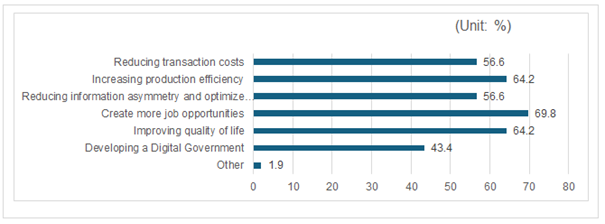
The surveyed subjects learned about the digital economy and pointed out the following outstanding benefits of the digital economy:
(Source: Survey results)
According to the understanding of the survey subjects (young people), the most prominent benefit of the digital economy is creating more job opportunities (69.8% of opinions) followed by improving the quality of life and increasing production efficiency (64.2% of respondents selected)
World Bank studies in the East Asia Pacific Digital Economy report have recognized Vietnam as one of the countries with the fastest and most vibrant digital economic development in the region, with undeniable important contributions from a team of young, talented engineers, programmers, software developers and technology managers. Vietnamese youth do not just stop at being passive users of technology, but increasingly assert themselves as active subjects, creating new and groundbreaking products, applications, digital content and business models, contributing to solving social problems. (tapchicongthuong.vn, 2025)
Youth have three undeniable strengths: creativity, dynamism, easy access to new technology and a pioneering force in many social issues. It is the quick access to technology that is the condition for young people to understand the digital economy.
To gain knowledge about the digital economy, Vietnamese youth can learn about high school programs, universities and colleges with subjects and majors on the digital economy, or at state information portals, development organizations, or press agencies and online platforms.
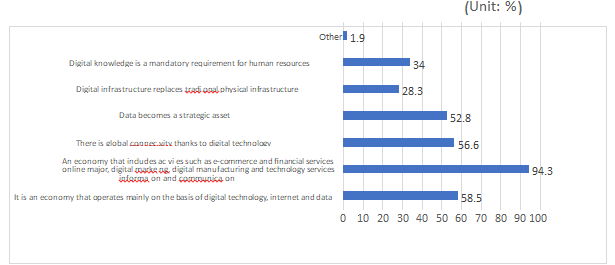
The surveyed subjects gave their understanding of the characteristics of the digital economy, shown in the following chart:
(Source: Survey results)
The young people surveyed here were relatively knowledgeable about the digital economy when pointing out that the most basic characteristic of the digital economy is that the economy includes activities such as ecommerce, online financial services, digital marketing, and digital manufacturing (nearly 95% of respondents chose this). The second basic characteristic of the digital economy is that the economy operates mainly on the basis of digital technology, internet and data (58.5% of respondents chose this option). The third characteristic of the digital economy is that the economy is globally connected thanks to digital technology (56.6% of respondents chose it).
In 2025, the current state of Vietnam's digital economy continues to affirm its role as an important growth driver of the Vietnamese economy. The proportion of added value of the digital economy in GDP is estimated at 14.02%, equivalent to about 72.1 billion USD, an increase of 1.64 times compared to 2020. The digital economy develops through two main groups: core technology group (such as information technology, ecommerce, digital finance) and technology application group (such as digital agriculture, smart logistics, digital health and education, smart tourism, smart manufacturing). Thus, digital finance is a core technology that young people in particular and all of us in general need to have knowledge and understanding of when the digital economy is operating.
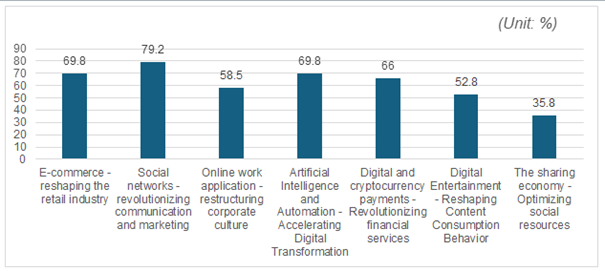
The surveyed subjects gave their opinions on a number of successful business models in the digital economy, which are: ecommerce, business on social network platforms, working online, automation, digital finance,
digital entertainment...
(Source: Survey results)
Thus, according to a survey of young people who currently have an understanding of successful business models in the digital economy, nearly 70% of opinions believe that the digital payment model and electronic money revolutionizing financial services are successful. Digital finance is still considered a core technology from which there are many applications in the fields of production, business and consumption.
The reality also shows that the digital financial ecosystem in Vietnam is also developing a variety of products such as digital payment, digital banking...
| Target | Number of transactions | Transaction value (billion VND) |
| Internet | 948.530.567 | 22,912,835 |
| Mobile Banking | 3,629,643,399 | 20,906,713 |
(Source: Payment Department, State Bank,2024)
4.3. Young people's financial knowledge in the digital economy
Youth's understanding of finance in the digital economy is firstassessed through youth's financial knowledge.
Financial knowledge involves understanding financial terms, concepts and how financial institutions operate... which is the foundation that shapes each individual's financial behavior and attitudes. For young people, financial literacy plays an important role, helping to make wise financial decisions, understanding financial institutions and developing essential financial management skills such as budgeting, saving and investing (Thomas and Subhashree, 2020).
Production of goods money and the state are the objective premises that determine the birth and existence of finance. Experiencing different socioeconomic forms in the development process of human society with the strong development of the commoditymoney economy, the form of money has become the main form of income and expenditure of the state as well as all other subjects. The economic development of goods and money has created objective conditions for the expansion of financial relationships.
Finance reflects the system of economic relationships that arise in the process of distributing financial resources through the formation of financial resources through the formation and use of monetary funds to meet the accumulation or consumption needs of subjects in society. (thuvien.due.udn.vn, 2007)
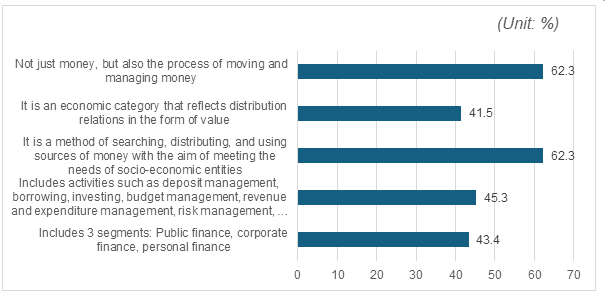
The surveyed subjects (representing young people) view the nature of finance as follows:
(Source: Survey results)
With more than 60% of respondents choosing the answer about the nature of finance as: the method of finding, distributing, and using money sources with the purpose of meeting the needs of socioeconomic and financial subjects, not only money, but the process of mobilizing and managing money, it shows that the surveyed subjects also basically understand the nature of finance.
The need for financial education in Vietnam has become urgent, especially when the size of the financial market (including banks, securities, insurance) is currently three times the size of the economy, with an average growth rate of 14%/year from 2021 to present. However, financial education programs in Vietnam are still quite late compared to the pace of development of the economy and financial market. This is the challenge of lifting. High community understanding and skills in personal financial management, including asset management, investment, risk control...
Currently, only about 30% of Vietnamese adults have financial knowledge, lower than the ASEAN region average of 38%. Young people come into daily contact with the internet and technology, and are the force that begins to have more access to money (earn money, save money, invest). But young people, especially the Gen Z generation (1227 years old) are struggling with money, surrounded by black credit and financial crimes among the most defrauded groups in cyberspace. (tinnhanhchungkhoan.vn, 2024).
In a market economy, finance plays the main role as a tool for distributing gross national product and a tool for macroeconomic regulation.
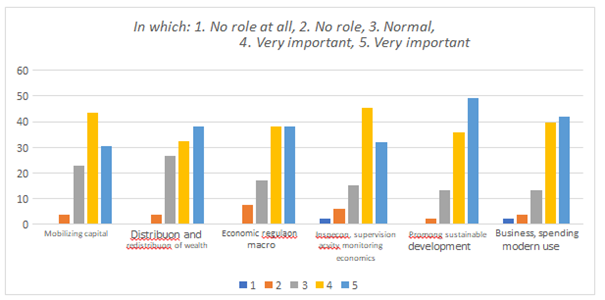
The survey subjects (representing young people in the study) evaluated the role of finance as follows:
(Source: Survey results)
Young people in this research survey rate the role of finance as always high at level 4 very important role and level 5 very important role. In particular, in the context of today's volatile digital economy, the role of finance in promoting sustainable development is highly appreciated.
Also according to survey opinions, surveyed subjects also have knowledge about financial instruments. Financial instruments are types of assets or capital packages that can be traded to effectively circulate capital for investors. According to survey respondents, cash instruments (savings deposits, bonds, capital instruments...) are the most numerous, followed by foreign exchange instruments and derivatives (forward contracts, futures contracts, options contracts, swap contracts...). However, in today's digital economy, the most popular financial tools are ewallets and platforms online payment. They serve the needs of money transfer, cashless shopping and daily bill payments. Then there are peertopeer lending tools (P2P Lending), digital currencies (Cryptocurrency) and crypto wallets. Thus, the survey subjects in the study still do not have a complete understanding of financial tools in the digital economy.
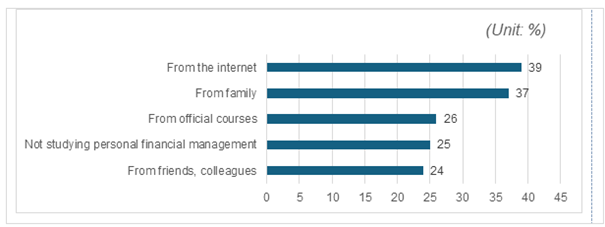
Financial literacy can come from many sources. According to's survey Statista (2024) shows that people in Southeast Asia, including Vietnam, are the dominant population The majority learn about personal finance via the Internet (39%) and from family (37%), while only 26% access financial knowledge through formal courses. Notably, up to 25% of respondents admitted that they have never learned how in financial education, especially digital finance in Southeast Asia as well as Vietnam, and shows that the current education system has not effectively met the needs of improving financial literacy.
(Source: Statista, 2024)
The lack of digital financial knowledge greatly affects the ability of population groups to access and use digital financial services. For middleaged and elderly people in particular, using digital financial platforms faces many barriers, mainly due to lack of technological skills and security concerns. Meanwhile, younger generations like Gen Z, despite having better access to technology, are easily drawn into unorthodox financial models and susceptible to fraud due to lack of knowledge about risk management. (tapchinganhang.gov.vn, 2025)
4.4. Young people's financial behavior in the digital economy
Financial behavior covers the decisions and actions that individuals take related to managing their finances, including budgeting, spending, saving, investing, debt management, and risk preparation. For young people, the cultivation of actions
vi positive finances are important to ensure future financial stability and success; helps them master budgeting skills to live within their means, save and invest early to take advantage of compound interest, manage debt responsibly, maintain a positive credit score, use financial tools wisely, and prepare for financial emergencies (Herdjiono and Damanik, 2016; Khuc The Anh and Tran Tuan Vinh, 2022).
In the context of strong ecommerce development, gen Z (born in 1997 2012) and Millennials (born 19811996) are the main online spending force. Report from Metric.vn (2024) shows that total spending on ecommerce platforms in Vietnam in the first quarter of 2024 reached more than 143.9 trillion VND, with customers aged 1830 accounting for 65%. Not only shopping, young people also quickly access forms of digital finance such as "buy now pay later" (Buy now pay later BNPL), ewallets or automatic investment applications. In Vietnam, the BNPL market recorded a value of more than 1.9 billion USD by the end of 2024, an increase of 44% compared to the previous year (according to Research and Markets). As a result, many young people own 35 loans or installments at the same time, easily leading to loss of control over cash flow. (tapchixaydung.vn, 2025)
Young people today don't wait to "have extra money" to invest. They start their financial journey from familiar consumer experiences: payments, cashback, earning points. With technology and AI accompanying, small amounts a few hundred thousand to one million VND become a way for them to control cash flow, experiment with investments and gradually form sustainable financial habits.
From "affordable fun" behaviors, young people begin to explore financial tools: deposits, periodic investments, fund certificates... Convenience, ease of access and seamless user experience make these behaviors gradually become habits not through theoretical education, but through personalized technology.
As users increasingly expect to proactively control their finances without becoming an expert, AI plays a key role in turning
behavioral data into sustainable financial recommendations from small expenditures to longterm investment strategies.
Users do not need to understand the concept of "accumulation" or "credit limit", they just need to see suggestions that suit their cash flow, context and
capacity (thanhnien.vn, 2025).
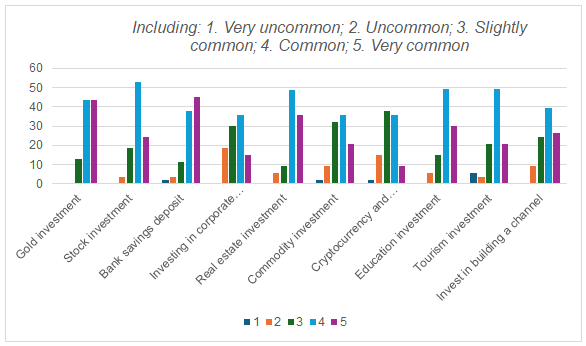
Surveyed subjects assessed the popularity of current types of financial investments as follows:
(Source: Survey results)
Based on personal experience, survey subjects have assessed the popularity of stock investment as the most popular, followed by investment in education and investment in tourism.
In addition to buying goods, young people are willing to spend heavily on experiences such as shortterm travel, dining, and learning skills (such as investing in building personal channels). A survey conducted by Decision Lab in early 2024 showed that more than 57% of young people prioritize spending on personal experiential activities.
In fact, some young people are applying effective financial management methods such as the 50/30/20 model (spend 50% on essential needs, 30% on hobbies, 20% for savings or investments), or applying technology to track cash flow through Money Lover, MISA Income and Expenditure Book, Spendee...
Without reasonable financial behavior, young people may face a number of risks. Although modern spending habits bring convenience and initiative, many young people still face financial risks due to lack of discipline and financial knowledge. In the digital economy, where all financial transactions can be performed with just a few touches, Vietnamese young people are facing situations: either being swept away by the flow of consumption or taking control of their own finances.
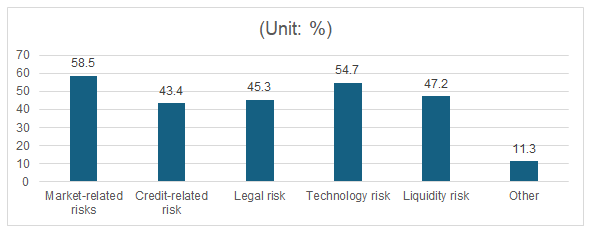
The surveyed subjects (representing young people) gave their opinions on the financial risks they have encountered as follows:
(Source: Survey results)
According To the survey results, the subjects who encountered the most were marketrelated risks (nearly 60% of the risks encountered), followed by technologyrelated risks and liquidity risks.
Financial risks that young people face cause them to lose money and fall into debt. In the digital economy, there are many pitfalls in the market that put young people at risk. When lacking financial knowledge, information and experience, young people easily become targets of scams such as super profitable investments, or loan apps with high interest rates. A study by the Ministry of Public Security in 2023 showed that 40% of victims of financial fraud were people under 30 years old.
Many young people are willing to spend large amounts of money on items such as new phones, large motorbikes or branded items that tend to be used a lot. These expenses are all liabilities and depreciate over time. Difficulties from excessive income and spending can cause young people to become in debt and possibly destitute.
In addition, many young people seek and trust financial advice on social networks and artificial intelligence tools. They rely on virtual financial experts, relying on unsubstantiated analysis on social platforms to make consumption and investment decisions. The risks from this technology cause young people to not have enough information, or to be influenced.
4.5. Financial attitudes of young people in the digital economy
Financial attitudes represent an individual's predisposition toward financial matters, shaped by their beliefs and perceptions. Financial attitudes influence how individuals approach financial decisions and behaviors, impacting their financial outcomes (Yong et al., 2018; OECD, 2015). Cultivating positive financial attitudes is important for young people to navigate financial management and related financial decisionmaking.
The biggest difference compared to the previous generation is that, like the previous generation, they prefer "tangible assets" such as gold bars and real estate, because they have experienced many economic fluctuations and value absolute safety. The younger generation prioritizes high liquidity, transparency and rapid growth. They accept higher risks in exchange for the opportunity to grow their assets with small initial capital, and they want to manage their investment portfolios anytime, anywhere via mobile applications. (vneconomy.vn, 2026)
For the younger generation, those born and raised in a digital environment, receiving and using digital financial services happens naturally and quickly. However, the convenience and prominence of the digital economy also come with new challenges and pressures, creating psychological stress and pressure on digital finance.
Different from traditional financial stress, which only revolves around tangible issues such as student debt, rent costs or the cost of living, digital financial stress is a more multifaceted phenomenon, including psychological and behavioral pressures arising from financial management in a comprehensive digital environment (Teng, Xia and He, 2025). Digital financial stress is not only related to the use of banking and payment applications but is also strongly influenced by nonmaterial but powerful factors. Such as exposure to misleading information about “super profitable” investment opportunities on social networks, pressure from comparing one's lifestyle with friends through online posts, and the risk of falling into a spiral of overspending due to the nearinstant convenience of noncash payment methods (Ramsden and Talbot, 2025; An et al., 2025).
Financial knowledge in the digital economy cannot solve all problems. Although high digital financial literacy improves financial management behavior, it does not directly reduce stress levels (Chhillar, Sharma, and Arora, 2025). Stress is often more related to psychological factors such as attitudes toward debt and perceptions of future financial security. For example, a student may be very knowledgeable about digital investment tools, but if they have an inherently negative attitude toward debt or are pessimistic about their financial future, they still feel anxious (Perry et al., 2024). This shows that financial education programs should not only focus on providing technical knowledge but should also focus on building healthy attitudes, emotional control skills and confidence in one's financial abilities. (tapchinganhang.gov.vn, 2026)
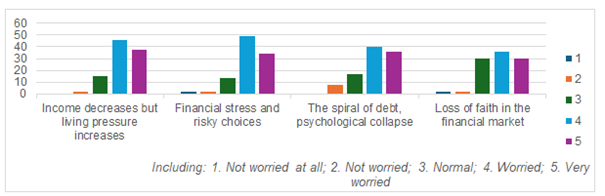
The surveyed subjects gave their opinions on their attitudes when facing financial difficulties as follows:
(Source: Survey results)
Young people surveyed in this study were the most worried when facing financial stress and risky choices and they were also very worried about reduced income but increased life pressure.
Among the groups of people pressured by financial worries are urban youth, low income, high living costs and pressure to prove themselves. Financial stress not only causes insomnia but also affects emotions, from emotional exhaustion to anxiety disorders and depression.
According to Deloitte's 2025 survey conducted with more than 23,000 people in 44 countries, the proportion of Gen Z feeling financially insecure increased from 30% to 48%, this increase also occurred in the Millenial group from 32% to 46%. This data also shows great motivation and a growing desire for financial freedom. (vneconomy.vn, 2026)
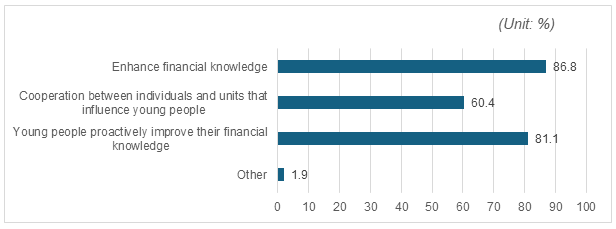
Young people surveyed by this study are aware of the mistakes that are easy to make when investing financially: lack of knowledge and information, overconfidence, looking for a sense of adventure, lack of diversity in choices, and being influenced by the media.
(Source: Survey results)
There are many mistakes when investing financially. Young people in this research survey pointed out that mistakes due to lack of knowledge and information are the biggest (nearly 90% of choices) followed by mistakes due to the media and because young people are too confident.
Indeed, due to the proliferation of business opportunities in the digital economy, many young people earn quite a good income early on, but later cannot keep the money and even get into debt. They also invest based on emotions and FOMO, are too confident without knowledge or information, do not have a clear personal financial plan, get caught up in trends and eventually lose control.
5. Some recommendations to improve financial knowledge for Vietnamese youth in the digital economy
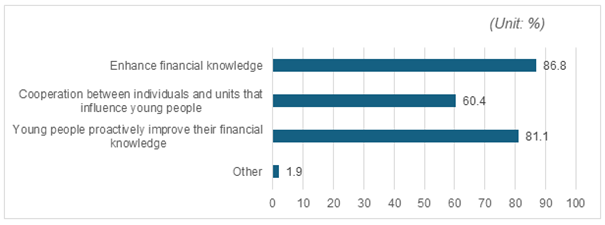
According to the survey of subjects, the research team also received opinions on measures to improve financial knowledge for young people today, which are: improving financial knowledge, cooperation between individuals and units that influence young people, young people proactively improving financial knowledge.
finance for young people
(Source: Survey results)
After Recognizing the current reality of financial knowledge of Vietnamese youth, identifying the level of knowledge and risks encountered as well as mistakes that have occurred when young people invest and manage finances, consulting the survey, the research team proposed and recommended a number of solutions to improve financial knowledge for Vietnamese youth in the digital economy.
First, young people themselves are an important target. It is they who must proactively seek financial knowledge in learning programs, through family teachings, then update official technologies and application platforms that are allowed to operate for consumption or investment, financial accumulation, bringing benefits to themselves and minimizing risks. Young people also change their thinking system, Understand the nature of money, the nature of finance, have the right attitude and do not follow other people's financial fraud activities.
According to the opinions of the surveyed subjects, young people themselves must proactively improve their financial knowledge is a very important measure to take (accounting for more than 80% of survey opinions) (according to Figure 11)
Second, it is recommended that schools and educational management agencies need to more deeply integrate digital financial education into the curriculum of all levels, right from preschool to university, from the simplest lessons to deeply specialized
lessons, thereby helping the younger generation have financial knowledge, orient financial behavior correctly and have reasonable financial attitudes.
According to the survey, the measure to improve financial knowledge for young people is the measure with the most choices that need to be made (nearly 90% of choices), and the role of schools as well as educational agencies and educational management has a great responsibility in equipping and improving financial knowledge for young people.
Third, recommendations for family society. Financial knowledge is immediately equipped by parents for young people, from understanding the birth and meaning of money to accumulating, saving and spending money properly. Financial transactions in life also have specific designs for young people to guide appropriate financial behavior. Improving a culture of responsibility and financial awareness requires the collaborative efforts of families, educational institutions, financial experts and society.
Fourth, make recommendations to State agencies and units. To improve financial literacy for young people in Vietnam in today's digital economy, State agencies and
units should initiate comprehensive strategies focusing on education, policy and raising financial awareness for young people. In the digital economy, the State and Government also participate in signing agreements related to international finance, coordinate with international financial security organizations, create a global ecosystem and ensure the reduction of financial risks for Vietnamese people in general and Vietnamese youth in particular. In addition, the State also creates conditions for young people to have many opportunities to study, work, buy housing, and make financial investments to reduce financial pressure with appropriate credit policies, employment policies, housing policies and investment policies...
Fifth, recommendations for media units and financial companies. Media units and financial companies have a great influence on young people's financial behavior and financial attitudes. Media and technology units need to have programs that provide appropriate financial knowledge and financial technology for young people. Initiatives such as financial education clubs, investment clubs and financial competitions are always designed and organized regularly to enrich young people's knowledge and experiences and strengthen financial planning and management skills essential risks. Financial companies combine with technology companies to create financial products that benefit young people, create a healthy financial ecosystem, and shape a modern and transparent Vietnamese financial market in the future. These units should take advantage of modern technology and flexibility and creativity suitable for young people to foster and improve ethics and qualities in investment and consumption for the young generation of the country's future owners.
Conclusion
The digital economy opens up many opportunities in management, administration, production business and consumption for individuals, organizations and countries. Young people in the digital economy already have certain financial knowledge to shape appropriate actions and attitudes. The article summarizes, evaluates and provides highly practical recommendations and proposals to improve understanding of young people in Vietnam about finance today and in the future.
References
- Anfin (2025). What is financial investment? 6 popular personal financial investment channels. DOI ↗ Google Scholar ↗
- British Council (2020). Research report on Vietnam's young generation. DOI ↗ Google Scholar ↗
- Dai Nam University (2021). Effective financial investment lessons for newbies begin. https://dainam.edu.vn/vi/tintuc/nhungbaihocdaututaichinhhieuquachonguoimoibatdau Google Scholar ↗
- Dao My Hang (2025). Dan tri digital finance in Vietnam: Current status and solutions. https://tapchinganhang.gov.vn/dantritaichinhsotaivietnamthuctrangvagiaiphap16077.html Google Scholar ↗
- Doan Phuong Ngan (2025). Factors affecting financial risk tolerance of modern youth. DOI ↗ Google Scholar ↗
- Hoang Xuan Lam (2023). Potential for the Development of the Digital Economy and Digital Transformation in Vietnam. https://tapchicongthuong.vn/tiem-nang-phat-trien-kinh-te-so-va-chuyen-doi-so-tai-viet-nam-103420.htm Google Scholar ↗
- Academy of Policy and Development (2026). What is digital economy? From the traditional economy to the modern digital,https://apd.edu.vn/a/240801/Kinh-te-so-la-gi-Tu-nen-tang-kinh-te-truyen-thong-den-mo-hinh-kinh-te-so-hien-dai?c=18275 Google Scholar ↗
- Homecredit (2026). What are financial instruments? Which financial instrument is the most popular? https://www.homecredit.vn/blog/congcutaichinhlagi101 Google Scholar ↗
- Fptis (2024). What is digital economy? Characteristics and solutions to promote digital economy. DOI ↗ Google Scholar ↗
- Khanh Quynh (2025). Vietnamese young people experiment with finance as a game of intelligence.https://thanhnien.vn/nguoitrevietthunghiemtaichinhnhumotcuocchoithongminh185250710194714985.htm Google Scholar ↗
- Le Duy Anh BA (Dunelm) Mphi, PhD (Cantab) (2021). The role of the younger generation is real currently advocates developing the digital economy on the basis of science and technology and innovation. https://dcs.nhandan.vn/bao-ve-nen-tang-tu-tuong-cua-dang/vai-tro-cua-the-he-tre-thuc-hien-chu-truong-phat-trien-kinh-te-so-tren-nen-tang-khoa-hoc-va-cong-nghe-doi-moi-sang-tao-589558.html Google Scholar ↗
- Le Hoang Anh, Đa Ngoc Duy, Ngo Gia Phong, Nguyen Thi Thanh Huyen, Hoang Minh Quang (2019). Factors Influencing the Level of Personal Financial Literacy among Vietnamese University Students. https://khoahoc.neu.edu.vn/Resources/Docs/SubDomain/khoahoc Google Scholar ↗
- Le Thi Mai Lien, Nguyen Thuy Quynh (2024). Fiscal policy promotes development Digital economic development. https://tapchikinhtetaichinh.vn/chinh-sach-tai-chinh-thuc-day-phat-trien-kinh-te-so-58710.html Google Scholar ↗
- Le Huu Khoi (2025). What is digital economy? Impact and opportunities for modern businesses. https://base.vn/blog/ Kinhtesolagi/ Google Scholar ↗
- Ngoc Thanh (2025). Spending Habits in the Digital Age: How Are Young Vietnamese People Spending Their Mone? https://tapchixaydung.vn/thoiquenchitieuthoisohoanguoitrevietdangtieutienthenao20201224000029792.html Google Scholar ↗
- Nguyen Minh Sang (2026). Student financial stress in transfercontexts Digital change: Challenges and management implications. https://tapchinganhang.gov.vn/cangthangtaichinhcuasinhvientrongboicanhchuyendoisothachthucvahamyquantri17421.html Google Scholar ↗
- Nguyen Thi Cam Tu (2026). Financial understanding – the initiative of young people in today's time digital. https://www.quanlynhanuoc.vn/2026/03/26/hieu-biet-tai-chinh-su-chu-dong-cua-gioi-tre-trong-thoi-dai-tai-chinh-ky-thuat-so/ Google Scholar ↗
- Nguyen Thi Thuc Hien (2023). The role of digital finance in financial stability of the financial system. https://tapchinganhang.gov.vn/vaitrocuataichinhsotrongondinhtaichinhcuahethongtaichinh10783.html Google Scholar ↗
- Nguyen Hoang Phuong (2024). Personal Financial Literacy among Youth: An Empirical Study of the Current Situation in Hanoi and policy recomendations. https://tapchicongthuong.vn/hieubiettaichinhcanhancuagioitrekhaosatdieutrathuctrangtaihanoivadexuatgiaiphap126675.htm Google Scholar ↗
- Nguyen Phuong Nhung (2025). Vietnamese Generation Z: The Pioneering Force Driving the E-commerce and Digital Economy Revolution. https://tapchicongthuong.vn/gen-z-viet-nam--luc-luong-tien-phong-thuc-day-cach-mang-thuong-mai-dien-tu-va-kinh-te-so-138979.htm Google Scholar ↗
- An House (2024). Only 30% of Vietnamese adults are financially literate. https://www.tinnhanhchungkhoan.vn/chi30nguoivietnamtruongthanhhieubietvetaichinhpost354708.html Google Scholar ↗
- Phan Dinh Khoi (2023). Digital economy, concepts, measurement and current status in Vietnam. https://chuyendoiso.cantho.gov.vn/media/files/3_Phan%20Dinh%20Khoi_Kinh %20te%20so_CT_271023.pdf Google Scholar ↗
- P.V (2023). Basic business finance knowledge is necessary for everyone Vneconomy. https://tienphong.vn/nhungkienthuctaichinhKinhdoanhcobancanthietchomoinguoipost1503204.tpo Google Scholar ↗
- PV (2025). Young people's financial knowledge base: The key to unlocking inner strength of the economy. https://vtv.vn/nen-tang-kien-thuc-tai-chinh-cua-nguoi-tre-chia-khoa-mo-ra-suc-manh-noi-tai-cua-nen-kinh-te-100251127101218085.htm Google Scholar ↗
- Quách Trang & Nguyễn Kiên (2025). Understanding Gen Z's Financial Behavior. https://thoibaonganhang.vn/docviphongcachtaichinhgenz161418.html Google Scholar ↗
- Lam Minh Chanh (2024). Personal finance for young people. TCAM Youth Publishing House (2025). 5 financial mistakes young people often make and how to avoid them. https://tcam.com.vn/vi/knowledgelibrary/5sailamtaichinhgioitrethuongmacphaivacachtranhn1517 Google Scholar ↗
- Tue Lam (2026). Increasing Pressure for Financial Independence among Young People: Expert recommendations? https://vneconomy.vn/ap-luc-tu-do-tai-chinh-o-gioi-tre-ngay-cang-lon-chuyen-gia-khuyen-nghi-gi.htm Google Scholar ↗
- Lan Anh (2025). Financial education for children: Global trend or urgent need setting? https://vneconomy.vn/Giaoductaichinhchotrexuhuongtoancauhaynhucaucapthiet.htm Google Scholar ↗
- Nha An (2024). Only 30% of Vietnamese adults are financially literate. https://www.tinnhanhchungkhoan.vn/chi-30-nguoi-viet-nam-truong-thanh-hieu-biet-ve-tai-chinh-post354708.html Google Scholar ↗
- Thien Nhan (2025). Young People and Financial Lessons: What Do Experts Say about Personal Financial Management Skills? https://svvn.tienphong.vn/nguoi-tre-va-bai-hoc-ve-dong-tien-chuyen-gia-noi-gi-ve-ky-nang-quan-ly-tai-chinh-ca-nhan-post1788681.tpo Google Scholar ↗
- VIB (2023). What is financial literacy? The nature and role of finance. https://www.vib.com.vn/vn/camnang/nganhangso/tienichvatrainghiem/ kienthuctaichinhlagi Google Scholar ↗