Abstract
The purpose of this research is to analyze the effects of Technology, Organization, and Environment on the growth of MSMEs using Financial Performance and Digital Transformation as mediating variables. The methodology used for this research is the quantitative method using Structural Equation Modeling (SEM) approach based on Partial Least Square (PLS). The population used in this research is all MSMEs that have been assisted by Bank Indonesia in Banda Aceh city, and the number of total units is 250, and all of them were involved as respondents with a census sampling technique. Results show that technology, organization, and environment have a positive impact on both financial performance and digital transformation. Additionally, financial performance and digital transformation have a positive effect on MSME growth. However, technology, organization, and environment directly have no significant effect on MSME growth. Mediation analysis has confirmed that Financial Performance and Digital Transformation act as complete mediators between the three TOE factors and growth of MSMEs, with Environment being the highest contributor to Digital Transformation. This study adds value to the Technology-Organization-Environment framework through the addition of Financial Performance and Digital Transformation as two more factors that explain MSME growth. The implication here is that any move towards improving the technology, organization, and business environment dimensions has to start with an improvement in financial performance and digitalization because they are the major avenues for sustainable growth of MSMEs.
Keywords
Technology Organization Environment Financial Performance Digital Transformation MSME Growth
1. Introduction
As the central bank of Indonesia, Bank Indonesia (BI) has three main duties to ensure the stability of the value of the rupiah through its main functions of formulating monetary policy, establishing a sound payment system, and financial stability. In addition to those main duties, Bank Indonesia is also committed to fostering the growth of Micro, Small, and Medium Enterprises (MSMEs) by providing more access to financing, developing the capabilities of business players, and digital marketing.
In the framework of the country’s economy, MSMEs are very important because they employ most of the people and greatly affect the Gross Domestic Product. The time of Industrial Revolution 4.0 is approaching and digital transformation of MSMEs becomes a necessary element that will help them be competitive, effective, and extend their presence in the market, either by digital marketing or digital accounting or using services of fintech (Alifudin et al., 2024).
Being the capital and administrative center of Aceh Province, Banda Aceh exhibits a highly encouraging growth trend in MSMEs that indicates a revitalization of the entrepreneurial attitude of the community in the face of calamities and wars that have taken place before. The revitalization is more apparent in food service industry, tourism, and the creative economy sectors. Nonetheless, the development is still hampered by factors like lack of capital, inadequacy of human resources, conventional approaches to financial management, and digital literacy among MSME operators (Mispi et al., 2024).
Globally, the economy of digitalization has been rising fast; by 2024, the number of internet users all around the world was recorded to have hit the mark of 5.35 billion (Annur, 2024). But the rate of digitization on average in industries does not exceed 40% (Bughin et al., 2017). That is to say that the application of digital technology has not been exhausted yet and is of high importance to keep going, even for MSMEs (Sturgeon, 2021).
For a thorough investigation of the process of digital technology adaptation among MSMEs, this research makes use of the Technology-Organization-Environment (TOE) framework introduced by (Tornatzky et al., 1990). There are three main variables in the TOE model: the Technology variable (related to the availability and level of technology), the Organization variable (concerning human resources' preparedness and managerial commitment), and the Environment variable (consisting of competitive pressure, regulatory support from the government, and the presence of infrastructure) (Thalib & Zulkarnain, 2025); (Aryanto et al., 2023). The three variables are believed to directly affect financial performance and digitalization of MSMEs, which ultimately results in their growth.
While there is no denying the significance of digital transformation, there are very few empirical investigations into the drivers of digital transformation using the TOE model among MSMEs located in Banda Aceh City. Almost all of the existing literature has concentrated on areas other than Aceh, such as Surakarta, Tegal, and Bogor (Adiyanti & Nursiam, 2025); (Aryanto et al., 2023). It can be said that the factors found in Java cannot be used in this case due to different societal, cultural, and regulatory environment in Banda Aceh.
The uniqueness of this study is the attempt to include Financial Performance as another factor in addition to Digital Transformation in the TOE model. In this regard, the mediating processes between the factors in the TOE model and Financial Performance and Digital Transformation and the ultimate effect on the growth of the MSMEs will be explored. In this way, this study intends to help provide a better understanding of how technology adoption could result in growth and, at the same time, offer useful information for policy makers, especially the Banda Aceh City Government.
2. Literature Review
MSME Growth
Growth in MSMEs is portrayed as a multifaceted construct that entails the increase in the magnitude of scale of the business enterprise, capability, and value, showing not only the effectiveness of the strategy of the MSME but also the ability of the MSME to change in response to changes in the market (Alifudin et al., 2024). The growth of MSMEs, being one of the main determinants of sustainable development, not only involves growth in scale but also indicates qualitative changes in management skills, efficiency of resource use, and competitive advantages in an ever-changing environment. Growth of MSMEs becomes especially important since it represents the ability of an enterprise to convert strategic initiatives into practical results, increase resilience to market risks, and establish itself on the market better. In conformity with this definition, the current study measures the growth of MSMEs using seven different variables, namely (a) Increase in sales volume, (b) Increase in profitability, (c) Growth in business assets, (d) Return on assets (ROA), (e) Increase in number of employees, (f) Growth in market share, and (g) Geographic expansion of marketing activities (Alifudin et al., 2024).
Financial Performance
Performance financial is the accomplishments or achievements that are made by an organization within a particular period of time in terms of financial performance, for instance, profitability, liquidity, and efficiency of resource management within the organization (Adiyanti & Nursiam, 2025). Since financial performance is an important factor of organizational effectiveness, it can give a clear picture about how effectively an organization has managed its resources to create value and maintain competitiveness. Within the MSME framework, good financial performance becomes especially important, since not only does it establish whether the business will be able to survive in an uncertain environment, but it also becomes the basis of gaining access to external financing, expansion of business and adaptation to changes in the business environment, including new digital technology. Based on this framework, the current research work defines financial performance using five dimensions, including (1) profitability, (2) liquidity, (3) asset efficiency or efficiency of business operations, (4) business growth rate, and (5) efficiency of digital operations (Adiyanti & Nursiam, 2025).
Digital Transformation
According to (Wasudawan & Sim, 2024), (Firmasari et al., 2025), Digital Transformation is understood as an enduring strategy approach that determines how far the organization will be capable of surviving, competing and growing through digital technologies’ transformation either in rethinking the business model or improving customer experience. Digital transformation can be defined as a strategic approach that takes into account the ever-changing and technology-oriented business environment and involves complete redesigning of the process of organization, resources utilization, and ways of value creation in order to attain sustainable competitive advantage. Digital transformation is especially important for MSMEs, since it allows enterprises to break through barriers set by lack of resources and increase market accessibility and efficiency. Along these lines, digital transformation in this study is measured using seven indicators, which include: (1) the extent of utilization of digital payment systems like e-payment or QRIS, (2) utilization of digital lending systems, (3) digital record-keeping system, (4) online sales applications (e-commerce), (5) digital financial literacy level, (6) digital competence of the workforce and business owners, and (7) organizational readiness in allocating resources for digital activities (Thalib & Zulkarnain, 2025).
Technology
The definition of technology in this research study pertains to all forms of technology that have been created for the purpose of facilitating activities undertaken by individuals and organizations (Cahyadi & Pradnyani, 2022). From the perspective of innovation diffusion theory, technology is more than just technology in physical form; it can be considered an innovation which can influence the process of adoption depending on how advantageous, compatible, and complex it may be. With regard to MSMEs, the use of technology has a key role in influencing how well an organization can automate their operations and ensure transactions are correct as well as be flexible in the face of quick changes in digital finance and artificial intelligence. Accordingly, the current study measures the technology variable using seven variables that include (1) relative advantage, (2) level of compatibility, (3) level of complexity, (4) digital financial services usage, (5) IT application, (6) use of transaction record-keeping software, and (7) artificial intelligence (Cahyadi & Pradnyani, 2022).
Organization
Organization refers to a social organization that is structured in such a way that common objectives are met. The internal attributes of the organization, like the support of top management and the degree of readiness of the organization, are some of the factors that play a significant role in enabling the adaptation to the technological changes (Hendri & Sudarmilah, 2024). In the context of TOE model, the organizational perspective emphasizes that the success of the adoption of technology does not depend only on the nature of the technology being adopted but also on the internal attributes of the adopter. Organizational capability becomes even more important within the scope of MSMEs since, due to the scarcity of managerial capabilities and organizational flexibility, it can become the main factor determining the success of implementing technological innovation initiatives. Within the theoretical framework outlined above, this research defines the organization variable by means of five components, namely: (1) top-management support; (2) organizational readiness level; (3) internal coordination; (4) digital literacy and skills; and (5) organizational size (Hendri & Sudarmilah, 2024).
Environment
Environment refers to all the factors, elements, and externalities other than those within the operations of the organization but which impact decision-making, performance, and strategy formulation within the organization, especially in relation to adoption of technology innovations (Aryanto et al., 2023). The environmental context is the third dimension in the Technology Organization Environment (TOE) model whereby environment refers to the setting in which an organization operates including the structure of the industry, presence of competing organizations, and the overall infrastructure which helps or hinders technological innovation. As far as MSMEs are concerned, environmental variables tend to have a greater impact since the small size of enterprises makes them vulnerable to external influences. It is therefore common for competitive pressure, governmental policy, and infrastructural access to define the ability of an enterprise to implement technological advancement. In accordance with the above description, the environment variable in the current study is represented by four indicators, namely, (1) competitive pressure from rival companies, (2) industry and global trends, (3) government policies, and (4) access to supporting infrastructure (Aryanto et al., 2023).
Research Framework
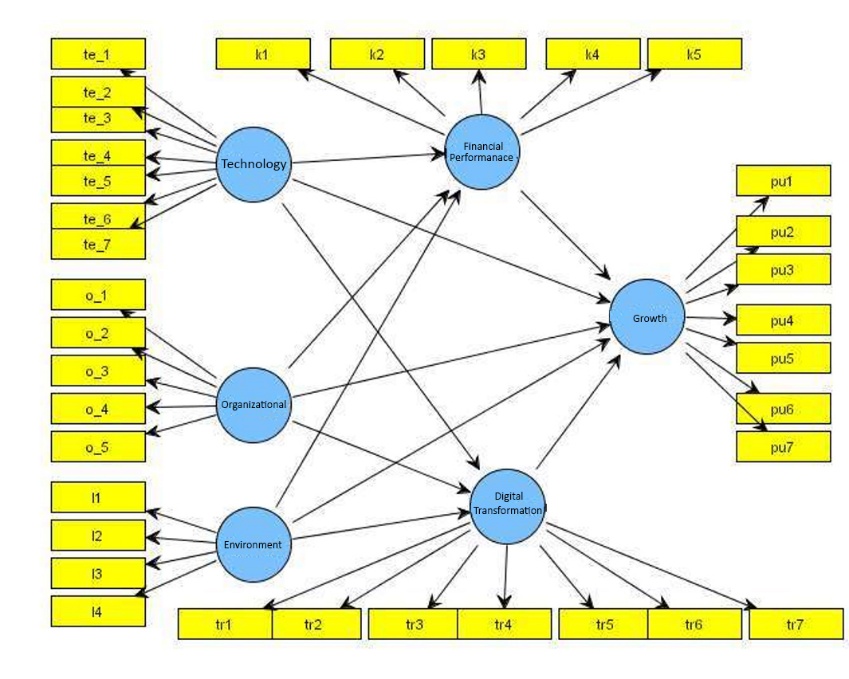
The research model is constructed through a Partial Least Squares Structural Equation Modelling (PLS-SEM) technique, based on the Technology, Organization and Environment (TOE) paradigm. In this model, the three exogenous variables; namely Technology (X1), Organization (X2) and Environment (X3) are assumed to have a direct impact on Financial Performance (M1) and Digital Transformation (M2) as the two mediating variables that relate the exogenous variables to the endogenous variable, MSME Growth (Y). The conceptual model upon which this research is based is depicted in Figure 1 below.
Research Hypotheses
H1: Technology is hypothesized to have a significant effect on the financial performance of MSMEs in Banda Aceh City.
H2: Organization is hypothesized to have a significant effect on the financial performance of MSMEs in Banda Aceh City.
H3: The environment is predicted to have a significant effect on the financial performance of MSMEs in Banda Aceh City.
H4: Technology is hypothesized to have a significant impact on the digital transformation of MSMEs in Banda Aceh City.
H5: Organization is hypothesized to have a significant effect on the digital transformation of MSMEs in Banda Aceh City.
H6: The environment is predicted to have a significant effect on the digital transformation of MSMEs in Banda Aceh City.
H7: Technology is hypothesized to have a significant effect on the growth of MSMEs in Banda Aceh City.
H8: Organization is hypothesized to have a significant effect on MSME growth in Banda Aceh City.
H9: The environment is predicted to have a significant effect on MSME growth in Banda Aceh City.
H10: Financial performance is hypothesized to have a significant effect on MSME growth in Banda Aceh City.
H11: Digital transformation is predicted to have a significant impact on MSME growth in Banda Aceh City.
H12: The effect of technology on MSME growth is hypothesized to be significant when mediated by financial performance.
H13: Organization is hypothesized to significantly affect MSME growth through the mediating role of financial performance.
H14: The effect of the environment on MSME growth is hypothesized to be significant when mediated by financial performance.
H15: Technology is hypothesized to significantly influence MSME growth through the mediating role of digital transformation.
H16: The effect of organization on MSME growth is hypothesized to be significant when mediated by digital transformation.
H17: The environment is hypothesized to significantly affect MSME growth through the mediating role of digital transformation.
3. Research Methodology
The research was carried out in Banda Aceh City, among the MSMEs that were supported by Bank Indonesia, using the following six independent variables: Technology, Organization, Environment, Financial Performance, Digital Transformation, and MSME Growth. The target population comprised all Bank Indonesia-supported MSMEs in Banda Aceh City, which amounted to 250 business entities. Considering that the population was small, the sample included all the population members through census technique.
Primary data were collected through the distribution of questionnaires to the respondents on a five-point Likert Scale which ranged from 1 (strongly disagree) to 5 (strongly agree). This study involves three exogenous variables namely Technology (X1), Organization (X2), and Environment (X3); two mediating variables namely Financial Performance (M1) and Digital Transformation (M2); and an endogenous variable MSME Growth (Y). Table 1 contains the list of variables and the number of indicators involved.
| Variable | Variable Type | Number of Indicators |
|---|---|---|
| Technology (X1) | Exogenous | 7 |
| Organization (X2) | Exogenous | 5 |
| Environment (X3) | Exogenous | 4 |
| Financial Performance (M1) | Mediating | 5 |
| Digital Transformation (M2) | Mediating | 7 |
| MSME Growth (Y) | Endogenous | 7 |
Source: Primary Data, 2026 (processed).
The analysis of data in this research used SEM-PLS model that involved the use of SmartPLS application. The SEM-PLS was chosen since the method does not rely on the normal distribution of data, and it is capable of handling a relatively large number of variables and indicators. Model evaluation was done in two phases. In the first phase, the measurement model (outer model) was tested for convergent validity using factor loading and Average Variance Extracted (AVE). Then tests were conducted to determine discriminant validity and construct reliability using Cronbach's Alpha and Composite Reliability. The second phase of testing involved testing the structural model (inner model) where coefficient of determination (R²) and significance testing were determined using the bootstrapping procedure.
4. Research Results and Discussion
A. Respondent Characteristics
The study sample was composed of 250 MSME actors in Banda Aceh City who have been assisted by Bank Indonesia as respondents. In terms of gender, most of the female respondents were found, with a number of 140 respondents (56.0%), whereas the male respondents were 110 respondents (44.0%). This information illustrates the importance of the involvement of women in running MSMEs in Banda Aceh. In terms of age, the age range 30-39 years was the highest, amounting to 40.4%, whereas the next age range was 40-49 years with 28.0%.
B. Description of Research Variables
Responses given by the respondents for each variable were rated based on the average scores provided in the survey. Scores of 3.41 to 4.20 were considered "good" responses, whereas scores more than 4.20 were considered "very good" responses. The whole data is shown in Table 2.
| Variable | Mean Score | Category |
|---|---|---|
| Technology | 4.242 | Very Good |
| Organization | 4.207 | Good |
| Environment | 4.204 | Good |
| Financial Performance | 4.098 | Good |
| Digital Transformation | 4.241 | Very Good |
| MSME Growth | 4.306 | Very Good |
Source: Primary Data, 2026 (processed).
According to Table 2 above, all the six research variables lie between the good and very good categories range. MSME Growth obtained the highest average score of 4.306 (very good category) while Technology and Digital Transformation obtained an average of 4.242 and 4.241 respectively (both very good categories). On the other hand, Organization and Environment have average scores of 4.207 and 4.204 respectively (good category) while Financial Performance obtained the lowest average score of 4.098 but is still in the good category. This implies that the perceptions of the respondents on all the research variables are positive hence the next step will be the structural model testing stage.
C. Measurement Model Evaluation (Outer Model)
Measurement model testing at this stage evaluates two major components that include convergent validity (factor loading and AVE) and construct reliability (Cronbach's Alpha and Composite Reliability). Construct is said to be reliable if its Cronbach's Alpha and Composite Reliability scores are 0.60 or above, while convergent validity is proved when the AVE score is 0.50 or above (Hair et al., 2020).
| Variable | Cronbach's Alpha | Composite Reliability | AVE |
|---|---|---|---|
| Technology | 0.831 | 0.846 | 0.749 |
| Organization | 0.800 | 0.822 | 0.714 |
| Environment | 0.770 | 0.998 | 0.779 |
| Financial Performance | 0.940 | 0.972 | 0.892 |
| Digital Transformation | 0.832 | 0.847 | 0.749 |
| MSME Growth | 0.827 | 0.934 | 0.717 |
Source: Primary Data, 2026, processed using SmartPLS.
Based on Table 3, all constructs in this study meet the criteria for reliability and convergent validity, as evidenced by Cronbach's Alpha values ranging from 0.770 to 0.940, Composite Reliability from 0.822 to 0.998, and Average Variance Extracted (AVE) from 0.714 to 0.892. The outer-loading test results also indicate that all indicators load positively and significantly (t-statistics above 1.96; p-values below 0.05). Although a few indicators under Environment and Digital Transformation have loading values ranging from 0.50 to 0.69, these values are still considered acceptable in PLS-SEM, provided they remain significant and do not reduce the overall AVE (Hair et al., 2020). Therefore, the measurement model is deemed suitable for proceeding to structural model testing.
D. Structural Model Evaluation (Inner Model)
Testing the structural model aims to evaluate the strength of its predictive power, as indicated by the coefficient of determination (R²) value. According to (Hair et al., 2020), an R² of 0.75 is considered strong, 0.50 is moderate, and 0.25 is weak.
| Variable | R² | Adjusted R² | Category |
|---|---|---|---|
| Digital Transformation | 0.588 | 0.575 | Moderate to Strong |
| Financial Performance | 0.648 | 0.637 | Moderate to Strong |
| MSME Growth | 0.725 | 0.716 | Strong |
Source: Primary Data, 2026, processed using SmartPLS.
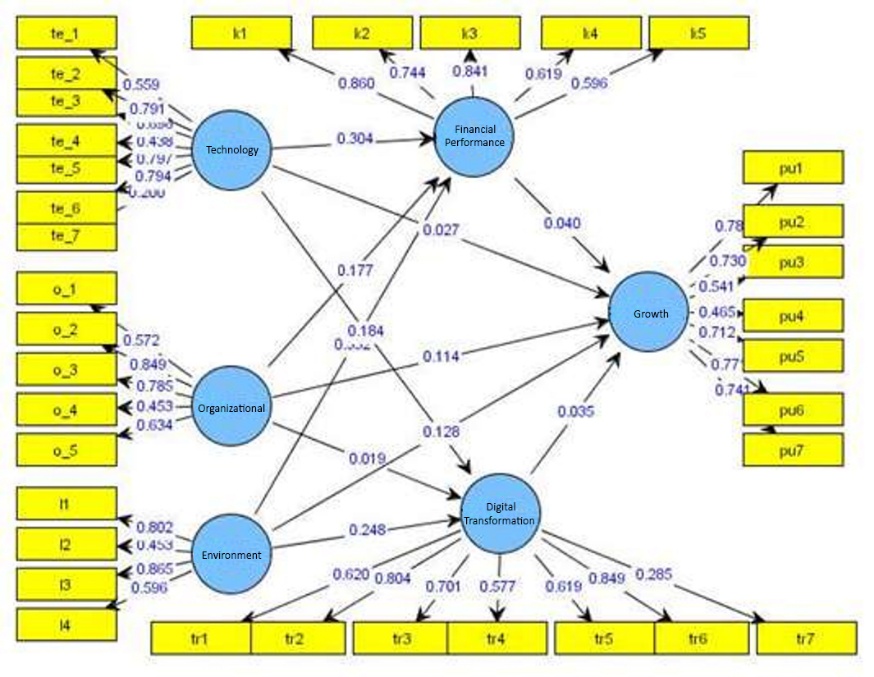
The R² value for Digital Transformation is 0.588, indicating that approximately 59% of its variance can be jointly explained by Technology, Organization, and Environment factors, placing it in the moderate-to-strong category. The same trend is also seen for Financial Performance (R²= 0.648), while MSME Growth shows the highest value of R², which is equal to 0.725. Thus, the model is highly capable of predicting its output. As there is very little difference between R² and Adjusted R², one can assume that the model is not overfitted and therefore can go forward with hypothesis testing.
E. Direct Effect Hypothesis Testing
The bootstrapping approach to hypothesis testing was done in this research using the SmartPLS program. Below is shown the direct effect test outcomes among the variables presented in Table 5.
| Hypothesis | Path | β | t-statistic | p-value | Remarks |
|---|---|---|---|---|---|
| H1 | Technology → Financial Performance | 0.196 | 2.113 | 0.000 | Accepted |
| H2 | Organization → Financial Performance | 0.209 | 2.098 | 0.000 | Accepted |
| H3 | Environment → Financial Performance | 0.110 | 2.723 | 0.000 | Accepted |
| H4 | Technology → Digital Transformation | 0.398 | 2.525 | 0.000 | Accepted |
| H5 | Organization → Digital Transformation | 0.269 | 2.958 | 0.000 | Accepted |
| H6 | Environment → Digital Transformation | 0.831 | 7.851 | 0.000 | Accepted |
| H7 | Technology → MSME Growth | 0.027 | 1.043 | 0.174 | Not Significant |
| H8 | Organization → MSME Growth | 0.114 | 1.302 | 0.129 | Not Significant |
| H9 | Environment → MSME Growth | 0.128 | 1.291 | 0.103 | Not Significant |
| H10 | Financial Performance → MSME Growth | 0.183 | 2.261 | 0.000 | Accepted |
| H11 | Digital Transformation → MSME Growth | 0.156 | 3.113 | 0.000 | Accepted |
Source: Primary Data, 2026 (processed).
The test results reveal that all three exogenous variables have a positive and significant effect on financial performance namely, Technology (β = 0.196; t = 2.113; p < 0.05), Organization (β = 0.209; t = 2.098; p < 0.05), and Environment (β = 0.110; t = 2.723; p < 0.05) thus, H1, H2, and H3 are accepted. This suggests that effective use of technology, effective organization, and favorable external environment have the potential to improve the financial performance of MSMEs. In terms of concept, the effective use of technology makes the business process more efficient and also improves financial accounting practices; organization helps in making quicker decisions and effective monitoring, whereas the favorable external environment encourages MSMEs to change strategically. This is consistent with the Technology-Organization-Environment model, which holds that all the three factors are interdependent and together help in improving organizational preparedness and performance (Tornatzky et al., 1990); (Baker, 2012).
Testing the path toward Digital Transformation reveals significant results, with Technology (β = 0.398; t = 2.525; p < 0.05), Organization (β = 0.269; t = 2.958; p < 0.05), and Environment (β = 0.831; t = 7.851; p < 0.05) all making positive contributions. Thus, hypotheses H4, H5, and H6 are accepted. Of these three variables, the Effect of Environment is the most significant. It shows that competition, change in consumers' preferences, and dynamics of market technology are the key determinants that accelerate the digitalization process of MSMEs in the city of Banda Aceh. The result supports the institutional approach, as it suggests that organizations react to external pressure (Baker, 2012). On the other hand, the contribution of Technology and Organization proves that technical infrastructure readiness in addition to organizational commitment is an important basis for digital transformation (Verhoef et al., 2021).
Unlike this trend, the direct influence of Technology (β = 0.027; p > 0.05), Organization (β = 0.114; p > 0.05), and Environment (β = 0.128; p > 0.05) on MSME growth is insignificant; thus, hypotheses H7, H8, and H9 should be rejected. This means that technology availability, organizational readiness, and business environment alone do not guarantee the influence on business growth. Instead, the influence will be observed only when all three elements contribute to financial performance or digitalization first.
Conversely, Financial Performance (β = 0.183; t = 2.261; p < 0.05) and Digital Transformation (β = 0.156; t = 3.113; p < 0.05) have a positive and significant effect on MSME growth; therefore, H10 and H11 are accepted. Higher financial performance, which is depicted in higher profitability, efficiency, and improved cash flow, is the key base for the business to grow. However, digital transformation, which includes the usage of such tools as e-commerce, digital marketing, and digital payment systems, can be used to enlarge the market presence of MSMEs and make them more competitive. It corresponds to RBV where financial and digital resources are viewed as a source of competitive advantage (Barney et al., 2011); (Bouwman et al., 2019).
F. Mediation Hypothesis Testing (Indirect Effect)
Testing of mediation effects involved multiplication of the path coefficient of the independent variable towards the mediating variable and the path coefficient of the mediating variable towards the growth of MSMEs. The result is shown in Table 6 below.
| Hypothesis | Indirect Path | Coefficient | Remarks |
|---|---|---|---|
| H12 | Technology → Financial Performance → MSME Growth | 0.196 × 0.183 = 0.036 | Full Mediation |
| H13 | Organization → Financial Performance → MSME Growth | 0.209 × 0.183 = 0.038 | Full Mediation |
| H14 | Environment → Financial Performance → MSME Growth | 0.110 × 0.183 = 0.020 | Full Mediation |
| H15 | Technology → Digital Transformation → MSME Growth | 0.398 × 0.156 = 0.062 | Full Mediation |
| H16 | Organization → Digital Transformation → MSME Growth | 0.269 × 0.156 = 0.042 | Full Mediation |
| H17 | Environment → Digital Transformation → MSME Growth | 0.831 × 0.156 = 0.130 | Full Mediation |
Source: Primary Data, 2026 (processed).
According to Table 6, all the indirect relationships between Technology, Organization, and Environment and MSME Growth regardless of Financial Performance or Digital Transformation as mediators are statistically significant. Because the direct relationships of the three variables of the TOE framework and MSME Growth are insignificant (H7, H8, and H9 are rejected), and their indirect relationships are significant, it is safe to say that both Financial Performance and Digital Transformation act as full mediators in the relationship between the TOE framework and MSME Growth. Thus, all the hypotheses from H12 to H17 are accepted.
The highest coefficient value is achieved in the indirect relationship between the Environment and the MSME Growth via Digital Transformation, with a value of 0.130. This supports the evidence that external variables such as competition, governmental policies, and technological dynamics of the market are the most important determinants that encourage firms to use digital transformation, thereby facilitating business growth. This study supports the theories of (Nambisan et al., 2019) and (Kraus et al., 2021) by showing how digital technology can create economic value through business-model transformation. This is in accordance with (Verhoef et al., 2021), who prove that digital transformation allows firms to create economic value through business-model innovations.
Contrarily, the path of mediation via Financial Performance shows that the use of technology, organization capabilities, and business environment should first boost efficiency and profitability to eventually lead to business growth. This phenomenon corroborates the Resource-Based View, which states that strategic resources can create competitive advantage when successfully transformed into high performance (Barney et al., 2011). The research findings are also supported by the study of (Kraus et al., 2021) and (Bouwman et al., 2019), which show that digital transformation and digital capabilities act as key mediators between capability and business growth of MSMEs.
G. General Discussion
In conclusion, this study clearly shows that the growth of MSMEs in the city of Banda Aceh does not depend only on the existence of technology, organizational readiness, or environmental factors. On the contrary, it needs an internal factor, which is marked by better financial performance and successful implementation of digital transformation. It means that this study not only confirms the importance of TOE framework but also expands the RBV framework that treats technology and organizational capabilities as strategic resources, which need to be optimized via digital transformation and financial management (Barney et al., 2011); (Verhoef et al., 2021).
In practice, the mere adoption of technology is not enough for MSME players; rather, technology needs to be properly adopted within their business strategy in order to improve their financial performance. Moreover, the government along with other parties, such as Bank Indonesia, should continue developing the ecosystem that promotes the digitalization of MSMEs through such programs as digital literacy training, mentoring, and easier technology financing so that the development of MSMEs in Banda Aceh city becomes more structured and sustainable.
5. Conclusion
From the results of the analysis and discussion above, it is clear that there is an effect that is positive and significant between Technology, Organization, and Environment towards Financial Performance and Digital Transformation of MSMEs in Banda Aceh. Of all those variables, Environment is the most dominant variable that affects Digital Transformation. In addition to that, Financial Performance and Digital Transformation show a significant and positive effect on the growth of MSMEs.
However, the direct effects of Technology, Organization, and Environment on the growth of MSMEs are not significant. Rather, the variables of Financial Performance and Digital Transformation are shown to be complete mediators between Technology, Organization, and Environment, and the growth of MSMEs. This means that the growth of MSMEs in Banda Aceh City is not directly affected by Technology, Organization, and Environment but by their financial performance and digital transformation.
In general, the findings from this study reaffirm the validity of the TOE framework through the identification of financial performance and digital transformation as mediating mechanisms that influence business growth. In practice, it is important for any initiatives intended to improve technology use, organizational capability, and business-environment support to focus on enhancing the financial performance and digital transformation of businesses. This would help Bank Indonesia supported MSMEs in Banda Aceh City to attain business growth more optimally.
References
- Adiyanti, M., & Nursiam. (2025). Pengaruh Penerapan Teknologi Informasi, Literasi Keuangan Dan Strategi Pemasaran Terhadap Kinerja Keuangan Umkm Di Kota Surakarta. Management Studies and Entrepreneurship Journal, 6(3), 3368–3380. DOI ↗ Google Scholar ↗
- Alifudin, M., Mulyati, H., & Mahfudz, N. (2024). The Effect of Digital Technology Adoption On Industry 4.0 Readiness and Business Performance of Culinary MSMEs in Bogor Regency. Jurnal Manajemen Dan Organisasi, 15(3), 255–267. DOI ↗ Google Scholar ↗
- Annur, C. M. (2024). Individu Pengguna Internet Global Tembus 5,35 Miliar pada Januari 2024. Databoks.Katadata.Co.Id. DOI ↗ Google Scholar ↗
- Aryanto, Hanum, N., & Syaefudin, R. (2023). Faktor Teknologi, Organisasi, dan Lingkungan pada Penerapan Akuntansi Digital serta Dampaknya Terhadap Kinerja UMKM. Owner : Riset Dan Jurnal Akuntansi, 7(1), 632–643. DOI ↗ Google Scholar ↗
- Baker, J. (2012). The Technology–Organization–Environment Framework. In Information Systems Theory (pp. 231–245). Springer Link. DOI ↗ Google Scholar ↗
- Barney, J. B., Ketchen, D. J., & Wright, M. (2011). The Future of Resource-Based Theory: Revitalization or Decline? Journal of Management, 37(5), 1299–1315. DOI ↗ Google Scholar ↗
- Bouwman, H., Nikou, S., & Reuver, M. de. (2019). Digitalization, business models, and SMEs: How do business model innovation practices improve performance of digitalizing SMEs? Telecommunications Policy, 43(9), 101828. DOI ↗ Google Scholar ↗
- Bughin, J., LaBerge, L., & Mellbye, A. (2017). The case for digital reinvention. McKinsey Quarterly, 1. DOI ↗ Google Scholar ↗
- Cahyadi, L. D. C. R., & Pradnyani, N. L. P. S. P. (2022). Digitalisasi Umkm Dengan Menggunakan Pendekatan Toe Model. E-Jurnal Ekonomi Dan Bisnis Universitas Udayana, 11(9), 1132–1140. Google Scholar ↗
- Firmasari, P., Arpilliya, P., & Kurnia, M. S. (2025). Peran Technology-Organization-Environment (TOE) Dan Digital Finance Terhadap Kinerja Bisnis Umkm Provinsi Jambi Melalui Green Innovation. Jurnal Manajemen Terapan Dan Keuangan, 14(3), 1259–1276. DOI ↗ Google Scholar ↗
- Hair, joseph F., Black, W. C., Babin, B. J., & Anderson, R. E. (2020). Multivariate Data Analysis (seventh). Google Scholar ↗
- Hendri, A. S., & Sudarmilah, E. (2024). Enhancing Information Technology Adoption Potential in MSMEs: a Conceptual Model Based on TOE Framework. JUITA: Jurnal Informatika, 12(1), 91–100. DOI ↗ Google Scholar ↗
- Kraus, S., Breier, M., Dasí-Rodríguez, S., & Borocki, J. (2021). Digital Transformation in Banking: The Influence of Social and Economic Factors on Digital Banking Usage. Journal of Business Research, 124, 456–465. DOI ↗ Google Scholar ↗
- Mispi, N. M. B., Nurmahdi, A., & Adnani, A. (2024). Analisis Faktor-faktor yang Mempengaruhi Penerapan Digital Marketing pada UMKM di Kota Banda Aceh. Jurnal Ilmiah Mahasiswa Ekonomi Manajemen, 7(1), 108–117. DOI ↗ Google Scholar ↗
- Nambisan, S., Wright, M., & Feldman, M. (2019). The digital transformation of innovation and entrepreneurship: Progress, challenges and key themes. Research Policy, 48(8), 103773. DOI ↗ Google Scholar ↗
- Sturgeon, T. (2021). Upgrading strategies for the digital economy. Global Strategy Journal, 11(1), 34–57. DOI ↗ Google Scholar ↗
- Thalib, D. A., & Zulkarnain. (2025). Technology-Organization-Environment Framework: The Role of Digital Financial Services Adoption in the Performance of MSMEs (A Study in the Tokyo Market Area, PIK 2). Count : Journal of Accounting, Business and Management, 3(1), 40–52. DOI ↗ Google Scholar ↗
- Tornatzky, L. G., Fleischer, M., & Chakrabarti, A. K. (1990). The Processes of Technological Innovation Issues in organization and management series. Lexington Books. DOI ↗ Google Scholar ↗
- Verhoef, P. C., Broekhuizen, T., Bart, Y., Bhattacharya, A., Dong, J. Q., Fabian, N., & Haenlein, M. (2021). Digital transformation: A multidisciplinary reflection and research agenda. Journal of Business Research, 122, 889–901. DOI ↗ Google Scholar ↗
- Wasudawan, K., & Sim, C. H. (2024). Shaping a Digital Future: Examining Technology, Organisation and Environment (TOE) Framework. Journal of Technology Management and Business, 11(1), 80–97. DOI ↗ Google Scholar ↗