Abstract
Background and objective: Childhood stunting remains a major manifestation of chronic undernutrition and requires interventions that connect caregiver knowledge with sustained household feeding practices. This study evaluated a culturally anchored Nggahi–Rawi–Pahu model integrating maternal education, daily egg provision, and anthropometric monitoring among children under five in Wawo District. Methods: A community-based one-group pre–post intervention was conducted among 62 mother–child dyads followed for three months. Nggahi comprised structured maternal education on stunting, child nutrition, and animal-source foods. Rawi operationalized the behavioral component through provision of one egg per child per day, with adherence monitored by community health cadres and researchers; ≥80% adherence was classified as successful. Pahu represented outcome monitoring using weight and height/length, with height-for-age status interpreted against WHO Child Growth Standards. Descriptive statistics, contingency-table analyses, odds ratios, and McNemar testing were used where supported by the available aggregated data. Results: At baseline, 43 of 62 children (69.4%) were classified as stunted. Good maternal knowledge increased from 11.3% before Nggahi to 64.5% afterward, while poor knowledge decreased from 40.3% to 9.7%. Forty-eight families (77.4%) achieved ≥80% adherence to daily egg provision. Following the three-month program, 42 children (67.7%) were classified as normal height-for-age and 20 (32.3%) remained stunted. Among children initially stunted, 23 transitioned to normal status and none of the initially normal children became stunted (McNemar p<0.001). Improved knowledge and successful Rawi implementation were strongly associated with the reported favorable outcome classification. Conclusion: The Nggahi–Rawi–Pahu model was accompanied by substantial improvements in maternal knowledge, adherence to daily egg feeding, and height-for-age classification. The findings support culturally grounded, caregiver-centered nutrition programs, while controlled studies using individual longitudinal HAZ data are required to establish causal effectiveness.
Keywords
Stunting Maternal Education Eggs Child Growth Community Intervention
1. Introduction
Child stunting is a persistent public-health problem characterized by impaired linear growth and conventionally defined as height-for-age below −2 standard deviations from the median of the World Health Organization (WHO) Child Growth Standards [1][2]. It reflects the cumulative influence of inadequate dietary intake, recurrent infection, suboptimal caregiving, and adverse household and environmental conditions. Beyond short stature, stunting is important because it signals constrained biological and developmental potential and is associated with poorer cognitive development, educational attainment, health, and later economic productivity [2][3]. The first years of life are particularly sensitive to nutritional insults, but meaningful prevention and recovery efforts also require attention to the household behaviors that determine whether nutrient-dense foods are consistently offered to children.
Indonesia continues to face a substantial burden of childhood stunting, with pronounced variation across socioeconomic groups and geographic settings. Indonesian evidence indicates that maternal education is associated with childhood stunting, highlighting the importance of caregiver capacity to interpret health information, select appropriate foods, seek care, and sustain recommended feeding practices [4]. Maternal knowledge alone, however, may be insufficient when families face difficulties translating information into repeated daily behavior. Effective community programs therefore need to move beyond information transfer and establish a practical bridge between knowledge, action, adherence, and objective monitoring of child growth. [24][27]
Nutrition education can strengthen maternal knowledge and caregiving practices when it is interactive, repeated, contextually appropriate, and linked to feasible household actions. A quasi-experimental Indonesian study demonstrated that structured nutrition and reproductive-health education delivered repeatedly over three months improved knowledge and related behavioral outcomes [5]. More recent work has similarly shown that educational interventions can improve maternal knowledge and attitudes relevant to the care of children affected by stunting [6]. These findings suggest that education is most likely to contribute to nutritional improvement when messages are reinforced through community contact and converted into concrete routines that caregivers can implement at home. [13][16]
Animal-source foods are particularly relevant because they provide high-quality protein and multiple micronutrients in a compact form. Eggs are widely available, relatively affordable, and contain essential amino acids, choline, vitamin B12, fat-soluble vitamins, and other nutrients important for tissue accretion and neurodevelopment. The Lulun randomized controlled trial showed that providing one egg per day during complementary feeding improved linear-growth indicators among young children [7]. Subsequent biomarker analyses demonstrated that early egg consumption also influenced choline-pathway biomarkers and docosahexaenoic acid, providing biological plausibility for developmental and growth effects [8]. A meta-analysis of interventional trials involving 3,575 participants found that egg supplementation was associated with modest but statistically significant improvements in height/length and body weight, while emphasizing heterogeneity and the need for longer, well-controlled interventions [9]. [17][21]
Despite this evidence, the effectiveness of a food intervention depends heavily on adherence. A theoretically efficacious food cannot influence growth if it is not offered consistently, is shared within the household, or is rejected by the child. Community health cadres and home-based monitoring may help close this implementation gap by supporting caregivers, identifying barriers, and reinforcing routines. This is particularly important for interventions that must be sustained over weeks or months rather than delivered as a single clinical encounter. [22][23]
The present study was built around the culturally framed Nggahi–Rawi–Pahu sequence. In the source program, Nggahi represented the educational component intended to improve mothers’ understanding of stunting and child nutrition; Rawi represented implementation through provision of one egg each day for three months; and Pahu represented anthropometric evaluation of the child after implementation. Conceptually, this sequence links knowledge to action and action to measurable growth monitoring. Such an approach is attractive for community nutrition because it embeds behavior change within familiar local terminology while retaining objectively assessable implementation and outcome indicators.
The source study followed 62 mother–child dyads in Wawo District for three months. Maternal knowledge was assessed before and after education, daily egg consumption was monitored by cadres and researchers, and children were remeasured for weight and height/length and interpreted using WHO growth curves. The reported program data showed marked improvements in maternal knowledge, high adherence to the egg-feeding component, and a shift in height-for-age classification after the intervention. Nevertheless, a rigorous manuscript must distinguish these observed pre–post changes from causal effects because the study did not include a concurrent control group.
Accordingly, this study aimed to evaluate changes in maternal nutrition knowledge, adherence to one-egg-per-day feeding, and height-for-age classification during implementation of the Nggahi–Rawi–Pahu model among children under five in Wawo District. A secondary objective was to examine whether improvement in maternal knowledge and successful implementation of the Rawi component were associated with the favorable outcome classification reported in the program dataset. We hypothesized that the integrated sequence would be accompanied by improved caregiver knowledge, high implementation adherence, and a lower proportion of children classified as stunted at follow-up.
2. Methods
2.1 Study design and setting
This study used a community-based, one-group pretest–posttest intervention design. Mother–child dyads were followed for three months in Wawo District. The design was intended to evaluate within-program changes across three linked components—Nggahi, Rawi, and Pahu—rather than to estimate a randomized treatment effect. The reporting strategy therefore emphasizes observed pre–post changes and associations and avoids causal language that would require a concurrent comparison group.
2.2 Participants and sample
The analytic sample comprised 62 mother–child dyads recorded in the source study. Eligible children were younger than five years so that height-for-age could be interpreted using the WHO 0–5-year Child Growth Standards. The source dataset included children aged one to four years and mothers responsible for day-to-day feeding and participation in the intervention. A formal a priori sample-size calculation, recruitment frame, refusal rate, and detailed exclusion criteria were not available in the final study report and therefore could not be reported.
2.3 Intervention framework
The intervention was organized as a sequential Nggahi–Rawi–Pahu model. Nggahi was the knowledge-building stage. Mothers received education focused on stunting, child nutritional requirements, appropriate feeding, and the importance of animal-source protein. Maternal knowledge was assessed using a 10-item pretest and posttest. Scores of 8–10 correct responses were categorized as good knowledge, 6–7 as moderate knowledge, and ≤5 as poor knowledge. Rawi was the implementation stage in which each participating family was instructed to provide one egg to the child each day for three months. Preparation could be varied to improve acceptability. Community health cadres and researchers followed implementation. Successful Rawi implementation was defined in the source report as egg consumption on at least 72 days during the three-month period, corresponding to adherence of at least 80%; lower adherence was classified as unsuccessful. Pahu was the outcome-monitoring stage. After three months, children were remeasured and their anthropometric status was reassessed.
2.4 Anthropometric assessment
Child body weight and height or recumbent length, as age-appropriate, were assessed at baseline and again after the three-month intervention period. Height-for-age status was interpreted using WHO Child Growth Standards for children aged 0–60 months. Stunting was defined as height-for-age below −2 standard deviations from the WHO standard median, whereas children at or above this threshold were classified as normal for the binary analysis. The available data included categorical height-for-age classifications but not individual continuous height-for-age z scores, raw height values, measurement replicates, instrument model numbers, or calibration records. Consequently, changes in continuous HAZ could not be evaluated.
2.5 Outcomes
The primary implementation outcomes were change in maternal knowledge category after Nggahi and adherence to daily egg provision during Rawi. The primary anthropometric outcome was the change in binary height-for-age classification from baseline to three months. Additional analyses used the aggregated contingency tables reported in the source study to examine associations between improved maternal knowledge and favorable outcome classification and between successful Rawi implementation and favorable outcome classification.
2.6 Statistical analysis
Categorical variables were summarized using frequencies and percentages. Baseline and follow-up height-for-age classifications were evaluated as paired binary observations. Because the source report provided the complete 2×2 transition table—19 children normal at both assessments, 23 transitioning from stunted to normal, 20 remaining stunted, and no child transitioning from normal to stunted—the McNemar exact test was appropriate for assessing asymmetry in paired status changes. Associations between knowledge improvement and the reported favorable outcome and between Rawi adherence and the reported favorable outcome were evaluated from the supplied 2×2 tables using Pearson chi-square tests. Odds ratios and 95% confidence intervals were calculated from those aggregate cell counts to quantify association magnitude. Statistical significance was set at two-sided p<0.05. Because individual-level paired knowledge scores, continuous anthropometric measurements, covariates, and missing-data indicators were unavailable in the final report, multivariable regression, repeated-measures modeling, and adjusted effect estimates were not performed.
2.7 Data integrity and reporting
All numerical analyses were restricted to information available in the final study report or mathematically derivable from the reported cell counts. For aggregate outcome tables in which the individual-level outcome definition was not fully specified, results are conservatively described as a favorable reported outcome and are not interpreted as verified reversal of baseline stunting.
3. Results
All 62 mother–child dyads represented in the final report were included in the descriptive analyses. Children were predominantly female (64.5%), and the largest age group was four years (40.3%). Mothers were most commonly 31–35 years of age (37.1%), had completed senior high school (46.8%), and were homemakers (64.5%). At baseline, 43 children (69.4%) were classified as stunted and 19 (30.6%) as normal height-for-age.
| Characteristic | n | % |
| Child sex | ||
| Male | 22 | 35.5 |
| Female | 40 | 64.5 |
| Child age: 1 year | 23 | 37.1 |
| Child age: 2 years | 7 | 11.3 |
| Child age: 3 years | 7 | 11.3 |
| Child age: 4 years | 25 | 40.3 |
| Baseline HAZ: Normal | 19 | 30.6 |
| Baseline HAZ: Stunted | 43 | 69.4 |
| Maternal age: 20–25 years | 10 | 16.1 |
| 26–30 years | 17 | 27.4 |
| 31–35 years | 23 | 37.1 |
| 36–40 years | 6 | 9.7 |
| 41–45 years | 5 | 8.1 |
| 46–50 years | 1 | 1.6 |
| Maternal education: Primary | 8 | 12.9 |
| Junior high school | 6 | 9.7 |
| Senior high school | 29 | 46.8 |
| Diploma | 2 | 3.2 |
| Bachelor degree | 17 | 27.4 |
| Maternal occupation: Homemaker | 40 | 64.5 |
| Teacher | 8 | 12.9 |
| Farmer | 4 | 6.5 |
| Government contract | 4 | 6.5 |
| Part-time | 2 | 3.2 |
| Pharmacy/midwifery | 2 | 3.2 |
| Honorary worker | 1 | 1.6 |
| Private employee | 1 | 1.6 |
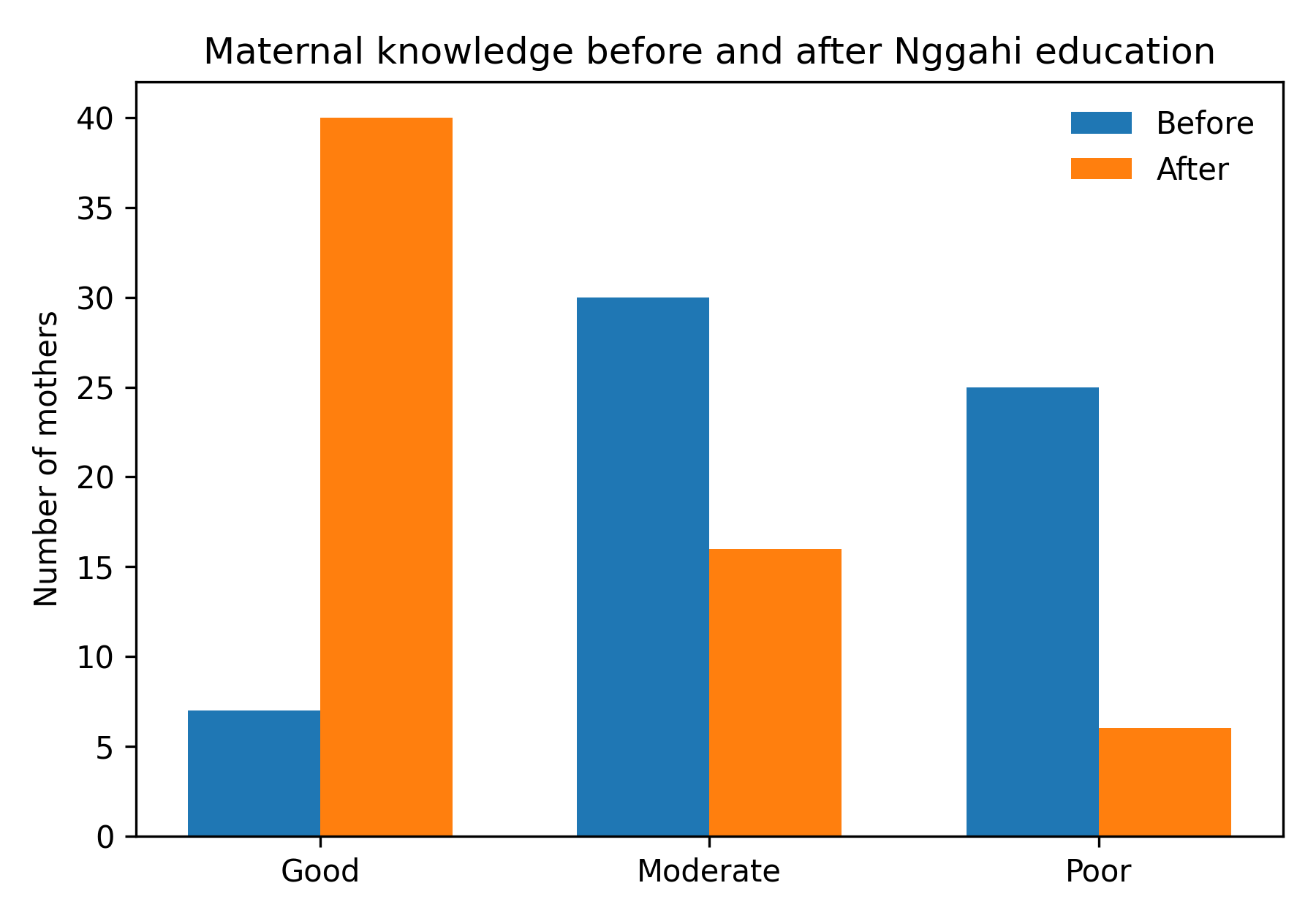
Maternal knowledge improved markedly after Nggahi education. The number of mothers in the good-knowledge category increased from 7 (11.3%) to 40 (64.5%), while poor knowledge declined from 25 (40.3%) to 6 (9.7%). Moderate knowledge decreased from 30 (48.4%) to 16 (25.8%), consistent with movement toward the good category. Because the source report did not provide the participant-level cross-tabulation of pre- and post-knowledge categories, a paired ordinal significance test cannot be validly reconstructed.
| Measure | Category | Before n (%) | After/observed n (%) | Analysis |
| Nggahi knowledge | Good | 7 (11.3) | 40 (64.5) | Descriptive paired distribution |
| Moderate | 30 (48.4) | 16 (25.8) | ||
| Poor | 25 (40.3) | 6 (9.7) | ||
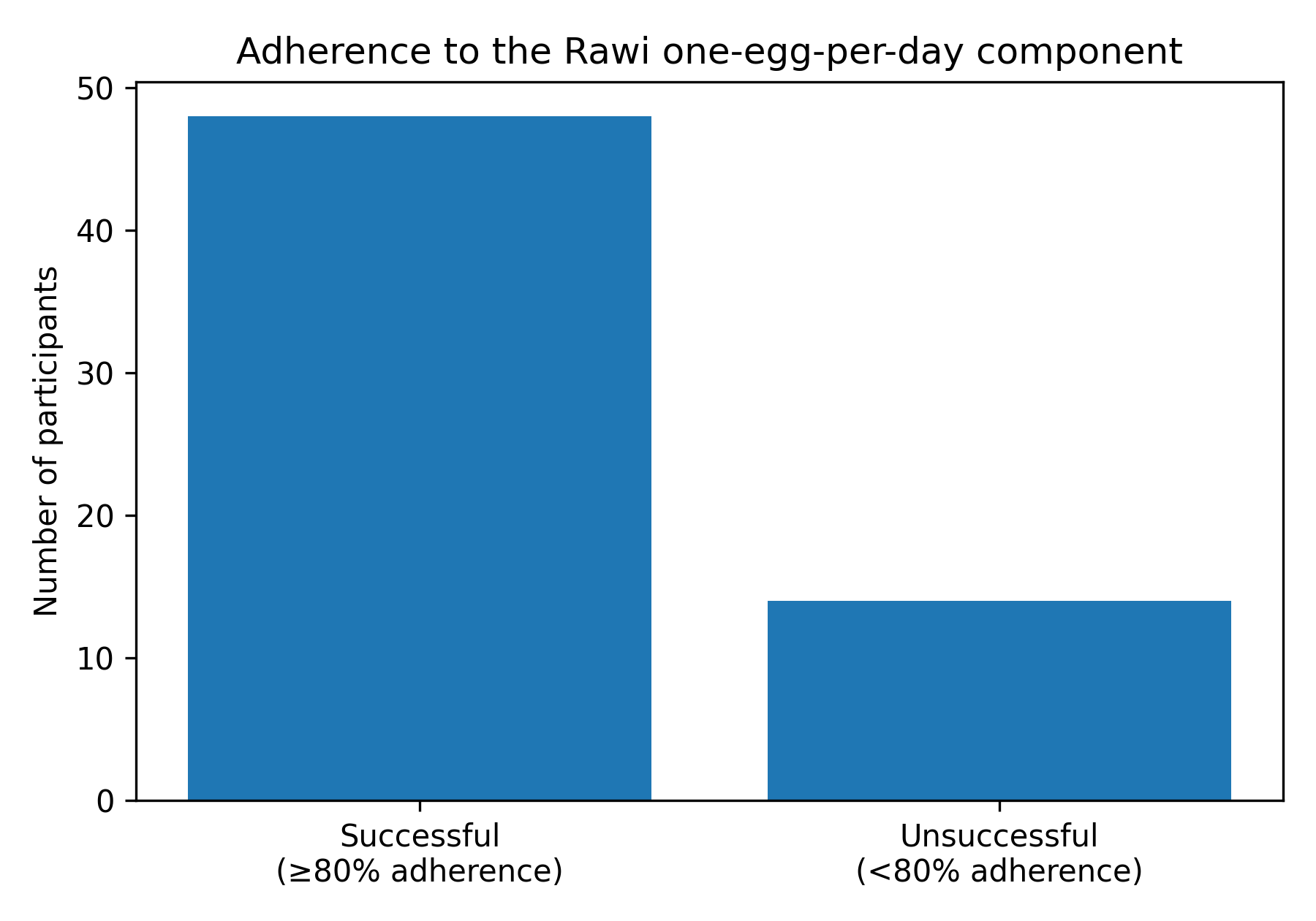
| Rawi adherence | Successful (≥80%) | — | 48 (77.4) | Descriptive adherence |
| Unsuccessful (<80%) | — | 14 (22.6) |
Statistical note: Frequencies and percentages summarize Nggahi and Rawi. A Wilcoxon signed-rank or marginal-homogeneity test would require participant-level paired knowledge data, which were not available in the source report.
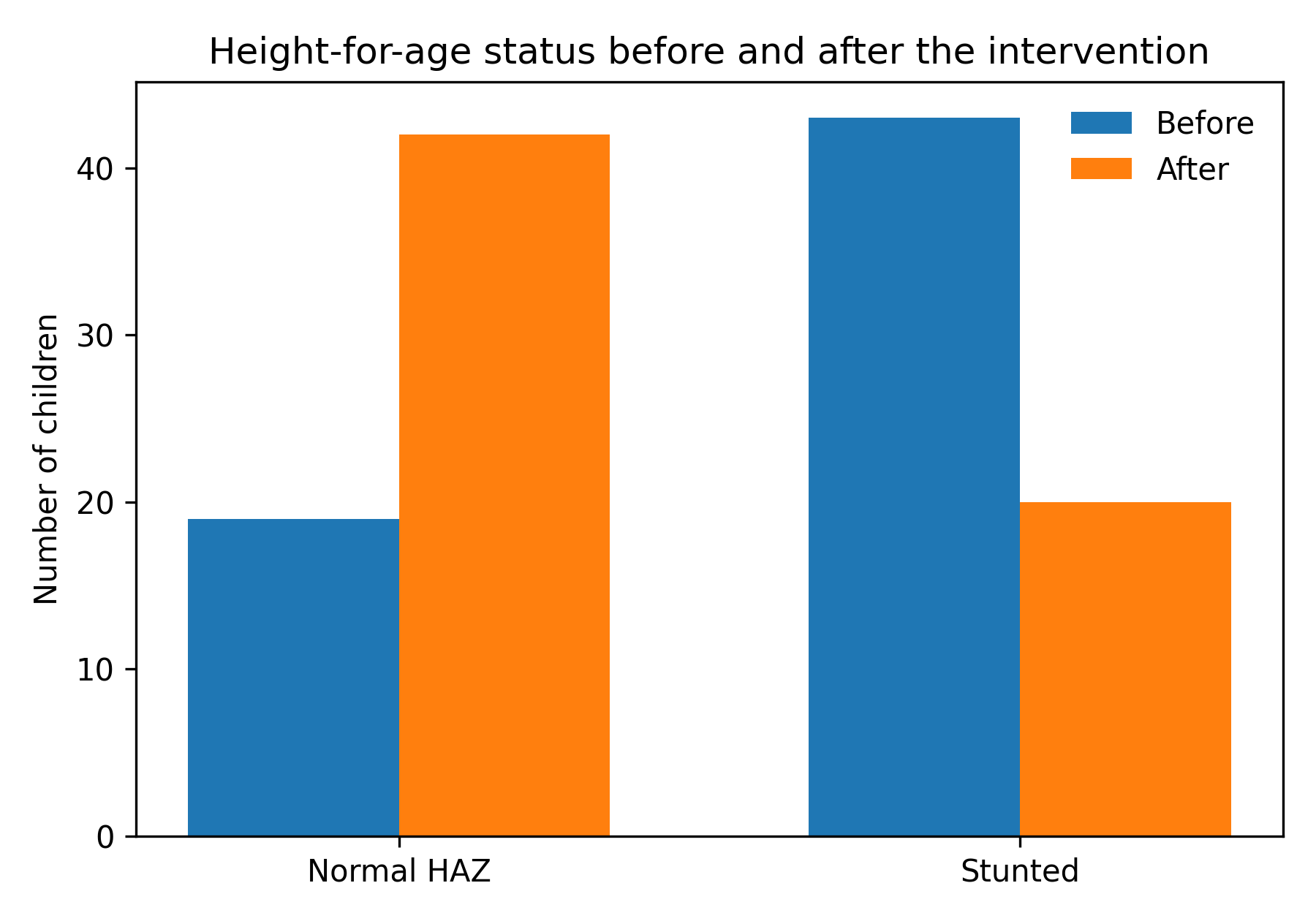
Height-for-age classification improved over the three-month observation period. The number classified as normal increased from 19 (30.6%) to 42 (67.7%), whereas the number classified as stunted decreased from 43 (69.4%) to 20 (32.3%). The paired transition table showed that all 19 children who were normal at baseline remained normal, 23 of 43 initially stunted children were classified as normal at follow-up, and 20 remained stunted. No normal-to-stunted transition was reported. The exact McNemar test based on the 23 versus 0 discordant pairs was significant (p<0.001), indicating a statistically asymmetric pre–post shift in binary height-for-age classification.
| Baseline status | Follow-up normal | Follow-up stunted | Total |
| Normal | 19 | 0 | 19 |
| Stunted | 23 | 20 | 43 |
| Total | 42 | 20 | 62 |
Test: exact McNemar test for paired binary classifications, p<0.001. Twenty-three children changed from stunted to normal and none changed from normal to stunted.
The aggregate outcome tables further indicated that improved knowledge and successful Rawi implementation were strongly associated with the favorable outcome classification. Among mothers whose knowledge improved, 38 of 46 were in the favorable outcome category compared with 4 of 16 whose knowledge did not improve. Pearson’s chi-square was 18.03 (p<0.001), and the unadjusted odds ratio calculated from the reported cells was 14.25 (95% CI 3.64–55.77). For Rawi, 39 of 48 successful implementers were in the favorable outcome category compared with 3 of 14 unsuccessful implementers. Pearson’s chi-square was 17.75 (p<0.001), corresponding to an unadjusted odds ratio of 15.89 (95% CI 3.66–68.97).
| Predictor | Favorable | Not favorable | Total | χ² | p | OR (95% CI) |
| Knowledge improved | 38 | 8 | 46 | 18.03 | <0.001 | 14.25 (3.64–55.77) |
| Knowledge not improved | 4 | 12 | 16 | Reference | ||
| Rawi successful | 39 | 9 | 48 | 17.75 | <0.001 | 15.89 (3.66–68.97) |
| Rawi unsuccessful | 3 | 11 | 14 | Reference |
Test: Pearson chi-square tests calculated from the aggregate 2×2 tables. OR = unadjusted odds ratio. Because the individual-level definition of the favorable outcome in these two tables was not fully specified, this outcome should not be interpreted as verified reversal of baseline stunting.
4. Discussion
The present study evaluated a culturally anchored, three-stage community nutrition model linking maternal education (Nggahi), sustained one-egg-per-day feeding (Rawi), and anthropometric monitoring (Pahu). Across the three-month program, the data showed a substantial shift in maternal knowledge, high adherence to daily egg provision, and a marked improvement in binary height-for-age classification. Among the 43 children classified as stunted at baseline, 23 were classified as normal at follow-up, while no child classified as normal at baseline shifted to stunted status. These findings are encouraging, but the one-group pre–post design requires careful interpretation: the observed changes occurred during the intervention and are consistent with benefit, yet they cannot establish that the intervention alone caused the anthropometric improvement.
The strong improvement in maternal knowledge is consistent with evidence that caregiver education can alter proximal determinants of child nutrition. Indonesian studies have repeatedly shown that maternal education and nutrition-related knowledge are relevant to childhood nutritional outcomes [4][6]. Education may influence how caregivers recognize growth problems, interpret feeding recommendations, diversify diets, and respond to illness. In the present program, the proportion of mothers categorized as having good knowledge rose from 11.3% to 64.5%, while the poor-knowledge category fell sharply. The Nggahi component may have been particularly useful because it connected general stunting information with an immediate household behavior rather than leaving knowledge as an abstract endpoint.
However, education should not be viewed as a sufficient treatment for stunting. Stunting is multidimensional and may reflect prenatal growth restriction, repeated infections, inadequate dietary quality, poverty, sanitation, food insecurity, and other structural factors [1][3]. The value of Nggahi is therefore better conceptualized as a behavior-enabling component within a broader package. The observed association between improved knowledge and the favorable outcome category was large, but the estimate was unadjusted and derived from aggregate data. Maternal education, household resources, baseline severity, child age, infection burden, and other factors could confound this relationship. [28][30]
The Rawi component translated education into a concrete daily feeding practice. More than three quarters of participating families achieved the program definition of successful adherence. Eggs are nutritionally dense and provide high-quality protein, essential amino acids, choline, vitamin B12, and other nutrients relevant to growth. The Lulun randomized trial demonstrated that one egg per day during early complementary feeding improved linear-growth indicators [7], and associated analyses identified favorable changes in nutrient biomarkers [8]. A later meta-analysis pooling interventional trials found significant, although modest, average gains in height/length and weight with egg supplementation [9]. The current findings therefore align biologically with prior intervention literature, while differing importantly in design, age distribution, setting, and absence of a control group. [17][21]
Adherence is a central implementation finding. Nutritional efficacy observed under controlled conditions does not automatically translate into community effectiveness. Families may encounter food availability constraints, child refusal, competing household demands, illness, or difficulties maintaining a repetitive feeding schedule. Cadres and researchers monitored the daily egg intervention, and successful implementation required at least 80% adherence. The strong unadjusted association between successful Rawi and the favorable outcome category suggests that implementation intensity deserves attention in future trials. Nevertheless, adherence itself may be a marker of broader family capacity: households that adhere well may also have better overall diets, caregiving practices, sanitation, healthcare use, and socioeconomic conditions. [22][23]
The Pahu component provided an objective endpoint through repeat anthropometric assessment. WHO height-for-age standards are appropriate for children younger than five years and permit standardized classification of linear-growth deficits [1][10]. The reduction in the proportion classified as stunted—from 69.4% at baseline to 32.3% at follow-up—was statistically significant in the paired transition table. Yet interpretation of categorical transitions over only three months requires caution. A child close to the −2 SD threshold may change category following a relatively small difference in measured height, age calculation, or growth velocity. Without individual HAZ values, measurement replicates, and equipment quality-control information, it is impossible to quantify the magnitude of continuous linear-growth change or distinguish robust catch-up growth from threshold crossing.
The integrated character of Nggahi–Rawi–Pahu is nevertheless programmatically important. Many community interventions fail because education, food provision, and monitoring are delivered as disconnected activities. Here, the model follows a plausible implementation pathway: caregivers first receive understandable information, then enact a specific feeding behavior, and finally observe the child's growth status through structured monitoring. Culturally meaningful naming may further strengthen community ownership and recall. This type of design may be especially valuable in settings where cadres are trusted intermediaries between families and formal health services. [13][14][24]
Future research should test the model in a controlled, preferably cluster-randomized or well-matched quasi-experimental design with a larger sample and longer follow-up. Individual HAZ trajectories should be retained, along with dietary diversity, morbidity, household food security, socioeconomic indicators, maternal height, birth history, and baseline stunting severity. Repeated adherence measurement would permit dose–response analysis, while implementation outcomes could clarify acceptability, fidelity, feasibility, and cost. Such a design would allow investigators to determine whether maternal knowledge mediates adherence and whether adherence subsequently predicts continuous linear growth.
In summary, the study provides promising real-world evidence that a locally framed sequence integrating caregiver education, daily animal-source food provision, and growth monitoring can be implemented with high adherence and can coincide with favorable changes in child height-for-age status. The most defensible interpretation is not that three months of egg feeding definitively cured stunting, but that the Nggahi–Rawi–Pahu model represents a plausible, culturally grounded implementation strategy deserving rigorous controlled evaluation.
5. Conclusion
The three-month Nggahi–Rawi–Pahu program was accompanied by substantial improvements in maternal nutrition knowledge, strong adherence to one-egg-per-day feeding, and a favorable shift in height-for-age classification among 62 children under five in Wawo District. Good maternal knowledge increased markedly, 77.4% of families achieved at least 80% adherence to the Rawi component, and the proportion of children classified as stunted decreased from 69.4% at baseline to 32.3% at follow-up. Paired analysis confirmed a significant shift in binary height-for-age status, while aggregate analyses showed strong unadjusted associations of knowledge improvement and Rawi adherence with the favorable reported outcome. These results support the feasibility and potential value of linking culturally grounded education with a specific nutrient-dense feeding behavior and objective growth monitoring. Nevertheless, the absence of a control group, individual continuous HAZ data, and covariate-adjusted analyses precludes causal inference. Larger controlled longitudinal studies are required before effectiveness can be established.
References
- World Health Organization. WHO Child Growth Standards: Length/Height-for-Age, Weight-for-Age, Weight-for-Length, Weight-for-Height and Body Mass Index-for-Age: Methods and Development. Geneva: WHO; 2006. 2. World Health Organization. Malnutrition in children: stunting, wasting, overweight and underweight. WHO Nutrition Landscape Information System. DOI ↗ Google Scholar ↗
- de Onis M, Branca F. Childhood stunting: a global perspective. Maternal & Child Nutrition. 2016;12(Suppl 1):12–26. doi:. DOI ↗ Google Scholar ↗
- Laksono AD, Wulandari RD, Amaliah N, Wisnuwardani RW. Stunting among children under two years in Indonesia: Does maternal education matter? PLoS One. 2022;17(7):e0271509. doi:. DOI ↗ Google Scholar ↗
- Sari K, et al. The effect of nutrition and reproductive health education of pregnant women in Indonesia using quasi experimental study. BMC Pregnancy and Childbirth. 2021. PMID: 33663418. DOI ↗ Google Scholar ↗
- Faridah F, Anies A, Kartasurya MI, Widjanarko B. Online educational intervention: Improving maternal knowledge and attitudes in providing developmental stimulation for stunting toddlers. Narra J. 2024;4(1):e591. doi:. DOI ↗ Google Scholar ↗
- Iannotti LL, Lutter CK, Stewart CP, et al. Eggs in Early Complementary Feeding and Child Growth: A Randomized Controlled Trial. Pediatrics. 2017;140(1):e20163459. doi:. DOI ↗ Google Scholar ↗
- Iannotti LL, et al. Eggs early in complementary feeding increase choline pathway biomarkers and DHA: a randomized controlled trial in Ecuador. American Journal of Clinical Nutrition. 2017;106(6):1482–1489. PMID: 29092879. DOI ↗ Google Scholar ↗
- Egg consumption and growth in children: a meta-analysis of interventional trials. 2024. PMID: 38249601; PMCID: PMC10796599. 10. World Health Organization. Child Growth Standards. Geneva: WHO. Growth charts and standards for children aged 0–60 months. DOI ↗ Google Scholar ↗
- Handayani NS, Huriyati E, Hasanbasri M. Association of Maternal Education With Nutritional Outcomes of Poor Children With Stunting in Indonesia. Asia Pac J Public Health. 2023;35(5):373–380. doi:. DOI ↗ Google Scholar ↗
- Muhamad Z, Mahmudiono T, Abihail CT, et al. Preliminary Study: The Effectiveness of Nutrition Education Intervention Targeting Short-Statured Pregnant Women to Prevent Gestational Stunting. Nutrients. 2023;15(19):4305. doi:. DOI ↗ Google Scholar ↗
- Arikpo D, Edet ES, Chibuzor MT, Odey F, Caldwell DM. Educational interventions for improving primary caregiver complementary feeding practices for children aged 24 months and under. Cochrane Database Syst Rev. 2018;5(5):CD011768. doi:. DOI ↗ Google Scholar ↗
- Panjwani A, Heidkamp R. Complementary Feeding Interventions Have a Small but Significant Impact on Linear and Ponderal Growth of Children in Low- and Middle-Income Countries: A Systematic Review and Meta-Analysis. J Nutr. 2017;147(11):2169S–2178S. doi:. DOI ↗ Google Scholar ↗
- Imdad A, Yakoob MY, Bhutta ZA. Impact of maternal education about complementary feeding and provision of complementary foods on child growth in developing countries. BMC Public Health. 2011;11(Suppl 3):S25. doi:. DOI ↗ Google Scholar ↗
- Lassi ZS, Das JK, Zahid G, Imdad A, Bhutta ZA. Impact of education and provision of complementary feeding on growth and morbidity in children less than 2 years of age in developing countries: a systematic review. BMC Public Health. 2013;13(Suppl 3):S13. doi:. DOI ↗ Google Scholar ↗
- Asare H, Rosi A, Faber M, Smuts CM, Ricci C. Animal-source foods as a suitable complementary food for improved physical growth in 6 to 24-month-old children in low- and middle-income countries: a systematic review and meta-analysis of randomised controlled trials. Br J Nutr. 2022;128(12):2453–2463. doi:. DOI ↗ Google Scholar ↗
- Shapiro MJ, Downs SM, Swartz HJ, Parker M, Quelhas D, Kreis K, et al. A Systematic Review Investigating the Relation Between Animal-Source Food Consumption and Stunting in Children Aged 6–60 Months in Low and Middle-Income Countries. Adv Nutr. 2019;10(5):827–847. doi:. DOI ↗ Google Scholar ↗
- Headey D, Hirvonen K, Hoddinott J. Animal Sourced Foods and Child Stunting. Am J Agric Econ. 2018;100(5):1302–1319. doi:. DOI ↗ Google Scholar ↗
- Parikh P, Semba R, Manary M, Swaminathan S, Udomkesmalee E, Bos R, et al. Animal source foods, rich in essential amino acids, are important for linear growth and development of young children in low- and middle-income countries. Matern Child Nutr. 2022;18(1):e13264. doi:. DOI ↗ Google Scholar ↗
- Eaton JC, Rothpletz-Puglia P, Dreker MR, Iannotti L, Lutter C, Kaganda J, et al. Effectiveness of provision of animal-source foods for supporting optimal growth and development in children 6 to 59 months of age. Cochrane Database Syst Rev. 2019;2(2):CD012818. doi:. DOI ↗ Google Scholar ↗
- Dewey KG, Adu-Afarwuah S. Systematic review of the efficacy and effectiveness of complementary feeding interventions in developing countries. Matern Child Nutr. 2008;4(Suppl 1):24–85. doi:. DOI ↗ Google Scholar ↗
- Menon P, Nguyen PH, Saha KK, Khaled A, Kennedy A, Tran LM, et al. Combining intensive counseling by frontline workers with a nationwide mass media campaign has large differential impacts on complementary feeding practices but not on child growth: results of a cluster-randomized program evaluation in Bangladesh. J Nutr. 2016;146(10):2075–2084. doi:. DOI ↗ Google Scholar ↗
- Beal T, Tumilowicz A, Sutrisna A, Izwardy D, Neufeld LM. A review of child stunting determinants in Indonesia. Matern Child Nutr. 2018;14(4):e12617. doi:. DOI ↗ Google Scholar ↗
- Torlesse H, Cronin AA, Sebayang SK, Nandy R. Determinants of stunting in Indonesian children: evidence from a cross-sectional survey indicate a prominent role for the water, sanitation and hygiene sector in stunting reduction. BMC Public Health. 2016;16:669. doi:. DOI ↗ Google Scholar ↗
- Titaley CR, Ariawan I, Hapsari D, Muasyaroh A, Dibley MJ. Determinants of the stunting of children under two years old in Indonesia: a multilevel analysis of the 2013 Indonesia Basic Health Survey. Nutrients. 2019;11(5):1106. doi:. DOI ↗ Google Scholar ↗
- Krasevec J, An X, Kumapley R, Bégin F, Frongillo EA. Diet quality and risk of stunting among infants and young children in low- and middle-income countries. Matern Child Nutr. 2017;13(Suppl 2):e12430. doi:. DOI ↗ Google Scholar ↗
- Black RE, Victora CG, Walker SP, Bhutta ZA, Christian P, de Onis M, et al. Maternal and child undernutrition and overweight in low-income and middle-income countries. Lancet. 2013;382(9890):427–451. doi:. DOI ↗ Google Scholar ↗
- Victora CG, Christian P, Vidaletti LP, Gatica-Domínguez G, Menon P, Black RE. Revisiting maternal and child undernutrition in low-income and middle-income countries: variable progress towards an unfinished agenda. Lancet. 2021;397(10282):1388–1399. doi:. DOI ↗ Google Scholar ↗
- Prendergast AJ, Humphrey JH. The stunting syndrome in developing countries. Paediatr Int Child Health. 2014;34(4):250–265. doi:. DOI ↗ Google Scholar ↗