Abstract
The increasing deployment of autonomous drones for surveillance in smart cities, border security, disaster management, and critical infrastructure protection has generated unprecedented volumes of sensitive visual data. Traditional cloud-based surveillance architectures expose these data to privacy breaches, high communication latency, and excessive bandwidth consumption. This paper proposes a Privacy-Preserving Edge Artificial Intelligence (AI) Framework that integrates Edge Computing, Federated Learning, Differential Privacy, and Explainable Artificial Intelligence (XAI) to enable secure and intelligent drone surveillance. In the proposed framework, drones perform real-time object detection and activity recognition locally using lightweight deep learning models, while model parameters not raw surveillance data are collaboratively trained through federated learning. Differential privacy is incorporated during model updates to safeguard sensitive information, and XAI enhances transparency by providing interpretable AI decisions. The framework is expected to improve surveillance accuracy, reduce communication overhead, preserve user privacy, and increase trust in autonomous AI systems. This work contributes to the convergence of Artificial Intelligence, Machine Learning, Robotics, Drone Development, and Cybersecurity, making it highly relevant to emerging smart city applications.
Keywords
Keywords: Edge AI Federated Learning Differential Privacy Explainable AI Drone Surveillance Machine Learning Smart Cities.
1. Introduction
Artificial Intelligence (AI) has emerged as one of the most transformative technologies of the Fourth Industrial Revolution, revolutionizing decision-making, automation, and intelligent service delivery across diverse sectors (Ayodele et al., 2026). Advances in Machine Learning (ML), Natural Language Processing (NLP), robotics, computer vision, and autonomous systems have significantly enhanced the capabilities of intelligent systems to perform complex tasks that previously required human intervention (Pushpakumara & Ahsan, 2025). Among these innovations, autonomous drones equipped with AI technologies are increasingly being deployed for applications such as smart city surveillance, disaster response, border security, environmental monitoring, precision agriculture, and critical infrastructure inspection (Olawade et al., 2024)
The convergence of AI technologies with robotics and unmanned aerial vehicles (UAVs) has transformed conventional surveillance systems into intelligent, autonomous platforms capable of real-time sensing, navigation, object detection, and decision-making. Modern AI-enabled drones utilize deep learning algorithms to detect objects, recognize human activities, track moving targets, and generate actionable insights with minimal human intervention (Abdullah et al., 2026). These capabilities have substantially improved operational efficiency, situational awareness, and response time in security and emergency management applications.
Despite these remarkable advancements, existing cloud-centric drone surveillance architectures present significant challenges. Most AI-enabled drones rely on centralized cloud servers for data storage and model inference, requiring continuous transmission of large volumes of sensitive images and videos. This architecture increases communication latency, consumes considerable network bandwidth, and exposes surveillance data to cybersecurity threats and privacy breaches (Abdullah et al., 2026). In applications involving public safety and critical infrastructure, unauthorized access to surveillance data may compromise individual privacy, national security, and public trust.
Edge Artificial Intelligence (Edge AI) has recently emerged as a promising paradigm for addressing these limitations by moving AI computation closer to the data source. Instead of transmitting raw surveillance data to centralized cloud servers, Edge AI enables autonomous drones to perform real-time inference directly on onboard computing devices. This decentralized approach significantly reduces latency, lowers bandwidth consumption, improves operational resilience, and enhances real-time decision-making in dynamic environments (Mohamad et al., 2026). However, although Edge AI minimizes data transmission, collaborative model improvement across multiple drones remains challenging because locally collected data often contain sensitive or confidential information.
Federated Learning (FL) offers a privacy-preserving solution by enabling multiple intelligent devices to collaboratively train a shared machine learning model without exchanging raw datasets. Under this paradigm, only encrypted model parameters or gradients are transmitted to a central aggregation server, thereby preserving data privacy while benefiting from distributed learning ( Yurdem et al., 2024). Nevertheless, recent studies have demonstrated that model updates themselves may inadvertently leak sensitive information through inference attacks. Consequently, additional privacy-preserving mechanisms are required to strengthen the security of federated learning systems.
Differential Privacy (DP) has been widely recognized as one of the most effective mathematical approaches for protecting sensitive information during machine learning. By introducing carefully calibrated statistical noise into model updates, differential privacy minimizes the risk of reconstructing confidential data while maintaining acceptable model performance (Jahan et al., 2026). Integrating Differential Privacy with Federated Learning therefore provides stronger privacy guarantees for distributed AI systems operating in surveillance environments.
Another emerging challenge in AI-enabled surveillance concerns the interpretability of machine learning decisions. Deep learning models often function as "black boxes," making it difficult for security personnel to understand why particular predictions or classifications are made. The lack of transparency may reduce user confidence, particularly in mission-critical applications involving law enforcement, disaster response, and public safety. Explainable Artificial Intelligence (XAI) seeks to address this limitation by providing interpretable explanations that enable users to understand, validate, and trust AI-generated decisions (Sharma et al., 2025).
Although previous studies have separately investigated Edge AI, Federated Learning, Differential Privacy, autonomous drones, and Explainable AI, relatively few have explored an integrated framework that combines these technologies into a unified architecture for intelligent drone surveillance. Addressing this research gap, this paper proposes a Privacy-Preserving Edge AI Framework for Autonomous Drone Surveillance using Federated Learning and Differential Privacy. The proposed framework enables drones to perform real-time object detection and surveillance at the network edge while collaboratively improving machine learning models without exposing sensitive surveillance data. Furthermore, the integration of Explainable AI enhances transparency and accountability in AI-assisted decision-making.
The proposed framework contributes to the convergence of Artificial Intelligence, Machine Learning, Robotics, Drone Development, Edge Computing, and Cybersecurity by providing a secure, intelligent, and scalable surveillance solution suitable for smart cities, border protection, environmental monitoring, disaster management, and critical infrastructure security.
2. Literature Review
2.1 Artificial Intelligence in Autonomous Drone Surveillance
Artificial Intelligence (AI) has significantly enhanced the capabilities of unmanned aerial vehicles (UAVs), enabling autonomous navigation, intelligent decision-making, object detection, target tracking, and activity recognition. The integration of deep learning algorithms into drone platforms has transformed conventional surveillance systems into intelligent systems capable of real-time monitoring with minimal human intervention. AI-powered drones are increasingly employed in smart cities, border security, disaster management, environmental monitoring, traffic control, precision agriculture, and critical infrastructure inspection due to their efficiency, flexibility, and wide-area coverage (Reddy et al., 2024).
Deep learning-based object detection models, particularly the You Only Look Once (YOLO) family, Faster R-CNN, and Single Shot MultiBox Detector (SSD), have demonstrated remarkable performance in aerial image analysis. Recent versions of YOLO have improved detection speed and accuracy, making them suitable for deployment on resource-constrained edge devices installed on drones (Abdullah & Mat, 2026).
However, most existing AI-driven surveillance systems depend heavily on centralized cloud computing infrastructures, which increase communication latency, bandwidth requirements, and vulnerability to cyberattacks.
2.2 Edge Artificial Intelligence for Real-Time Surveillance
Edge Artificial Intelligence (Edge AI) addresses many of the limitations associated with cloud-centric AI by enabling intelligent data processing closer to the source of data generation. Rather than transmitting raw images or videos to remote cloud servers, edge devices execute machine learning inference locally, thereby reducing latency, conserving network bandwidth, and improving system resilience (Mohamad et al., 2026).
Mobile Edge Computing (MEC) has become an important enabling technology for autonomous drone systems because it facilitates real-time processing under limited network connectivity. (Alamir et al., 2026) observed that edge computing significantly improves Quality of Service (QoS) in latency-sensitive applications such as surveillance, emergency response, and autonomous navigation. Despite these advantages, Edge AI systems often suffer from limited computational resources and restricted access to large-scale datasets required for continuous model improvement.
2.3 Federated Learning for Privacy-Preserving Artificial Intelligence
Federated Learning (FL) is a distributed machine learning paradigm that enables multiple devices to collaboratively train a shared model without transferring raw training data to a central server. Instead, each participating device trains a local model and sends only model parameters for aggregation, thereby reducing privacy risks and complying with data protection regulations (Yazici et al., 2023).
Federated Learning has gained considerable attention in healthcare, finance, smart transportation, and Internet of Things (IoT) applications because of its ability to support collaborative intelligence while preserving data locality. In drone surveillance systems, FL enables multiple autonomous drones operating in different geographical locations to improve object detection models collaboratively without exposing sensitive surveillance images. Nevertheless, several studies have shown that model gradients exchanged during federated learning may still reveal confidential information through model inversion and membership inference attacks (Akhtarshenas et al., 2024). Consequently, Federated Learning alone cannot guarantee complete privacy protection.
2.4 Differential Privacy in Machine Learning
Differential Privacy (DP) has emerged as one of the most rigorous privacy-preserving techniques for machine learning systems. It provides formal mathematical guarantees by injecting calibrated random noise into data or model parameters, thereby preventing adversaries from inferring sensitive information about individual record (Jahan et al., 2026).
Recent studies have demonstrated that integrating Differential Privacy into Federated Learning substantially improves resistance against inference attacks while maintaining acceptable predictive performance (Kunjumon et al., 2026). However, selecting an appropriate privacy budget remains a major challenge because excessive noise can reduce model accuracy, whereas insufficient noise weakens privacy guarantees. Therefore, balancing privacy and model utility remains an active area of research.
2.5 Explainable Artificial Intelligence in Autonomous Systems
Although deep learning algorithms have achieved state-of-the-art performance across numerous AI applications, their decision-making processes are often difficult to interpret. This lack of transparency is particularly problematic in safety-critical applications such as autonomous surveillance, healthcare, and transportation.
Explainable Artificial Intelligence (XAI) seeks to improve the transparency and interpretability of AI models by providing understandable explanations for predictions and recommendations. According to Haque et al. (2023), XAI enhances user confidence, facilitates regulatory compliance, and supports responsible AI deployment. Techniques such as SHAP (SHapley Additive exPlanations), LIME (Local Interpretable Model-Agnostic Explanations), and Grad-CAM have become widely adopted for interpreting deep learning models. However, the application of XAI in drone-based surveillance remains relatively limited, with most existing studies focusing primarily on improving detection accuracy rather than interpretability.
2.6 Related Works
Several researchers have proposed Artificial Intelligence (AI)-based solutions for intelligent drone surveillance, each focusing on specific aspects such as object detection, edge computing, privacy preservation, or explainability. However, a comprehensive framework integrating these technologies remains scarce.
Hashem et al. (2026) conducted a comprehensive survey on AI-enabled drone surveillance systems, highlighting the application of machine learning, deep learning, and computer vision in intelligent monitoring. Their study demonstrated the effectiveness of AI algorithms in enhancing surveillance accuracy but noted that most existing systems rely on centralized cloud infrastructures, thereby introducing latency, high bandwidth consumption, and privacy concerns.
Shi et al. (2016) introduced the concept of Edge Computing as a paradigm for processing data closer to its source. Their work showed that edge computing significantly reduces communication latency and improves real-time decision-making in Internet of Things (IoT) applications. Nevertheless, the study did not investigate privacy-preserving collaborative learning among distributed edge devices such as autonomous drones.
Yurdem et al. (2024) proposed Federated Learning as a distributed machine learning approach that enables multiple devices to collaboratively train a shared model without transmitting raw data. Their framework has become the foundation for privacy-preserving distributed AI. However, subsequent studies revealed that model parameters exchanged during federated learning may still leak sensitive information through model inversion and gradient inference attacks (Chang & Zhu, 2024).
To strengthen privacy protection, Belenguer et al. (2025) integrated Differential Privacy into Federated Learning by adding calibrated noise to model updates. Their approach improved resistance to inference attacks while preserving acceptable model accuracy. However, the study focused primarily on generic federated learning environments and did not address the unique computational and communication constraints associated with autonomous drone surveillance.
Zhang et al. (2026) reviewed Explainable Artificial Intelligence (XAI) techniques and emphasized their importance in improving the transparency, accountability, and trustworthiness of AI systems. The authors highlighted the growing demand for interpretable AI in safety-critical domains such as healthcare, finance, and autonomous systems. However, practical integration of XAI into intelligent drone surveillance architectures remains limited.
Sahoo and Varadarajan (2025) reviewed deep learning-enabled UAV systems for intelligent surveillance and reported significant improvements in aerial object detection, scene understanding, and autonomous navigation. Despite these advances, the reviewed studies largely emphasized detection accuracy and computational efficiency while paying relatively little attention to privacy preservation, collaborative learning, and explainability.
Overall, existing studies demonstrate considerable progress in individual AI technologies. Nevertheless, most investigations focus on isolated components rather than an integrated architecture capable of simultaneously achieving real-time intelligence, distributed learning, privacy preservation, and transparent decision-making.
2.7 Research Gap
The reviewed literature reveals significant progress in Artificial Intelligence, Edge Computing, Federated Learning, Differential Privacy, Explainable Artificial Intelligence, and autonomous drone technologies. However, several critical gaps remain.
First, most AI-enabled drone surveillance systems continue to depend on centralized cloud computing architectures, resulting in increased communication latency, bandwidth consumption, and exposure of sensitive surveillance data to cybersecurity threats.
Second, while Federated Learning preserves data locality by avoiding the transmission of raw datasets, it remains susceptible to gradient leakage and model inversion attacks. Existing studies often overlook the integration of stronger privacy-preserving mechanisms capable of mitigating these vulnerabilities.
Third, Explainable Artificial Intelligence has received comparatively little attention within autonomous drone surveillance. Most current research prioritizes detection accuracy over transparency, making it difficult for security personnel to interpret and validate AI-generated decisions in mission-critical applications.
Fourth, only a limited number of studies have proposed lightweight AI architectures suitable for deployment on resource-constrained edge devices embedded in autonomous drones. Achieving high detection accuracy while maintaining low computational complexity remains a major challenge.
Finally, and most importantly, there is a lack of an integrated framework that combines Edge AI, Federated Learning, Differential Privacy, Explainable AI, and autonomous drone technologies into a unified intelligent surveillance architecture. Existing studies typically investigate these technologies independently, resulting in fragmented solutions that do not adequately address the combined requirements of real-time processing, privacy preservation, collaborative intelligence, and trustworthy AI.
To bridge these gaps, this study proposes a Privacy-Preserving Edge AI Framework for Autonomous Drone Surveillance Using Federated Learning and Differential Privacy. The proposed framework integrates lightweight edge intelligence, collaborative federated learning, differential privacy, and explainable AI into a unified architecture capable of delivering secure, efficient, transparent, and scalable surveillance for smart cities, border protection, disaster management, and critical infrastructure monitoring.
3. Methodology
3.1 Research Design
This study adopts the Design Science Research (DSR) methodology to develop and evaluate a Privacy-Preserving Edge Artificial Intelligence (AI) Framework for Autonomous Drone Surveillance Using Federated Learning and Differential Privacy. Design Science Research is appropriate because the study aims to create an innovative technological artifact that addresses identified challenges in intelligent drone surveillance, including communication latency, privacy preservation, cybersecurity, and model transparency.
The methodology comprises six major phases: (i) problem identification, (ii) framework design, (iii) model development, (iv) implementation, (v) experimental evaluation, and (vi) performance analysis.
3.2 Proposed System Architecture
The proposed framework consists of five major layers:
i. Autonomous Drone Layer
This layer comprises multiple AI-enabled drones equipped with high-resolution cameras, Global Positioning System (GPS), onboard sensors, and embedded edge computing devices. The drones autonomously capture aerial images and videos from surveillance environments such as smart cities, border regions, highways, and critical infrastructure.
ii. Edge AI Processing Layer
Captured images are processed locally on each drone using lightweight deep learning models. Object detection, human recognition, vehicle identification, anomaly detection, and activity classification are performed at the edge without transmitting raw surveillance data to cloud servers.
iii. Federated Learning Layer
Each drone independently trains its local machine learning model using locally collected surveillance data. Instead of sharing sensitive images or videos, only encrypted model parameters are transmitted to the federated aggregation server. The server aggregates the model updates using the Federated Averaging (FedAvg) algorithm to generate an improved global model, which is redistributed to participating drones for subsequent training rounds.
iv. Differential Privacy Layer
To prevent privacy leakage during model aggregation, calibrated random noise is added to model gradients before transmission. Differential Privacy ensures that sensitive information contained within local surveillance datasets cannot be reconstructed by malicious adversaries or inference attacks.
v. Explainable AI Layer
The final prediction generated by the object detection model is accompanied by visual explanations using Explainable Artificial Intelligence (XAI) techniques such as SHAP or Grad-CAM. This enables security personnel to understand the rationale behind AI predictions and improves trust in autonomous surveillance systems.
3.3 Data Collection
The proposed framework will be evaluated using publicly available aerial image datasets commonly employed in drone surveillance research. Suitable datasets include:
-
VisDrone Dataset (The benchmark dataset consists of 288 video clips formed by 261,908 frames and 10,209 static images, captured by various drone-mounted cameras)
-
UAVDT (Unmanned Aerial Vehicle Benchmark): The UAVDT benchmark consists of 100 video sequences, about 80, 000 representative frames from 10 hours raw videos
-
xView Dataset: xView is one of the largest publicly available sets of overhead imagery. It contains images from complex scenes around the world, annotated using bounding boxes.
-
DOTA (Dataset for Object Detection in Aerial Images): DOTA is a large-scale dataset for object detection in aerial images. It can be used to develop and evaluate object detectors in aerial images. The images are collected from different sensors and platforms. Each image is of the size in the range from 800 × 800 to 20,000 × 20,000 pixels and contains objects exhibiting a wide variety of scales, orientations, and shapes.
3.4 Data Pre-processing
Prior to model training, the datasets will undergo several preprocessing operations:
-
Image resizing to a fixed input resolution.
-
Data normalization.
-
Data augmentation using image rotation, flipping, scaling, brightness adjustment, and cropping.
-
Annotation verification.
-
Dataset partitioning into training, validation, and testing subsets.
These preprocessing techniques improve model generalization and reduce overfitting.
3.5 Object Detection Model
A lightweight version of the YOLO object detection algorithm will be deployed on each autonomous drone because of its high detection speed and suitability for real-time edge inference.
The model performs: Human detection, Vehicle detection, Road object recognition, Threat identification and Abnormal activity detection
Model performance will be optimized using transfer learning to reduce training time while maintaining high detection accuracy.
3.6 Federated Learning Implementation
The proposed framework adopts the Federated Averaging (FedAvg) algorithm for collaborative model training.
The implementation process consists of the following steps:
-
Initialize the global model on the aggregation server.
-
Distribute the model to participating drones.
-
Each drone performs local training using its private surveillance dataset.
-
Model parameters are encrypted and perturbed using Differential Privacy.
-
Updated parameters are transmitted to the federated server.
-
The server aggregates the received parameters to produce an improved global model.
-
The updated global model is redistributed to all drones.
-
The process continues iteratively until model convergence.
Throughout this process, raw surveillance images remain on individual drones, thereby enhancing privacy and reducing communication overhead.
3.7 Differential Privacy Mechanism
Differential Privacy is incorporated into the federated learning process to prevent reconstruction attacks.
The Gaussian Noise Mechanism is applied to local model gradients before transmission according to a predefined privacy budget (ε).
This mechanism provides formal privacy guarantees while maintaining acceptable model performance.
3.8 Explainable Artificial Intelligence
To improve transparency, Explainable Artificial Intelligence techniques are incorporated into the proposed framework.
SHAP (SHapley Additive exPlanations) and Grad-CAM will be employed to identify image regions contributing most significantly to object detection decisions.
The generated visual explanations assist surveillance operators in validating AI predictions and improving confidence in autonomous decision-making.
3.9 Experimental Setup
The proposed framework will be implemented using the following software and hardware environment:
Programming Language: Python
Deep Learning Framework: PyTorch
Object Detection: YOLO
Federated Learning Framework: Flower (FLWR)
Differential Privacy Library: Opacus
Explainable AI: SHAP and Grad-CAM
Simulation Environment: Microsoft AirSim
Hardware:NVIDIA Jetson Nano or Raspberry Pi 5 mounted on autonomous drones
3.10 Performance Evaluation Metrics
The proposed framework will be evaluated using the following metrics:
| Object Detection Performance | Classification Performance | System Performance | Privacy Evaluation | Explainability Evaluation |
| Precision Recall F1-score Mean Average Precision (mAP) | Accuracy Receiver Operating Characteristic (ROC) Area Under the Curve (AUC) | Inference latency Communication overhead Bandwidth utilization Energy consumption | Privacy budget (ε) Resistance to gradient inversion attacks Differential privacy guarantee | Fidelity explanations Human interpretability User trust and transparency |
3.11 Data Analysis
Experimental results will be analysed using descriptive statistics and comparative performance evaluation. The proposed framework will be compared with conventional cloud-based surveillance systems and standard federated learning models without differential privacy. Performance improvements in detection accuracy, latency, communication cost, privacy preservation, and explainability will be analysed to determine the effectiveness of the proposed framework.
The methodology provides a comprehensive approach for designing, implementing, and evaluating a secure, privacy-preserving, and explainable edge AI surveillance system that integrates autonomous drones, federated learning, differential privacy, and explainable artificial intelligence into a unified intelligent surveillance architecture.
4. Proposed Framework and System Architecture
4.1 Overview of the Proposed Framework
This study proposes a Privacy-Preserving Edge Artificial Intelligence (AI) Framework for Autonomous Drone Surveillance Using Federated Learning and Differential Privacy. The framework is designed to address the limitations of conventional cloud-based surveillance systems, particularly high communication latency, excessive bandwidth consumption, privacy risks, and the lack of transparency in AI-driven decision-making.
The proposed framework integrates five complementary technologies: Edge Artificial Intelligence, Autonomous Drones, Federated Learning, Differential Privacy, and Explainable Artificial Intelligence (XAI) into a unified intelligent surveillance architecture. The framework enables autonomous drones to perform real-time object detection and activity recognition locally while collaboratively improving machine learning models without transmitting sensitive surveillance data to centralized cloud servers.
Unlike traditional surveillance architectures that depend on cloud computing for model inference and data storage, the proposed framework performs AI inference directly on edge devices embedded within drones. Consequently, only encrypted model parameters are exchanged during federated learning, thereby reducing communication costs and preserving data privacy.
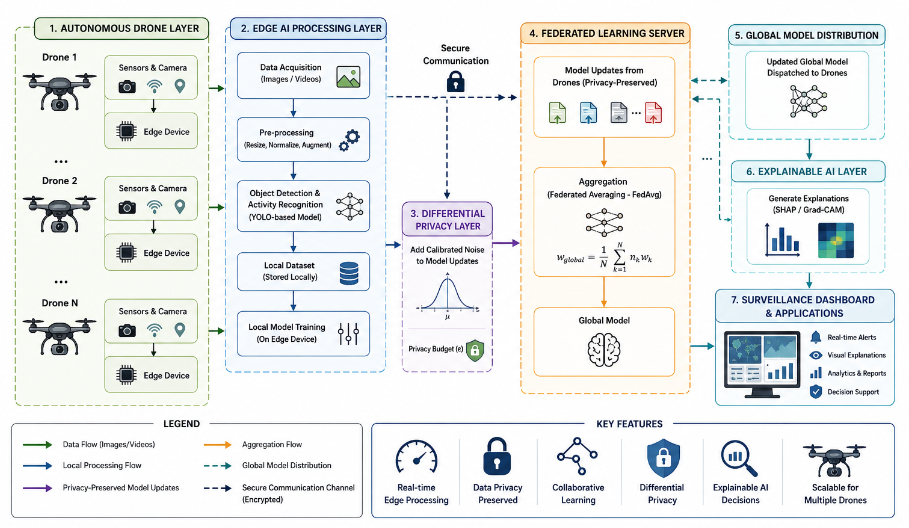
The architecture consists of five functional layers, each responsible for a specific task in the intelligent surveillance process.
4.2 Architecture of the Proposed Framework
The proposed framework comprises the following interconnected layers:
4.2.1 Autonomous Drone Layer
The first layer consists of multiple autonomous drones equipped with:
-
High-resolution RGB cameras
-
GPS modules
-
Inertial Measurement Units (IMUs)
-
Wireless communication modules
-
Embedded edge computing devices (e.g., NVIDIA Jetson Nano or Raspberry Pi 5)
The drones continuously patrol designated surveillance zones while capturing aerial images and videos. These surveillance data remain stored locally on each drone throughout the learning process.
4.2.2 Edge Artificial Intelligence Layer
The Edge AI layer performs intelligent processing directly on the drone.
Captured images undergo preprocessing before being analysed using a lightweight deep learning object detection model. The model identifies surveillance targets such as:
Human beings, Vehicles, Buildings, Roads, Restricted areas and Suspicious activities
Executing inference at the network edge minimizes communication latency, enables rapid decision-making, and reduces dependence on cloud infrastructure.
4.2.3 Federated Learning Layer
Each drone independently trains its local object detection model using locally generated surveillance data. Rather than transmitting raw images, the trained model parameters are securely transmitted to the Federated Learning server. The server aggregates model parameters using the Federated Averaging (FedAvg) algorithm to generate a new global model. The updated global model is redistributed to all participating drones, allowing continuous improvement of detection accuracy while preserving data privacy.
4.2.4 Differential Privacy Layer
Although Federated Learning protects raw datasets from exposure, model parameters may still reveal confidential information through inference attacks. To mitigate this risk, Differential Privacy is integrated into the learning process. Before transmitting model updates to the aggregation server, carefully calibrated Gaussian noise is added to model gradients according to a predefined privacy budget (ε). This mechanism prevents attackers from reconstructing sensitive surveillance data while maintaining acceptable learning performance.
4.2.5 Explainable Artificial Intelligence Layer
To improve transparency and trustworthiness, Explainable AI techniques are incorporated into the final stage of the framework. Visual explanation methods such as SHAP and Grad-CAM identify image regions that contributed most significantly to each prediction. The generated explanations enable surveillance personnel to verify AI decisions, identify possible false detections, and improve confidence in autonomous surveillance operations.
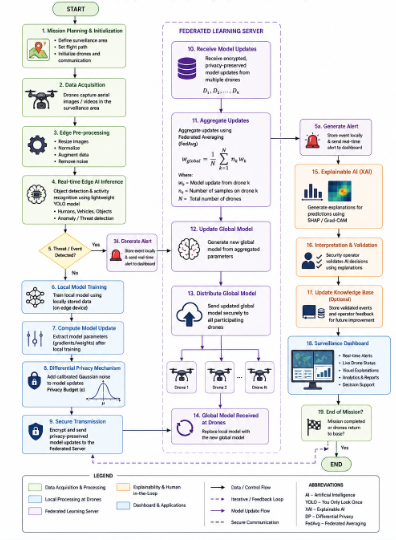
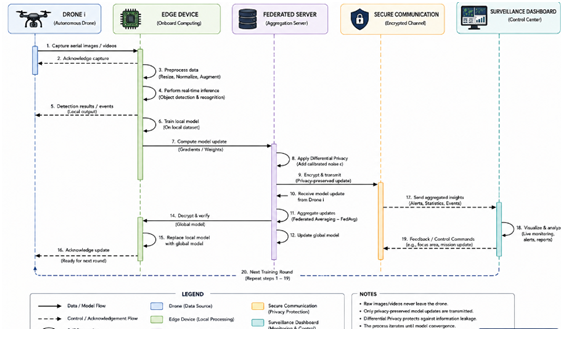
4.3 Operational Workflow of the Framework
The proposed framework operates according to the following sequence:
Step 1: Autonomous drones capture aerial surveillance images and videos.
Step 2: Captured data are preprocessed locally on each drone.
Step 3: The Edge AI model performs real-time object detection and activity recognition.
Step 4: Each drone trains its local deep learning model using newly collected surveillance data.
Step 5: Differential Privacy is applied to local model parameters before transmission.
Step 6: Privacy-preserved model updates are transmitted to the Federated Learning server.
Step 7: The server aggregates the received parameters using the Federated Averaging algorithm.
Step 8: The updated global model is redistributed to participating drones.
Step 9: Explainable AI generates visual explanations for every important prediction.
Step 10: Security operators receive both surveillance alerts and interpretable explanations for informed decision-making.
This iterative process continues until the model converges and achieves satisfactory performance.
4.4 Advantages of the Proposed Framework
Compared with conventional cloud-based surveillance systems, the proposed framework offers several advantages:
-
Real-time surveillance through Edge AI processing.
-
Reduced communication latency.
-
Lower network bandwidth consumption.
-
Preservation of sensitive surveillance data through Federated Learning.
-
Enhanced privacy using Differential Privacy.
-
Improved transparency through Explainable AI.
-
Scalability across multiple autonomous drones.
-
Improved resilience against cyberattacks targeting centralized data repositories.
-
Reduced cloud storage requirements.
-
Increased public trust in AI-assisted surveillance systems.
4.5 Theoretical Contribution
The proposed framework extends existing research by integrating five emerging technologies into a unified surveillance architecture. Previous studies have generally focused on individual technologies such as Edge AI, Federated Learning, Differential Privacy, or Explainable AI independently. This research demonstrates how these technologies can work synergistically to achieve secure, efficient, privacy-preserving, and trustworthy autonomous surveillance.
The framework therefore contributes to the convergence of Artificial Intelligence, Machine Learning, Robotics, Edge Computing, Cybersecurity, and Drone Development, while providing a practical solution for smart city surveillance, border security, disaster management, environmental monitoring, and critical infrastructure protection.
4.6 Conceptual Architecture of the Proposed Framework
The proposed conceptual architecture can be represented as follows:
Source: Author’s Conceptualisation (2026)
The architecture illustrates the end-to-end workflow of the proposed system, emphasizing localized intelligence, privacy-preserving collaborative learning, and transparent AI-assisted decision-making.
Source: Author’s Conceptualisation (2026)
Source: Author’s Conceptualisation (2026)
5. Expected Results and Discussion
5.1 Expected Results
The proposed Privacy-Preserving Edge Artificial Intelligence (AI) Framework is expected to significantly improve the efficiency, security, privacy, and trustworthiness of autonomous drone surveillance systems. By integrating Edge AI, Federated Learning (FL), Differential Privacy (DP), and Explainable Artificial Intelligence (XAI), the framework addresses key limitations of conventional cloud-based surveillance architectures.
First, the deployment of lightweight deep learning models at the edge is expected to reduce inference latency considerably. Since image processing and object detection are performed locally on each drone, the dependency on cloud computing is minimized, enabling faster identification of surveillance targets such as pedestrians, vehicles, restricted areas, and suspicious activities. This localized processing is anticipated to improve response times in mission-critical applications including border security, disaster management, and smart city surveillance.
Second, the proposed federated learning mechanism is expected to improve the accuracy and robustness of the object detection model through collaborative learning among multiple drones. Because each drone contributes model parameters rather than raw surveillance data, the global model is expected to benefit from diverse training data while preserving data locality and reducing communication overhead.
Third, the integration of Differential Privacy into the federated learning process is expected to provide stronger protection against gradient leakage, model inversion, and membership inference attacks. By injecting calibrated Gaussian noise into local model updates before transmission, the framework is anticipated to protect sensitive surveillance information without causing a substantial reduction in model performance.
Fourth, the incorporation of Explainable Artificial Intelligence techniques such as SHAP and Grad-CAM is expected to improve the interpretability of AI-generated predictions. Security personnel are expected to receive visual explanations indicating the image regions that contributed to object detection decisions, thereby increasing user confidence, accountability, and transparency.
Finally, the proposed framework is expected to reduce network bandwidth utilization because only encrypted model parameters are exchanged between drones and the federated server. This reduction in communication requirements makes the framework suitable for deployment in environments with limited or intermittent network connectivity.
Expected Performance Indicators
The framework is expected to achieve the following performance improvements when compared with conventional cloud-based surveillance systems:
-
Reduced inference latency through local edge processing.
-
Lower communication bandwidth consumption.
-
Improved object detection accuracy through collaborative federated learning.
-
Enhanced privacy preservation using Differential Privacy.
-
Increased robustness against cyberattacks targeting surveillance data.
-
Improved transparency and user trust through Explainable AI.
-
Better scalability for large-scale multi-drone surveillance deployments.
-
Reduced cloud storage and processing requirements.
-
Enhanced operational efficiency in real-time surveillance applications.
5.2 Comparative Analysis with Existing Approaches
Table 5.1 presents a qualitative comparison between conventional cloud-based surveillance systems and the proposed Privacy-Preserving Edge AI Framework.
| Performance Metric | Conventional Cloud-Based Surveillance | Proposed Framework |
|---|---|---|
| Data Processing | Centralized cloud processing | Local edge processing |
| Inference Latency | High | Low |
| Bandwidth Consumption | High | Low |
| Privacy Protection | Limited | High (Federated Learning + Differential Privacy) |
| Raw Data Transmission | Required | Not required |
| Cybersecurity Risk | High | Reduced |
| Scalability | Moderate | High |
| Explainability | Limited | Integrated Explainable AI |
| Real-Time Decision Making | Limited by network delay | Real-time edge inference |
| Multi-Drone Collaboration | Minimal | Federated collaborative learning |
The proposed framework is expected to outperform traditional cloud-based surveillance systems across several important dimensions. By relocating intelligence from centralized cloud servers to edge devices embedded within autonomous drones, the framework minimizes communication delays and improves operational efficiency. Furthermore, the combined use of Federated Learning and Differential Privacy provides stronger privacy guarantees than approaches relying solely on centralized machine learning.
5.3 Discussion
The proposed framework demonstrates how the convergence of Edge Artificial Intelligence, Federated Learning, Differential Privacy, Explainable Artificial Intelligence, and autonomous drone technologies can address several long-standing challenges in intelligent surveillance systems.
Unlike traditional surveillance architectures that require continuous transmission of raw images and videos to cloud servers, the proposed framework performs object detection and decision-making locally on autonomous drones. This decentralized architecture is expected to reduce communication latency, improve responsiveness, and lower bandwidth requirements, making it suitable for environments with unstable or low-bandwidth communication infrastructure.
The integration of Federated Learning enables multiple drones to collaboratively improve object detection models while preserving the confidentiality of locally generated surveillance data. This collaborative learning strategy is expected to enhance model generalization by leveraging diverse operational environments without exposing sensitive information. The addition of Differential Privacy further strengthens the framework by reducing the likelihood of privacy leakage during model aggregation, thereby improving resilience against inference attacks.
The incorporation of Explainable Artificial Intelligence represents another significant contribution of the framework. While many existing AI-based surveillance systems function as opaque "black-box" models, the proposed framework provides interpretable explanations for AI predictions. This capability is expected to improve user trust, facilitate validation of surveillance decisions, and support regulatory compliance in applications where transparency and accountability are essential.
From a practical perspective, the framework offers potential applications in smart city surveillance, border protection, disaster response, environmental monitoring, wildlife conservation, traffic management, and critical infrastructure protection. Its modular architecture also supports scalability, allowing additional drones to participate in collaborative learning without major modifications to the system.
Although the proposed framework offers several advantages, some implementation challenges may arise. Resource limitations of onboard edge devices, communication instability, synchronization among distributed drones, and the trade-off between privacy protection and model accuracy require careful consideration during deployment. Future work should therefore focus on optimizing lightweight deep learning models, adaptive privacy budget selection, communication-efficient federated optimization, and large-scale field validation using real-world autonomous drone platforms.
Overall, the expected findings suggest that the proposed Privacy-Preserving Edge AI Framework has strong potential to advance secure, intelligent, and trustworthy autonomous drone surveillance by integrating complementary AI technologies into a unified architecture capable of supporting next-generation smart surveillance systems.
6. Conclusion and Future Work
6.1 Conclusion
This study proposed a Privacy-Preserving Edge Artificial Intelligence Framework for Autonomous Drone Surveillance Using Federated Learning and Differential Privacy to address the limitations of conventional cloud-based surveillance systems. The proposed framework integrates five emerging technologies: Edge Artificial Intelligence, Federated Learning, Differential Privacy, Explainable Artificial Intelligence (XAI), and autonomous drone systems—into a unified architecture capable of delivering secure, intelligent, and real-time surveillance.
The proposed framework enables autonomous drones to perform local object detection and activity recognition using lightweight deep learning models deployed on edge devices. By adopting Federated Learning, the framework facilitates collaborative model training among multiple drones without transmitting raw surveillance data, thereby preserving data privacy and reducing communication overhead. Furthermore, the incorporation of Differential Privacy strengthens protection against inference attacks by ensuring that sensitive information cannot be reconstructed from exchanged model updates. The integration of Explainable Artificial Intelligence enhances transparency by providing interpretable explanations for AI-generated decisions, thereby improving user trust and accountability.
Based on the proposed design, the framework is expected to reduce inference latency, lower bandwidth consumption, improve privacy preservation, strengthen cybersecurity, enhance detection performance through collaborative learning, and support scalable deployment across multiple autonomous drones. These anticipated improvements demonstrate the potential of the proposed framework to support next-generation intelligent surveillance systems for smart cities, border security, disaster management, environmental monitoring, traffic surveillance, and critical infrastructure protection.
The major contribution of this research lies in the development of a comprehensive architecture that converges multiple advanced Artificial Intelligence technologies into a single privacy-preserving surveillance framework. Unlike existing approaches that treat Edge AI, Federated Learning, Differential Privacy, and Explainable AI as separate technologies, this study demonstrates how their integration can produce a secure, efficient, transparent, and scalable surveillance solution.
6.2 Future Work
Although the proposed framework provides a comprehensive conceptual architecture, further research is required to validate its effectiveness through practical implementation and experimentation.
Future studies should implement the proposed framework on real autonomous drone platforms equipped with embedded edge computing devices such as NVIDIA Jetson Nano, NVIDIA Jetson Orin, or Raspberry Pi 5. Performance evaluation should be conducted using publicly available aerial surveillance datasets, including VisDrone, UAVDT, DOTA, and xView, as well as real-world drone imagery collected under varying environmental conditions.
Subsequent research should also investigate communication-efficient Federated Learning algorithms capable of reducing model update overhead while maintaining high detection accuracy. Adaptive Differential Privacy mechanisms that dynamically adjust the privacy budget according to application requirements may further improve the balance between privacy protection and model utility.
Another promising direction is the integration of advanced foundation models and multimodal Artificial Intelligence capable of combining aerial imagery, thermal imaging, sensor data, and natural language instructions to improve situational awareness and autonomous decision-making. Reinforcement Learning may also be incorporated to enable adaptive drone navigation and cooperative mission planning in dynamic environments.
Future investigations should evaluate the scalability of the framework in large-scale multi-drone deployments involving hundreds of autonomous drones operating simultaneously over geographically distributed environments. Such studies should assess communication efficiency, model convergence, fault tolerance, energy consumption, and resilience against adversarial attacks.
Finally, future work should include prototype implementation, field testing, and comparison with existing cloud-based surveillance systems using quantitative performance metrics such as inference latency, communication bandwidth, energy consumption, detection accuracy, privacy guarantees, explainability scores, and overall system reliability. These investigations will provide empirical evidence of the effectiveness of the proposed framework and facilitate its deployment in real-world intelligent surveillance applications.
References
- Abdullah, M., Zulfiqar, A., & Arman, J. H. (2026). A comprehensive review on UAV control systems: From linear to intelligent approaches. ACM Computing Surveys, 58(13), 1–35. DOI ↗ Google Scholar ↗
- Abdullah, S. H., & Mat, I. N. A. (2026). You only look once (YOLO): A comprehensive review of its evolution and applications in electronic component defect detection. Results in Control and Optimization, 23, 100731. DOI ↗ Google Scholar ↗
- Akhtarshenas, A., Vahedifar, M. A., Ayoobi, N., Maham, B., Alizadeh, T., Ebrahimi, S., & López-Pérez, D. (2024). Federated learning: A cutting-edge survey of the latest advancements and applications. Computer Communications, 228, 107964. DOI ↗ Google Scholar ↗
- Alamir, R., Noor, A., Almukhalfi, H., Almukhlifi, R., & Noor, T. H. (2026). AI-Enhanced cybersecurity in edge computing: Threats, solutions, and future directions. ACM Computing Surveys, 58(11), 1–48. DOI ↗ Google Scholar ↗
- Ayodele, O. S., Ajayi, E. A., Odiketa, J. C., Samuel, R. M., & Seyi-Ayodele, A. L. (2026). From AI-Driven curriculum design to AI-Enabled teaching and assessment: Bridging the implementation gap. SSR Publisher. DOI ↗ Google Scholar ↗
- Belenguer, A., Pascual, J. A., & Navaridas, J. (2025). A review of federated learning applications in intrusion detection systems. Computer Networks, 111023–111023. DOI ↗ Google Scholar ↗
- Chang, W., & Zhu, T. (2024). Gradient-based defense methods for data leakage in vertical federated learning. Computers & Security, 139, 103744. DOI ↗ Google Scholar ↗
- Haque, A. B., Islam, A. K. M. N., & Mikalef, P. (2023). Explainable artificial intelligence (XAI) from a user perspective: A synthesis of prior literature and problematizing avenues for future research. Technological Forecasting and Social Change, 186, 122120. DOI ↗ Google Scholar ↗
- Hashem, I. A., Zerdoumi, S., Jhanjhi, N., Siddiqa, A., & Foufou, S. (2026). Optimization and performance analysis of drones and unmanned aerial systems and their intelligence applications. International Journal of Cognitive Computing in Engineering, 7, 128–144. DOI ↗ Google Scholar ↗
- Jahan, S., Ge, Y., Bertino, E., Kabir, E., Mahmud, H., Zheng, Z., & Wang, H. (2026). Systematic literature review on differential privacy in machine learning. ACM Computing Surveys, 58(11), 1–36. DOI ↗ Google Scholar ↗
- Khanfor, A., Hamadi, R., Lasla, N., & Ghazzai, H. (2026). AI-driven intrusion detection for UAV in smart urban ecosystems: A comprehensive survey (2601.19345V1). arXiv. DOI ↗ Google Scholar ↗
- Kunjumon, A., Sarath, G., & Nair, J. J. (2026). A comprehensive survey on communication optimization and privacy preservation in federated learning. Discover Computing, 29(1). DOI ↗ Google Scholar ↗
- Mohamad, A. A., Dornaika, F., & Charafeddine, J. (2026). Edge artificial intelligence: Past advances, current paradigms, and emerging horizons. Engineering Applications of Artificial Intelligence, 181, 115635. DOI ↗ Google Scholar ↗
- Olawade, D. B., Wada, O. Z., Ige, A. O., Egbewole, B. I., Olojo, A., & Oladapo, B. I. (2024). Artificial intelligence in environmental monitoring: Advancements, challenges, and future directions. Hygiene and Environmental Health Advances, 12, 100114–100114. DOI ↗ Google Scholar ↗
- Pushpakumara, T., & Ahsan, F. (2025). Transforming Industries through AI and emerging technologies: Literature review of opportunities, challengers, responsibilities, and strategies. International Journal of Innovative Science and Research Technology. International Journal of Innovative Science and Research Technology, 10(1), 1861–1880. DOI ↗ Google Scholar ↗
- Reddy, V., Madan, H., Khatri, N., Antar, & K. Shridhar Patnaik. (2024). Autonomous UAV navigation using deep learning-based computer vision frameworks: A systematic literature review. Array, 100361–100361. DOI ↗ Google Scholar ↗
- Sahoo, L. K., & Varadarajan, V. (2025). Deep learning for autonomous driving systems: Technological innovations, strategic implementations, and business implications - A comprehensive review. Complex Engineering Systems, 5(1). DOI ↗ Google Scholar ↗
- Sharma, A., Rani, S., & Shabaz, M. (2025). A comprehensive review of explainable AI in cybersecurity: Decoding the black box. ICT Express. DOI ↗ Google Scholar ↗
- Shi, W., Cao, J., Zhang, Q., Li, Y., & Xu, L. (2016). Edge Computing: Vision and Challenges. IEEE Internet of Things Journal, 3(5), 637–646. DOI ↗ Google Scholar ↗
- Yazici, İ., Shayea, I., & Din, J. (2023). A survey of applications of artificial intelligence and machine learning in future mobile networks-enabled systems. Engineering Science and Technology, an International Journal, 44(1), 101455. DOI ↗ Google Scholar ↗
- Yurdem, B., Kuzlu, M., Gullu, M. K., Catak, F. O., & Tabassum, M. (2024). Federated learning: Overview, strategies, applications, tools and future directions. Heliyon, 10(19), e38137–e38137. DOI ↗ Google Scholar ↗
- Zhang, K., Wang, D., Lin, F., Xie, J., & Zhou, W. (2026). A comprehensive review of explainable artificial intelligence in healthcare methods, evaluation, and clinical integration. iScience, 29(3), 115026. DOI ↗ Google Scholar ↗