Abstract:
This study examines the effectiveness of collaboration between the government and local communities and the use of information technology to support the development of smart tourism in Ciamis Regency, West Java. A qualitative-descriptive approach was used to understand the patterns of cooperation, forms of participation, effectiveness of coordination, and implementation of digital applications and social media in Ciamis Regency. tourist destinations. The results show that collaboration through the active role of the local government, villages, and Pokdarwis (Tourism Awareness and Development Group) has been ongoing, but still faces challenges in cross-sector synergy and the limited digital capacity of tourism actors. The use of information technology is mainly in social media-based promotion, while advanced digital features such as online booking systems and virtual tours have not been optimally developed. This study emphasises the need to enhance digital capacity, collaborative governance, and the provision of information technology infrastructure to accelerate tourism transformation. Smart tourism within the Ciamis region.Tourism is a strategic sector that contributes to regional economic growth, job creation, and cultural preservation. The integration of information technology has promoted the concept of smart tourism, which emphasises three pillars: smart destinations, smart governance, and smart experiences to enhance destination competitiveness. In Ciamis Regency, the potential for natural, cultural, and religious tourism is significant, but digital transformation and cross-stakeholder collaboration have not been evenly distributed. This study aims to: (a) analyse patterns of government-community collaboration; (b) identify forms of participation and coordination effectiveness; and (c) assess the implementation of Information Technology and its impact on promotion, services, and community involvement.
Introduction
This research contributes by providing an initial overview of smart tourism indicators based on field data for Ciamis Regency and recommendations for strengthening smart governance. The transformation towards smart tourism in Ciamis Regency requires synergy between the local government, community, and private sector in developing digital infrastructure and improving human resource capacity. The use of information technology, such as travel applications, online reservation systems, and social media-based promotion, can be the first step in expanding the reach of destination promotion and strengthening the image of regional tourism. However, these efforts need to be balanced with inclusive and transparent governance policies to ensure that the benefits of digitalisation are felt equally by all tourism stakeholders, including micro-enterprises and local communities.
Literature Review
Smart Tourism Concept
Meanwhile, smart governance is the main foundation for ensuring transparent, participatory, and adaptive tourism management. Local governments play a crucial role in designing policies that support cross-sector collaboration and ensure sustainable destination management. The use of open data-based tourism information systems, for example, enables faster and more targeted decision-making. Furthermore, synergy between the government, academics, business actors, and the community creates a solid coordination mechanism to ensure a balance between economic interests and environmental preservation.
In the context of smart experiences, tourists are no longer passive consumers, but actively shape their travel experiences through digital interactions. The use of technologies such as virtual reality, augmented reality, and mobile tourism applications enriches the travel experience by providing in-depth information about local history, culture, and tourist attractions. Furthermore, tourist participation in providing online reviews and feedback becomes a valuable source of data for destination managers to continuously improve service quality. This approach strengthens the emotional bond between tourists and destinations, while building long-term loyalty.
With the integration of smart destinations, smart governance, and smart experiences, Ciamis Regency has a great opportunity to become a model for the implementation of smart tourism at the regional level. The success of developing this ecosystem depends on a shared commitment to continuous innovation and strengthening the digital capacity of the local community. Through sustained collaboration, Ciamis can create a tourism model that not only drives the local economy but also preserves cultural values and maintains environmental sustainability.
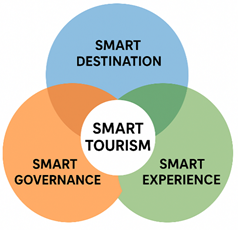
Source: Gajdošík, Tomáš, 2018.
The Smart Destination component focuses on developing smart and sustainable tourist destinations supported by digital infrastructure, data management, and innovation. This component involves the use of IoT systems, mobile applications, and online platforms to improve accessibility, resource management, and visitor flow. In the context of regional tourism, this pillar ensures that destinations are well-connected digitally, environmentally friendly, and able to provide real-time information to improve tourist travel. Thus, Smart Destinations serve as the operational backbone of smart tourism systems.
The Smart Governance pillar represents the management and policy aspects, emphasising collaboration between local governments, communities, and the private sector. This includes data-driven decision-making, open governance, and participatory approaches that empower local stakeholders. Effective governance ensures transparency, accountability, and inclusivity in tourism planning and implementation. By integrating digital tools into the governance process, local governments can respond to tourism demands more efficiently, improve resource allocation, and ensure that development is aligned with sustainability goals. Finally, Smart Experience focuses on visitor interaction with destinations, emphasising personalisation, engagement, and satisfaction through technology. This pillar utilises digital tools such as augmented reality, virtual tours, and mobile guides to enrich the tourist experience. The intersection of Smart Experience with the other two pillars creates a feedback loop that continuously refines services based on user input and behaviour analysis. Overall, the synergy of these three elements—destination, governance, and experience—builds a comprehensive model that transforms tourism into a smart, inclusive, and sustainable system.
Collaboration Between Government and Local Communities
Community participation in tourism is a key factor in creating sustainability and empowering communities around tourist destinations. Community involvement is not only as beneficiaries, but also as planners, managers, and innovators in developing local potential. When communities are given space to play an active role in the decision-making process, they will develop a strong sense of ownership of the destination. This has an impact on increasing awareness of environmental sustainability, preservation of local culture, and improving the quality of tourism services oriented towards local wisdom.
Government involvement in supporting community participation is a crucial element in strengthening cross-sector collaboration. Support can be provided through training, technology facilitation, institutional assistance, and access to financing for local tourism operators. With community-focused policies and inclusive governance systems, the synergy between the government and the community will promote an adaptive and independent community-based tourism model. In the context of smart tourism, this collaboration not only strengthens the competitiveness of destinations but also creates a fair and sustainable tourism ecosystem for all stakeholders.
The Role of Information Technology
The benefits of information technology reach the community inclusively by opening up wider access to information, economic opportunities, and participation in the digital tourism ecosystem. Through online platforms, local communities can independently promote products, services, and tourist attractions without relying entirely on external parties. This enables the equitable distribution of economic benefits, especially for micro, small, and medium enterprises (MSMEs) in the tourism sector. This digital inclusivity is in line with the principles of smart tourism, which emphasises the use of technology to strengthen collaboration and ensure that all levels of society benefit from technology-based tourism development. In the context of smart and sustainable tourism, information technology is also a crucial instrument in maintaining a balance between economic progress and the environment.
With digital monitoring systems, tourism data and activities can be managed to prevent overtourism and support efficient resource management policies. Furthermore, environmentally friendly applications such as electronic ticketing systems, digital guides, and educational content-based promotions also encourage responsible tourism behaviour. Thus, the use of technology not only accelerates the growth of the tourism industry, but also serves as a tool to ensure long-term sustainability. Furthermore, the inclusiveness driven by information technology strengthens the capacity of local communities to adapt to global changes and the needs of modern tourists. Improving digital literacy, technology skills training, and government policy support are important prerequisites for building a smart and resilient tourism community. Collaboration between the public, private, and community sectors creates synergies that support a vision of smart and sustainable tourism, where innovation, sustainability, and social justice go hand in hand to shape a more inclusive and competitive future for tourism.
Previous Research and Research Gaps
The literature over the past five years has shifted from conceptualisation to the systematic mapping of smart destination dimensions, information technology capabilities, and partnerships. However, implementation across different regions in Indonesia remains diverse, requiring stronger governance and data integration among stakeholders. At the local level, many studies map actors and collaborative processes, but rarely examine the measurable impact on smart experiences and economic performance. Tourism Information Technology studies often focus on short-term marketing metrics, rather than linking them to governance and Micro, Small, and Medium Enterprises (MSME) empowerment indicators. The context of Ciamis Regency, with its local platform, has not been empirically evaluated longitudinally, and this mixed-methods approach opens up opportunities for further research.
Materials And Methods
Describe in sufficient detail how the study was conducted so that it can be replicated.
Type and Approach
This study uses a descriptive qualitative approach to describe in depth the dynamics of collaboration between the government, community, and tourism stakeholders in the application of the smart tourism concept. This approach focuses on understanding the social context and behaviour of the actors involved, thereby revealing the meanings, strategies, and challenges faced in the development of information technology-based tourism in Ciamis Regency. By emphasising the process, rather than just the results, this study seeks to explore how interactions between stakeholders shape effective and sustainable patterns of collaboration.
Data collection techniques were carried out through in-depth interviews with key informants, including tourism officials, community leaders, tourism destination managers, and local business actors. Direct observations were conducted at several leading tourist locations in Ciamis Regency to assess the application of information technology and the level of community involvement in tourism activities. Documentation was used to supplement primary data, including policy archives, activity reports, and official publications relevant to smart tourism development.
Research Location
The research location is in Ciamis Regency, West Java, an area that has natural, cultural, and religious tourist destinations such as Situ Lengkong, Panjalu, Kuta Traditional Village, Karangkamulyan Site, and Curug Tujuh. This context is relevant for assessing the elements of smart destinations, smart governance, and smart experiences as well as the effectiveness of government-community synergy.
Results And Discussion
General Conditions of Tourism Transformation in the Ciamis Region
Tourism transformation in Ciamis Regency has shown significant dynamics in recent years, along with increasing awareness of the importance of digitalisation and cross-stakeholder collaboration. Ciamis Regency has diverse tourism potential, ranging from natural attractions such as Situ Lengkong and Curug Tujuh Cibolang to cultural and religious attractions that reflect the richness of local history. However, this potential has not been fully utilised due to limitations in digital infrastructure, technology-based promotion, and integration between destinations. Local government efforts to encourage sustainable tourism development are beginning to be seen through destination strengthening and community training programmes, but challenges in strategic alignment still need to be overcome.
From a governance perspective, the Ciamis Regency Government has sought to build synergy between institutions, communities, and tourism businesses through collaborative policies. The concept of smart governance has begun to be implemented through the use of an online tourism information system that facilitates access to information for tourists and investors. However, this transformation is still in its early stages, as not all tourist villages and local communities have adequate digital capacity. This digital divide has resulted in unequal participation among communities in independently managing and marketing tourism potential. Therefore, improving digital literacy and providing internet infrastructure in tourist areas is an urgent need.
From the perspective of community participation, community-based tourism (CBT) initiatives have emerged, encouraging community involvement in managing and developing tourist destinations. These initiatives are a crucial foundation for the creation of sustainable tourism based on local wisdom. The community plays a role not only as implementers but also as decision-makers in determining the direction of tourism development in their region. In the context of the transformation towards smart tourism, the role of the local community is increasingly strategic, as they are the main source of information, innovation, and technology-based management. Government support through digital training, online promotion, and institutional assistance are key factors in the success of this collaboration.
Overall, tourism transformation in Ciamis Regency is moving towards a smarter, more collaborative, and more sustainable model. Integration between the government, community, and information technology is key to creating a tourism ecosystem that adapts to changing times ( ). By strengthening digital governance, increasing human resource capacity, and optimising local potential in an inclusive manner, Ciamis has the potential to become a leading smart tourism destination in West Java. Going forward, the main challenge is to maintain a balance between digital innovation and preserving cultural and environmental values to ensure sustainable tourism transformation. The regional policy framework guides the transformation towards an integrated experience-based destination management model. Efforts to establish a promotion agency, focus on marketing and the creative economy, and increase tourist arrivals indicate opportunities to strengthen digitalisation, but challenges remain in coordination and the suboptimal use of information technology, as well as weak supporting infrastructure.
Collaboration between the Government and Local Communities
The pattern of collaboration shows a division of roles between the local government as regulator and facilitator, and the community (tourism-aware groups) as destination service managers. Participation in the service sector, homestays, tour guides, and the creative economy has increased, but the effectiveness of coordination between parties is still limited.
| No. | Objective | Smart Objectives (1–5) | Smart Governance (1–5) | Smart Experience (1–5) | Average | |
| 1 | Lengkong Lake | 4.0 | 3.6 | 3.5 | 3.7 | |
| 2 | Panjalu Traditional Village | 3.0 | 2.7 | 2.8 | 2.8 | |
| 3 | Kuta Beach | 3.5 | 3.0 | 3.2 | 3.2 | |
| 4 | Seven Karangkamulyan Waterfall | 2.8 | 2.5 | 2.4 | 2.6 |
Note: Score 1-5; higher = better implementation. Source: Field observations (2025), processed by researchers.
Implementation of Information Technology in Smart Tourism
The use of information technology in Ciamis Regency is most prominent in social media promotion, while online booking, virtual tours, and analytics are still not widely used. This has resulted in increased destination visibility, ease of service information, and digital feedback channels. However, the quality of digital services is still inconsistent due to the lack of an integrated destination information system.
| No. | Stakeholders | Social Media (1–5) | Websites/Portals (1–5) | Online Booking (1–5) | Average |
| 1 | Local Government | 4.5 | 3.8 | 2.5 | 3.6 |
| 2 | Tourism Group (Pokdarwis) | 3.8 | 2.5 | 1.5 | 2.6 |
| 3 | MSMEs (Tourism SMEs) | 3.5 | 2.0 | 1.8 | 2.4 |
| 4 | Goal Manager | 3.2 | 2.2 | 1.6 | 2.3 |
Note: Score 1-5; higher = higher adoption rate.
Source: Interviews and documentation (2025), processed by researchers.
The use of information technology in the tourism sector in Ciamis Regency shows rapid development, particularly in promotion through social media. The local government, tourism operators, and local communities utilise various platforms such as Instagram, Facebook, and TikTok to promote the region's natural, cultural, and culinary tourism potential. This digital promotion strategy has succeeded in increasing the visibility of destinations and attracting the attention of domestic and foreign tourists. The presence of social media also enables two-way interaction between tourism managers and tourists through creative content, reviews, and community-based digital promotion activities.
The positive impact of utilising existing information technology can be seen in the increasing ease of access to tourism information, the dissemination of activity schedules, and more effective promotion of local products. Tourists can quickly obtain information about available routes, facilities, and tourist activities. Furthermore, social media serves as a digital feedback channel, helping managers understand tourist preferences and satisfaction. This mechanism provides opportunities for managers to tailor services and enhance the tourism experience based on data and user participation.
However, the overall quality of digital services in Ciamis Regency is still inconsistent due to the lack of an integrated destination information system that integrates all aspects of regional tourism. The absence of this system results in fragmented tourism data, limited coordination between stakeholders, and non-standardised promotion. The development of an integrated digital platform that combines information, reservations, maps, and tourist reviews is an urgent need to strengthen the smart tourism ecosystem. With this system, Ciamis tourism can transform towards efficient, transparent, and sustainable digital governance, while increasing the competitiveness of the destination at the regional and national levels.
Conclusion
Collaboration between the government, the community, and the use of information technology plays a strategic role in strengthening the pillars of smart destinations, smart governance, and smart experiences in Ciamis Regency. This synergy between stakeholders not only improves the effectiveness of destination governance but also lays the foundation for tourism development that is adaptive to digital developments. Through a collaborative approach, tourism management can be directed in a more integrated, efficient, and inclusive manner, thereby increasing the competitiveness of the region in the context of the transformation
towards smart tourismTo realise sustainable digital-based tourism governance, planned and measurable strategic steps are required. Recommendations include the establishment of a data-based collaborative forum involving the government, tourism stakeholders, academics, and local communities to facilitate information exchange and innovation. Furthermore, continuous digital training is needed to strengthen human resource capacity in the fields of information technology, online marketing, and destination management. Improving the digital literacy of the community will have a direct impact on the optimisation of tourism platforms and the quality of technology-based services. Furthermore, the development of an integrated smart platform that includes information systems, reservations, digital maps, and tourist reviews will strengthen a smart and comfortable travel experience.
Interactive. The implementation of this policy requires investment in internet infrastructure and reliable data management systems to ensure connectivity and information security. Furthermore, aligning tourism policy with the regional smart city agenda is essential to ensure that the development of smart tourism in Ciamis Regency is in synergy with the overall direction of regional development. Therefore, multisectoral collaboration and the utilisation of information technology will be the main drivers in realising an
innovative, inclusive, and sustainable tourism ecosystem Collaboration between the government and the community, as well as the utilisation of information technology, contributes significantly to strengthening smart destinations, smart governance, and smart experiences in Ciamis Regency. Key recommendations: (a) institutionalisation of data-based collaborative forums; (b) continuous digital training; (c) development of integrated smart platforms (information, booking, maps, and reviews); (d) investment in internet infrastructure and data governance; and (e) alignment of tourism policies with the regional smart city agenda.
References
- Clemente P, Giovinazzi S, Fantoni R. Special issue on knowledge, evaluation and preservation of cultural heritage. J Civ Struct Heal Monit [Internet]. 30 January 2024;14(1):83–4. Available from: https://link.springer.com/10.1007/s13349-024-00763-3 Google Scholar ↗
- Demirović Bajrami D, Radosavac A, Cimbaljević M, Tretiakova TN, Syromiatnikova YA. Determinants of Residents’ Support for Sustainable Tourism Development: Implications for Rural Communities. Sustainability [Internet]. 13 November 2020;12(22):9438. Available from: https://www.mdpi.com/2071-1050/12/22/9438 Google Scholar ↗
- Sorokina E, Wang Y, Fyall A, Lugosi P, Torres E, Jung T. Constructing a smart destination framework: A destination marketing organisation perspective. Journal of Destination Marketing Management [Internet]. 2022 Mar;23:100688. Available from: https://linkinghub.elsevier.com/retrieve/pii/S2212571X21001384 Google Scholar ↗
- Ivars-Baidal JA, Celdrán-Bernabeu MA, Mazón J-N, Perles-Ivars ÁF. Smart destinations and the evolution of ICTs: a new scenario for destination management? Current Issues in Tourism [Internet]. 9 August 2019;22(13):1581–600. Available from: https://www.tandfonline.com/doi/full/10.1080/13683500.2017.1388771 Google Scholar ↗
- Ivars-Baidal JA, Celdrán-Bernabeu MA, Femenia-Serra F, Perles-Ribes JF, Giner-Sánchez D. Measuring the progress of smart destinations: The use of indicators as a management tool. Journal of Destination Marketing Management [Internet]. 2021 Mar;19:100531. Available from: https://linkinghub.elsevier.com/retrieve/pii/S2212571X20301530 Google Scholar ↗
- Williams AM, Rodriguez I, Makkonen T. Innovation and smart destinations: Critical insights. Ann Tour Res [Internet]. 2020 Jul;83:102930. Available from: https://linkinghub.elsevier.com/retrieve/pii/S0160738320300748 Google Scholar ↗
- 1. Gajdošík T. Smart Tourism: Concepts and Insights from Central Europe. Czech J Tour [Internet]. 2018 Jun 1;7(1):25–44. Available from: https://www.sciendo.com/article/10.1515/cjot-2018-0002 Google Scholar ↗
- Zhou L, Buhalis D, Fan DXF, Ladkin A, Lian X. Attracting digital nomads: Smart destination strategies, innovation and competitiveness. Journal of Destination Marketing Management [Internet]. 2024 Mar;31:100850. Available from: https://linkinghub.elsevier.com/retrieve/pii/S2212571X23000896 Google Scholar ↗
- Jeong M, Shin HH. Tourists’ Experiences with Smart Tourism Technology at Smart Destinations and Their Behavioural Intentions. Journal of Travel Research [Internet]. 8 November 2020;59(8):1464– Google Scholar ↗
- Jeong M, Shin HH. Tourists’ Experiences with Smart Tourism Technology at Smart Destinations and Their Behavioural Intentions. Journal of Travel Research [Internet]. 8 November 2020;59(8):1464–77. Available from: https://journals.sagepub.com/doi/10.1177/0047287519883034 Google Scholar ↗
- Zhang C, Liao L. The active participation in a community transformation project in China: constructing new forums for expert-citizen interaction. Journal of Chinese Government [Internet]. 3 July 2022;7(3):372–99. Available from: https://www.tandfonline.com/doi/full/10.1080/23812346.2020.1830569 Google Scholar ↗
- Cairney P, Toomey C. Collaborative Policymaking: a qualitative systematic review of advice for policymakers. Open Res Eur [Internet]. 18 September 2024;4:204. Available from: https://open-research-europe.ec.europa.eu/articles/4-204/v1 Google Scholar ↗
- Seyfi S, Rasoolimanesh SM, Vafaei-Zadeh A, Esfandiar K. Can tourist engagement enhance tourist behavioural intentions? A combination of PLS-SEM and fsQCA approaches. Tour Recreat Res [Internet]. 2 January 2024;49(1):63–74. Available from: https://www.tandfonline.com/doi/full/10.1080/02508281.2021.1981092 Google Scholar ↗
- Rahmi HA, Indihadi D, Elan E. Educational Storybook Development to Cultivate Gotong Royong. J Innov Res Prim Educ [Internet]. 26 July 2025;4(3):908–18. Available from: https://ejournal.papanda.org/index.php/jirpe/article/view/1648 Google Scholar ↗
- Ruhanen L. Local government: facilitator or inhibitor of sustainable tourism development? Journal of Sustainable Tourism [Internet]. 2 January 2013;21(1):80– Google Scholar ↗
- Ruhanen L. Local government: facilitator or inhibitor of sustainable tourism development? Journal of Sustainable Tourism [Internet]. 2 January 2013;21(1):80–98. Available from: https://www.tandfonline.com/doi/full/10.1080/09669582.2012.680463 Google Scholar ↗