Abstract
Purpose - This study aims to investigate the role of Generation Z employees' voice behavior in improving organizational effectiveness through the mediating mechanisms of organizational innovation and organizational culture. Given the dominance of Gen Z in today's workforce, it is important to understand how their vocal and proactive nature affects organizational strategic achievement.
Design/methodology/approach - This research uses a quantitative approach with SEM-PLS method. This study was conducted on 206 respondents, generation Z employees in Yogyakarta, Indonesia. Selected using purposive sampling, data were collected through a questionnaire and analyzed using Structural Equation Modeling Partial Least Squares (SEM-PLS).
Findings - The results of this study confirmed the conceptualized model and revealed that voice behavior affects organizational innovation (OI) and organizational culture (OC). OI and OC were found to be fully mediating the effect of voice behavior on organizational effectiveness.
Research limitation/implication - This study is limited in geography and are limited sample size. Future research can expand the scope of the area so that the results can be more generalized. This study is also limited in the type of approach; so, future research can use a qualitative/mix method approach for more explorative findings.
Practical implication – Companies can develop strategies to optimize employee voice behavior, so that it can provide positive benefits for the company and increasing its competitives.
Originality/value - This study is the first to conceptualize the relationship between voice behavior, organizational innovation, organizational culture, and organizational effectiveness in Indonesia.
Keywords: voice behavior, generation Z, organizational innovation, organizational culture, organizational effectiveness, competitive advantage.
Introduction
In facing an increasingly dynamic business era, companies are required to increase organizational effectiveness and maintain their competitiveness[1] [2]. Organizational effectiveness (OE) not only reflects the achievement of goals, but also involves optimizing resources, strengthening organizational culture, and adaptability to changes in the external environment[3] [4] [5]. Companies are required to not only develop their business strategies but also develop the internal and external foundations of the company[6]
To obtain sustainable profits, companies need to occupy a superior position in the market by creating competitive advantage as a strategy to survive and compete[1]. Competitive advantage is the ability of a company to perform superior to competitors through its characteristics and resources[7]. Effectiveness plays a role in dealing with various risks that lead to negative changes [8]. Organizational effectiveness is the extent to which an organization is able to achieve its goals[9].
In the midst of these dynamic changes in the business environment, the resource-based view theory shows that human resources plays a strategic role as a driver of innovation and organizational transformation. The skills possessed by employees can be the main foundation for companies in creating added value and maintaining competitiveness[10]. Employees have a role to produce outputs through their skills or abilities. In this context, employees is not only seen as a task executor but is seen as the main driver of the organization in transforming through innovative and participatory behavior[11]. The skills, experience, and abilities possessed by these employees are referred to as human capital which can be a source of sustainable competitive advantage[12]. Employee performance has an important role in improving organizational effectiveness[13]
The world of work is now starting to be dominated by generation Z (i.e., those born in the range of 1997-2012), including in Indonesia[14]. The proportion of Gen Z reaches 34.74% of the entire productive age in Indonesia. Gen Z, who are known to have strong personal values and courage in voicing opinions, tend to be more vocal in the workplace, especially when they feel out of sync with the existing system[15] [16]. Gen Z's personality characteristics make them more likely to voice ideas, criticisms, and suggestions in the workplace[17]. This can be considered a form of defiance against authority. Gen Z, which often gets a negative view, on the other hand proves that they actually emerge as a new force that changes the dynamics of the world of work. The courage of Gen Z employees to voice ideas not only reflects a critical attitude but also encourages organizations to adapt, learn quickly, and innovate in a changing work environment[15]. Employees will always be faced with situations where they have to make decisions, whether they will speak up or keep quiet when they have information or ideas that are potentially useful to the company[18]
Voice behavior (VB) is one of the employee behaviors that can determine their performance[19]. The understanding of VB used in this study refers to the understanding that this behavior is constructive and aims to make a positive contribution to the company ([25]; Howell and Higgins, 1990; LePine and Van Dyne, 1998; [39]; Zhou and George, 2001). Such is the phenomenon that occurred in Yogyakarta, Indonesia, a region famous for its Javanese culture and customs that are still strong amid modernization[20]. Despite the language shift among the younger generation, Javanese cultural values (e.g., manners, courteus, respect) are maintained and passed on. It shows that young people, especially Generation Z, remain agents of local culture preservation in the midst of modernization[21]. Generation Z plays a role in preserving culture by being vocal through the use of digital technology and active in cultural and community activities. Because of Gen Z’s VB, Javanese culture in Yogyakarta can be preserved. This again proves that VB has a positive impact.
For companies, VB can be an opportunity to provide input through decision-making procedures that allow employees to express their views[18]. The courage to express opinions can trigger fresh ideas that are key to the company's success in market competition. Organizational innovation (OI) that includes the implementation of various forms of new ideas (i.e., services, processes, administrative systems) can improve organizational performance to face market dynamics[22]. Meanwhile, an open and proactive organizational culture (OC) can improve effectiveness as a weapon in adapting to the market. When organizations are able to create a work environment that supports active participation and openness, VB becomes the key to creating innovation and adaptive OC[23]. Innovation and culture are important factors in improving OE[24].
Although rarely discussed, we want to prove that VB can influence an adaptive and open OC, because we realize the importance of OC factors to OE. The phenomenon that occurs results in two contradictory acceptances of VB in the organizational environment (i.e., a negative form of dissent and a positive form of contribution).RBV theory reinforces the urgency of organizations in managing and maximizing the potential of employee VB as a strategic resource to achieve sustainable competitive advantage. The absence of previous research on VB towards OI, OC and its impact on company effectiveness, indicates a research gap that needs to be filled. Therefore, this study aims to fill this gap by empirically examining how VB plays a role in driving innovation and OC and how it can ultimately impact overall OE.
Literature Review
Resource-Based View (RBV) Theory
Resource Based View (RBV) theory was developed by[10] , this theory views a firm's resources (i.e., all assets, capabilities, knowledge, organizational processes, characteristics, and information) as the primary basis for building sustainable competitive advantage. RBV focuses on what is uniquely owned and done. Resources can be tangible or intangible. Barney emphasizes that not all resources can be a competitive advantage. To create a sustainable competitive advantage, resources in a company must meet 4 criteria known as the VRIN framework (valuable, rare, inimitable, non-substitutable). In the context of this research, the VB of Gen Z employees is positioned as intangible resources with strategic value. Constructive VB can be a unique asset for an organization because it is rooted in personal characteristics, collective experiences, and OC that are difficult to replicate by competitors.
Voice Behavior
Voice behavior is defined as proactive and prosocial behavior that is oriented towards positive change in the organization, although this behavior can carry risks for the individuals who voice it[19]. VB as a form of expression of constructive challenges aimed at improving organizational systems, rather than simply criticizing[23]. VB contributes to bringing new ideas and different perspectives which if the organization is able to build an environment that supports such behavior, then this can encourage increased employee engagement while increasing overall OE[18]. Constructive and change-oriented VB is considered important because it can encourage better decision making. In an organizational environment that supports active participation, these behaviors can reinforce an adaptive, innovative, and continuous improvement-oriented OC[25]
Organizational Innovation
Organizational innovation plays an important role in the development of an organization[22]. OI is defined as the capacity of the organizational climate to create, support, and sustain innovative processes on an ongoing basis[26]. OI refers to the application of new ideas, processes, products, or systems that include technology, administrative processes, policies, or services that aim to improve OE[27]. OI is part of a company's dynamic ability to respond to environmental changes through product, process, and strategy updates[6]. Not only includes product or service changes,[28] [29] suggests that innovation also includes the transformation of administrative processes, technology, and organizational structure to improve effectiveness.
Innovative orientation in organizations reflects a proactive attitude towards environmental changes and market demands[30]. Previous research shows that employee VB can be a key driver of OI[31] [32] [33]. Work environments that support VB tend to increase employee engagement[34]. This contributes to the organization's capacity to innovate and adjust to external dynamics[35]
Based on this description, the first hypothesis in this study is:H1: VB affects OI.
Organizational Culture
Organizational culture is a system of values, beliefs, and practices that influence how organizational members behave and how the organization functions[36] [37][38]. OC can determine the way organizations form, absorb, and use knowledge as a source of excellence[24]. Organizations that build an innovative culture have a higher propensity to survive and thrive in a competitive business environment[11]
VB has an important role in shaping an inclusive, open, and adaptive OC[19] [39]. When employees feel their voices are valued and listened to, they tend to show higher commitment to constructive and collaborative OC norms[40] [34]
Based on this explanation, the second hypothesis is proposed as follows:H2: VB affects OC
Organizational Effectiveness
Organizational effectiveness is defined as the extent to which an organization is able to achieve its stated goals[4] [41]. Traditionally, OE is widely studied through the goal approach to measure it. This approach emphasizes the achievement of predetermined results as the main indicator of organizational success[42]. The existence of practical limitations such as difficulties in identifying organizational goals that are often multiple, inconsistent, changing, and cannot be measured directly, has led some researchers to start adopting the resource-based approach. The resource-based approach emphasizes the organization's ability to obtain, manage, and utilize resources as an indicator of effectiveness. [43] define OE as the organization's ability to achieve goals through the effective use of resources. Effectiveness is also about the company's ability to secure scarce resources of value from the environment[44]. OE appears to be much more complex, where in reflecting organizational success, OE is determined to be a multidimensional concept[41] [45] [4] [5] [46]
New ways of managing resources and internal processes are a factor of management innovation which is one of the main drivers of increased effectiveness[47]. OE is strongly influenced by the extent to which organizations are able to effectively adopt innovations in the face of change[46]. Previous research shows that OI significantly improves effectiveness[48] through the creation of new ideas, improving process efficiency, and strengthening the adaptive capacity of the organization[49] [29]. In addition, a strong, integrated, and adaptive OC also plays an important role in driving effectiveness through alignment between individual and organizational goals, increased commitment, and employee motivation[50] [24] [11]
Thus, the hypothesis proposed in this study is as follows:H3: OI has a positive effect on OE.H4: OC has a positive effect on OE.
Mediating Role of Innovation and Organizational Culture
Based on the RBV theory[10] , VB as an intangible resource is believed to encourage competitive advantage through the creation of innovation and strengthening of OC. When VBis supported by an open and psychologically safe work environment, this will encourage the birth of new ideas that are the forerunner of OI[19]. OI is the ability of companies to create, develop, and implement new ideas to increase effectiveness and competitiveness[49]. In RBV theory, innovation resulting from superior human resources is a strategic element in creating competitive advantage. In this case, OI plays an important mediating role in bridging the influence of VBon OE.
H 5: OI fully mediates the relationship between VBand OE.
In RBV Theory, OC is seen as an intangible resource that develops through deep social processes and is difficult to replicate by other organizations. The VB of employees, especially Gen Z who value transparency and collaboration, will significantly encourage the formation of a healthy and growth-oriented OC[39]. A consistent, adaptive, and participatory value-based OC has a positive impact on OE[37] [3]. Thus, OC acts as a fully mediating variable that bridges the relationship between VBand OE.
H6: OC fully mediates the relationship between VBand OE.
Method
Research design
The research design used in this study is a quantitative approach, with survey method to collect data from Gen Z employees in Yogyakarta, Indonesia to answer research questions. 206 samples are selected using purposive sampling. This method was chosen because it is able to provide an objective and measurable description of the phenomenon being studied. Data through a questionnaire were collected and analyzed using SEM-PLS.
The research conceptual model refers to the Resource-Based View theory that places VB as an intangible resource that can drive competitive advantage through increased innovation, adaptive culture, and subsequently OI and OC increase OE.
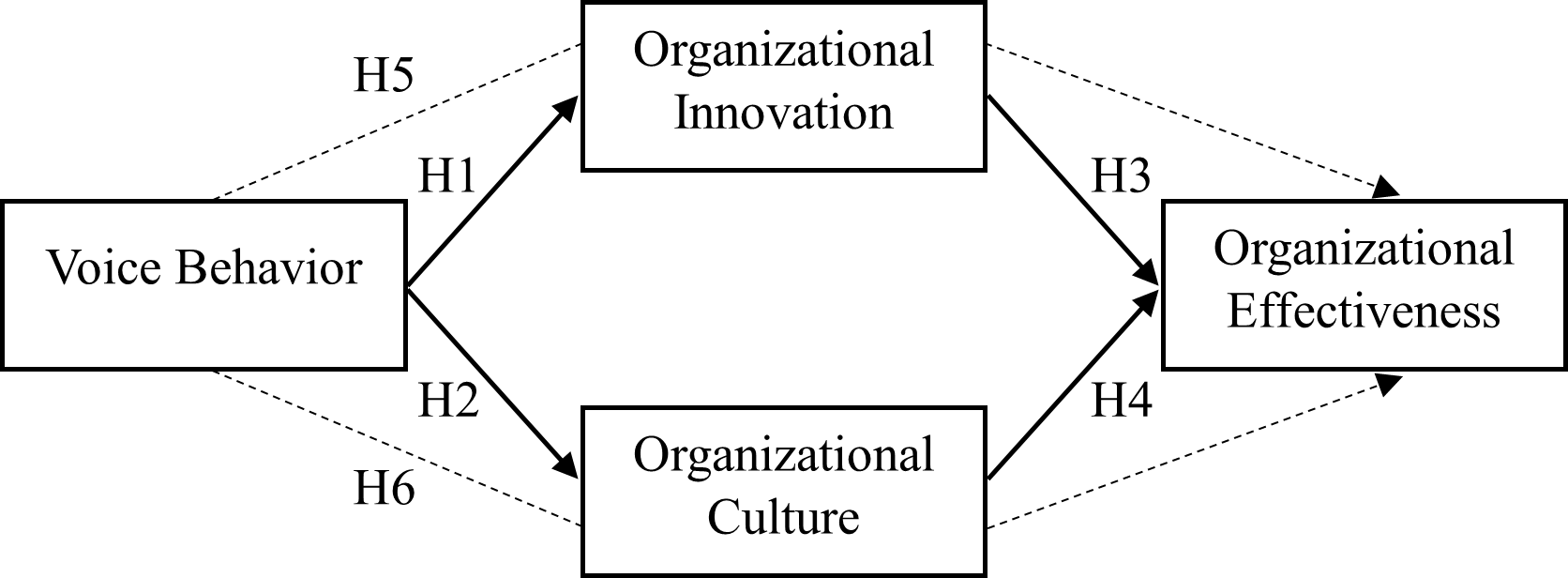
This study measured four main variables, which each variable is measured using indicators that have been tested in previous studies by . The measures were scored using the Likert scale, ranging from 1 (strongly disagree) to 4 (strongly agree).
Result
The purpose of this study was to investigate the mediating role of OI and OC in bridging the relationship between VB and OE. Data collected from the questionnaires were tabulated, and analyzed using SmartPLS 4.0.
Outer model
| Questionnaire Items | Loading factor |
| Voice Behavior | |
| You passively supports the ideas of others because you are disengaged | 0.732 |
| You passively agrees with others about solutions to problems | 0.720 |
| You participate and communicate support for the group, due to self-protection (seeking a safe zone) | 0.818 |
| You expresses solutions to problems with the cooperative motive of benefiting the organization | 0.747 |
| Organizational Innovation | |
| Your organization constantly looking to develop and offer new or improved services | 0.785 |
| Employees' ability to function creatively is respected by leaders | 0.732 |
| Assistance in developing new ideas is readily available | 0.729 |
| The company communicates a clear future direction to employees | 0.714 |
| The company encourages innovative strategies, knowing well that some will fail | 0.713 |
| Managers are constantly seeking new opportunities for the organization | 0.722 |
| Managers take the initiative in efforts to create an environment that benefits the organization | 0.822 |
| Organizational Culture | |
| You feel involved in your work | 0.773 |
| Business planning is ongoing and involves everyone in the process to some degree | 0.743 |
| Your company has clear and consistent values that govern how it does business | 0.791 |
| The company responds well to competitors and other changes in the business environment | 0.800 |
| Your company has long-term goals and direction | 0.834 |
| There is a clear mission that gives meaning and direction to employees' work | 0.813 |
| Organizational Effectiveness | |
| Employees perform their jobs very efficiently | 0.823 |
| Employees seem to get the most out of available resources (money, equipment, etc.) | 0.795 |
| The company is flexible enough to mobilize resources according to urgent priorities | 0.796 |
| The performance of people in your organization in anticipating problems that may arise in the future is excellent | 0.825 |
| If there are changes in routines or equipment, people in your organization are very quick to accept and adapt to these changes | 0.830 |
Table I shows the convergent validity by looking at the loading factor. This test can reduce ambiguity that may occur in indicators [51]. Outer loading value > 0,70 indicate that the construct can be considered valid.
| Variable | Cronbach's alpha | Composite reliability (rho_a) | Composite reliability (rho_c) | Average variance extracted (AVE) |
| Organizational Culture | 0.882 | 0.889 | 0.910 | 0.629 |
| Organizational Effectiveness | 0.873 | 0.876 | 0.907 | 0.662 |
| Organizational Innovation | 0.868 | 0.879 | 0.898 | 0.557 |
| Voice Behavior | 0.759 | 0.802 | 0.841 | 0.570 |
Table II shows Cronbach's Alpha value, which considered reliable if it is > 0,70 based on the criteria[51]. All variables in this study meet these criteria. AVE value measures how much of the average indicator variance can be explained by the construct. Variables are said to be valid and good if they have an Average Variance Extracted (AVE) value> 0,5[51]. The AVE value of the four variables is > 0,50, meaning that all variables can be categorized as valid. The composite reliability value is > 0,70, indicates that the research instrument is reliable. So that, the four constructs are declared reliable in measuring their indicators.
| Variabel | BudayaOrganisasi | EfektivitasOrganisasi | InovasiOrganisasi | Voice Behavior |
| Organizational Culture | 0.793 | |||
| Organizational Effectiveness | 0.345 | 0.814 | ||
| Organizational Innovation | 0.295 | 0.369 | 0.746 | |
| Voice Behavior | 0.301 | 0.285 | 0.358 | 0.755 |
| Heterotrait-monotrait ratio (HTMT) | |
| OE <-> OC | 0.386 |
| OI <-> OC | 0.318 |
| OI <-> OE | 0.418 |
| VB <-> OC | 0.33 |
| VB <-> OE | 0.333 |
| VB <-> OI | 0.379 |
Table III and IV shows the discriminant validity. Fornell-Larcker is effectively used to check whether the constructs in the PLS model have good discrimination. These results show that each construct in this research model has a root AVE greater than the correlation value in the same row, so the construct is said to be valid. HTMT, as the most accurate method in discriminant validity testing, is used to evaluate construct validity by looking at the empirical differences between two constructs. All constructs have values < 0,90. So that, the measurement model is valid.
Inner Model
Table V. R-Square
| Variable | R-square | R-square adjusted |
| OC | 0,091 | 0,086 |
| OE | 0,210 | 0,198 |
| OI | 0,128 | 0,124 |
Table V shows the R-Square value. These values indicate that the relationship between variables in the model is relatively weak, so there are still many other factors outside the model that play a role in explaining these three variables. In the context of the Resource-Based View theory[10] , this finding shows that to improve OE, it cannot only rely on the contribution of internal resources (VB, OI, OC ), but the contribution can also be influenced by broader external factors.
| Original sample (O) | T statistics | P values | |
| OC -> OE | 0,233 | 2,312 | 0,021 |
| OI -> OE | 0,256 | 2,863 | 0,004 |
| VB -> OC | 0,301 | 4,224 | 0,000 |
| VB -> OE | 0,123 | 1,320 | 0,187 |
| VB -> OI | 0,358 | 5,218 | 0,000 |
Table VI shows the bootstrapping test of direct effect. This test produces output in the form of path coefficient values, t-statistics, and p-values. These values are used to assess whether the hypothesis is acceptable or not. The analysis shows that H1 and H2 is accepted, in which VB has a direct effect on OI and OC. Also, OI and OC has a direct effect on OE, so H3 and H4 is accepted. In contrast, VB has no direct effect on OE, that makes the role of mediating is necessary.
| Original sample (O) | T statistics | P values | |
| VB-> OI -> OE | 0,092 | 2,624 | 0,009 |
| VB-> OC -> OE | 0,07 | 2,013 | 0,044 |
Table VII shows bootstrapping test indirect effect. The analysis shows that H5 and H6 is accepted, in which VBhas a significant indirect effect on OE through OI and OC, so H5 and H6 is accepted. This finding indicates that employees' VB can encourage the creation of a positive OC, which in turn contributes to increasing OE.
Overall, the results of this test indicate that employee VBdoes not have a direct impact on OE, but its role becomes significant when combined with OC and innovation as a mediator. This finding is consistent with the RBV view, that organizational excellence depends not only on individual behavior, but also on how that behavior is processed into collective capabilities integrated in OC and innovation.
Discussion
Findings
By investigating the impact of VB on OE through the mediating role of OI and OC, this study discusses important findings regarding individual behaviors that can bring change to the organizational level and determine the direction of company growth. This study found that VB has a direct influence on OI, reflecting that the vocal effects of generation Z employees in Yogyakarta are able to generate critical ideas and ideas that drive OI (Hypothesis 1). Furthermore, VB has a direct influence on OC, which reflects the vocal effects of generation Z employees in Yogyakarta are able to encourage an open and participatory OC (Hypothesis 2). These findings prove that the vocal behavior of Gen Z employees can be an organizational strategic resource in creating competitive constructive change. The results of this study are in line with the Resource-Based View theory[10] which in the context of this study emphasizes that proactive behavior such as VB is an intangible resource that is difficult to
While OI has a direct effect on OE (Hypothesis 3). OI allows organizations to adapt to a dynamic business environment, in order to keep up with the times (e.g., technology, market needs, consumer desires), and maintain their competitive advantage. OI is seen as the result of managing internal resources that are valuable, rare, difficult to imitate, and irreplaceable in accordance with RBV theory. When the organization is able to manage its human resources and knowledge to produce innovation, then the organization can be said to have a competitive advantage. Previous research shows that organizations with high innovative capacity tend to achieve optimal operational effectiveness[35] [27]. A structurally designed innovation strategy is able to improve internal efficiency while strengthening organizational competitiveness in the long term[52] [53]
In addition, this study also proves that OC has a direct effect on OE (Hypothesis 4). In RBV theory, OC that is formed from collective values and consistent internal processes and ultimately has unique characteristics is considered a strategic asset that ultimately increases capabilities in terms of OE. A culture that has developed through long-term interaction, emotional involvement, and agreement on internal values makes the organization have a sustainable advantage from a strong culture. The findings of the influence of OC on OE are in line with previous research by[54] [3] [55] [56] [37] [11] [48]
VB has no effect on OE. This finding provides a new understanding that the contribution of Gen Z employees does not necessarily have a direct impact on organizational performance, but rather through the formation of culture and innovation first. In this case, OI and OC as full mediation play a role in bridging VB so that it can ultimately have an impact on OE. Another interesting finding is the very small effect size value in the direct relationship between VB and OE, but it increases significantly when going through the mediation path. At the same time, the relationship between VB and OE is fully mediated by OI (Hypothesis 5) and OC (Hypothesis 6). Both indirect effect hypotheses were accepted.
Theoretical implication
Theoretically, the results of this study enrich the literature on RBV theory, where in this case VB as an intangible strategic resource can play a role in driving the company's competitive advantage through OI and OC. This research also supports the RBV framework which says that competitive advantage is not only seen from the resources owned, but also about how the organization is able to manage and optimize these resources. In addition, the findings of this study add new knowledge that VB on OE is indirect. Thus, this study provides a conceptual contribution in identifying the variable mechanism that bridges the role of VB on OE. This study also answers the research gap that has not previously discussed the influence between VB, OC, innovation, and effectiveness simultaneously.
Managerial implication
From a practical perspective, the results of this study provide important insights for organizational managers and leaders in managing Gen Z employee behavior, especially VB. VB, which tends to be expressive, should not be ignored and misinterpreted as a form of insubordination. Instead, companies need to create an open system and provide a space for dialogue for employees to create innovative ideas and critical solutions to problems that occur. Organizations must also realize the importance of developing an inclusive, adaptive, and collaborative work culture. By strategically managing VB, companies will not only create innovation and a strong culture, but also build a sustainable competitive advantage in the long run.
Limitations and future directions
This study still has limitations on the geographical scope that only focuses on Generation Z employees in Yogyakarta, Indonesia. Therefore, future researchers are advised to develop this research with a wider area coverage or in certain industry sectors to obtain a more specific picture. Secondly, although the focus on Generation Z provides a strong context, the results may not be generalizable to other regions with different cultures. Future research is recommended to use qualitative or mixed methods in order to explore other factors that influence VB, OI, OC, and organizational effectiveness.
Ethical approval
The research involved human participants who voluntarily took part in a questionnaire survey. Formal ethical clearance was not required by my institution for minimal-risk survey research. Nevertheless, the study adhered to ethical principles, and all participants provided informed consent. Confidentiality and anonymity were fully ensured throughout the stud
References
- An, ji Y., Yom, Y.H. and Ruggiero, J.S. (2011) ‘Organizational Culture, Quality of Work Life, and Organizational Effectiveness in Korean University Hospitals’, Journal of Transcultural Nursing, 22(1), pp. 22–30. doi:. DOI ↗ Google Scholar ↗
- Andriyanti, E. (2019) ‘Language Shift among Javanese Youth and Their Perception of Local and National Identities’, GEMA Online Journal of Language Studies, 19(3), pp. 109–125. doi:. DOI ↗ Google Scholar ↗
- Arditya Afrizal Mahardika, Ingarianti, T. and Uun Zulfiana (2022) ‘Work-life balance pada karyawan generasi Z’, Collabryzk Journal for Scientific Studies, 1(1), pp. 1–16. doi:. DOI ↗ Google Scholar ↗
- Barney, J. (1991) ‘Firm Resources and Sustained Competitive Advantage’, Journal of Management, 17(1), pp. 99–120. doi:. DOI ↗ Google Scholar ↗
- Bashshur, M.R. and Oc, B. (2014) ‘When Voice Matters: A Multilevel Review of the Impact of Voice in Organizations’, Journal of Management, xx(x), pp. 1530–1554. doi:. DOI ↗ Google Scholar ↗
- Birkinshaw, J., Hamel, G. and Mol, M.J. (2008) ‘Management innovation’, Academy of Management Review, 33(4), pp. 825–845. doi:. DOI ↗ Google Scholar ↗
- Boer, H. and During, W.E. (2001) ‘Innovation, what innovation? A comparison between product, process, and organizational innovation’, International Journal of Technology Management, 22(1), pp. 83–107. doi:. DOI ↗ Google Scholar ↗
- Brinsfield, C.T., Edwards, M.S. and Greenberg, J. (2009) ‘Voice and silence in organizations: Historical review and current conceptualizations’, in Greenberg, J. and Edwards, M.S. (eds) Voice and Silence in Organizations. Bingley, UK: Emerald Group Publishing, pp. 3–33. Google Scholar ↗
- Cameron, K. (1986) ‘A Study of Organizational Effectiveness and Its Predictors’, Management Science, 32(1), pp. 87–112. doi:. DOI ↗ Google Scholar ↗
- Cameron, K.S. and Whetten, D.A. (2013) Organizational Effectiveness A Comparison of Multiple Models. New York (US): Academic Press. Google Scholar ↗
- Chou, S.Y. and Barron, K. (2016) ‘Employee Voice Behavior Revisited: Its Forms and Antecedents’, Management Research Review, 39(12), pp. 1720–1737. doi:. DOI ↗ Google Scholar ↗
- Coff, R.W. (1997) ‘Human assets and management dilemmas: Coping with hazards on the road to resource-based theory’, Academy of Management Review, 22(2), pp. 374–402. doi:. DOI ↗ Google Scholar ↗
- Damanpour, F. (1991) ‘ORGANIZATIONAL INNOVATION: A META-ANALYSIS OF EFFECTS OF DETERMINANTS AND MODERATORS’, Academy of Management Journal, 34(3), pp. 555–590. doi:. DOI ↗ Google Scholar ↗
- Damanpour, F. and Evan, W.M. (1984) ‘Organizational Innovation and Performance: The Problem of “Organizational Lag”’, Administrative Science Quarterly, 29(3), pp. 392–409. doi:. DOI ↗ Google Scholar ↗
- Damanpour, F. and Gopalakrishnan, S. (2001) ‘The Dynamics of the Adoption of Product and Process Innovations in Organizations’, Journal of Management Studies, 38(1), pp. 0022–2380. doi:. DOI ↗ Google Scholar ↗
- Damanpour, F., Walker, R.M. and Avellaneda, C.N. (2009) ‘Combinative effects of innovation types and organizational Performance: A longitudinal study of service organizations’, Journal of Management Studies, 46(4), pp. 650–675. doi:. DOI ↗ Google Scholar ↗
- Darmawan, D. (2022) ‘Budaya Organisasi, Kepemimpinan dan Komitmen: Determinan Efektivitas Organisasi yang Akurat’, TIN: Terapan Informatika Nusantara, 3(7), pp. 260–266. doi:. DOI ↗ Google Scholar ↗
- Deem, J.W., DeLotell, P.J. and Kelly, K. (2015) ‘The relationship of employee status to organizational culture and organizational effectiveness: a quantitative analysis’, International Journal of Educational Management, 29(5), pp. 563–581. DOI ↗ Google Scholar ↗
- Denison, D. and Mishra, A.K. (1995) ‘Toward a theory of OC and effectiveness’, Institute for Operations Research and the Management Sciences, 6(2), pp. 204–223. doi:. DOI ↗ Google Scholar ↗
- Denison, D.R., Haaland, S. and Goelzer, P. (2003) ‘Corporate Culture and Organizational Effectiveness: Is There a Similar Pattern Around the World?’, Advances in Global Leadership, 3, pp. 205–227. doi:. DOI ↗ Google Scholar ↗
- Denison, D.R., Haaland, S. and Goelzer, P. (2004) ‘Corporate culture and organizational effectiveness: Is Asia different from the rest of the world?’, Organizational Dynamics, 33(1), pp. 98–109. doi:. DOI ↗ Google Scholar ↗
- Denison, D.R. and Neale, W.S. (1996) Denison Organizational Culture Survey: Facilitator’s Guide. Ann Arbor, USA: Aviat. Google Scholar ↗
- Dhoopar, A., Sihag, P. and Gupta, B. (2023) ‘Antecedents and measures of organizational effectiveness: A systematic review of literature’, Human Resource Management Review, 33(1). doi:. DOI ↗ Google Scholar ↗
- Douglas, S. et al. (2021) ‘Systemic Leadership Development: Impact on Organizational Effectiveness’, International Journal of Organizational Analysis, 30(2), pp. 568–588. doi:. DOI ↗ Google Scholar ↗
- Dyne, L. Van, Ang, S. and Botero, I.C. (2003) ‘Conceptualizing employee silence and employee voice as multidimensional constructs’, Journal of Management Studies, 40(6), pp. 1359–1392. doi:. DOI ↗ Google Scholar ↗
- Dyne, L. Van and LePine, J.A. (1998) ‘Helping and Voice Extra-Role Behaviors: Evidence of Construct and Predictive Validity’, Academy of Management Journal, 41(1), pp. 108–119. doi:. DOI ↗ Google Scholar ↗
- Farida, I. and Setiawan, D. (2022) ‘Business Strategies and Competitive Advantage: The Role of Performance and Innovation’, Journal of Open Innovation: Technology, Market, and Complexity, 8(3), p. 163. doi:. DOI ↗ Google Scholar ↗
- Farndale, E. et al. (2011) ‘THE INFLUENCE OF PERCEIVED EMPLOYEE VOICE ON ORGANIZATIONAL COMMITMENT: AN EXCHANGE PERSPECTIVE’, Human Resource Management, 50(1), pp. 113–129. doi:. DOI ↗ Google Scholar ↗
- Gold, A.H., Malhotra, A. and Segars, A.H. (2001) ‘Knowledge management: An organizational capabilities perspective’, Journal of Management Information Systems, 18(1), pp. 185–214. doi:. DOI ↗ Google Scholar ↗
- Gregory, B.T. et al. (2009) ‘Organizational culture and effectiveness: A study of values, attitudes, and organizational outcomes’, Journal of Business Research, 62(7), pp. 673–679. doi:. DOI ↗ Google Scholar ↗
- Guzman, F.A. and Espejo, A. (2019) ‘Introducing changes at work: How voice behavior relates to management innovation’, Journal of Organizational Behavior, 40(1), pp. 73–90. doi:. DOI ↗ Google Scholar ↗
- Hair, J.F. et al. (2021) Evaluation of Formative Measurement Models. doi:. DOI ↗ Google Scholar ↗
- Hakim, N.P.A. et al. (2024) ‘Partisipasi Gen Z dalam Konteks Dinamika Pembangunan di Indonesia’, Jurnal Penelitian Sosial Ilmu Komunikasi, 8(1), pp. 21–29. doi:. DOI ↗ Google Scholar ↗
- Joseph, S. and Shetty, N. (2022) ‘An empirical study on the impact of employee voice and silence on destructive leadership and organizational culture’, Asian Journal of Business Ethics, 11, pp. 85–109. doi:. DOI ↗ Google Scholar ↗
- Katsaros, K.K. (2024) ‘Gen Z Employee Adaptive Performance: The Role of Inclusive Leadership and Workplace Happiness’, Administrative Sciences, 14(8). doi:. DOI ↗ Google Scholar ↗
- Kim, J.H., Kim, C.S. and Kim, J.M. (2011) ‘Analysis of the effect of leadership and organizational culture on the organizational effectiveness of radiological technologist’s working environments’, Radiography, 17(3), pp. 201–206. doi:. DOI ↗ Google Scholar ↗
- Miao, R. et al. (2020) ‘The high-performance work system, employee voice, and innovative behavior: The moderating role of psychological safety’, International Journal of Environmental Research and Public Health, 17(4), p. 1150. doi:. DOI ↗ Google Scholar ↗
- Morgan, R.E. and Strong, C.A. (1998) ‘Market orientation and dimensions of strategic orientation’, European Journal of Marketing, 32(11), pp. 1051–1073. doi:. DOI ↗ Google Scholar ↗
- Morrison, E.W. (2011) ‘Employee voice behavior: Integration and directions for future research’, The Academy of Management Annals, 5(1), pp. 373–412. doi:. DOI ↗ Google Scholar ↗
- Mott, P.E. (1972) The characteristics of effective organizations. New York (US): Harper & Row. Google Scholar ↗
- Munna, U.L. and Ayundasari, L. (2021) ‘Islam Kejawen: Lahirnya akulturasi Islam dengan budaya Jawa di Yogyakarta’, Jurnal Integrasi dan Harmoni Inovatif Ilmu-Ilmu Sosial, 1(3), pp. 317–325. doi:. DOI ↗ Google Scholar ↗
- Naveed, R.T. et al. (2022) ‘Do organizations really evolve? The critical link between organizational culture and organizational innovation toward organizational effectiveness: Pivotal role of organizational resistance’, Journal of Innovation and Knowledge, 7(2), p. 100178. doi:. DOI ↗ Google Scholar ↗
- Otoo, F.N.K. (2024) ‘The mediating role of employee performance in the relationship between human resource management (HRM) practices and police service effectiveness’, IIM Ranchi Journal of Management Studies, 3(2), pp. 108–141. doi:. DOI ↗ Google Scholar ↗
- Porter, M.E. (1985) Competitive Advantage Creating and Sustaining Superior Performance. 1st edn, Studia Politica. 1st edn. New York (US): The Free Press. Google Scholar ↗
- Price, J.L. (1972) ‘The Study of Organizational Effectiveness’, Sociological Quarterly, 13(1), pp. 3–15. doi:. DOI ↗ Google Scholar ↗
- Quinn, R.E. and Rohrbaugh, J. (1981) ‘A Competing Values Approach to Organizational Effectiveness’, Public Productivity Review, 5(2), pp. 122–140. doi:. DOI ↗ Google Scholar ↗
- Rasheed, M.A. et al. (2017) ‘Exploring the role of employee voice between high-performance work system and organizational innovation in small and medium enterprises’, Journal of Small Business and Enterprise Development, 24(4), pp. 670–688. doi:. DOI ↗ Google Scholar ↗
- Robbins, S.P. and Judge, T. (2009) Organizational Behavior. 2nd edn. Edited by N. Pfaff. South Africa: Pearson Education. Google Scholar ↗
- Rosenbusch, N., Brinckmann, J. and Bausch, A. (2011) ‘Is innovation always beneficial? A meta-analysis of the relationship between innovation and performance in SMEs’, Journal of Business Venturing, 26(4), pp. 441–457. doi:. DOI ↗ Google Scholar ↗
- Ruvio, A.A. et al. (2014) ‘Organizational innovativeness: Construct development and cross-cultural validation’, Journal of Product Innovation Management, 31(5), pp. 1004–1022. doi:. DOI ↗ Google Scholar ↗
- Saffold, G.S. (1988) ‘Culture Traits, Strength, and Organizational Performance: Moving Beyond “Strong” Culture’, Academy of Management Review, 13(4), pp. 546–558. doi:. DOI ↗ Google Scholar ↗
- Salavou, H., Baltas, G. and Lioukas, S. (2004) ‘Organisational innovation in SMEs: The importance of strategic orientation and competitive structure’, European Journal of Marketing, 38(9–10), pp. 1091–1112. doi:. DOI ↗ Google Scholar ↗
- Sanders, K. et al. (2010) ‘How to Support Innovative Behaviour?The Role of LMX and Satisfaction with HR Practices’, Technology and Investment, 01(01), pp. 59–68. doi:. DOI ↗ Google Scholar ↗
- Steers, R.M. (1977) Organizational effectiveness : a behavioral view. California (US): Goodyear. Google Scholar ↗
- Tedone, A.M. and Bruk-Lee, V. (2022) ‘Speaking up at work: personality’s influence on employee voice behavior’, International Journal of Organizational Analysis, 30(2), pp. 289–304. doi:. DOI ↗ Google Scholar ↗
- Teece, D.J., Pisano, G. and Shuen, A. (1997) ‘Dynamic capabilities and strategic management’, Strategic Management Journal, 18(7), pp. 509–553. doi:. DOI ↗ Google Scholar ↗
- Yuchtman, E. and Seashore, S.E. (1967) ‘A System Resource Approach to Organizational Effectiveness’, American Sociological Review, 32(6), p. 891. doi:. DOI ↗ Google Scholar ↗
- Zheng, W., Yang, B. and McLean, G.N. (2010) ‘Linking organizational culture, structure, strategy, and organizational effectiveness: Mediating role of knowledge management’, Journal of Business Research, 63(7), pp. 763–771. doi:. DOI ↗ Google Scholar ↗