Abstract
The development of artificial intelligence (AI) technology on social commerce platforms, especially TikTok Shop, has presented two dominant innovations in the formof recommender systems and chatbots that play an important role in shaping the consumptive behavior of Gen Z. This research aims to analyze the recommender and chatbot influence on the buying intention of Gen Z Muslim consumers on TikTok Shop, with trust as a mediation variable and Islamic business ethics as a moderation variable. A quantitative approach was applied through the distribution of questionnaires to 300 Muslim Gen Z respondents in Banda Aceh City, selected using a purposive sampling technique. The data were analyzed using PLS-SEM with SmartPLS. The results show that recommender and chatbot positively significantly affect trust and buying intention. Trust has been shown to partially mediate the recommender and chatbot technologies' impact on buying intention. Islamic business ethics have a direct effect on buying intention, but they have not been shown to moderate the impact of recommender and chatbot recommendations on consumer buying intention. These findings imply that optimizing the quality of AI technology in line with the values of transparency and honesty is a crucial strategy for increasing trust and buying intention among Muslim consumers in the era of social commerce.
Keywords
chatbot islamic business ethics buying intention recommender system
1. Introduction
Technological advancements in Artificial Intelligence (AI) have revolutionized the way people interact in the digital commerce ecosystem, particularly on social commerce platforms, which combine video-based entertainment with electronic transaction systems simultaneously. In Indonesia, this transformation is taking place very rapidly along with the dominance of the population Digital Native, especially Gen Z, who make technology an inseparable part of their daily lives. TikTok Shop is the most prominent representation of this phenomenon by intensively integrating AI algorithms to provide a personalized and efficient shopping experience. Based on We Are Social (2024) data, more than 80% of Indonesian internet users are in the age group of 16–34 years old, and most rely on digital recommendations in making purchasing decisions. Reports from (Kemp, 2024) noted that 68% of TikTok Shop users in Indonesia are from Gen Z, and seven out of ten of them have made direct transactions through product recommendations or Live Shopping.
The two forms of AI application that dominate TikTok Shop are recommender system and chatbot. A recommender system is an algorithm-based system that presents the most relevant product recommendations according to preferences and user interaction history (Garapati & Chakrabort, 2025), while a chatbot is an AI-based software agent that automatically interacts with consumers to provide information and guidance on purchasing in real-time (Syarifudin et al., 2024). The combination of these two technologies creates a holistic shopping experience, but at the same time raises serious ethical and regulatory questions regarding algorithmic transparency and economic fairness (Mittelstadt et al., 2016). In September 2023, the Indonesian government temporarily suspended direct buying and selling activities on TikTok Shop through Trade Minister Regulation Number 31 of 2023 in order to organize the digital trade ecosystem and prevent monopoly practices. After regulatory adjustments, TikTok Shop has resumed operations through a partnership with Tokopedia since December 2023. However, after this recovery, consumer buying intentions have not fully recovered, with a decline in sales in a number of product categories that reached 38%, so the role of the two AI technologies has become increasingly crucial in rebuilding consumer trust.
Theoretically, Trust has been identified as the main determinant of buying intention in digital transactions. (Gefen et al., 2003) Define Trust as an individual's belief that the digital platform will behave honestly and not harm users, while (Pavlou, 2003) confirms that trust serves as a psychological mechanism to reduce uncertainty in an anonymous digital environment. When Recommender presents accurate and personalized recommendations, consumers consider the platform to have high integrity, so that trust is formed organically. Similarly, the quality of interaction of a responsive contributes significantly to the improvement of trust, which ultimately drives buying intent (Pavlou, 2003). From the perspective of Islamic Business Ethics, as stated (Beekun, 2006), good business practices should reflect a balance between economic efficiency and moral responsibility, where the value of honesty (ṣidq), justice ('adl), and mandate is the main foundation of economic activity. This context becomes particularly relevant in Banda Aceh as the only provincial capital in Indonesia to formally implement sharia law, with 98% of the population being Muslim (BPS-BandaAceh, 2024), so that Islamic business ethics are positioned as a moderating variable that has the potential to strengthen or weaken the AI technology relationship with the buying intention of Muslim consumers.
There are several gaps in research that underlie the urgency of this research. Studies from (Balampaki & Rawat, 2025) and (Kervenoael et al., 2024) each only researched one form of AI technology separately without integrating the two in a single model. In addition, empirical testing of the role of Islamic business ethics as a moderator in the relationship between AI technology and buying intention on the platform Social Commerce It is still very limited. (Zubaidi, 2026) emphasized the importance of developing AI systems that are in line with the principles maqāṣid al-syarī'ah, but this normative emphasis has not been followed by adequate empirical testing. The novelty of this research lies in the use of the moderated mediation that integrates two forms of AI technology at once, with Trust as a mediator and Islamic business ethics as a moderator, focusing on Gen Z Muslim consumers in the area of formal Islamic Sharia implementation.
This study formulated nine research questions about how the recommender and chatbot affect the trust and buying intention of Gen Z Muslim consumers on TikTok Shop. According to the problem discussed above, this research contributes to the development of AI-based digital marketing literature in the context of Islamic economics, as well as enriching the study of Muslim consumer behavior of Gen Z on social commerce, which is still limited in academic research in Indonesia. Practically, these findings are expected to be input for platform developers in designing AI algorithms that are more ethical and transparent, as well as helping MSME actors in Banda Aceh understand the dynamics of Muslim consumer behavior of Gen Z in the social commerce era.
2. Literature Review
2.1 Buying intention
Buying intention is defined as the tendency of consumers behavior to make a purchase for a certain product or service based on their attitudes, beliefs, and experience with a digital platform (Pavlou, 2003). In the context of e-commerce, the buying intention does not appear instantly, but rather is formed through the process of evaluating the user's experience of the system used, where the existence of relevant and personalized AI technology contributes to the increase in positive perception of consumers, which ultimately encourages the psychological impulse to transact (Balampaki & Rawat, 2025). From the perspective of Islamic economics, the buying intention is not solely shaped by functional rational considerations but is also influenced by the dimension of religious beliefs, to the extent that consumers believe that the transaction process is in harmony with the principles of halal, honesty (ṣidq), and justice ('adl) in Islam (Putra et al., 2025).
Recommender
Recommender is an artificial intelligence algorithm-based technology that studies user behavior and preferences to generate relevant, efficient, and personalized product suggestions (Balampaki & Rawat, 2025). This system acts as a decision-making tool that is able to reduce consumer uncertainty in choosing products amid the abundance of digital information (Pavlou, 2003). From an Islamic perspective, Recommender should not only adjust consumer preferences but also adhere to Islamic business ethics by not displaying products that are contrary to halal principles or encouraging excessive consumptive behavior (Rahel et al., 2025).
2.2 Chatbot
A chatbot is an AI-based software agent designed to automatically interact with users through conversational interfaces, process natural language, and provide information and support services in a timely manner (Kervenoael et al., 2024). Quality Chatbot is measured through four main dimensions, namely responsiveness, information accuracy, empathy, and similarity of interaction with human conversation. From the perspective of Islamic business ethics, a Chatbot designed according to Sharia principles should avoid misleading practices, convey information honestly, and maintain user privacy as a manifestation of trust values in digital activities (Azzah et al., 2026).
2.3 Trust
In the context of e-commerce, trust is defined as an individual's belief that a digital platform or system will behave honestly, reliably, and not harm the interests of users (Gefen et al., 2003). Trust serves as a psychological mechanism to reduce uncertainty in an anonymous and risky digital environment, where consumers with a high level of trust will be more willing to make transactions even if there is no face-to-face interaction (Pavlou, 2003). In an Islamic perspective, trust is not just a social contract, but a moral responsibility that is born when a platform demonstrates honesty (ṣidq), transparency (tablīgh), and justice ('adl) in every digital interaction (Putra et al., 2025).
2.4 Islamic Business Ethics
Islamic Business Ethics is a set of moral principles that govern business activities to be in harmony with Islamic teachings, emphasizing the values of honesty, trust, justice, and social responsibility as the basis for economic decision-making (Beekun, 2006). In the context of AI adoption and digital automation, Islamic business ethics demand that technological systems such as Recommender and Chatbot operate transparently, avoid data misuse, do not mislead users, and respect sharia values (Azzah et al., 2026). The application of Islamic ethical principles in digital marketing has been proven to strengthen the trust of Muslim consumers because they feel that the transaction activities carried out are in harmony with their spiritual beliefs and moral commitments (Rahel et al., 2025).
2.5 Hypothesis
Based on the theoretical studies and empirical findings that have been described, the hypotheses in this study are formulated as follows:
H1: significantly recommender affects trust
H2: significantly chatbot affects trust
H3: significantly the recommender affects buying intention
H4: significantly chatbot affect buying intention
H5: significantly trust affects buying intention
H6: significantly trust mediates the recommender affecting buying intention
H7: significantly trust mediates the chatbot affecting buying intention
H8: significantly Islamic business ethics moderate the recommender affecting buying intention
H9: significantly Islamic business ethics moderate the chatbot affecting buying intention
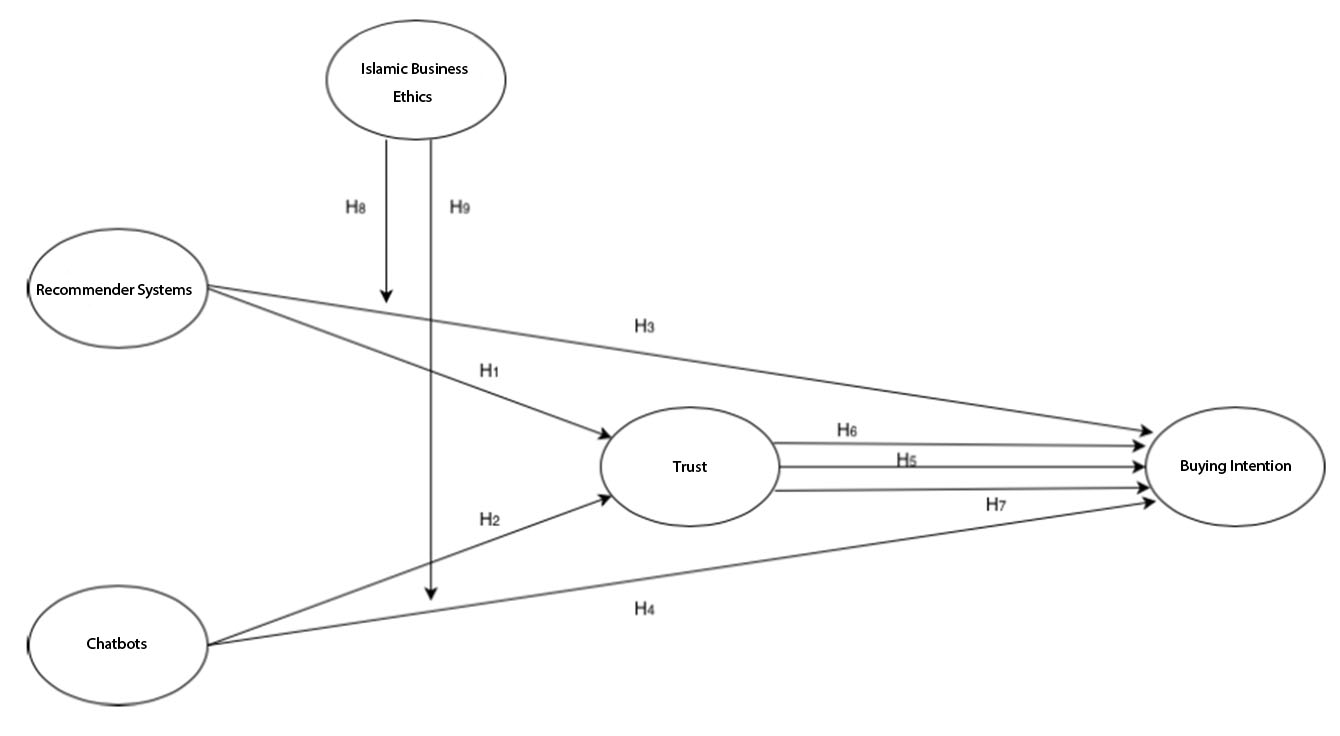
Figure 1 above shows that recommender and chatbot affect the purchasing intention of Gen Z Muslim consumers either directly or indirectly through trust as a mediator. Islamic business ethics is positioned as a moderating variable that regulates the strength of the relationship between the two AI technologies and buying intentions, thus forming a moderated mediation model that is the main analytical framework of this study.
3. Method
This study uses a quantitative method that aims to analyze the relationship between variables statistically to produce measurable, objective conclusions. Primary data was obtained through the distribution of questionnaires to Gen Z respondents who had made transactions on TikTok Shop, while secondary data was sourced from relevant scientific journals and literature on e-commerce and consumer behavior (Scott et al., 2017). The research population is Gen Z individuals in Banda Aceh City who have transacted through TikTok Shop. Respondents were determined using purposive sampling with the criteria: 18–28 years old, active in using TikTok Shop, domiciled in Banda Aceh City, having interacted with the Recommender or Chatbot, and understanding the basic principles of Islamic business ethics. Refer to the PLS-SEM recommendations:≥5–10 respondents per indicator. This study targets 300 respondents, with a Buffer of 10%, for a total of 330 respondents. Variable measurement using a Likert scale (1-5), ranging from strongly disagree to strongly agree.
This research involves five variables, that are recommender and chatbot as independent variables, buying intention as the dependent variable, trust as a mediating variable, and Islamic business ethics as a moderating variable. Data analysis is carried out using Partial Least Squares-Structural Equation Modeling (PLS-SEM), assisted by SmartPLS. This method was chosen because it is able to analyze complex models, combine latent variables with multiple indicators, and test direct relationships, mediation, and moderation simultaneously without requiring strict normality of data (Hair et al., 2021). The analysis process is carried out in two main stages, namely evaluation of the Outer model to assess the validity and reliability of the construct through convergent validity, Discriminant validity, Composite reliability, and Cronbach's alpha, as well as evaluation of the Inner model to test the structural relationships between variables through the values of R², F², Q², and goodness of fit.
4. Result And Discussion
4.1 Result
4.1.1 Outer Model
Before testing the hypothesis, outer model evaluation was first carried out to ensure the validity and reliability of all constructs in this study. Convergent validity testing was carried out through outer loading analysis and Average Variance Extracted (AVE) values. The test results are presented in Table 1 below.
| Construct | Indicator | Outer Loading | AVE |
| chatbot | CH1–CH6 | 0.847–0.909 | 0.774 |
| Islamic business ethics | IBE1–IBE6 | 0.853–0.909 | 0.787 |
| buying intention | BI1–BI6 | 0.818–0.904 | 0.736 |
| recommender | RS1–RS6 | 0.855–0.894 | 0.770 |
| trust | T1–T6 | 0.835–0.890 | 0.738 |
Source: Data processing with PLS, 2026
Table 1 shows that all indicators in each construct have an outer loading value >0.70 and an AVE value > 0.50, so that the convergent validity criteria are well met. Furthermore, discriminant validity testing was carried out through the Fornell-Larcker Criterion and the Heterotrait-Monotrait Ratio (HTMT) presented in Table 2.
| chatbot | Islamic business ethics | buying intention | recommender | trust | |
|---|---|---|---|---|---|
| chatbot | 0.880 | ||||
| Islamic business ethics | 0.534 | 0.887 | |||
| buying intention | 0.707 | 0.632 | 0.858 | ||
| recommender | 0.601 | 0.542 | 0.729 | 0.878 | |
| trust | 0.659 | 0.593 | 0.729 | 0.637 | 0.867 |
Source: Data processing with PLS, 2026
Table 2 shows that the square root value of each construct (diagonal) is greater than the correlation between other constructs, so that the discriminant validity of the model is met. The HTMT test results also show that the entire value is below 0.90, which confirms that each construct has sufficient differentiating power. The construct reliability test is presented in Table 3.
| Construct | CR (rho_a) | CR (rho_c) | Cronbach's Alpha |
|---|---|---|---|
| chatbot | 0.942 | 0.946 | 0.954 |
| Islamic business ethics | 0.946 | 0.948 | 0.957 |
| buying intention | 0.928 | 0.929 | 0.944 |
| recommender | 0.940 | 0.942 | 0.953 |
| trust | 0.929 | 0.929 | 0.944 |
Source: Data processing with PLS, 2026
Table 3 shows that all constructs have composite reliabilities> 0.70 and Cronbach's alphas> 0.60, indicating excellent reliability.
4.1.2 Inner Model
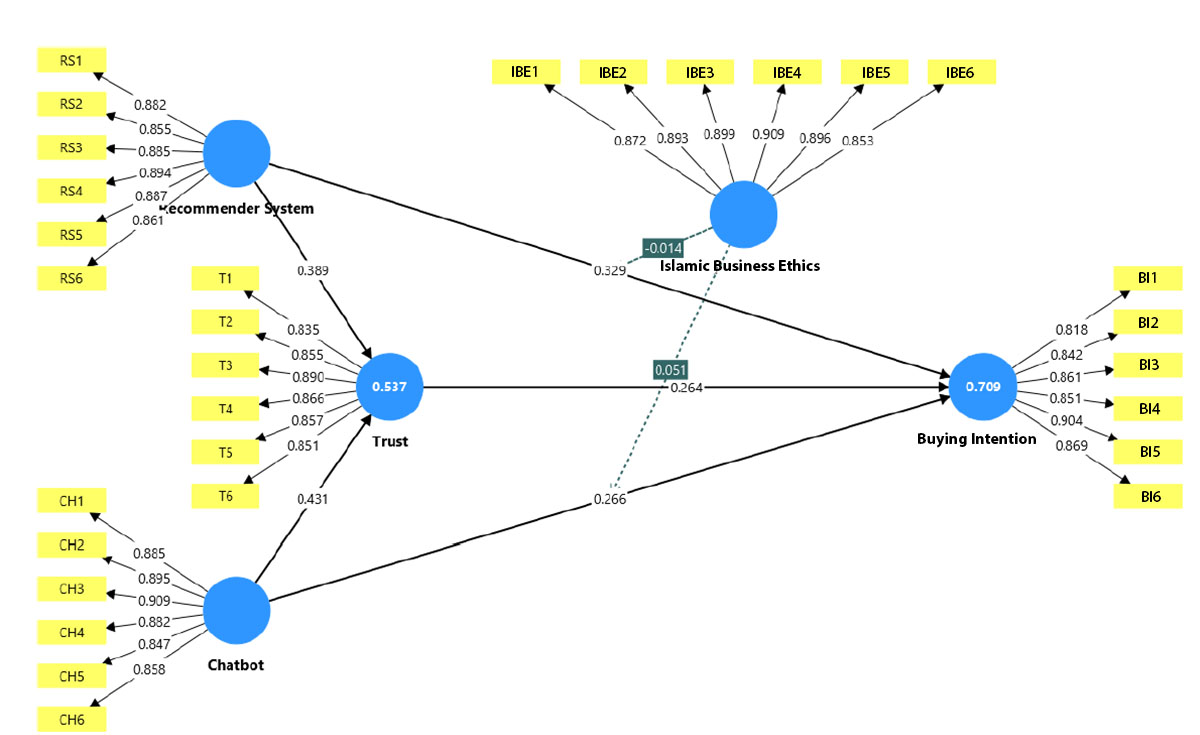
Once the measurement model has proven to be valid and reliable, the next stage is the evaluation of the inner/structural model. The R² for the Trust is 0.535, and the Buying Intention is 0.703, which means that the recommender and chatbot are able to explain 53.5% of the variation in trust, while the three variables together explain 70.3% of the variation in buying intent. A Q² value of 0.861 is close to 1, and a Goodness of Fit (GOF) value of 0.686 is well above the large category threshold (≥0.36), indicating that the model has excellent predictive and fit capabilities. Visualization of the results of the PLS-SEM analysis is presented in the following figure.
-
4.1.3 Hypothesis Testing
Direct influence hypothesis testing was carried out based on the coefficient presented in Table 4..
| Pathway | Original Sample (O) | T-Statistics | P | Remarks |
| chatbot → buying intention | 0.266 | 5.958 | 0.000 | Accepted |
| chatbot → trust | 0.433 | 9.912 | 0.000 | Accepted |
| recommender → buying intention | 0.333 | 7.405 | 0.000 | Accepted |
| recommender → trust | 0.377 | 8.758 | 0.000 | Accepted |
| trust → buying intention | 0.264 | 5.681 | 0.000 | Accepted |
Source: Data processing with PLS, 2026
Table 4 shows that all direct influence pathways are positive and statistically significant with a T-Statistic > 1.96 and p 0.000. Chatbot is the strongest predictor of tof rust, with a coefficient of 0.433, in line with the findings of (Kervenoael et al., 2024), which state that the quality of the interaction Chatbot contributes significantly to the formation of consumer trust. Meanwhile, the influence of Recommender on buying intention (β=0.333) is consistent with the study by (Balampaki & Rawat, 2025), who found that AI-driven personalization drives consumer engagement and amplifies purchase trends. Testing of mediation and moderation effects is presented in Table 5.
| Pathway | Original Sample (O) | T-Statistics | P | Remarks |
| recommender → trust → buying intention | 0.099 | 4.869 | 0.000 | Partial Mediation |
| chatbot → trust → buying intention | 0.114 | 5.054 | 0.000 | Partial Mediation |
| Islamic business ethics × chatbot → buying intention | 0.049 | 0.904 | 0.366 | Rejected |
| Islamic business ethics × recommender → buying intention | -0.013 | 0.240 | 0.811 | Rejected |
Source: Data processing with PLS, 2026
Table 5 shows that trust is partially mediates (partial mediation), influencing recommender and Chatbot on buying intention, because the direct and indirect influences of both are equally significant. These findings strengthen the argument (Pavlou, 2003) that Trust serves as a psychological mechanism that bridges technological stimuli with purchasing behavioral responses. In contrast, Islamic business ethics have not been shown to moderate the chatbot or recommender and buying intention (p > 0.05), indicating that Gen Z consumers tend to evaluate AI technology based on functional benefits, independent of normative considerations of Islam.
4,2 Discussion
4.2.1 Recommender Affecting Trust
Recommender positively significantly influences Trust (β=0.377; T=8,758; p=0.000). These findings indicate that the more relevant, accurate, and personalized the product recommendations presented by the system, the higher consumer trust in the platform. In the e-commerce ecosystem, AI-based Recommender functions like a digital assistant that helps consumers filter product choices efficiently. When the system consistently understands the needs of users, consumers judge that the platform has good competence and integrity, so that trust is formed organically ((Balampaki & Rawat, 2025). These results are reinforced by (Rasool et al., 2025), who found that personalization in the digital environment improves the perception of consumer value, and by (Chaudhary et al., 2025), who, in the context of Aceh, proved that AI technology is able to increase loyalty through Trust as a mediation variable. From the perspective of Gen Z Muslim consumers, the relevance of recommendations is not only evaluated functionally, but also from the dimensions of fairness and transparency of the system that reflects the values ṣidq and 'adl in Islam (Putra et al., 2025).
4.2.2 Chatbot Affecting Trust
Chatbot positively significantly influences Trust with the highest coefficient in the model (β=0.433; T=9,912; p=0.000). This shows that the quality of interaction between consumers and chatbots, including response speed, clarity of information, and politeness of language, plays a strategic role in building trust. In digital transactions with minimal human interaction, a chatbot is a direct representation of the quality of the platform's services, so that when it is able to answer questions accurately and not misleadingly, consumers feel safer in transacting (Kervenoael et al., 2024). (Uddin et al., 2024) confirm that trust mediates the relationship between chatbot and buying intention, while Ansarullah et al. (2026) emphasize that from a Sharia perspective, chatbot operating honestly and transparently is a manifestation of the fundamental trust value in building Muslim consumer trust.
4.2.3 Recommender Affecting Buying Intention
Recommender positively significantly influences buying intention (β=0.333; T=7,405; p=0.000). In an information-laden digital environment, Gen Z consumers tend to rely on recommendation systems to speed up decision-making. Hussain (2025) found that AI-based personalization significantly influences buying intention, especially when it aligns with Sharia values. (Ul Haq et al., 2026), adding that while Gen Z cares about privacy, they still receive personalization as long as the perceived benefits outweigh the risks. Thus, the accuracy and relevance of recommendations are a significant added value in driving digital consumer purchase decisions (Pavlou, 2003).
4.2.4 Chatbot Affecting Buying Intention
Chatbot positively significantly influences buying intention (β=0.266; T=5,958; p=0.000). Consumers can have certainty about product details, prices, and transaction processes through responsive and informative chatbots, where uncertainty is minimized, which enables faster turnaround of purchase decisions. Abdallah et al (2022) also found that chatbot positively influences customer satisfaction, which will ultimately have an impact on the tendency to repurchase. Sari et al. (2022) found that a favorable digital experience has the greatest impact on buying intention on the platform. The chatbot is not just a tool for automation, it it shapes the way consumers make buying decisions.
4.2.5 Trust Affecting Buying Intention
Trust positively significantly affects buying intention (β=0.264; T=5.681; p=0.000), thus confirming its role as the strongest predictor of digital purchases. On the other hand, in non-face-to-face transactions, consumers face uncertainty about product quality and data security (Gefen et al., 2003). When the trustworthiness of the platform is sufficiently high, their perception of risk is lower,, which increases the consumer's intent to complete a transaction. According to Prestige & Heart (2025), trust alone predicts online purchase decisions, while Maduku & Thusi (2023) found that Trust mediates the relationship between digital services quality and rebuying intention; thus leading to the argument that trust not only exerts its effect on initial consumption behavior but also indirectly on sustainable consumption behavior.
4.2.6 Trust Mediation On The Recommender Affecting Buying Intention
Testing Bootstrapping shows that trust partially mediates the recommender effect on buying intention (O=0.099; T=4.869; p=0.000). This indicates that a true and helpful recommender system directly increases the buying intention in addition to enhancing consumer trust, which acts as a psychological tie, strengthening the decision to buy. At the same time, consumers feel that the platform is a competent and trustworthy servant when they believe that the system objectively and transparently understands their preferences (Pavlou, 2003). (Chaudhary et al., 2025) additionally confirmed these observations. The influence of AI technology on retention was explained using trust as a mediating variable, and the results confirmed that, similarly to (Maduku & Thusi, 2023), it plays the role of an intervening variable in the service quality-buying intention relationship. Therefore, the proper functioning of a recommendation system requires not only complex algorithms but also an effective way to make consumers believe it is honest and trustworthy in the long run.
4.2.7 Trust Mediation On The Chatbot Affecting Buying Intention
Trust has also been shown to partially mediate the Chatbot influence on buying intention (O=0.114; T=5.054; p=0.000), with a slightly larger mediation coefficient than the recommender path. This indicates that the quality of the interaction chatbot first builds consumer trust, then finally encourages buying intention. A responsive, non-misleading chatbot creates a perception of the platform's professionalism, which increases consumers' confidence to transact. (Becan & Çeber, 2026) confirms that trust mediates the relationship between AI chatbots and buying intention, while (Ansarullah et al., 2026) emphasize that, from a Sharia perspective, chatbot honesty is a key prerequisite for maintaining Muslim users' trust. Trust thus serves as a mediation mechanism that transforms a quality Chatbot into a real consumer buying behavior.
4.2.8 Islamic Business Ethics Moderation On The Recommender And Chatbot Affecting Buying Intention
Islamic business ethics have not been shown to moderate the influence of the recommender (O = -0.013; T = 0.240; p = 0.811) and chatbot (O = 0.049; T = 0.904; p = 0.366) on buying intention. This means that the effect of the two AI technologies on buying intention remains stable at various levels of consumer ethical perception. Gen Z consumers tend to evaluate AI technology independently based on functional benefits, without being influenced by Islamic normative considerations in the relationship. These findings differ from (Hussain, 2025), who found that sharia values reinforce AI personalization, but are consistent with the argument that consumers are separating the utility of technology from ethical perceptions on platforms already commonly used (Octaviani & Puspita, 2021). Nevertheless, Islamic business ethics still have a direct and significant effect on buying intention (O=0.170; T=3.706; p=0.000), confirming that the value of honesty (ṣidq), trust, and justice ('adl) independently shaped the purchasing tendency of Muslim consumers in Banda Aceh (Beekun, 2006).
5. Conclusions
This research shows that recommender systems and chatbots positively and significantly affect the trust and buying intention of Gen Z Muslim consumers on TikTok Shop. Trust has been shown to partially mediate the recommender and chatbot effect on buying intention, confirming that trust is a central psychological mechanism that transforms the quality of technology into a driving behavior. Islamic business ethics have a direct effect on buying intention, but it has not been proven to strengthen or weaken the relationship between recommender and chatbot on consumer buying intention. Based on these findings, developers of the TikTok Shop platform are advised to increase the transparency of recommendation algorithms, develop natural language processing-based chatbots that are more adaptive and humane, and strengthen data privacy policies in accordance with Sharia principles. MSME actors in Banda Aceh are expected to make optimal use of these two AI features while upholding the values of honesty, trust, and fairness in every digital trade activity.
References
- Ansarullah, S. I., Islam, M. I. ul, Iqbal, S., Ikhlaq, S., & Yousuf, T. (2026). Artificial Intelligence Applications in Halal Tourism: Enhancing Muslim Traveler Experiences. In A. Sharma, S. Arora, & H. Pamukçu (Eds.), Halal Tourism and Artificial Intelligence: New Approaches for a New Generation. Emerald Publishing Limited. DOI ↗ Google Scholar ↗
- Azzah, R. A., Mardhiah, Z. F., & Mubarok, A. K. R. (2026). Literature Review Chatbot E-Commerce. Socius: Jurnal Penelitian Ilmu-Ilmu Sosial, 3(6), 13–30. DOI ↗ Google Scholar ↗
- Balampaki, P., & Rawat, R. (2025). The Impact of Digital Marketing on Consumer Purchase Decisions in Kathmandu Valley. Nepalese Journal of Management, 12(1), 93–111. DOI ↗ Google Scholar ↗
- Becan, C., & Çeber, B. (2026). How technology readiness influences behavioral and purchasing intention: serial multiple mediating role of attitude toward AI and AI-driven consumer chatbot experience. Digital Transformation and Society, 5(1), 78–104. DOI ↗ Google Scholar ↗
- Beekun, R. I. (2006). Islamic Business Ethics. International Institute of Islamic Thought. DOI ↗ Google Scholar ↗
- BPS-BandaAceh. (2024). Kota Banda Aceh Dalam Angka 2024. DOI ↗ Google Scholar ↗
- Chaudhary, R., Jain, S., Gupta, R., Aggarwa, V., Soniya, & Bhamu, A. (2025). Understanding the Psychology of Impulse Buying in E-Commerce: A Behavioral Review. Journal of Marketing & Social Research, 2(6), 102–113. DOI ↗ Google Scholar ↗
- Garapati, R., & Chakrabort, M. (2025). Recommender systems in the digital age: a comprehensive review of methods, challenges, and applications. Knowledge and Information Systems, 67, 6367–6411. DOI ↗ Google Scholar ↗
- Gefen, D., Karahanna, E., & Straub, D. W. (2003). Trust and TAM in Online Shopping: An Integrated Model. MIS Quarterl, 27(1), 51–90. DOI ↗ Google Scholar ↗
- Hair, J. F., Hult, G. T. M., Ringle, C. M., Sarstedt, M., Danks, N. P., & Ray, S. (2021). An Introduction to Structural Equation Modeling : Partial Least Squares Structural Equation Modeling (PLS-SEM) Using R. DOI ↗ Google Scholar ↗
- Hussain, Z. (2025). AI-driven personalization and purchase intention in modest fashion: Sharia compliance as moderator. International Journal of Halal Industry, 1(1), 33–45. DOI ↗ Google Scholar ↗
- Kemp, S. (2024). Digital 2024: Indonesia. Https://Datareportal.Com/. DOI ↗ Google Scholar ↗
- Kervenoael, R. de, Schwob, A., Hasan, R., & Psylla, E. (2024). SIoT robots and consumer experiences in retail: Unpacking repeat purchase intention drivers leveraging computers are social actors (CASA) paradigm. Journal of Retailing and Consumer Services, 76, 103589. DOI ↗ Google Scholar ↗
- Maduku, D. K., & Thusi, P. (2023). Understanding consumers’ mobile shopping continuance intention: New perspectives from South Africa. Journal of Retailing and Consumer Services, 70, 103185. DOI ↗ Google Scholar ↗
- Mittelstadt, B. D., Allo, P., Taddeo, M., Wachter, S., & Floridi, L. (2016). The ethics of algorithms: Mapping the debate. Big Data & Society, 3, 1–21. DOI ↗ Google Scholar ↗
- Octaviani, W., & Puspita, R. E. (2021). The Muslim Fashion Consumers And Purchasing Decision. Maro: Jurnal Ekonomi Syariah Dan Bisnis, 4(1), 26–33. DOI ↗ Google Scholar ↗
- Pavlou, P. A. (2003). Consumer Acceptance of Electronic Commerce: Integrating Trust and Risk with the Technology Acceptance Model. International Journal of Electronic Commerce, 7(3), 101–134. DOI ↗ Google Scholar ↗
- Putra, Y. E., Sugianto, & Majid, M. S. A. (2025). Conflict of Values and Practices of Halal Consumption: An Analysis of Muslim Consumer Behavior from an Islamic Economic Perspective. Jurnal Akuntansi Manajemen Ekonomi Kewirausahaan, 5(2), 482–489. DOI ↗ Google Scholar ↗
- Rahel, M., Murtasiyah, & Salsabilaturribi. (2025). The Significance of Halal Certification Overriding Promotion in Muslim Consumers’ Purchasing Decisions on TikTok Shop. Iqtisad: Journal of Islamic Economic and Civilization, 1(2), 222–235. DOI ↗ Google Scholar ↗
- Rasool, M. S., Sajjad, A., & Touseef, S. A. (2025). The Role of Algorithmic Ad Personalization in Driving Impulse Buying Behavior: Mediating Effects of Perceived Value and Moderating Personality Traits. Journal of Law & Social Studies, 7(2), 85–98. DOI ↗ Google Scholar ↗
- Scott, P., Scott, T., Stokes, P., Moore, N., Smith, S. M., Rowland, C., & Ward, A. (2017). Reconceptualising buyer behaviour in the digital era: an emergent journey. International Journal of Technology Marketing, 12(2), 165–179. DOI ↗ Google Scholar ↗
- Syarifudin, M., Yulianto, E., & L.I.F, A. N. (2024). Modeling AI-Chatbot Service Quality and Purchase Intention: Mediating Mechanisms and the Moderating Role of Intrusiveness. Journal of Digital Marketing and Halal Industry, 6(2), 211–240. DOI ↗ Google Scholar ↗
- Uddin, M., Rahman, A., & Hossain, M. (2024). Attitude toward AI chatbots and purchase intention: The mediating role of trust. Technology in Society, 76, 102463. DOI ↗ Google Scholar ↗
- Zubaidi. (2026). Artificial Intelligence (AI) Algorithm Bias from the Perspective of Maqāṣid Al-Syarī‘Ah. J-Ceki: Jurnal Cendekia Ilmiah, 5(3), 743–752. DOI ↗ Google Scholar ↗