Abstract
Religious neglect of timber merchants has been a culture in Muslim societies for quite some time. This research aims to demonstrate the neglect of religion in the buying and selling of wood. Data collection was conducted through interviews. Participants were asked about the process of buying and selling wood that they carried out. The results of the study show that among traders, some admit that there is religious neglect in the process of buying and selling wood. Most of the participants replied that they sold wood that had been produced by producers. Regarding religious rules, they only inform consumers about the condition of the available wood. A small percentage of traders do not explain the condition of the wood that is not suitable for the size, if consumers do not ask. The study was limited to the perceptions of timber traders and has not touched on the perceptions of producers and consumers. It is hoped that at another time, there will be researchers who have the initiative to complete this study.
Keywords
Religious abandonment timber trade Islamic business da'wah program trade education
1. Introduction
There has been a "religious neglect" in the activities of buying and selling wood in the community. In Payakumbuh City, traders do not follow religious doctrines when carrying out timber buying and selling transactions. Wood merchants almost all sell wood that does not match its original size. "The wood is termed 'five seven' (size 5x7). When measured, it turns out that the result is only 4x6 cm" (Kadri, 48 years old, R1). In Cirebon, there was also a reduction in the wood's size relative to its original size (Asmuni, 68 years old, R2). In Pekanbaru, David confirmed that none of the wood sold in the market matched the actual size (David, 38 years old, R3). So buying and selling wood has indeed contained a lot of neglect. The behavior of the timber trade in society, with all forms of neglect of religion, has not been mapped.
Studies of religious neglect in timber merchants show two things. First, existing studies show that timber traders have run their businesses without adhering to religious teachings (Goleman, Daniel; Boyatzis, Richard; Mckee et al., 2011). Buying and selling activities also involve low literacy. Second, studies evaluating timber trading activities have underpinned the continued neglect, both legally and morally [2].
This paper aims to complement the shortcomings of existing studies by accommodating the perspective of timber traders. The trader's experiences and difficulties are carefully mapped. In line with that, three questions can be formulated: first, how is religious neglect manifested in the timber trade; second, why is there "religious neglect in the timber trade"; Third, how does the neglect of religion in the timber trade have implications for the continuation of trade that deviates from religion. The answers to these three questions are intended to explain why the abandonment of religion that has become a tradition is so difficult to eliminate. It is difficult to provide awareness of religious teachings in trade. It is difficult to restore the Islamic pattern of the timber trade.
This paper is based on the argument that religious neglect among timber merchants is rooted in the tradition in which the seller is placed (Farid and Zahroh 2015). The trader's experiences and difficulties are carefully mapped. Traders are basically in a dilemmatic position. On the one hand, traders are forced to accept processed wood products that have been prepared by producers. On the other hand, traders also do not want their business to lose money. This condition results in the actions of traders who are forced to look for loopholes to legalize their trading activities, so that they do not lose money on the one hand, but are morally and religiously legal.
2. Literature Review
Religious abandonment is also a form of religious justification for certain wrongs (Oxford Dictionary 898). Neglect is fraud committed by engineering all or part of the facts (Fitriati et al., 2022,). The Qur'an strictly prohibits religious neglect (Qur'an 11:84, 85). Religious abandonment also means obscuring religious teachings for a specific purpose (Merdeka.com, 2019). Anwar Abas emphasized that religious neglect is carried out by obscuring the interpretation of religious teachings for certain interests (Republika, 2018). The obscuration of religious teachings is carried out to legitimize the timber trade, which is actually not legal. A form of abandonment in the context of trade is carried out by reducing the size of the wood from its actual size.
The trade in timber with a reduction in size has been a structured tradition for 20 years (Asnam is 72 years old, R13 trader). Islam prohibits the treatment of neglect and regulates the ethics of trading properly and correctly (Rahmawati & Kamisnawati, 2015, Akbar & Asse, 2016). Islam expressly prohibits cheating in trading (QS, 11:84). Islam does not allow the sale of unclear goods [7]. The abandonment of religion by timber merchants has been going on for generations and continues to be carried out by the heirs of timber merchants [8].
Existing writings have made it clear that religion has established concrete rules of trade, as well as penalties for such violations. It has also been shown that, in addition to honest traders, there are also many traders who cheat. This study tends to be objective in measuring the need for information in buying and selling activities according to religion and law. Da'wah and education information basically have the power to motivate traders to run Islamic businesses. Targeted da'wah can also be an effective strategy to stabilize the relationship between traders and consumers. In addition, in the long term, knowledge of trade rules must also be included in school education.
3. Method
3.1 Type and Scope of Research
Research on religious neglect in the timber trade is qualitative and based on online news. The randomly selected online news focused on themes that were in accordance with the research focus indicators, namely the lack of guidance on religious teachings in trade. Religious neglect in trade includes inconsistencies in the size of wood, the desire to make large profits, and the limitations of da'wah. In addition to being categorized by relevant themes, the selected news includes the treatment of traders and cases that reflect the existence of irregularities in trading and the causes of abandonment. Thus, the neglect in this study includes tradition, religious knowledge, and information.
3.2 Research Participants
Data obtained from online news mapping was confirmed to a group of timber traders as research participants. Participants were limited to traditional market traders, consumers, and da'i as owners of moral responsibility in educating the public regarding buying and selling. Thirty respondents were interviewed in depth. Respondents in various categories came from three regions with different characteristics: the Western, Central, and Eastern Regions, as representatives of Indonesia.
3.3 Research Instruments
In data collection, interview guidelines are used as the basis for formulating questions. Open-ended questions cover four data fields. First, data related to the reduction in the size of wood, which shows a variation in fraud. Second, the data is related to religious teachings on trade as a guideline for buying and selling. Third, data related to the tradition of buying and selling that has been inherited from generation to generation. Fourth, da'wah and education as socialization of religious teachings in buying and selling.
3.4 Research Procedure
This research took place during October and November 2025. Traders who were participants in this study were interviewed for awareness and willingness. Questions are asked one by one openly in the atmosphere of buying and selling activities. Some of the interviews were conducted by telephone. Traders were asked to tell about their experiences in running the timber trade. At the same time, probing is carried out, a way of deepening the answer as shown by Singarimbun and Effendi (2000).
3.5 Data Analysis
Online mapping data and interview data are classified thematically to emphasize the trader's experience. In addition to the theme, the data classification is also carried out by considering the aspects covered. The context of the difference in experience is analyzed significantly based on applicable parameters, such as timber producers, timber sellers with different conditions, and consumers as users.
Data is analyzed in three stages: data restatement, data description, and data interpretation. Data restatement is carried out referring to interview excerpts based on traders' perceptions. The data description is carried out by showing the tendency of the data regarding the typology of traders' treatment. Data interpretation is carried out by paying attention to the individual context and religious knowledge that are the basis for the formation of traders' behavior. These three stages of analysis are the basis for concluding. Data sourced from traders becomes a mutually reinforcing comparison for data sourced from online news.
4. Results
The traded wood is neatly arranged in a warehouse to make it easier for consumers to sort it. The arrangement of the wood is made in such a way as shown in the following picture.
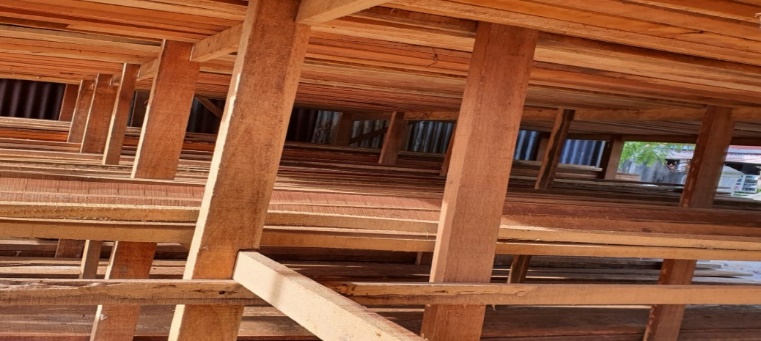
This photo was taken at David's wooden warehouse on March 5, 2025, in Pekanbaru.
4.1 The Existence of Religious Neglect in the Timber Trade
4.1.1 Reduction of Wood Size
The process of buying and selling wood that contains abandonment has been going on for quite a long time. Any wood sold is reduced in size from the normal size. The systematization of the neglect of timber size is described as follows:
| Yes | Wood Terms | Ideal Size | Actual Size | Differences |
| 1 | 12x12 | 12x12x400 cm | 11.5x11.5x380 cm | 7.345 cm3 |
| 2 | 10x10 | 10x10x400 cm | 9.5x9.5x380 cm | 5.705 cm3 |
| 3 | 12x6 | 12x6x400 cm | 11.5x5.5 x380 cm | 4.765 cm3 |
| 4 | 5x7 | 5x7x400 cm | 4.5x6.5x380 cm | 2,300 cm3 |
| 5 | 4x6 | 4x6x400 cm | 3.5x4.5x380 cm | 4.945 cm3 |
| 6 | 3x4 | 3x4x400 cm | 2.5x3.5x380 cm | 1.47 cm3 |
| 7 | 2x3 | 2x3x400 cm | 1.5x2.5x380 cm | 9.75 cm3 |
This category was obtained from the processed products of Somel Sutarman, 43 years old.
Table 1 above shows a reduction in the size of the wood from its original size. Wood with the term "five sevens" (5x7), which was originally 5x7x400 cm, was reduced to 4x6x380 cm. Likewise, the "four six" (4x6) wood with its original size of 4x6x400 cm, was reduced to 3.5x4.5x380 cm. The reduction in the size of the wood is not the same in each piece; it can be 1 cm or it can be 0.5 cm. To be sure, on each log there is a reduction from its original size. The process of reducing the size of the wood, which should be acknowledged by the traders themselves, as in the following interview;
"I've been running the timber business for almost 15 years, and this situation has happened in this model. I only buy wood as it is from Somel (a wood processing company). Some businessmen process wood not according to its original size, unless there is a special demand from consumers, but at a higher price (H. Kadri, 48 years R1).
Another informant asserted that:
"Reducing the size of wood from what should have become a tradition in society. No wood on the market that corresponds to its original size, and the minimum reduction is the size of a saw blade" (Asnam, 73 years old, R17 trader).
So, the form of neglect of the timber trade that has occurred so far has become a tradition in society.
4.1.2 Forgery of Documents
Document forgery occurs in large-scale timber buying and selling. The Sonokeling Mahakam Unit Company is suspected of forging six wooden documents (Tempo 26/02/2023). In East Nusa Tenggara, 1 fake wooden document was found on a sailing ship that was transporting wood (Economy, Tuesday, June 21, 2020). So document forgery has become one of the modes that has become a culture among timber traders.
The falsification of wooden documents illustrates the behavior of traders that is laden with neglect. The shadow of huge profits has prompted traders to forge documents. The frequency of more than illegal timber has definitely made others lose money, including the state. Thus, the creation of false documents has become evidence of the neglect of the timber trade.
The act of reducing the size of wood according to jurists is called gharar, which is a nature in muamalah that causes some of its pillars to be uncertain (mastur al-'aqibah). Operationally, gharar can be interpreted as a transaction between both parties that does not have certainty about the goods that are the object of the transaction, both related to the quality, quantity, price, and delivery time of the goods, so that the second party is harmed. Gharar occurs when something that is certain becomes uncertain.
4.1.3 Timber Conditions Not Explained to Consumers
Some traders do not explain the condition of the available wood to consumers. Consumers choose the wood they like and do not pay attention to the size of the wood clearly. Traders unload the wood that the consumer has chosen from its place, then make a transaction (Ujang Maya, 67 years old, R14). So consumers do not know the shortage of wood they buy.
The absence of information from traders to consumers about the condition of the wood includes violating the rules of buying and selling because the goods being traded must be clear [9]. The vagueness of the size of the wood is actually an element of neglect of religious teachings.
4.2 Reasons for abandonment
4.2.1 Pursuit of Big Profits
The purpose of trading is none other than to obtain optimal profits, [10]. In trading activities, that want to be obtained are profits [11]. There is no trader who does not want huge profits. Chasing big profits has become a natural attitude for every trader. The trader's efforts in pursuing profits by maximizing buying and selling are to meet the needs of life [12]. So, chasing profits in buying and selling is a trait for traders.
Attempts to reduce the size of the wood from its original size influenced the merchant to pursue profits. Every difference in the size of the wood is depicted as a great advantage to increase wealth. The more wood stock is added, the more profit is obtained (Asnam, 73 years old, R17 trader). The process of making a large profit can be done by engineering the size of the wood. Engineering the size of wood and the pursuit of profit in the timber trade have developed in society.
4.2.2 Lack of Traders' Knowledge of Buying and Selling Rules
The explanation of trade rules in the Qur'an (QS. 11:84-85) shows that trade rules are very concrete. The key to successful trading is trading that is based on honesty [13], [14], [15]. But because of the tradition that has been formed over the years, not all the information about the rules of buying and selling that the Qur'an shows is known to the traders. The trading system that has existed since the time of the Prophet (peace be upon him) is still not the basis for buying and selling.
The ignorance of timber traders about religious rules in buying and selling is acknowledged by traders. "I don't know the religious rules about trade. When I was in school, I was not taught how to trade in Islam" (Dt. Malingka, 49 years old, R17). Other traders emphasized that there were no teachers who taught the rules of buying and selling. I never learned about commercial law during my education (Ujang Maya, 62 years old, R14).
David confirmed, "I went to university level in economics but never learned the religious rules about buying and selling. I just carry on my parents' business" (David, 42 years old, R3). So, traders admit that their knowledge of the trading rules is very minimal.
4.2.3. Da'wah Does Not Touch the Rules of Buying and Selling
So far, the rules of buying and selling have escaped the object of da'wah. The dai in Friday sermons and tabligh rarely touch on the rules of trade. Syahril emphasized, "So far I have never heard a sermon or lecture about religious rules related to trade. I don't know what the rules of buying and selling are correct according to Islam" (Syahril, 64 years old, R11). So, the rules of buying and selling as a guideline that the community needs when trading have not been the concern of da'i and da'wah institutions. Da'wah institutions such as IKMI and MDI do not program rules for buying and selling in da'wah. (Irman Majid, 74 years old, R25).
| Yes | Da'wah Topics |
| 1 | Worship problems |
| 2 | Education |
| 3 | Rezki |
| 4 | Social Religion |
| 5 | Human Nature and Character |
| 6 | Islamic Holidays |
| 7 | Health Issues |
| 8 | Disaster problems |
| 9 | The Problem of Sin |
| 10 | perkawinan |
IKMI and MDI Friday Sermon Guidelines for 2022-2023.
Table 2 above shows that the topics of the Friday sermon did not mention trade. So, the rules of buying and selling that traders should know have been forgotten by the da'is and da'wah institutions.
4.3. Implications of Religious Abandonment on the Timber Trade
4.3.1 Damaging Ukhwah Trade
Buying and selling activities, in addition to fulfilling welfare, both personal, family, and group, are also inseparable from social relationships. A good relationship between traders and consumers actually forms a good social relationship as well. The better the social relations of the residents, the more peace and tranquility there will be for every citizen in the community, including trade activities.
Neglect is an unpleasant act that can damage social relationships. There is often neglect in society, including between traders and consumers, which gives rise to discontent in that society. A Waiver is a fraudulent act that often leads to a greater distance between the merchant and the consumer.
It has been explained that the purpose of trade in Islam, in addition to meeting needs, is also to realize prosperity and justice. On the contrary, Neglect in trade is an act that undermines welfare and justice. The sustainability of traders neglecting causes consumers to be deceived, so that their welfare and justice are disturbed. Allowing the continuation of religious abandonment will certainly cause the social order to be further damaged. Thus, it is not welfare and justice that are realized, but social inequality that occurs.
4.3.2 Traders and Consumers Lose Out
Actually, religious abandonment is not something that is profitable, but brings losses to both consumers and traders. Consumer losses occur at the time of the transaction because the size of the wood purchased has decreased. The loss of traders is not immediately felt because the addition of the sold wood stock is already worth money and profitable. But at that time, the door of losses has started because consumers begin to feel disadvantaged. Because they are deceived, consumers spontaneously begin to socialize their experiences to others, so that traders are visited by consumers less and less. So, the neglect made by traders has opened the door to losses for traders.
Merchants and consumers are partners who are interdependent and need each other. In business affairs, a good relationship between traders and consumers is needed. Merchant businesses can thrive when consumers feel lucky in shopping. Consumers are lucky when they get the best service from traders. So consumers will not turn to other traders if they are satisfied and get the wood that suits their needs.
Neglect is one of the destructive factors of the trading process. Trade relations can be severed if consumers are deceived by traders. The flight of consumers is the beginning of traders' losses. If the neglect drags on, the trader's business can go bankrupt. Therefore, the relationship between traders and consumers needs to be maintained so that consumers do not turn to other traders.
4.3.3 The Widespread Secularization of Trade
The neglect of religion in the process of buying and selling wood has opened up opportunities for the formation of trade secularization. The secularization of trade is a social movement that leads to the separation of trade and religion [16]. The practice of buying and selling that does not refer to religion in the daily life of traders can form a tradition that leads to the act of leaving religion in buying and selling activities. This kind of buying and selling habit, when passed on to posterity, also turns a trade that used to be loaded with religion into a trade that leaves religion.
The neglect of non-religious trade that is passed down continuously to the next generation becomes an act of socialization of secular trade. The children and grandchildren who continue their parents' trading business have gradually stabilized the trade that is increasingly moving away from religious values. The maturity of this kind of buying and selling pattern can form a new trade tradition that forgets religion. The sustainability of trade that is realized based on separation from religion leads to the permanence of the distance between religion and trade. So, this opens up opportunities for secularization in trade in religious countries.
5. Discussion
This study has produced an important map of the ideological basis of trade (Nurkholis, M., 2016; Harisah & Habibah, 2019) on the one hand and culture on the other (Setiawahyu & Efendi, 2022). Ideologically and traditionally, in addition to being a subject, traders are placed as intermediaries between producers and consumers [19]. Traders are positioned with a dilemma between chasing profits [20] and obey religious rules [21]. Likewise, as a community and value, traders cannot do much to overcome the occurrence of fraud due to the treatment of producers [5]. In buying and selling activities, the difficulties and dilemmas faced by traders cannot be solved because there is no institution that is concerned about handling this problem.
Allah said: Auf al-kaila wa al-mīzāna bi al-qisṭ, wa lā tabkhas al-nāsa asyyāahum wa lā ta’tsau fi al-arḍi mufsidīn, Give just measure and weight, nor withhold from the people the things that are their due, commit not evil in the land with intent to do mischieih (QS, 11:85). Secara tegas Islam melarang berbuat curang dalam berdagang. Wa lā tanquṣu al-mikyāla wa al-mīzān, do not reduce the measure and the scales (QS11:84). In a hadith, the Prophet PBUH said: Ḥaddatsanā Abu Bakr ibn Abī Syaibah `an Abī al-Ḥamrā’ qāla raaitu Rasūlallāh Ṣallallahu `Alaihi wa Sallam, marra bijanabāti rajulin `indahu ṭa`āmun fī wi`āin fa adkhala yadahū fīhī fa qāla `asyasyta ? man gasyyanā fa laisa minnā;. Abu Bakr ibn Abi Shaybah, Abu al-Hamra' said, "I saw the Messenger of Allah (peace and blessings of Allaah be upon him) passing by the stall of someone who was storing food in a vessel. He put his hand into the vessel, and said: "Why are you deceitful? Whoever deceives us, he is not of our group (Ningsih and Sari 2016; Nizar 2017, Septiani 2019). The consequences of religious abandonment are not only valid in this world, but also in the hereafter (al-Muthaffifin, 1-3).
Although the religious rules about trading are concrete, it turns out that not all traders carry them out. There are still fraudulent traders. On the one hand, there are still non-religious trade transactions (Muhammad Farid & Amilatuz Zahrah, 2015). But on the other hand, there are still honest traders. Bilo wak mangicuah pambali, mako kito nantinyo ka kehilangan konsumen, pambali ka manjauh dari awak, tapi bilo kito jujur dan pamurah, pelanggan ka taruih jo awak. If consumers are lied to, they will run away, but if the scales are perfected, coupled with giving more customers a reason to be loyal (Pangiuk, 2019).
Traders' limitations in understanding Islamic trading rules [24]. And the pressure of producers to produce wood results in the neglect of Islamic trade rules. The dilemmatic experience of traders has a great effect on religious abandonment. Traders first choose to anticipate trading losses rather than pay attention to religious rules. In this condition, the trader's treatment is manifested in the form of taking advantage of the weakness of consumers who are forced to accept wood as it is. Some traders are to maintain a religious economy [25] Keep trying to find alternatives by telling consumers that the real condition of the wood is not up to the actual size (Nizar, 2017; Septiani, 2019, Pangiuk, 2019). The disclosure of information from traders to consumers about the reality of the available timber sizes is a one-sided way for traders to avoid violating religious rules. This attitude is a religious interpretation of subjective buying and selling wood to reconcile the inner pressure of the timber traders. However, such a way to legalize buying and selling cannot be the right step to anticipate the continuity of religious neglect in trade.
The neglect that the trader shows in buying and selling is actually planting the seeds of loss for his own business. Neglecting treatment can remove the sustainability of the business. Sustainable trade is not only based on religious rules but also strengthened by the maintenance of good business ethics (Baidowi, 2011). The formation of a safe and sustainable business is based on a good network (Retno Andriati, 2012). The correct trading indicator is "not hiding defects, diseases, not cheating" (Muhammad Farid & Amilatuz Zahrah, 2015). So, sustainable trade is a trade that is independent of neglect (Abdurrahman Alfaqih, 2017).
The results of this study are an indication that it is very difficult to avoid religious neglect in the timber trade. A trading culture that is already structured in such a way has stabilized a trading process that is fraught with neglect. The existence of a trader is often aimed at fulfilling a specific desire. Positioning traders in this case risks causing traders to become a tool that transforms the sustainability of abandonment in the process of buying and selling timber to the next generation.
This study provides an in-depth understanding of how this trading system has perpetuated religious neglect in the timber trade. The dimension of this study is something that is neglected due to the tendency of existing research to be more objective. Measures of a trader's success and profit have become mainstream in looking at trading status. The trader's subjectivity is not accommodated, so the trader's feelings and expectations regarding self-protection from religious neglect are also not accommodated. The trader's inner conflict is instantly imagined by the trader. Existing studies legitimize the perspective of traders as a tool for the preservation of traditions.
Based on the results of the research, an awareness movement is needed on the importance of freeing traders from the treatment of religious neglect. Five ways can be taken. First, trade needs to be built on the principle of honesty and mutual benefit between producers, traders, and consumers. Both open trade climates and religious ideologies need to be carefully designed. Third, the reorientation of trade on the spiritual and non-spiritual dimensions so that the quality of trade can be in line with religious principles. Fourth, optimizing da'wah activities by emphasizing religious teachings related to trade rules. Fifth, in the long term, it is necessary to educate a generation that understands religious teachings about trade through school educational institutions. The educational curriculum on trade rules needs to be formulated constructively to be taught so that the generation that pursues trade activities will have a basic knowledge base about trade rules in trade. The future trading cycle must be more religious and continue to increase over time.
6. Conclusion
The occurrence of religious neglect in buying and selling wood is not only caused by the behavior of traders alone, but is structured by the power of the system that has been cultivated in society. Traders have delivered the producer's work to be sold to consumers in the form of finished goods that are impossible to repair. These business people, both producers and traders, have run their businesses with minimal religious knowledge about buying and selling. In addition, the attention of institutions that are supposed to teach the public lessons is not going as it should, so the preservation of religious neglect in trade is very difficult to fix.
This study has shown in detail the process of religious abandonment in trade. More than that, this study has also illustrated the need for a comprehensive change between related elements in society, specifically regarding the way of trading with Islamic nuances, to create a harmonious and God-pleasing society.
This research is limited to the perception of traders and has not discussed issues related to the perception of producers and consumers. Synchronization between producers, traders, and consumers is a new hope for a harmonious trade chain that must be realized in the future. Opportunities are open for other researchers who are interested in continuing their studies in a broader and more complete form.
References
- A. Goleman, Daniel; Boyatzis, Richard; Mc Kee et al., “ETIKA BISNIS RASULULLAH,” J. Chem. Inf. Model., vol. 53, no. 9, pp. 1689–1699, 2011. DOI ↗ Google Scholar ↗
- S. I. Ayub and A. Chief, “Principles Of Prohibited Trades In The Light Of Islamic Law : An Analytical Study,” vol. 19, no. 4, pp. 5803–5816, 2020, doi: . DOI ↗ Google Scholar ↗
- M. Farid and A. Zahroh, “Analisis Penerapan Etika Bisnis Islam dalam Perdagangan Sapi di Pasar Hewan Pasirian,” Iqtishoduna, vol. 6, no. 2, pp. 13–30, 2015, [Online]. Available: DOI ↗ Google Scholar ↗
- N. R. Fitriati, Inayah Faniyah, “HAMBATAN TEKNIS PENYIDIKAN TINDAK PIDANA MANIPULASI,” vol. 51, pp. 390–400, 2022. DOI ↗ Google Scholar ↗
- M. A. Rahmawati and Kamisnawati, “Sistem Perdagangan Dalam Perspektif Ekonomi Islam Pada Pusat Niaga Desa Belawa Baru Kec . Malangke,” J. Muamalah, vol. V, no. 2, pp. 112–119, 2015, [Online]. Available: file:///E:/BELAJAR MENULIS JURNAL/684-1482-1-SM.pdf DOI ↗ Google Scholar ↗
- M. Akbar and A. Asse, “Analisis Tingkat Kecurangan Dalam Takaran Dan Timbangan Bagi Pedagang Terigu (Studi Kasus di Pasar Sentral Maros),” J. Iqtisaduna, vol. 2, pp. 1–16, 2016, [Online]. Available: file:///D:/Users/Downloads/2394-Article Text-5072-1-10-20170427.pdf DOI ↗ Google Scholar ↗
- M. J. Arifin, “Keabsahan Akad Transaksi Jual Beli dengan Sistem Dropshipping dalam Perspektif Ekonomi Islam,” Lisyabab J. Stud. Islam dan Sos., vol. 1, no. 2, pp. 279–290, 2020, doi: . DOI ↗ Google Scholar ↗
- R. In and W. Javan, “Jurnal Kebudayaan Batak,” vol. 16, 2021, [Online]. Available: file:///E:/BELAJAR MENULIS JURNAL/PULAU_MIWARA_PUSAT_NIAGA_MASA_LAMPAU_Tinjauan_Seja.pdf DOI ↗ Google Scholar ↗
- O. Shobirin, “JUAL BELI DALAM PANDANGAN ISLAM,” Bisnis, vol. 3, no. 1, pp. 239–261, 2015, [Online]. Available: file:///D:/Users/Downloads/1494-4935-1-SM (2).pdf DOI ↗ Google Scholar ↗
- A. Listiani and S. Wahyuningsih, “Analisis Pengelolaan Persediaan Barang Dagang Untuk Mengoptimalkan Laba,” STIE Kesuma Negara Blitar, vol. 4, no. 1, pp. 97–103, 2019, [Online]. Available: DOI ↗ Google Scholar ↗
- F. Fachrudin, “Kajian Teori Laba Pada Transaksi Jual Beli Dalam Fiqh Mu’āmalah (Studi Komparasi Teori Laba Ekonomi Konvensional),” Ad Deenar J. Ekon. dan Bisnis Islam, vol. 1, no. 01, p. 68, 2018, doi: . DOI ↗ Google Scholar ↗
- Jamin, “ANALISIS HUKUM ISLAM TERHADAP KEUNTUNGAN DALAM JUAL BELI (Telaah Kritis Sirkulasi Ekonomi Dalam Transaksi Penjualan),” LABATILA (Jurnal Ilmu Ekon. Islam, vol. 3, no. 1, pp. 97–114, 2019, doi: DOI ↗ Google Scholar ↗
- M. Nizar, “Prinsip Kejujuran Dalam Perdagangan Versi Islam,” J. Istiqro, vol. 4, no. 1, p. 94, 2018, [Online]. Available: http://ejournal.iaida.ac.id/index.php/istiqro/article/view/212 DOI ↗ Google Scholar ↗
- M. Nizar, “Prinsip Jujur dalam perdagangan versi Al-Qur’an,” J. Ilmu al-Qur’an dan Tafsir, vol. 2, no. November, pp. 309–320, 2017. DOI ↗ Google Scholar ↗
- R. Ningsih and M. M. K. Sari, “Moralitas Pedagang Loak Etnis Madura Di Surabaya,” Kaji. Moral dan Kewarganegaraan, vol. 3, no. 4, pp. 931–947, 2016, [Online]. Available: http://jurnalmahasiswa.unesa.ac.id/index.php/jurnal-pendidikan-kewarganegaraa/article/view/15745 DOI ↗ Google Scholar ↗
- L. Andarwati, “Sufisme Perkotaan Dan Pedesaan Di Era Modernisasi Dan Sekularisasi,” Universum, vol. 10, no. 1, pp. 41–48, 2016, doi: . DOI ↗ Google Scholar ↗
- Harisah and S. D. Habibah, “Manipulasi Merk Perspektif Hukum Ekonomi Syariah Pendahuluan Di era global persaingan perdagangan semakin ketat banyak orang melakukan perdagangan secara kotor . Perdagangan bisa normal dan dapat dipertahankan jika terdapat persaingan usaha yang sehat . D, Al-Huquq J. Indones. Islam. Econ. Law, vol. 1, no. 2, pp. 122–142, 2019, [Online]. Available: http://ejournal.iainmadura.ac.id/index.php/alhuquq/article/view/3105/1736 DOI ↗ Google Scholar ↗
- M. D. Setiawahyu and Y. Efendi, “Kecurangan dalam Jual Beli Menurut Al-Qur’an Perspektif Tafsir Al-Munir,” Lathaif Literasi Tafsir, Hadis dan Filol., vol. 1, no. 1, p. 48, 2022, doi: . DOI ↗ Google Scholar ↗
- Siti Hofifah, “Analisis Persaingan Usaha Pedagang Musiman di Ngebel Ponorogo ditinjau dari Perspektif Etika Bisnis Islam,” Syarikat J. Rumpun Ekon. Syariah, vol. 3, no. 2, pp. 37–44, 2020, doi: . DOI ↗ Google Scholar ↗
- A. W. Nugroho, “Abstrak,” pp. 45–63, [Online]. Available: DOI ↗ Google Scholar ↗
- S. Safuan, B. Budiandru, and I. Ismartaya, “Fraud dalam Perspektif Islam,” Owner, vol. 5, no. 1, pp. 219–228, 2021, doi: . DOI ↗ Google Scholar ↗
- S. Septiani, “Etika Jual Beli dalam Perspektif Hadis dan Implementasinya di Lingkungan Pasar Tradisional Rau Serang,” Holist. al-Hadis, vol. 5, no. 2, p. 28, 2019, doi: . DOI ↗ Google Scholar ↗
- A. Pangiuk, “Tinjauan Etika Bisnis Islam dalam Penggunaan Timbangan Sembako dalam Jual Beli (Studi Kasus di Pasar Mendahara Ilir, Tanjabtim),” Indones. J. Islam. Econ. Bus., vol. 4, no. 1, pp. 39–51, 2019, [Online]. Available: http://repository.uinjambi.ac.id/id/eprint/1716 DOI ↗ Google Scholar ↗
- S. I. F. Faraby, Muhammad Ersya, “ETOS KERJA DAGANG ETNIS MADURA DI SURABAYA,” Pontif. Univ. Catol. del Peru, vol. 8, no. 33, p. 44, 2014. DOI ↗ Google Scholar ↗
- N. Yanti, “Konsep Mashlahah Mursalah Perspektif Ekonomi Islam,” Stud. Econ. J. Ekon. Islam, vol. 8, no. 2, p. 312, 2022, doi: . DOI ↗ Google Scholar ↗