Abstract
This study examined the relationship between self-image, personality traits, and career choice among Senior High School (SHS) students in Ghana’s Effutu Municipality, along with the effectiveness of a career development intervention. Using a quantitative correlational and quasi-experimental design, data were collected from 336 students (68.5% male) at Winneba Senior High School. Measures included the Rosenberg Self-Esteem Scale and the Big Five Inventory. Results showed high levels of self-image (70.2%) and positive traits (98.2%), but these had weak, non-significant correlations with career choice factors (r = 0.002–0.027). Personal (M = 3.41) and economic/environmental factors (M = 2.94) most influenced career choices, while social factors had minimal impact (M = 2.44). Significant gender differences emerged in self-image, personality, and social influences. Regression analysis revealed that self-image and traits explained only 0.5% of variance in career choice. However, the intervention significantly improved career decision-making knowledge (mean difference = 1.42, p < .001). Findings suggest students prioritize economic and personal considerations over psychological factors, underscoring the need for context-sensitive career counseling.
Keywords
Career Choice Ghana Intervention Personality Traits Self-Image
1. Introduction
Career selection is a critical developmental process that influences adolescents’ future success, well-being, and contribution to national development. Although family, peers, and community factors shape career decisions, limited research in Ghana has examined how self-image and personality traits influence career choice among Senior High School (SHS) students. Self-image affects students’ confidence and resilience in pursuing desired careers, while personality traits such as openness and conscientiousness influence perceptions of success and career aspirations. Students with high self-esteem are more likely to pursue ambitious careers, whereas those with low self-esteem may settle for less challenging options. Career decision-making may also create anxiety due to inadequate career guidance, causing students to rely on peers and media for information, which can result in career choices inconsistent with their interests and abilities.
Psychological factors significantly influence career selection. Students with strong self-esteem pursue careers more confidently, while personality traits shape occupational preferences and decision-making. Conscientious students often prefer structured careers, whereas highly neurotic students may experience greater anxiety in making career choices. Gender socialization and cultural expectations also influence career decisions.
In Ghanaian culture, gender roles strongly affect SHS students’ career aspirations. Studies such as Ametepee and Dimitris found that societal pressure discourages female students from entering male-dominated fields like STEM. Cultural beliefs about gender roles also limit female students’ confidence and career decision-making. However, most Ghanaian studies focus mainly on external influences such as parental support and socioeconomic status, with limited attention to internal psychological factors, career decision-making processes, and intervention outcomes.
Overall, little empirical research in Ghana has examined how self-image, personality traits, gender, and contextual factors interact to influence female SHS students’ career choices. This study seeks to address this gap by investigating the predictive effects of self-image, personality traits, gender, and intervention-based career counseling outcomes.
The theoretical framework for this study includes Parsons’ Trait and Factor Theory, Holland’s Career Development Theory, Gottfredson’s Theory of Circumscription and Compromise, and Super’s Developmental Self-Concept Theory. Parsons’ Trait and Factor Theory outline a three-step approach to assist individuals in making informed career decisions: Self-Discovery, Out-of-School Practice, and Job Matching. Self-discovery helps individuals understand their strengths and interests; out-of-school practice enables them to learn about occupations available; job matching helps individuals align their personal traits with career demands (Alornyo, 2023).
Holland (1966) posited that people tend to be more satisfied with their work environments when the environment aligns with their personality. Holland proposed the RIASEC model (Realistic, Investigative, Artistic, Social, Enterprising, and Conventional) to depict the relationship between personality and the extent to which individuals will be successful in their work environment. He argued that when an individual's work environment is congruent with their personality type, they experience greater satisfaction and productivity (Smith & Wood, 2018).
According to Gottfredson, career choices involve cognitive processes of circumscription (eliminating options considered socially unacceptable within one’s culture) and compromise (adjusting aspirations because of limitations such as gender, socioeconomic status, or labor market conditions) (Kuzmin et al., 2023; Austin & Austin, 2019).
Super’s theory states that career development occurs over the entire lifespan of an individual and has a strong relationship to the way a person perceives themselves. There are five stages of career development based on Super's Developmental Self-Concept Theory: Growth (birth through mid-adolescence); Exploration (15 to 21 years old); Establishment; Maintenance; and Disengagement (Nayak, 2020; Sangadah et al., 2025).
All of these theories demonstrate that career choice results from the interaction of personal characteristics, self-perceptions, the realities of one's environment, and the developmental experiences that an individual has had thus far. In this study, self-image and personality are the internal factors that predict the career choices of SHS students, while gender and context serve as moderating factors to predict career choice. The hypotheses and regression analysis in this study will determine the degree to which psychological factors are predictive of the career choices of SHS students.
The study's theoretical framework integrates Trait and Factor Theory, Holland’s Career Development, Gottfredson’s Circumscription and Compromise, and Super’s Developmental Self-Concept. Together, they explain how interests, personality, and self-image shape career decisions.
Frank Parsons’ Trait and Factor Theory propose a three-stage approach: self-discovery (understanding strengths, interests, values), out-of-school practice (knowledge of occupational requirements), and job matching (aligning personal traits with career demands). This promotes informed decision-making (Alornyo, 2023).
Holland (1966) suggests individuals seek work environments matching their characteristics, proposing six personality types (RIASEC): Realistic, Investigative, Artistic, Social, Enterprising, and Conventional. Congruence between personality and environment enhances satisfaction, stability, and commitment (Smith & Wood, 2018).
Gottfredson’s theory describes career choice as a cognitive process shaped by personal preferences and social realities. Circumspection narrows options by eliminating socially unacceptable or inaccessible occupations; compromise adjusts aspirations due to constraints like socioeconomic status, gender, education, or labor market conditions (Kuzmin et al., 2023; Austin & Austin, 2019).
Super’s Developmental Self-Concept Theory views career development as lifelong, linked to evolving self-concept. Its five stages are: Growth (birth to mid-adolescence, forming interests), Exploration (15–21, investigating options), Establishment (securing and advancing), Maintenance (stability and productivity), and Disengagement (retirement, reduced participation) (Nayak, 2020; Sangadah et al., 2025).
While Trait and Factor and Holland’s theories emphasize person-environment fit, Gottfredson and Super address developmental and contextual influences. Their integration offers a multidimensional explanation of how psychological and environmental factors jointly shape career choices. In this study, self-image and personality traits represent internal psychological dimensions, while gender and contextual realities serve as moderators. Specifically, Trait and Factor and Holland’s theories explain how traits and self-image influence occupational preferences, whereas Gottfredson and Super explain how contextual realities, gender expectations, and developmental experiences moderate those preferences. These assumptions guide the study’s hypotheses and regression analysis examining whether psychological factors significantly predict career choice among senior high school students.
The conceptual framework posits that self-image and personality traits are independent variables affecting senior high school students' career choices (dependent variable). Demographic factors such as gender may also play a role in determining the intensity and/or flexibility of how self-image interacts with personality traits to influence students' career choices.
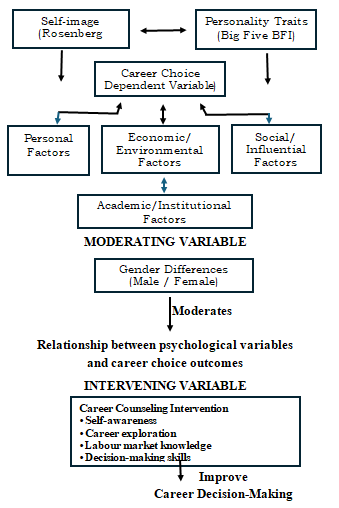
The conceptual framework explains how psychological, demographic, and contextual variables interact to influence career choices of Senior High School (SHS) students in Ghana. Career decisions stem from internal characteristics and external realities combined.
Career Choice is the dependent variable, representing students’ occupational preferences. It is influenced by personal, economic/environmental, social/influential, and academic/institutional factors.
Self-Image (measured by Rosenberg Self-Esteem Scale) is the first independent variable. Students with positive self-image tend to make confident, ambitious career decisions. Personality Traits (measured by Big Five Inventory: openness, conscientiousness, extraversion, agreeableness, emotional stability) form the second independent variable. Personality affects career preferences and decision-making—e.g., conscientious students prefer structured careers; open individuals prefer creative or exploratory work.
A double-headed arrow (↔) connects self-image and personality, indicating mutual influence. Single-headed arrows (→) point from both variables toward career choice, representing hypothesized causal relationships.
Gender serves as a moderating variable, affecting the strength or direction of psychological variables on career choice. Due to societal norms and gender-role socialization, male and female students may experience self-image and personality effects differently.
Career Counseling Intervention is an intervening variable, including guidance workshops, self-awareness training, labor market education, and decision-making support. Effective counseling strengthens career understanding, improves decision-making skills, and aligns interests with realistic opportunities.
The dimensions of career choice are:
-
Personal Factors – interests, talents, abilities, fulfillment.
-
Economic/Environmental Factors – salary, job security, work conditions, employment opportunities.
-
Social/Influential Factors – parents, peers, teachers, role models.
-
Academic/Institutional Factors – school performance, counseling, educational experiences.
Overall, the framework presents career choice among Ghanaian SHS students as a multidimensional process shaped by self-perception, personality, gender, counseling interventions, and socioeconomic realities. Although the framework hypothesizes that psychological variables influence career choice, study findings later showed that practical and economic factors were stronger determinants. The following research questions guided the study:
-
What are the demographic attributes of Senior High School students in the Effutu Municipality in terms of gender?
-
What factors influence career choice of students in Senior High Schools in the Effutu Municipality?
-
How does self-image influence career choice among Senior High School students in the Effutu Municipality?
-
What personality traits influence the career choices of Senior High School students in the Effutu Municipality in Ghana?
-
To what extent do students have knowledge on career choice?
The following were research hypotheses for the study:
Ho1: There is no statistically significant gender difference in self-image among Senior High School students in the Effutu Municipality.
Ha1: There is statistically significant gender difference in self-image among Senior High School students in the Effutu Municipality.
Ho2: There is no statistically significant gender difference in personality traits among Senior High School students in the Effutu Municipality.
Ha2: There is statistically significant gender difference in personality traits among Senior High School students in the Effutu Municipality.
Ho3: There is no statistically significant gender difference in career choice among Senior High School students in the Effutu Municipality.
Ha3: There is statistically significant gender difference in career choice among Senior High School students in the Effutu Municipality.
Ho4: Self-image does not significantly predict career choice among Senior High School students in the Effutu Municipality.Ha4: Self-image significantly predicts career choice among Senior High School students in the Effutu Municipality.
Ho5: Personality traits do not significantly predict career choice among Senior High School students in the Effutu Municipality.Ha5: Personality traits significantly predict career choice among Senior High School students in the Effutu Municipality.
Ho6: There is no statistically significant difference between pre-intervention and post-intervention career counseling knowledge scores.Ha6: There is a statistically significant difference between pre-intervention and post-intervention career counseling knowledge scores.
The study’s research objectives were based on the following:
-
To identify the demographic attributes of Senior High School students in the Effutu Municipality in terms of gender and education.
-
To identify the factors that influence career choice of students in Senior High Schools in the Effutu Municipality.
-
To examine self-image factors of students in Senior High Schools that influence career choice.
-
To find out how personality traits of students in Senior High Schools influence their career choice.
-
To find the relationship between self-image and career choices of Senior High School students.
-
To find the relationship between personality traits and career choice of Senior High School students.
-
To find out the extent of knowledge students have on career choice.
-
To find the gender difference of students in career choice.
-
To find out how self-image and personality traits predict career choice among students.
-
To determine which independent variable is most predictive.
2. Methodology
2.1 Research Design
The study adopted a quantitative correlational design complemented by a quasi-experimental pre-test/post-test intervention component. According to Creswell and Creswell (2023), correlational research design allows researchers to observe the level to which two or more variables co-vary without establishing a cause-and-effect relationship.
The Effutu Municipality in Ghana's Central Region is home to Winneba Senior High School, which has a current enrolment of approximately 2,084 students, making it one of the largest public schools in the county. The target population comprised all students enrolled at Winneba Senior High School. This school was selected due to accessibility, administrative approval, and its large and diverse student population.
2.2 Sample and Sampling Technique
Yamane's model size calculation formula, n = N/(1+N(e²)), was used to determine the sample size. With population N = 2,084 and margin of error e = 0.05, the sample size was calculated as:
n = 2,084/(1+2,084(0.05²))n = 2,084/(1+2,084(0.0025))n = 2,084/(1+5.21)n = 2,084/6.21n = 335.59 (approximately 336 participants)
Stratified random sampling was employed, dividing students into subgroups based on gender and class level to ensure proportional representation of participants. A sample was randomly selected from each stratum to ensure representation.
2.3 Data Gathering Instruments
The data collection instrument used for the study was a structured questionnaire divided into four sections. Section A gathered demographic information about the respondents, including characteristics relevant to the study. Section B focused on self-image and assessed how participants perceived themselves using items adapted from the Rosenberg Self-Esteem Scale. Section C measured participants’ personality characteristics using items developed from the Big Five Inventory (BFI), which evaluates major personality dimensions. The BFI consisted of 20 items measuring openness, conscientiousness, extraversion, agreeableness, and neuroticism. Section D assessed factors influencing career choice, including personal factors, economic and environmental influences, social and interpersonal influences, as well as academic and institutional factors. All questionnaire items were measured on a four-point Likert-type scale: Strongly Disagree (1), Disagree (2), Agree (3), and Strongly Agree (4). To interpret the mean scores obtained from respondents, the following decision rule was adopted:
2.4 Decision Rule for Scale Interpretation
| Mean Range | Interpretation |
|---|---|
| 3.25 – 4.00 | Strongly Agree / Very High / Highly Influential |
| 2.50 – 3.24 | Agree / High / Moderately Influential |
| 1.75 – 2.49 | Disagree / Moderate / Slightly Influential |
| 1.00 – 1.74 | Strongly Disagree / Low / Not Influential |
The interpretation of the mean scores depended on the context of the variable being measured, including self-image, personality traits, knowledge of career counseling programs, and factors influencing career choice.
2.5 Validity and Reliability
The questionnaire was validated through a pilot study at Potsin Senior High School with 20 participants (Obodo et al., 2023). Following factor analysis, items 8 and 10 in Section C were reworded for greater clarity Cronbach’s alpha coefficients obtained from the pilot study demonstrated acceptable internal consistency: self-image scale (α = .82), personality traits scale (α = .89), and career choice factors scale (α = .76).
2.6 Intervention Program
A career development intervention program was implemented consisting of:
-
Pre-intervention assessment: Baseline measurement of career decision-making knowledge
-
Career counseling workshops: Sessions covering self-awareness, career exploration, labor market information, and decision-making strategies
-
Post-intervention assessment: Re-administration of knowledge measures following program completion
2.7 Ethical consideration
Ethical approval was obtained from the relevant institutional authorities. Participants were informed about the purpose of the study, confidentiality was assured, and participation was voluntary. Informed consent was obtained before data collection.
2.8 Data Collection Procedure
The researcher obtained authorization from the headmaster of Winneba Senior High School to administer questionnaires to randomly selected students. Over three weeks (21 days), questionnaires were distributed directly to 336 participants, stratified by class level: 136 to Form 1, 110 to Form 2, and 90 to Form 3. Ample time and space were provided for students to respond. The questionnaire comprised four sections covering demographics, self-image, personality traits, and career counseling program perceptions, using a 4-point Likert scale. This systematic procedure ensured comprehensive data collection on factors influencing career choices among Ghanaian senior high school students.
2.9 Statistical Analysis Plan
Data collected for the study were analyzed using both descriptive and inferential statistical techniques. Descriptive statistics, including frequencies, percentages, means, and standard deviations, were used to summarize and describe the demographic characteristics of respondents as well as the general distribution of responses. Pearson Product–Moment Correlation analysis was employed to examine the relationships between self-image, personality traits, and career choice variables. Independent samples t-tests were conducted to determine whether significant gender differences existed among the study variables, while paired samples t-tests were used to evaluate the effectiveness of the career counseling intervention by comparing pre-intervention and post-intervention scores. All statistical analyses were tested at significance levels of .01 and .05.
Multiple regression analysis was further conducted to determine the predictive influence of self-image and personality traits on students’ career choice and to identify the most significant predictor variable.
2.10 Assumption Testing
Before conducting the inferential statistical analyses, the assumptions underlying Pearson correlation, t-tests, and multiple regression were examined to ensure the appropriateness of the statistical procedures. Normality of the data was assessed using skewness and kurtosis values, histograms, and the Shapiro–Wilk test. The distributions of the major study variables were approximately normal, with skewness and kurtosis values falling within the acceptable range of ±2.
Linearity and homoscedasticity assumptions for correlation and regression analyses were assessed through scatterplots, which indicated reasonably linear relationships and equal variance of residuals. Multicollinearity among predictor variables was examined using Variance Inflation Factor (VIF) and tolerance statistics. The VIF values ranged from 1.01 to 1.08, while tolerance values exceeded .20, indicating the absence of multicollinearity concerns.
For the independent samples t-tests, Levene’s Test for Equality of Variances was conducted to assess homogeneity of variance. The results showed that the assumption of equal variances was satisfied for most variables. Independence of observations was maintained through the use of stratified random sampling and individual questionnaire administration.
These diagnostic procedures confirmed that the data met the assumptions necessary for the application of Pearson correlation, t-tests, paired-samples t-tests, and multiple regression analyses.
3. Results
| Sex | Frequency | Percent |
|---|---|---|
| Male | 230 | 68.5 |
| Female | 106 | 31.5 |
| Total | 336 | 100.0 |
Table 1 shows that the majority of participants were male (68.5%), while females represented 31.5% of the sample.
| Statements | Mean | S.D. | Decision |
|---|---|---|---|
| I feel virtuous about who I am, totally | 3.55 | .544 | Strongly Agree |
| I feel that I have a number of good qualities | 3.52 | .500 | Strongly Agree |
| I believe I possess several positive traits | 3.31 | .513 | Strongly Agree |
| I can do things equally well on my own | 3.26 | .539 | Strongly Agree |
| I think I have a lot to be proud of | 3.22 | .522 | Agree |
| At times, I see my own usefulness | 3.43 | .624 | Strongly Agree |
| I recognize my inherent worth and see myself as fully equal to others | 3.27 | .585 | Strongly Agree |
| I trust myself | 3.38 | .486 | Strongly Agree |
| I tend to think I am not a failure | 3.33 | .472 | Strongly Agree |
| I am very positive about myself | 3.19 | .531 | Agree |
| I feel that I am as valuable as other people | 3.32 | .714 | Strongly Agree |
| I own my feelings and actions | 3.36 | .481 | Strongly Agree |
| I gain knowledge and develop from my errors | 3.34 | .522 | Strongly Agree |
| I'm sustained by warm, positive self-talk | 3.34 | .474 | Strongly Agree |
| I know I am a worthy person | 3.35 | .557 | Strongly Agree |
| Overall | 3.35 | .202 | High Self-Image |
As shown in Table 2, participants demonstrated a generally strong positive self-image, with an overall mean of 3.35 (SD = 0.20). The majority of items were rated as "Strongly Agree," reflecting that students consistently view themselves positively.
| Level | Frequency | Percent |
|---|---|---|
| High Self-Image | 236 | 70.2 |
| Moderately High Self-Image | 100 | 29.8 |
| Low Self-Image | 0 | 0.0 |
| Total | 336 | 100.0 |
Table 3 reveals that the majority of participants (70.2%) were classified as having a high self-image, with the remaining 29.8% having moderately high self-image. No participants were identified as having low self-image.
Personality Traits
| Statements | Mean | S.D. | Decision |
|---|---|---|---|
| I see myself as someone who is talkative | 3.06 | .965 | Agree |
| I habitually focus on the negatives in people | 1.93 | .829 | Disagree |
| I see myself as thorough and careful | 3.16 | .550 | Agree |
| I am an idea generator | 3.22 | .560 | Agree |
| I see myself as someone who is reserved | 1.68 | .537 | Strongly Disagree |
| I consider myself to be helpful and selfless | 3.29 | .528 | Strongly Agree |
| I have a tendency to be a little reckless | 2.22 | .881 | Disagree |
| I consider myself to be highly effective at managing stress | 3.13 | .455 | Agree |
| I am curious about many different things | 3.28 | .603 | Strongly Agree |
| I'm full of energy | 2.98 | .506 | Agree |
| I tend to be the one who initiates conflicts | 2.67 | .762 | Agree |
| I pride myself as someone others count on | 2.67 | .785 | Agree |
| I hold a lot of tension in my body/mind | 1.99 | .515 | Disagree |
| I consider myself an inventive person and a deep thinker | 3.40 | .526 | Strongly Agree |
| I tend to spark enthusiasm wherever I go | 3.09 | .421 | Agree |
| I consider myself a forgiving person | 3.25 | .650 | Agree |
| I am actively working to improve my organization | 2.68 | .727 | Agree |
| I have a tendency to worry excessively | 2.62 | .698 | Agree |
| I possess a highly creative and imaginative mind | 3.14 | .506 | Agree |
| Overall | 2.77 | .135 | High Level |
Participants reported generally high scores on personality trait measures of their personality traits, with an overall mean of 2.77 (SD = 0.14).
| Level | Frequency | Percent |
|---|---|---|
| High Level | 330 | 98.21 |
| Moderate Level | 6 | 1.79 |
| Low Level | 0 | 0.00 |
| Total | 336 | 100.0 |
The vast majority of participants (98.21%) reported a high level of personality traits.
| Parameters | r | Sig. |
|---|---|---|
| Personal Factors | -0.002 | .966 |
| Economic/Environmental Factors | -0.017 | .762 |
| Social/Influential Factors | -0.006 | .919 |
| Academic/Institutional Factors | 0.027 | .617 |
| Overall | 0.002 | .971 |
Table 6 presents negligible correlations between self-image and all career choice factors, indicating no statistically significant relationship.
| Parameters | r | Sig. |
|---|---|---|
| Personal Factors | 0.054 | .321 |
| Economic/Environmental Factors | 0.033 | .547 |
| Social/Influential Factors | -0.009 | .869 |
| Academic/Institutional Factors | 0.006 | .918 |
| Overall | 0.025 | .648 |
Table 7 shows no statistically significant correlation between personality traits and factors influencing career choice.
| Statements | Mean | SD | Decision |
|---|---|---|---|
| Existing career counseling programs adequately address the specific needs of Senior High School students | 3.51 | 0.59 | Strongly Agree |
| The career counseling services effectively help students make informed career choices | 3.42 | 0.54 | Strongly Agree |
| Existing programs provide practical advice and support that meets student needs | 3.27 | 0.50 | Strongly Agree |
| Career counseling programs have improved my self-awareness regarding career goals | 3.53 | 0.63 | Strongly Agree |
| Counseling services offer valuable resources and tools for exploring career options | 3.46 | 0.59 | Strongly Agree |
| Existing programs contribute positively to my self-image and self-confidence | 3.26 | 0.72 | Strongly Agree |
| Programs effectively address exclusive challenges faced by SHS students | 3.01 | 0.57 | Agree |
| Programs help students overcome self-doubt when making career decisions | 3.30 | 0.71 | Strongly Agree |
| Goal-setting and action planning are emphasized in existing programs | 3.38 | 0.62 | Strongly Agree |
| Technology and online resources are integrated well into existing programs | 3.34 | 0.72 | Strongly Agree |
| Assessments and evaluations are used effectively to track student progress | 3.20 | 0.66 | Agree |
| Feedback and continuous improvement methods are in place | 3.23 | 0.71 | Agree |
| Overall | 3.32 | 0.39 | Very High Extent |
Participants demonstrated a very high level of knowledge regarding career counseling programs, with an overall mean of 3.32 (SD = 0.39).
| Level of Knowledge | Frequency | Percent |
|---|---|---|
| Very High Extent of Knowledge | 249 | 74.1 |
| High Extent of Knowledge | 71 | 21.1 |
| Low Extent of Knowledge | 16 | 4.8 |
| Total | 336 | 100.0 |
The majority of participants (74.1%) reported having a very high extent of knowledge about career counseling programs.
| Factors | Mean | S.D. | Decision |
|---|---|---|---|
| Personal Factors | 3.41 | .755 | Highly Influential |
| My personal interests and hobbies | 3.57 | .822 | Highly Influential |
| My natural skills and talents | 3.44 | .963 | Highly Influential |
| My personality type | 3.24 | .889 | Moderately influential |
| The desire for a fulfilling career | 3.39 | .843 | Highly Influential |
| Economic/Environmental Factors | 2.94 | .584 | Moderately influential |
| The potential for a high salary | 3.27 | .977 | Highly Influential |
| Job security and stability | 3.33 | .872 | Highly Influential |
| Availability of jobs | 3.12 | .929 | Moderately influential |
| Future earning potential and growth | 3.30 | .800 | Highly Influential |
| Availability of financial aid | 2.57 | .901 | Moderately influential |
| Career prestige and social status | 2.53 | .949 | Moderately influential |
| Work-life balance offered by the career | 2.79 | .866 | Moderately influential |
| Opportunities for travel and relocation | 2.63 | 1.079 | Moderately influential |
| The overall work environment | 2.89 | .994 | Moderately influential |
| Social/Influential Factors | 2.44 | .822 | Slightly Influential |
| Influence from my parents/guardians | 2.09 | 1.054 | Slightly Influential |
| Influence from friends and peers | 2.12 | .895 | Slightly Influential |
| Influence from teachers | 2.62 | 1.105 | Moderately influential |
| Success stories of role models | 2.91 | 1.023 | Moderately influential |
| Academic/Institutional Factors | 2.73 | .751 | Moderately influential |
| My performance in specific subjects | 2.97 | .928 | Moderately influential |
| Career counseling received at school | 2.60 | .984 | Moderately influential |
| Work experience | 2.60 | 1.063 | Moderately influential |
| Overall | 2.88 | .571 | Moderately influential |
Personal factors emerged as the most influential domain (M = 3.41), followed by economic/environmental factors (M = 2.94). Social/influential factors showed the least influence (M = 2.44).
| Level | Frequency | Percent |
|---|---|---|
| Highly Influential | 85 | 25.3 |
| Moderately Influential | 200 | 59.5 |
| Slightly Influential | 34 | 10.1 |
| Not Influential | 17 | 5.1 |
| Total | 336 | 100.0 |
The majority of participants (59.5%) reported that factors had a moderate influence on their career decisions.
Gender Differences
| Factor | Gender | Mean | SD | t-value | p-value | Cohen’s d | Sig. |
|---|---|---|---|---|---|---|---|
| Self-Image | Male | 3.32 | 0.202 | -4.054 | <0.001 | 0.46 | S |
| Female | 3.41 | 0.186 | |||||
| Personality Traits | Male | 3.04 | 0.278 | 4.501 | <0.001 | 0.50 | S |
| Female | 2.90 | 0.279 | |||||
| Knowledge on Career Counseling | Male | 3.35 | 0.399 | 2.001 | 0.046 | 0.23 | S |
| Female | 3.26 | 0.378 | |||||
| Personal Factors | Male | 3.43 | 0.731 | 0.564 | 0.573 | 0.06 | NS |
| Female | 3.38 | 0.806 | |||||
| Economic/Environmental Factors | Male | 2.94 | 0.556 | 0.082 | 0.935 | 0.01 | NS |
| Female | 2.93 | 0.645 | |||||
| Social/Influential Factors | Male | 2.50 | 0.824 | 2.077 | 0.039 | 0.24 | S |
| Female | 2.30 | 0.804 | |||||
| Academic/Institutional Factors | Male | 2.74 | 0.727 | 0.500 | 0.617 | 0.05 | NS |
| Female | 2.70 | 0.805 | |||||
| Overall | Male | 2.90 | 0.555 | 1.116 | 0.265 | 0.12 | NS |
| Female | 2.83 | 0.604 |
Note: Gender 1 = Male, Gender 2 = Female; S = Significant (p < .05), NS = Not Significant
Significant gender differences were found for self-image (t = -4.05, p < .001), personality traits (t = 4.50, p < .001), knowledge of career counseling (t = 2.00, p = .046), and social/influential factors (t = 2.08, p = .039).
Also, note that, Cohen’s d values of 0.20, 0.50, and 0.80 represent small, medium, and large effect sizes respectively (Cohen, 1988).
Multiple Regression Analysis
To further determine the predictive influence of self-image and personality traits on career choice among Senior High School students, a multiple regression analysis was conducted using overall career choice as the dependent variable, while self-image and personality traits served as predictor variables.
| Variables | B | SE B | β | t | p |
|---|---|---|---|---|---|
| Constant | 2.214 | 0.421 | — | 5.26 | < .001 |
| Self-Image | 0.012 | 0.046 | 0.015 | 0.26 | .795 |
| Personality Traits | 0.083 | 0.071 | 0.067 | 1.17 | .244 |
Model Summary
| R | R² | Adjusted R² | F | p |
|---|---|---|---|---|
| 0.072 | 0.005 | -0.001 | 0.86 | .423 |
The multiple regression analysis revealed that self-image and personality traits jointly explained only 0.5% of the variance in career choice among students (R² = .005, Adjusted R² = -.001). The overall regression model was not statistically significant, F(2, 333) = 0.86, p = .423, indicating that self-image and personality traits did not significantly predict career choice among Senior High School students in the Effutu Municipality.
Individually, self-image did not significantly predict career choice (β = .015, t = 0.26, p = .795), while personality traits also failed to emerge as a significant predictor (β = .067, t = 1.17, p = .244). These findings suggest that although students demonstrated high levels of self-image and positive personality traits, these psychological variables had minimal direct influence on their career decisions.
The results suggest that variables beyond self-image and personality traits may play a more substantial role in influencing students’ career choices.
| Measure | Pre-Program M | Post-Program M | Pre SD | Post SD | Pre SE M | Post SE M |
|---|---|---|---|---|---|---|
| Knowledge on Career Programs | 40.32 | 41.74 | 4.89 | 4.25 | 0.46 | 0.40 |
Table 14 shows an increase of 1.42 points from pre-program (M = 40.32) to post-program (M = 41.74).
| Measure | N | r |
|---|---|---|
| Knowledge on Career Programs | 115 | 0.652 |
A strong positive correlation (r = 0.652) was found between pre- and post-program scores.
| Measure | Mean Difference | SD | SE Mean | 95% CI | t | df | p | Cohen’s d |
|---|---|---|---|---|---|---|---|---|
| Knowledge on Career Programs | 1.42 | 3.86 | 0.36 | [-2.13, -0.70] | 3.94 | 114 | < .001 | 0.37 |
Note: Cohen’s d values of 0.20, 0.50, and 0.80 represent small, medium, and large effect sizes respectively (Cohen, 1988).
The paired-samples t-test yielded a highly significant result (t(114) = 3.94, p < .001), indicating that the career counseling program effectively enhanced participants' knowledge.
Effect Size Analysis
To determine the practical significance of the statistically significant findings, effect sizes were calculated using Cohen’s d for the independent samples and paired-samples t-tests. According to Cohen (1988), effect sizes of 0.20, 0.50, and 0.80 represent small, medium, and large effects respectively.
The gender difference in self-image produced a moderate effect size (d = 0.46), indicating a meaningful practical difference between male and female participants. The gender difference in personality traits yielded a moderate effect size (d = 0.50), while the difference in knowledge of career counseling programs showed a small effect size (d = 0.23). Similarly, the gender difference in social/influential factors demonstrated a small effect size (d = 0.24).
For the intervention program, the paired-samples t-test produced a moderate effect size (d = 0.37), suggesting that the career counseling intervention had a practically meaningful impact on students’ career decision-making knowledge despite the relatively modest mean increase.
Overall, the effect size analysis indicates that although some statistically significant findings demonstrated small-to-moderate practical effects, the intervention program produced meaningful educational benefits for participants.
4. Discussion
The findings of this study provide a nuanced understanding of the relationship between self-image, personality traits, and career choice among Ghanaian Senior High School students. The results reveal both conventional patterns and unique contextual dynamics that characterize career decision-making in the Ghanaian context.
The finding that 70.2% of participants demonstrated high self-image levels aligns with Super's developmental theory, which posits that adolescents are expected to be developing a realistic sense of their self-image from which they can develop a career (Nayak, 2020). This high level of positive self-perception suggests that Ghanaian SHS students possess the psychological foundation necessary for healthy career development.
However, the negligible correlation between self-image and career choice factors (r = 0.002 to 0.027) is striking and somewhat counterintuitive. This finding resonates with research conducted in other African contexts where adolescents frequently base their career choices on real-world, pragmatic variables rather than identity-based variables (Alornyo, 2023). Okyere (2021) similarly found that SHS students often rely on external structures to make career decisions rather than relying on their own psychological characteristics.
The multiple regression analysis further confirmed that self-image and personality traits were weak predictors of career choice among the participants. Together, the two psychological variables explained less than 1% of the variance in career choice, and neither variable independently emerged as a statistically significant predictor. This finding reinforces the argument that contextual and socioeconomic realities may exert stronger influence on students’ occupational decisions than internal psychological dispositions. In developing economies such as Ghana, students may prioritize practical considerations such as employment opportunities, job security, and financial stability over personality-career congruence when making career decisions.
The disconnect between high self-image and career choice factors may be explained by the contextual constraints that Ghanaian students face, including economic pressures, limited job opportunities, and social expectations to pursue vocations that provide financial stability (Smith & Wood, 2018). This finding supports Holland's Theory assertion that context has a significant impact on shaping the results of self-beliefs in career-related behaviours.
The overwhelming majority of participants (98.21%) reporting high levels of positive personality traits—including inquisitiveness, helpfulness, creativity, emotional stability, and deep thinking—is consistent with the Big Five domains of Openness, Extraversion, and Conscientiousness (Bhattacharjee & Ramkumar, 2025). These characteristics have been associated with career adaptability, career exploration, and academic engagement in previous research.
Nevertheless, the absence of significant associations between personality traits and career choice factors contradicts international research demonstrating statistically significant relationships between personality and vocational behaviour (Amoako, 2024). However, this finding aligns with studies of individuals in Low- and Middle-Income Countries (LMICs), where contextual factors often override individual differences in determining behaviour. Ampofo (2020) found that SHS students in Ghana prioritize job security and social pressures over individual preferences regarding their chosen vocation.
The lack of substantial relationships suggests that students' identification of their strengths by trait may not be the main driving force behind their career choices. The findings suggest that economic considerations may play a more visible role than personality-job fit due to the influence of extrinsic factors on the career decision-making process (Kuzmin et al., 2023).
The finding that 74.1% of participants reported very high knowledge of career counseling programs is encouraging and consistent with international research on career education in secondary school settings (Otwine, 2022). Participants indicated that they follow the benefits of such programs using current technology and tools.
However, the moderate influence of career counseling on final career decisions (M = 2.60) reveals a significant "value-action gap." This finding supports research by Bukola and Kolawole (2020), indicating that adolescents report extrinsic factors rather than counseling programs as the major driving factors in their final career choices. The gaps between existing literature in Ghana and the implementation of guidance and counseling services are significant, with staff shortages, limited funding, and high student-to-staff ratios limiting the effectiveness of knowledge transfer into behaviour change (Amoako, 2024).
Personal factors (M = 3.41) emerged as the most influential domain, with participants strongly endorsing personal interests and hobbies (M = 3.57), natural skills and talents (M = 3.44), and desire for fulfilling careers (M = 3.39). This result aligns with current literature positing that personal interest and internal motivation are the most significant factors influencing career aspiration (Karen & Markus, 2023).
Economic and environmental factors (M = 2.94) were the second most influential domain, with job security (M = 3.33), salary potential (M = 3.27), and future earning potential (M = 3.30) rated as highly influential. This finding aligns with previous research in sub-Saharan Africa demonstrating that the majority of youth view education and career as avenues for upward socio-economic mobility (Ampofo, 2020). The moderate influence of environmental factors like work-life balance (M = 2.79) and career prestige (M = 2.53) aligns with findings that African youth often reconcile personal aspirations with perceived job security (Akinlolu & Haupt, 2019).
Contrary to previous African studies by Ojok and Kemeza (2025) reporting substantial parental impact on career aspiration, social/influential factors showed minimal influence (M = 2.44).
Significant gender differences were observed across multiple psychosocial domains. Female participants demonstrated higher self-image (M = 3.41) than males (M = 3.32), suggesting stronger emotional awareness and confidence (Kalim, 2023). Conversely, males reported higher personality trait scores (M = 3.04 vs. 2.90), which may reflect socio-cultural norms that encourage assertiveness, open-mindedness, and self-assurance in males (Connolly et al., 2025).
Males demonstrated greater sensitivity to social/influential factors (M = 2.50 vs. 2.30), which appears counter-intuitive but may reflect historical patterns where males exhibit higher reliance on peer and elder recognition when making career decisions (Kashif, Shaheen & Amjad, 2021). Males also demonstrated higher knowledge of career counseling programs, suggesting potentially greater exposure to career-related information sessions and resources.
Notably, no statistically significant gender differences were found for personal factors, economic/environmental factors, or academic/institutional factors, suggesting convergence in career decision-making processes and aspirations between male and female SHS students (UNICEF, 2021).
The career development intervention produced a statistically significant improvement in participants' career decision-making knowledge (mean difference = 1.42, t(114) = 3.94, p < .001). The strong positive correlation between pre- and post-program scores (r = 0.652) indicates that the program was consistently effective across different baseline knowledge levels. This finding demonstrates that structured career counseling interventions can meaningfully enhance students' career-related knowledge and decision-making capabilities.
5. Conclusion
In summary, this research examined how Self-Image, Personality Traits and Career Choices relate to one another among Senior High School (SHS) students located within the Effutu Municipality of Ghana as well as evaluating the impact that a Career Counselling Intervention Program had on these variables. It was found that the majority of SHS students in the study had positive Self-Images and Personality Traits, however there was no statistically significant correlation between either Self-Image or Personality Traits and the Career Choice made by the SHS students. Therefore, Psychological characteristics are not reliable indicators of a student's Career Choice.
6. Recommendations
Instead of Psychological characteristics affecting a student's Career Choice, practical and contextual needs heavily dictate Career Choices: personal interest/talents, job security, earning potential, and available employment opportunities all factor heavily into a student's decision-making process. Additionally, significant differences were found between genders with regard to Self-Image, Personality Traits, Knowledge of Career Counselling Programs, and Social Influences on Career Choice.
Further, although psychological characteristics had minimal predictive capability regarding Career Choice, the Career Counselling Intervention Program helped increase students’ knowledge and awareness of Career Decision-Making. Therefore, Career Counselling Programs in SHS's are an effective and important tool for providing students with the means by which to make informed Career Choices.
Finally, the findings demonstrate how socio-economic factors in Ghana play an important role in how a student makes a Career Decision and that Career Development Theories should be evaluated in the context of those socio-economic conditions. The research conducted by this study leads to the conclusion that the positive self-perceptions and personality characteristics that exist among Senior High School students in Ghana are outdone and overshadowed by the economic and practical realities that drive their career decisions. To support students in making informed, realistic, and fulfilling career choices that will match demands placed on them by the labor market, a sustained and systematically integrated approach is required through Career Counselling Programmes that are tailored to meet the specific needs of the students.
To meet the needs of Senior High School students in Ghana, Career Counselling Programmes must contain more than just relying on an individual's personality characteristics to guide students on decisions related to their future careers; rather there is a strong need for Career Counselling Programmes to use Labour Market Information, develop Employability Skills and provide Entrepreneurial Education and Practical Strategies for Career Development that coincide with current economic conditions.
Career development programmes in Ghanaian Senior High Schools should be expanded and reinforced as a systematic and permanent part of a student's education. Career Development should begin at the Senior High School level to allow plenty of time for students to engage in self-discovery, develop a career pathway, and make informed decisions about career choices.
Educational authorities need to allocate additional resources for the recruitment of trained Career Counselors, to improve the number of counselors per student and to provide schools with up-to-date career resources such as Career Information System and online career platforms.
As a part of their delivery of Career Counselling Services, School Counselors must take into account the context and be sensitive to the needs of both genders. Psychological assessment tools need to be used in the Counselling process to assist students in understanding their own personality and how those personality characteristics and self-image relate to careers that are offered through Employment Opportunities and Labour Market Demand.
Counselors are also in a position to offer and sponsor Career Fairs, Mentorship Programs, Work Shadowing Opportunities and Internships to provide students with hands-on experience in the areas of their chosen career paths. Counselors should also promote women to pursue careers in leadership positions and non-traditional occupations that may be viewed as contrary to the expectations based upon traditional gender stereotypes.
Counselors should adopt a Career Construction model that provides students the opportunity to develop flexible career narratives that will keep pace with changing Labor Markets and Economies. The primary use of Personality Characteristics and Self-Image are to provide a basis for Reflections and Adapting to Change.
Counsellors must advise students on how to recognize the limitations placed on them by Gender Stereotypes or False Ideas of Prestige, and to present Career Development as an Ongoing Process as opposed to a One-Time Decision.
Further, future researchers should take a Longitudinal and/or Mixed Method approach to investigate how Economic Conditions, Cultural Expectations, Parental Influence, and Emotional Regulation Interaction Impact Career Choice for adolescents in Ghana and what counseling interventions have proven to be the most effective in developing Career Decision-Making Ability and Long-term Occupational Opportunities.
7. Acknowledgement
The authors wish to thank the entire staff of Centro Escolar University; especial the Department of Guidance and Counseling.
8. Conflict Of Interests
The author declares that there are no competing interests. The study was conducted
independently without any influence from external organizations on the research design,
analysis, or interpretation of findings.
References
- Abe, E. N., & Chikoko, V. (2020). Exploring the factors that influence the career decision of STEM students at a university in South Africa. International Journal of STEM Education, 7(1), 1-14. DOI ↗ Google Scholar ↗
- Akinlolu, M., & Haupt, T. C. (2019). Investigating a male-dominated space: Female students' perceptions of gendered cultures in construction workplaces. In C. Aigbavboa & W. Thwala (Eds.), Proceedings of the 11th Construction Industry Development Board (CIDB) Postgraduate Research Conference (pp. 43-55). Johannesburg, South Africa. DOI ↗ Google Scholar ↗
- Alornyo, W. (2023). Factors influencing choice of future careers among Senior High School students (Doctoral dissertation). University of Cape Coast. DOI ↗ Google Scholar ↗
- Ametepee, L. K., & Dimitris, A. (2015). Special and inclusive education in Ghana: Status and progress, challenges and implications. International Journal of Educational Development, *41*, 143–152. DOI ↗ Google Scholar ↗
- Amoako, M. B. (2024). Personality traits and career choice among pre-service teachers in Ghanaian colleges of education: A structural equation modeling approach. International Multidisciplinary Journal of Research and Education, 2(1). DOI ↗ Google Scholar ↗
- Ampofo, J. A. (2020). Career choices of senior high technical students in the Wa Municipality of Ghana. International Journal of Applied Research in Social Sciences, 2(5), 111–129. DOI ↗ Google Scholar ↗
- Austin II, J. T., & Austin, J. A. (2019). Career theories in counseling. In Handbook of Counseling and Counselor Education (pp. 273-283). Springer. DOI ↗ Google Scholar ↗
- Bhattacharjee, R. R., & Ramkumar, A. (2025). Effect of big five personality dimensions on the academic performance of college students. Frontiers in Psychology, 16, 1490427. DOI ↗ Google Scholar ↗
- Bukola, O., & Kolawole, A. (2020). Determinants of career choice among female undergraduates in Obafemi Awolowo University, Nigeria. International Journal of New Economics and Social Sciences, 2(12). DOI ↗ Google Scholar ↗
- Cohen, J. (1988). Statistical power analysis for the behavioral sciences (2nd ed.). Lawrence Erlbaum Associates. DOI ↗ Google Scholar ↗
- Connolly, F. F., et al. (2025). The interplay between gender and personality in social perceptions and desirability. Journal of Research in Personality. DOI ↗ Google Scholar ↗
- Creswell, J. W., & Creswell, J. D. (2023). Research design: Qualitative, quantitative, and mixed methods approach (6th ed.). SAGE Publications. DOI ↗ Google Scholar ↗
- Holland, J. L. (1966). The psychology of vocational choice. Blaisdell. DOI ↗ Google Scholar ↗
- Kalim, S. (2023). Gender differences in self-image and career decision-making among adolescents. Journal of Adolescent Research, 38(4), 512-535. DOI ↗ Google Scholar ↗
- Karen, Z., & Markus, R. (2023). Excellence and expert performance in sports: What do we know and where are we going? International Journal of Sport and Exercise Psychology, 21(5), 766-786. DOI ↗ Google Scholar ↗
- Kashif, M., Shaheen, S., & Amjad, M. (2021). Gender differences in career decision-making: Role of social influences. Pakistan Journal of Psychological Research, 36(2), 245-262. DOI ↗ Google Scholar ↗
- Kuzmin, V., Gaivoronska, T., Khitrova, T., Velykzhanina, D., Kazannikova, O., & Kuzmina, M. (2023). Communicative and psychological aspects of professional career development: Exploring the differences. Revista de Cercetare si Interventie Sociala, 81. DOI ↗ Google Scholar ↗
- Nayak, L. J. U. (2020). Theories of career development: An analysis. Indian Journal of Natural Sciences, 10(60), 23515-23523. DOI ↗ Google Scholar ↗
- Obodo, S. C., Toher, D., & White, P. (2023). The just-about-right pilot sample size to control the error margin. International Journal of Statistics and Probability, 12(3). DOI ↗ Google Scholar ↗
- Ojok, S. & Kemeza, I. (2025). Parental Influence as Predictor of Career Choice Among Undergraduate Students of Lira University: A Mixed-Methods Study. Journal of Research Innovation and Implications in Education, 9(4), 1 – 16. DOI ↗ Google Scholar ↗
- Okyere, S. (2021). Factors influencing career choice among second cycle students in the Tema metropolis of Ghana (Doctoral dissertation). University of Cape Coast. DOI ↗ Google Scholar ↗
- Otwine, A. T. (2022). Efficacy of career guidance and counselling among secondary schools in Uganda. African Journal of Career Development, 4(1), 1–8. DOI ↗ Google Scholar ↗
- Sangadah, K., Isriyah, I., & Rahmawati, R. (2025). Super's career development theory in educational settings. Journal of Career Development and Education, 8(1), 45-58. DOI ↗ Google Scholar ↗
- Smith, C. K., & Wood, S. M. (2018). Career counseling for the gifted and talented: A life span development approach. In S. Pfeiffer (Ed.), Handbook of giftedness in children (pp. 315-333). Springer. DOI ↗ Google Scholar ↗
- UNICEF. (2021). Gender equality and career aspirations among adolescents in West and Central Africa. UNICEF Regional Office. DOI ↗ Google Scholar ↗