Abstract
The construction sector requires more resource-efficient cementitious systems that can reduce reliance on conventional cement while maintaining adequate engineering performance. This study investigated the combined use of untreated sugarcane bagasse ash (SCBA) and waste glass powder (WGP) as partial replacements for Portland limestone cement (PLC) in concrete. The experimental programme used a nominal mix ratio of 1:1.5:3 and a water-to-binder ratio (w/b) of 0.55. Three binder compositions were evaluated: a control containing 100% PLC, a mixture containing 5% untreated SCBA and 10% WGP, and a mixture containing 10% untreated SCBA and 10% WGP. The SCBA was produced by open-air burning of locally sourced sugarcane bagasse and used without grinding, sieving, or calcination, while waste glass bottles were washed, dried, crushed, and pulverized. Slump, specimen mass gain, and cube compressive strength at 7, 14, and 28 days were evaluated. Based on two specimens per mixture and curing age, the mean compressive strengths were 7.05, 9.12, and 11.36 MPa for the control; 9.39, 10.42, and 10.14 MPa for 5% SCBA + 10% WGP; and 8.26, 8.15, and 10.46 MPa for 10% SCBA + 10% WGP at 7, 14, and 28 days, respectively. The 5% SCBA + 10% WGP mixture recorded the highest mean strengths at 7 and 14 days, whereas the control recorded the highest 28-day mean strength. Recorded mass gain ranged from 1.27% to 1.31%, while slump ranged from 5 to 11 mm. Overall, the combined use of untreated SCBA and WGP influenced the fresh and hardened properties of PLC concrete, but no single replacement level produced the highest mean compressive strength at all curing ages.
Keywords
Portland limestone cement sugarcane bagasse ash waste glass powder sustainable concrete compressive strength waste valorization
1. Introduction
Concrete is the principal material used for a large proportion of modern infrastructure because it combines mouldability, compressive strength, durability and relatively broad raw-material availability. However, the environmental burden associated with conventional cement production has increased interest in reducing clinker demand and substituting part of the cementitious fraction with supplementary cementitious materials (SCMs). Recent reviews describe SCMs as an important route for lowering resource consumption and improving the environmental performance of cement-based materials, but also emphasize that their effectiveness depends on chemical composition, particle characteristics, replacement level, curing and interactions with the host cement system (Gupta & Chaudhary, 2022; Ndahirwa et al., 2022).
Sugarcane bagasse ash (SCBA) is an agro-industrial residue generated after the combustion of sugarcane bagasse. Its potential as an SCM is associated principally with silica-bearing phases that can participate in pozzolanic reactions when the ash contains sufficient reactive amorphous material. Reviews published in 2021–2024 show that SCBA can improve or maintain concrete performance at suitable replacement levels, while also documenting substantial variability caused by combustion conditions, particle size, residual carbon and post-combustion processing (Thomas et al., 2021; Kolawole et al., 2021; Li et al., 2022; Abdalla et al., 2024). This variability is particularly important for untreated SCBA because it is used with little or no beneficiation; consequently, the ash cannot automatically be assumed to have the same reactivity as finely ground or controlled-calcined SCBA reported in many laboratory studies.
The distinction between treated and untreated SCBA is central to the present study. Grinding and controlled calcination can increase fineness and promote the development or exposure of reactive phases, but these operations also introduce additional energy, equipment and processing requirements. Reviews of SCBA have consequently identified processing history as a major determinant of performance (Kolawole et al., 2021; Li et al., 2022). Recent work on untreated SCBA has likewise shown that its use is feasible, but that performance depends strongly on the characteristics of the ash and the selected replacement level. Therefore, evidence obtained from processed SCBA should not be transferred directly to untreated ash without experimental verification.
Waste glass powder (WGP) provides a second waste-derived SCM because glass is rich in silica and, when sufficiently fine, can participate in pozzolanic reactions and contribute to particle packing. Recent reviews report that the influence of WGP on workability is variable and depends on particle size, dosage and mixture composition, while moderate replacement levels can provide beneficial mechanical and durability responses (Jiang et al., 2022; Franco-Luján et al., 2024). More recent experimental evidence indicates that glass powder may show slower early-age reactivity than Portland cement but can continue contributing to strength development at later ages as pozzolanic reactions progress (Bameri et al., 2025). At the same time, waste-glass systems require attention to alkali–silica reaction and long-term durability, particularly where particle size and replacement level are not controlled (Xiao et al., 2022; Franco-Luján et al., 2024).
The simultaneous incorporation of SCBA and WGP is scientifically relevant because the two wastes may contribute through partly complementary mechanisms. SCBA provides silica-bearing material associated with pozzolanic activity, whereas finely divided glass can provide both reactive silica and a physical filler effect. Perez Arbelaez et al. (2022) experimentally evaluated combined cane bagasse ash and waste glass as cement substitutes and reported beneficial mechanical performance at selected combinations together with reductions in cost and carbon dioxide emissions. Their study nevertheless used a different cement system, ash condition and mixture matrix from the present investigation. Consequently, its findings establish a useful precedent but do not resolve how untreated SCBA and WGP behave when introduced jointly into Portland limestone cement (PLC) concrete under locally sourced Nigerian conditions.
PLC is itself relevant to this sustainability objective because part of its binder system is limestone rather than clinker. Recent work shows that PLC performance is governed by limestone content, particle characteristics, hydration and mixture design, and that performance can be improved through appropriate optimization (Lee et al., 2024; Akerele et al., 2025; Solís Cruz et al., 2026). Combining PLC with locally available waste-derived SCMs could therefore provide an additional route for reducing clinker demand. However, the resulting system is more complex than a conventional Portland-cement/SCM blend because the limestone-containing binder interacts with the supplementary materials and the overall binder dilution must remain compatible with the required fresh and hardened properties.
There is also a practical Nigerian context for this research. Agricultural and post-consumer wastes are increasingly being investigated as inputs for construction materials rather than being treated solely as disposal problems. For example, Akolade et al. (2025) reported the production of cement-bonded construction composites using banana pseudo-stem residue, demonstrating a related waste-valorization approach within the Nigerian construction-materials context. That study involved a different waste and product system, but it reinforces the broader relevance of converting locally available biomass residues into cement-based construction products.
Despite the expanding literature on SCBA, WGP and PLC individually, an identifiable experimental gap remains concerning the joint use of untreated SCBA and WGP as partial replacements for PLC under locally sourced Nigerian materials. Much of the published SCBA literature concerns processed ash, while studies combining SCBA and waste glass commonly use ordinary Portland cement or different replacement matrices (Thomas et al., 2021; Perez Arbelaez et al., 2022; Li et al., 2022). The present study therefore investigates the fresh and hardened behaviour of PLC concrete containing two combined replacement levels: 5% untreated SCBA + 10% WGP and 10% untreated SCBA + 10% WGP, with an unmodified PLC mixture as the control.
The specific objectives were to: (i) characterize the physical properties of the aggregates used in the concrete; (ii) determine the effect of the combined SCBA–WGP replacements on fresh-concrete workability; (iii) evaluate the mass-gain behaviour of the hardened concrete; (iv) compare compressive strength development at 7, 14 and 28 days; and (v) compare the performance of the investigated replacement combinations based on the measured properties. The study does not claim direct measurement of pozzolanic activity, hydration products, microstructure, alkali–silica reaction or life-cycle impacts because those measurements were not part of the experimental programme.
2. Materials and Methods
2.1 Materials
Portland limestone cement (PLC) was obtained from an accredited cement distributor. Untreated SCBA was produced from locally sourced sugarcane bagasse in Ibadan, Nigeria. The bagasse was air-dried and burned under atmospheric conditions, after which the ash was cooled, stored in airtight containers, and used without grinding, sieving or calcination. Waste glass bottles were collected from a university lounge area, washed, dried, mechanically crushed and pulverized without subsequent sieving. River sand, crushed granite and potable water were used as fine aggregate, coarse aggregate and mixing/curing water, respectively. The chemical and mineralogical compositions of the SCBA and WGP were not experimentally characterized in the present study; consequently, no measured compositional values are assigned to these materials. The actual chemical composition and reactivity of untreated SCBA can vary with combustion conditions (Kolawole et al., 2021; Li et al., 2022).
2.2 Experimental design and mixture proportions
A comparative experimental design was adopted. The independent variables were the replacement proportions of PLC with untreated SCBA and WGP, while the principal response variables were slump, specimen mass gain, and compressive strength. The nominal mixture ratio was 1:1.5:3 (cementitious material:fine aggregate:coarse aggregate), and the water-to-binder ratio (w/b) was maintained at 0.55 for all mixtures. The replacement percentages were expressed by mass of the cementitious component. The control mixture contained 100% PLC, whereas the two modified mixtures contained 5% SCBA + 10% WGP and 10% SCBA + 10% WGP, corresponding to PLC contents of 85% and 80%, respectively. The proportions of the three investigated binder compositions are summarized in Table 1.
| Mix ID | PLC (%) | SCBA (%) | WGP (%) | Nominal mix ratio | w/b |
| Control | 100 | 0 | 0 | 1:1.5:3 | 0.55 |
| SCBA5–WGP10 | 85 | 5 | 10 | 1:1.5:3 | 0.55 |
| SCBA10–WGP10 | 80 | 10 | 10 | 1:1.5:3 | 0.55 |
2.3 Specimen preparation and curing
The cementitious materials and aggregates were first dry-mixed until a visually uniform distribution was obtained. Water was then introduced gradually while mixing continued until a homogeneous concrete was produced. Fresh concrete was placed in 150 mm × 150 mm × 150 mm steel cube moulds in three layers, with each layer compacted on a vibrating table; the surface was finished with a steel trowel. Moulds were cleaned, lightly oiled and labelled before casting. Specimens remained in the moulds for 24 h before demoulding and were then transferred to a potable-water curing tank until 7, 14 and 28 days. Two documented specimen results were available for each mixture and curing age and were used to calculate the reported means and sample standard deviations (n = 2).
2.4 Aggregate characterization
The fine-aggregate moisture content was determined in accordance with ASTM D2216 (ASTM International, 2019b). The specific gravity of the fine aggregate was determined by the pycnometer method in accordance with ASTM C128 (ASTM International, 2015). Particle-size distribution of the fine and coarse aggregates was determined by sieve analysis in accordance with ASTM C136/C136M (ASTM International, 2019a). The fine-aggregate moisture content was 2.28%, while the specific gravities were 1.85 for the fine aggregate and 2.34 for the coarse aggregate. The sieve-analysis results classified both aggregates as well graded and suitable for concrete production, as summarized in Table 2.
| Property | Fine aggregate (river sand) | Coarse aggregate (crushed granite) |
| Average moisture content (%) | 2.28 | — |
| Specific gravity | 1.85 | 2.34 |
| Maximum sieve size used (mm) | 4.75 | 63.0 |
| Nominal maximum aggregate size (mm) | — | 19.0 |
| Grading classification | Well graded | Well graded |
| Suitability | Suitable for concrete production | Suitable for concrete production |
2.5 Fresh and hardened concrete tests
Slump was measured immediately after mixing to assess the workability of the fresh concrete. The slump was determined using the standard slump-cone procedure in accordance with ASTM C143/C143M (ASTM International, 2020). Mass gain was determined from the change in specimen mass before and after curing. Because the experimental record does not provide sufficient information on oven-drying conditions, immersion duration, specimen conditioning, or compliance with a specific water-absorption standard, the resulting values are reported as mass-gain values rather than as standardized water-absorption measurements. Compressive strength was determined using 150 mm × 150 mm × 150 mm concrete cube specimens in accordance with BS EN 12390-3 (British Standards Institution, 2019). After curing for 7, 14 and 28 days, the specimens were removed from the curing tank and excess surface moisture was removed. Each cube was centrally positioned on the lower platen of the compression-testing machine and subjected to continuous loading until failure.
fᶜᵤ = P / A
where fᶜᵤ is the cube compressive strength (MPa), P is the maximum failure load (N), and A is the loaded cross-sectional area (mm²).
2.6 Data treatment and interpretation
For each specimen, cube compressive strength was calculated as fᶜᵤ = P/A, where P is the maximum failure load and A is the loaded cross-sectional area. Mean and sample standard deviation were calculated from the two replicate specimen values available for each mixture and curing age (n = 2). Percentage change relative to the control was calculated as [(modified mixture − control)/control] × 100 using these means. No inferential significance testing was performed.
3. Results
3.1 Fresh-concrete workability
The measured slump values for the three concrete mixtures are presented in Table 3. The corresponding trend is shown in Figure 1.
| Concrete mix | Slump (mm) |
| Control (0% SCBA + 0% WGP) | 9 |
| 5% SCBA + 10% WGP | 11 |
| 10% SCBA + 10% WGP | 5 |
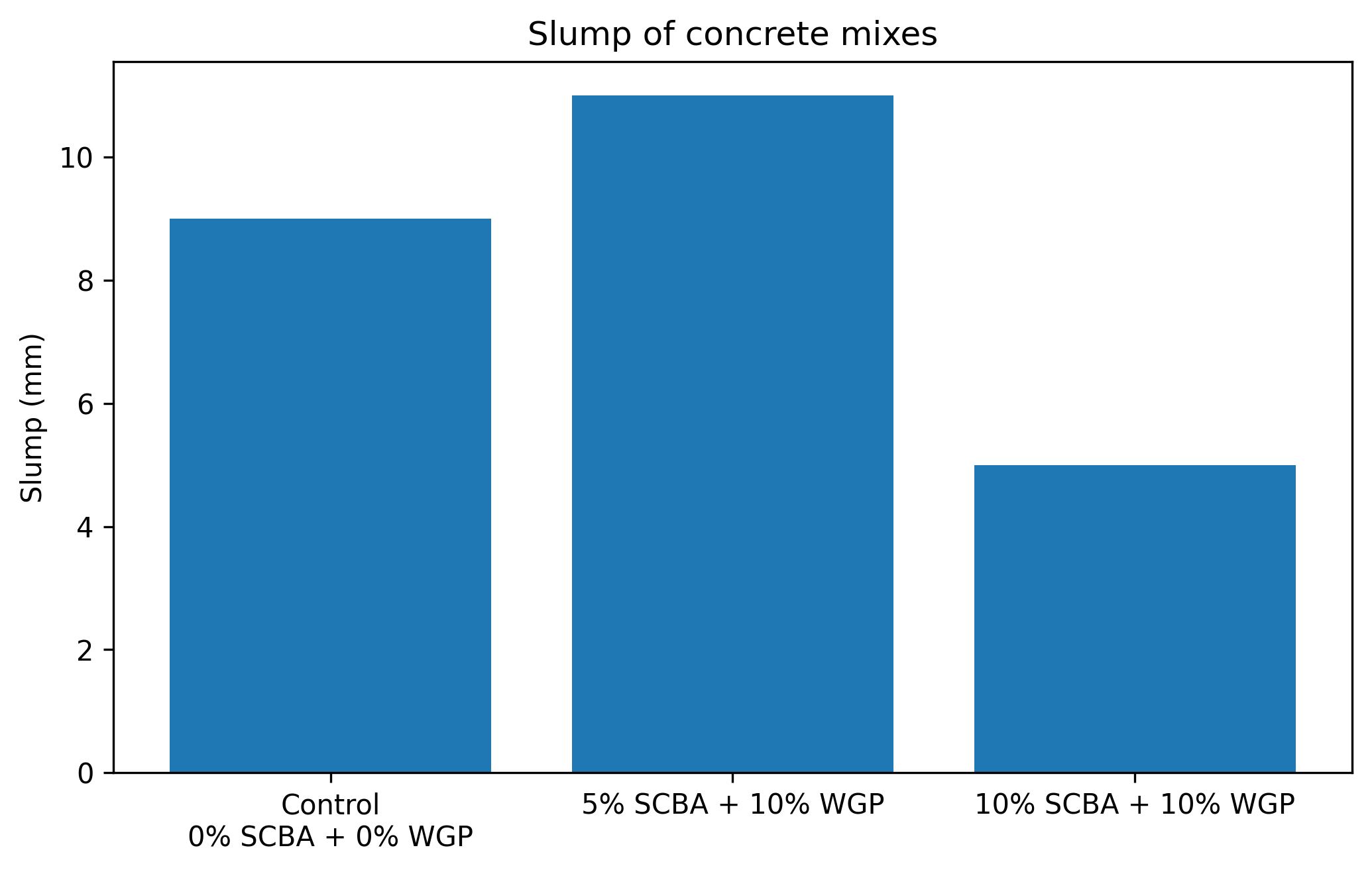
The control mixture produced a slump of 9 mm. Addition of 5% SCBA and 10% WGP increased the slump slightly to 11 mm, whereas increasing SCBA to 10% reduced the slump to 5 mm. Thus, the higher untreated-SCBA replacement produced the clearest reduction in workability within the tested matrix.
3.2 Mass gain
The recorded specimen masses before and after curing, together with the calculated mass-gain values, are presented in Table 4.
| Concrete mix | Average weight before curing (kg) | Average weight after curing (kg) | Mass gain (%) |
| Control (0% SCBA + 0% WGP) | 8.665 | 8.775 | 1.27 |
| 5% SCBA + 10% WGP | 8.235 | 8.340 | 1.28 |
| 10% SCBA + 10% WGP | 8.030 | 8.135 | 1.31 |
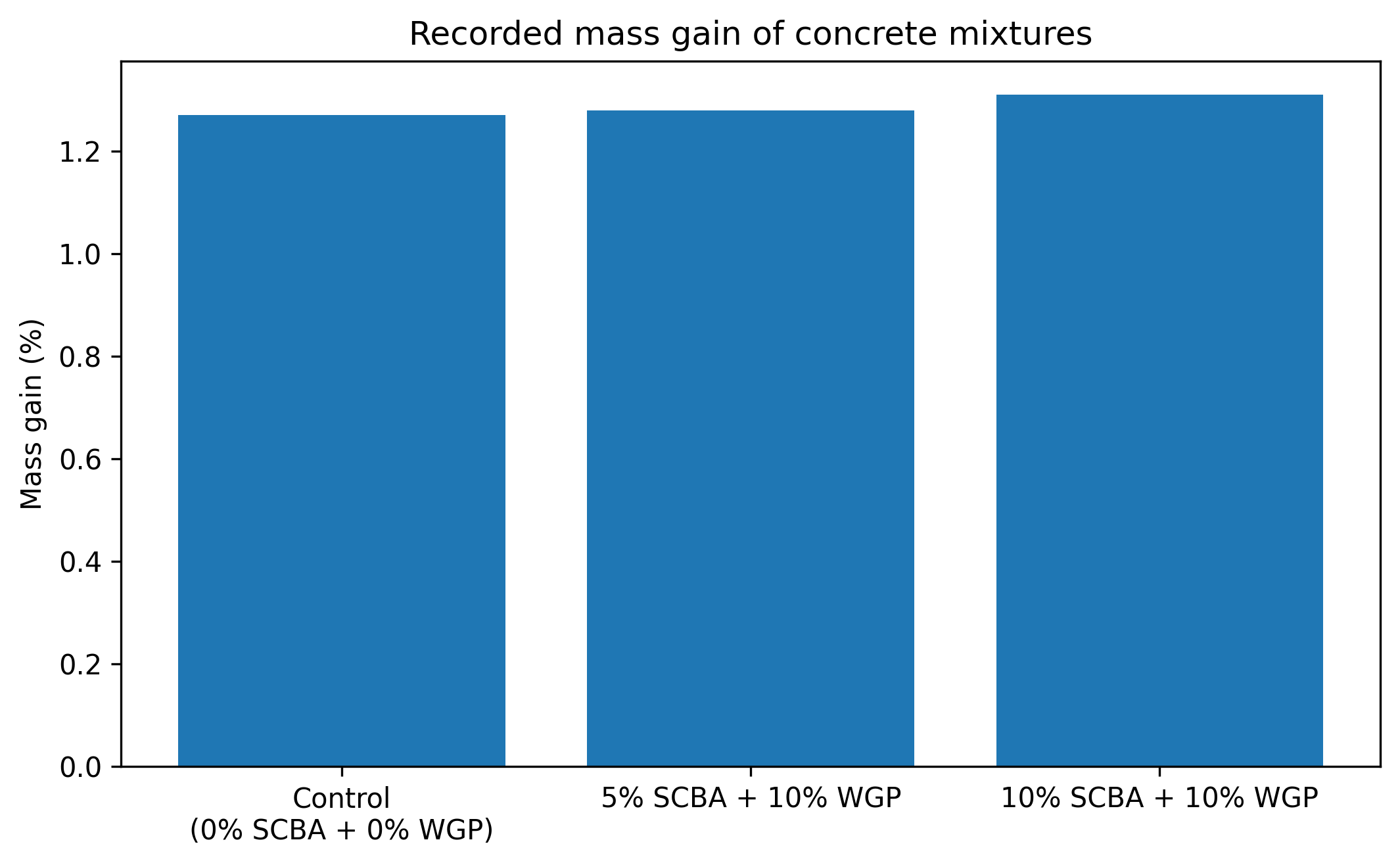
Mass gain was determined from the increase in specimen mass before and after curing. Because the experimental procedure did not document standardized drying, immersion and specimen-conditioning conditions, the resulting values are interpreted as a mass-gain indicator rather than definitive evidence of permeability or long-term durability. As shown in Figure 2, the recorded mass-gain values varied only slightly among the mixtures. The control had the lowest value (1.27%), followed by the 5% SCBA + 10% WGP mixture (1.28%) and the 10% SCBA + 10% WGP mixture (1.31%). The total range was only 0.04 percentage points, indicating relatively similar mass-gain behaviour among the three mixtures under the experimental procedure.
3.3 Compressive strength development
The mean compressive strengths and associated sample standard deviations at 7, 14 and 28 days are presented in Table 5.
| Concrete mix | 7 days (MPa) | 14 days (MPa) | 28 days (MPa) |
| Control (0% SCBA + 0% WGP) | 7.05 ± 0.29 | 9.12 ± 2.61 | 11.36 ± 1.87 |
| 5% SCBA + 10% WGP | 9.39 ± 0.71 | 10.42 ± 0.88 | 10.14 ± 1.43 |
| 10% SCBA + 10% WGP | 8.26 ± 1.06 | 8.15 ± 0.95 | 10.46 ± 0.98 |
Note. Values are mean ± sample standard deviation (n = 2).
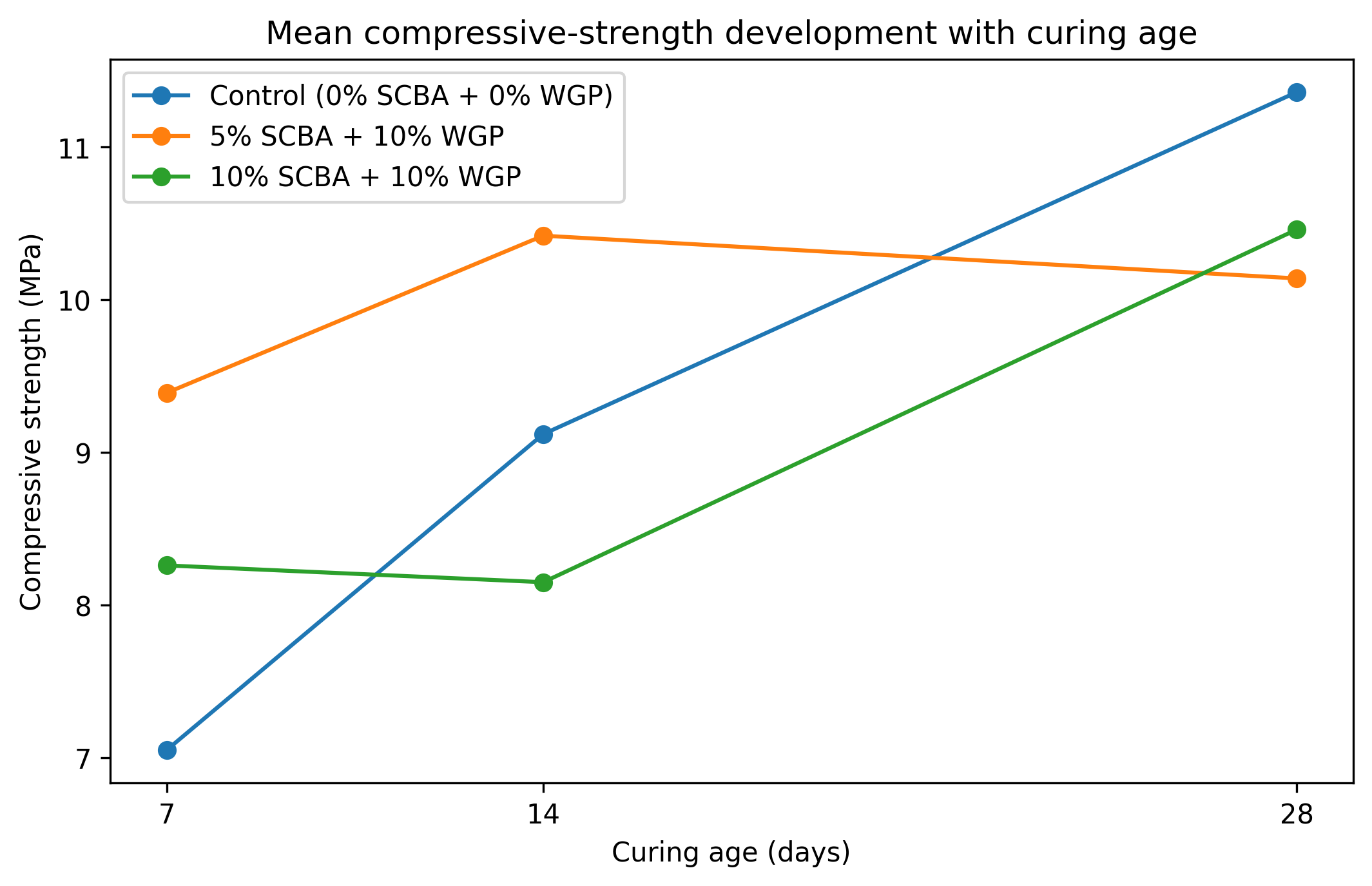
The strength-development trends shown in Figure 3 indicate that the control mean increased from 7.05 MPa at 7 days to 9.12 MPa at 14 days and 11.36 MPa at 28 days. The 5% SCBA + 10% WGP mixture increased from 9.39 to 10.42 MPa at 7 and 14 days but had a 28-day mean of 10.14 MPa. The 10% SCBA + 10% WGP mixture increased from 8.26 MPa at 7 days to 10.46 MPa at 28 days, despite a small decline at 14 days (8.15 MPa). At 28 days, the control exhibited the highest mean strength, followed by the 10% SCBA + 10% WGP mixture and the 5% SCBA + 10% WGP mixture. The percentage changes in mean compressive strength relative to the control are presented in Table 6.
| Concrete mix | 7 days | 14 days | 28 days |
| 5% SCBA + 10% WGP | +33.2% | +14.3% | −10.7% |
| 10% SCBA + 10% WGP | +17.2% | −10.5% | −7.9% |
Relative to the calculated control means, the 5% SCBA + 10% WGP mixture showed changes of +33.2%, +14.3% and −10.7% at 7, 14 and 28 days, respectively. The 10% SCBA + 10% WGP mixture showed +17.2%, −10.5% and −7.9% at the same ages. These results indicate that the 5% SCBA + 10% WGP mixture had an early-age strength advantage but not a 28-day advantage over the control.
4. Discussion
4.1 Effect of replacement level on workability
The measured workability varied with the combined replacement composition. The 5% SCBA + 10% WGP mixture produced a slightly higher slump than the control, whereas increasing SCBA to 10% reduced slump substantially. The reduction is consistent with mechanisms reported for SCBA-containing mixtures, where particle morphology, fineness, combustion history and dosage can influence water demand (Thomas et al., 2021; Kolawole et al., 2021; Li et al., 2022).
The increase from 9 to 11 mm at the 5% SCBA level should therefore not be interpreted as proof that WGP universally improves workability. Waste-glass systems show variable fresh-state responses depending on particle size, dosage and the characteristics of the host binder (Jiang et al., 2022; Franco-Luján et al., 2024). In the present experiment, the 11 mm value indicates only that the particular combination and processing condition used produced slightly greater measured slump than the control. At 10% SCBA, the workability penalty became dominant, giving a slump of 5 mm.
4.2 Mass-gain behaviour
The recorded mass-gain values changed only slightly across the mixtures, from 1.27% to 1.31%. The 5% SCBA + 10% WGP mixture therefore produced a value essentially comparable with the control, while the 10% SCBA + 10% WGP mixture showed the highest mass gain. This trend may reflect the influence of particle characteristics and water-demand effects associated with increasing untreated-SCBA content. However, the present experiment did not include porosity, sorptivity, permeability or microstructural measurements; consequently, the observed mass-gain values cannot by themselves establish a pore-refinement mechanism. The broader literature indicates that SCBA and WGP can alter transport properties through filler and pozzolanic effects, but these outcomes depend strongly on particle fineness, processing and replacement level (Thomas et al., 2021; Jiang et al., 2022; Franco-Luján et al., 2024). The narrow range observed here indicates that the tested replacement levels produced only a small change in the mass-gain indicator under the experimental procedure; it should not be interpreted as definitive evidence of improved long-term durability.
4.3 Compressive strength development and combined SCM action
The specimen-level data show that the 5% SCBA + 10% WGP mixture performed above the control at 7 and 14 days, but not at 28 days. At 7 days, its mean strength was 9.39 MPa compared with 7.05 MPa for the control (+33.2%), and at 14 days it was 10.42 MPa compared with 9.12 MPa (+14.3%). At 28 days, however, the control mean was 11.36 MPa, compared with 10.14 MPa for the 5% SCBA + 10% WGP mixture and 10.46 MPa for the 10% SCBA + 10% WGP mixture. Therefore, the data do not demonstrate a single replacement combination that was superior at all curing ages.
The early-age advantage of the 5% SCBA + 10% WGP mixture may be associated with the combined physical contribution of WGP and the reactive contribution of SCBA. However, this remains an interpretation rather than a directly measured mechanism because the study did not include XRD, XRF, SEM or thermogravimetric characterization of the actual binder system.
The 10% SCBA + 10% WGP mixture showed lower strength than the control at 7 and 14 days but approached the control at 28 days (10.46 versus 11.36 MPa). This pattern is compatible with slower strength development in a system containing a larger fraction of untreated ash, but the available data do not permit the reaction kinetics to be established. Literature on SCBA and WGP supports the importance of replacement level, particle characteristics and curing age, but the present study should be interpreted specifically as an experimental observation for the materials and processing conditions used.
4.4 Role of PLC in the blended system
The use of PLC distinguishes the present system from studies based solely on ordinary Portland cement. PLC contains a limestone component that can influence particle packing, phase assemblage and the hydration environment. Recent research has shown that limestone-containing cement systems can develop satisfactory engineering performance when their composition and processing are appropriately controlled (Lee et al., 2024; Akerele et al., 2025). The present results indicate that untreated SCBA and WGP can be incorporated into PLC concrete, although the observed performance depends on replacement level and curing age.
The sustainability implication should also be stated conservatively. Replacing part of PLC with waste-derived materials potentially reduces the quantity of manufactured binder required per unit volume of concrete and diverts waste from disposal. However, this study did not measure cement-production emissions, processing energy, transport distance, cost, or life-cycle impacts. Therefore, claims of lower carbon emissions or lower cost are not experimental findings of this study; they remain potential benefits that should be quantified in future work. This distinction is important because environmental performance depends on the actual processing and transport requirements of the alternative materials (Perez Arbelaez et al., 2022; Akerele et al., 2025).
4.5 Comparison with recent literature and practical significance
The present findings are broadly consistent with recent literature showing that moderate replacement levels of SCBA and WGP can preserve or improve selected concrete properties, while higher replacement can cause dilution and workability penalties (Thomas et al., 2021; Li et al., 2022; Franco-Luján et al., 2024). The distinctive feature of the present experiment is the combination of untreated SCBA, WGP and PLC using locally sourced materials and no additional processing of the ash. This provides experimental evidence relevant to regions where controlled calcination and intensive grinding may not be readily available.
The study also contributes to the broader waste-valorization literature emerging from Nigerian construction-material research. Akolade et al. (2025) demonstrated the use of banana pseudo-stem residue in cement-bonded composite boards, illustrating a related pathway in which locally available agricultural residues are converted into construction products. The present study extends this waste-utilization perspective to an ash-and-glass blended concrete system, although the two studies address different materials and performance requirements.
5. Conclusions
Within the limits of the specimen-level dataset and the three investigated mixtures, the following conclusions can be drawn:
-
Untreated SCBA and WGP were successfully incorporated jointly as partial replacements for PLC in the investigated concrete mixtures.
-
Workability was influenced by the untreated SCBA content. The slump increased from 9 mm for the control mixture to 11 mm for the 5% SCBA + 10% WGP mixture, but decreased to 5 mm at 10% SCBA + 10% WGP, indicating reduced workability at the higher untreated-SCBA level.
-
Recorded mass-gain values varied narrowly from 1.27% to 1.31%. Because the experimental procedure did not document the conditioning requirements of a standardized water-absorption method, these values are interpreted as a mass-gain indicator rather than definitive evidence of long-term durability.
-
The 5% SCBA + 10% WGP mixture exhibited the highest mean compressive strengths at 7 and 14 days, whereas the control mixture recorded the highest 28-day mean strength (11.36 MPa), followed by 10% SCBA + 10% WGP (10.46 MPa) and 5% SCBA + 10% WGP (10.14 MPa).
-
The results do not support identifying a single replacement combination as superior at all curing ages. The 5% SCBA + 10% WGP mixture demonstrated an early-age strength advantage but did not exceed the control at 28 days.
-
The findings provide baseline evidence for further investigation of untreated SCBA–WGP–PLC concrete, particularly with a broader range of replacement levels, increased specimen replication, and standardized durability testing.
6. Limitations and Recommendations for Further Research
The compressive-strength dataset comprised two replicate results for each mixture and curing age. This limited replicate number reduces the precision with which variability and statistical differences can be assessed.
Future studies should: (i) recover and archive all original specimen records; (ii) characterize the actual untreated SCBA and WGP using XRF/XRD and particle-size analysis; (iii) apply a standardized water-absorption procedure and report specimen conditioning; (iv) investigate a wider matrix of individual and combined replacement levels; (v) use a consistent replicate number and report mean ± standard deviation; (vi) extend curing to at least 56, 90 and 365 days; (vii) investigate ASR and other durability indicators relevant to glass-containing concrete; and (viii) undertake cost and life-cycle assessment using actual processing and transport requirements.
References
- Abdalla, T. A., Hussein, A. A. E., Ahmed, Y. H., & Semmana, O. (2024). Strength, durability, and microstructure properties of concrete containing bagasse ash—A review of 15 years of perspectives, progress and future insights. Results in Engineering, 21, 101764. DOI ↗ Google Scholar ↗
- Akerele, D. D., Aguayo, F., & Wu, L. (2025). Portland limestone cement in concrete pavement and bridge decks: Performance evaluation and future directions. Buildings, 15(5), 660. DOI ↗ Google Scholar ↗
- Akolade, A. S., Olaomotito, P. A., Adebiyi, A. Y., Abolarin, O. P., Adetunji, O. I., & Ogedengbe, K. (2025). Production and evaluation of cement-bonded composites board made from banana pseudo stem. FUDMA Journal of Engineering and Technology, 1(2), 664–677. DOI ↗ Google Scholar ↗
- ASTM International. (2015). ASTM C128-15: Standard test method for relative density (specific gravity) and absorption of fine aggregate. ASTM International. DOI ↗ Google Scholar ↗
- ASTM International. (2019a). ASTM C136/C136M-19: Standard test method for sieve analysis of fine and coarse aggregates. ASTM International. Google Scholar ↗
- ASTM International. (2019b). ASTM D2216-19: Standard test methods for laboratory determination of water (moisture) content of soil and rock by mass. ASTM International. Google Scholar ↗
- ASTM International. (2020). ASTM C143/C143M-20: Standard test method for slump of hydraulic-cement concrete. ASTM International. DOI ↗ Google Scholar ↗
- Bameri, M., Mohammadhasani, M., Khaloo, A., Ashour, A., & NikKhah, M. (2025). Influence of waste glass powder as a supplementary cementitious material (SCM) on the mechanical properties, expansion, environmental impact, and microstructure of cementitious mortar. Engineering Reports, 7(6), e70238. DOI ↗ Google Scholar ↗
- British Standards Institution. (2019). BS EN 12390-3:2019: Testing hardened concrete—Compressive strength of test specimens. BSI. DOI ↗ Google Scholar ↗
- Franco-Luján, V. A., Ramírez-Arellanes, S., Gomez-Sanchez, A., Pérez-Ramos, A.-E., Cruz-García, E. S., & Cruz-Martínez, H. (2024). Properties of fresh and hardened cement-based materials with waste glass as supplementary cementitious material: A review. Journal of Building Engineering, 95, 110137. DOI ↗ Google Scholar ↗
- Gupta, S., & Chaudhary, S. (2022). State of the art review on supplementary cementitious materials in India—II: Characteristics of SCMs, effect on concrete and environmental impact. Journal of Cleaner Production, 357, 131945. DOI ↗ Google Scholar ↗
- Jiang, X., Xiao, R., Bai, Y., Huang, B., & Ma, Y. (2022). Influence of waste glass powder as a supplementary cementitious material (SCM) on physical and mechanical properties of cement paste under high temperatures. Journal of Cleaner Production, 340, 130778. DOI ↗ Google Scholar ↗
- Kolawole, J. T., Babafemi, A. J., Fanijo, E., Paul, S. C., & Combrinck, R. (2021). State-of-the-art review on the use of sugarcane bagasse ash in cementitious materials. Cement and Concrete Composites, 118, 103975. DOI ↗ Google Scholar ↗
- Lee, J., Lothenbach, B., & Moon, J. (2024). Performance improvement of Portland-limestone cement by mechanochemical activation. Cement and Concrete Research, 176, 107411. DOI ↗ Google Scholar ↗
- Li, Y., Chai, J., Wang, R., Zhang, X., & Si, Z. (2022). Utilization of sugarcane bagasse ash (SCBA) in construction technology: A state-of-the-art review. Journal of Building Engineering, 56, 104774. DOI ↗ Google Scholar ↗
- Ndahirwa, D., Zmamou, H., Lenormand, H., & Leblanc, N. (2022). The role of supplementary cementitious materials in hydration, durability and shrinkage of cement-based materials, their environmental and economic benefits: A review. Cleaner Materials, 5, 100123. DOI ↗ Google Scholar ↗
- Perez Arbelaez, O. F., Restrepo Florez, D., Zapata Vergara, L. M., & Hernández Benavides, K. V. (2022). Innovative use of agro-waste cane bagasse ash and waste glass as cement replacement for green concrete: Cost analysis and carbon dioxide emissions. Journal of Cleaner Production, 379, 134822. DOI ↗ Google Scholar ↗
- Solís Cruz, D. M., Torres-Acosta, A. A., & Martín-Pérez, B. (2026). Durability and sustainability performance of Portland limestone cements. Revista ALCONPAT, 16(1), 60–98. DOI ↗ Google Scholar ↗
- Thomas, B. S., Yang, J., Bahurudeen, A., Abdalla, J. A., Hawileh, R. A., Hamada, H. M., Nazar, S., Jittin, V., & Ashish, D. K. (2021). Sugarcane bagasse ash as supplementary cementitious material in concrete—A review. Materials Today Sustainability, 15, 100086. DOI ↗ Google Scholar ↗
- Xiao, R., Huang, B., Zhou, H., Ma, Y., & Jiang, X. (2022). A state-of-the-art review of crushed urban waste glass used in OPC and AAMs (geopolymer): Progress and challenges. Cleaner Materials, 4, 100083. DOI ↗ Google Scholar ↗