Abstract
Between 2004 and 2009, civil movements in Mongolia experienced a period of heightened mobilization that brought issues of social justice, state accountability, corruption, and environmental protection to the center of political discourse. These movements played a significant role in institutionalizing forms of civic participation independent of the state and political parties. However, despite their initial momentum and public visibility, most civil movements failed to fully achieve their stated objectives. Over time, they experienced organizational fragmentation, decline, and eventual demobilization. This article provides a theoretical explanation for the disintegration and decline of Mongolian civil movements during this period. In the study of social movements, the concept of movement decline constitutes a distinct analytical framework that identifies several core causes of demobilization. Scholars commonly point to three principal explanations: (1) the successful attainment of movement goals; (2) repression and dissolution through the use of force; and (3) the erosion of legitimacy and public credibility. While Mongolian civil movements neither fully achieved their goals nor were completely suppressed through coercion, their decline was largely driven by a loss of public trust and decreasing societal support, which in turn disrupted access to critical organizational resources. This article examines the specific political, institutional, and social factors that contributed to this process of reputational decline and resource depletion.
Keywords
social movements; civil movements; mobilization theory; institutionalization theory; resource dependence theory; parliament; government; populism; polarization; crisis of trust.
Introduction
The civil (social) movements that emerged in Mongolia between 2004 and 2009 represented a new phase in the country’s democratic development. These movements constituted a broad-based social phenomenon addressing political, economic, environmental, and social justice issues. Their emergence was closely linked to multiple structural crises, including weak political accountability, pervasive corruption, a lack of transparency in governmental decision-making processes, economic inequality, environmental degradation, and declining living standards.
The combination of democratic deepening and economic liberalization exposed the deficiencies of state accountability mechanisms and created new opportunities for citizen participation outside formal political institutions. Civil movements during this period successfully elevated issues of social justice, government responsibility, and environmental protection to the center of political debate, thereby expanding the scope of civic engagement beyond state-controlled or party-centered channels.
Despite these contributions, the movements were largely unable to translate mobilization into sustained policy outcomes. Over time, organizational cohesion weakened, networks fragmented, and collective action lost momentum. Quantitative data indicate that a total of 1,392 protests and demonstrations were recorded between 2004 and 2009, with activity peaking in 2006. Initially, environmental protection and social justice concerns dominated mobilization, while political demands became more prominent during 2007–2008. From 2008 onward, economically oriented movements intensified. Beginning in 2009, however, the combined effects of economic crisis, increased state regulation, and stricter law enforcement policies contributed to a sharp decline in protest activity.
In the final phase of this cycle, certain movements—such as Gal Ündesten (Fire Nation) and Ongi River Movement—shifted toward more radical forms of action, with nationalist rhetoric becoming increasingly pronounced. These developments reflected not only strategic adaptation but also deeper structural and legitimacy-related challenges facing Mongolian civil movements during this period.
Theoretical Framework
This study analyses the fragmentation and declines of civil movements through three complementary theoretical perspectives: co-optation theory, institutional absorption theory, and resource dependence theory.
Co-optation Theory The intellectual foundations of co-optation theory can be traced to the works of Robert Michels, Philip Selznick, Peter Bachrach, and Morton Baratz. In Political Parties, Michels (1915) formulated the concept of the “iron law of oligarchy,” arguing that organizational leaders tend to become integrated into existing power structures, gradually abandoning the original goals of the movement they represent. [13], in TVA and the Grass Roots, introduced the concept of co-optation to explain how organizations respond to internal and external pressures by incorporating potential sources of opposition into their internal structures and cultures. Bachrach and Baratz (1962), in Two Faces of Power, further emphasized that power often operates through co-optative mechanisms that prevent conflict from becoming overt.
Co-optation theory has been widely applied in political science, organizational sociology, and social movement studies. Its central proposition is that dissent can be neutralized by selectively incorporating movement leaders or representatives into political institutions, decision-making bodies, or support networks. In this sense, co-optation refers to a political strategy through which ruling elites, state institutions, or powerful organizations create relationships of dependency by offering participation, recognition, or material support. Although such inclusion may appear to expand participation, it often weakens resistance from within and realigns movements with the prevailing system, thereby reducing their oppositional capacity.
Institutional Absorption Theory Institutional absorption theory builds primarily on the institutionalist tradition in organizational sociology. [14], in Leadership in Administration, conceptualized institutionalization as a process through which organizations internalize external pressures by embedding them into internal norms, rules, and organizational culture. Meyer and Rowan (1977) further argued that new ideas and practices are often absorbed into institutional environments in symbolic or ceremonial forms, allowing organizations to maintain legitimacy without fundamentally altering their core activities. DiMaggio and Powell (1983) introduced the concept of institutional isomorphism to explain how organizations within a shared field become increasingly similar through coercive, normative, and mimetic processes.
Within this theoretical framework, the absorption of civil movements is understood as a gradual process through which oppositional actors, ideas, and practices are incorporated into formal institutional structures. By embedding movement demands into official rules, procedures, and policy frameworks, institutional actors are able to exert control over civic initiatives while simultaneously reducing their radical potential. This long-term process internalizes external pressures and reforms, thereby preserving systemic stability while reshaping the form and content of civic participation.
Resource Dependence Theory Resource dependence theory is associated with the works of Emerson, Pfeffer, and Salancik. [4] proposed that power relations are fundamentally rooted in asymmetric dependencies on critical resources. Building on this insight, Pfeffer and Salancik (1978), in The External Control of Organizations, argued that organizations lose autonomy as they become increasingly dependent on external actors for financial resources, legitimacy, and operational support.
This perspective has been widely applied in organizational theory, studies of social movement financing, and analyses of state–civil society relations. From a resource dependence perspective, civil movements that rely on external sources—such as state institutions, donors, or market actors—for funding, access, or organizational space face structural constraints on their strategic autonomy. As dependency deepens, movements may be compelled to modify their goals, strategies, and modes of action in order to secure continued access to essential resources, thereby limiting their capacity for independent collective action.
Methodology
This study is based on both qualitative and quantitative empirical evidence and examines the influence of social movements on Mongolia’s political system at historical, institutional, and policy-response levels, while strictly adhering to fundamental principles of research ethics. The civil movements active in Mongolia between 2004 and 2009 emerged under conditions of political instability, widespread public protest, and heightened tension between the state and civil society. Under such circumstances, research findings carry the risk of being interpreted as assigning direct responsibility or blame to specific individuals, political actors, or institutions.
To mitigate this risk, the study prioritizes the ethical principle of non-maleficence and refrains from employing unverified assumptions or speculative accusations as causal explanations. Instead, the analysis focuses on empirically observable processes and structural patterns.
In explaining the decline, fragmentation, and demobilization of civil movements, the study employs theoretical frameworks commonly used in social movement research, including co-optation tactics, institutional absorption, and resource dependence. These theories are not intended to assess individual intentions or moral responsibility, but rather to explain how changes in institutional environments, resource structures, and participation mechanisms reshape the forms of collective action and the capacity for political influence at a processual level.
Accordingly, these theoretical perspectives are applied not to attribute blame or characterize outcomes in moral terms such as “betrayal,” but to interpret recurring patterns and sequences of institutional change observed across multiple sources. Furthermore, the study does not seek to explain the entire process through a single, fully documented case. Instead, theoretical interpretations are grounded in repeatedly observed indicators—such as shifts in policy engagement strategies, alignment between leadership structures and institutional frameworks, and changes in funding sources—that appear consistently across different empirical materials. This methodological choice allows the study to avoid individual-level accusations in contexts of limited evidence and serves as an important ethical safeguard in politically sensitive research settings.
Political Parties, Street Politics, and the Co-optation of Civil Movements
Conflicts among political parties and coalitions in parliament are not confined to the legislative arena. In practice, parties frequently extend their struggles beyond parliament by mobilizing street protests, social movements, and public demonstrations as instruments to expand public support, influence state policy, pressure political opponents, or shift the balance of political compromise in their favor. This form of engagement typically manifests in two distinct ways. First, direct mobilization, whereby a political party itself initiates, finances, and organizes a movement or protest. Second, indirect mobilization, in which parties operate through supporters, protectors, or representatives of ostensibly independent civil movements.
Such patterns of co-optation have been widely observed across different political contexts. In countries such as Italy, Spain, and Greece, left-wing parties—including Syriza and Podemos—successfully transformed protest movements that emerged during periods of economic crisis into organized political forces and subsequently leveraged them in parliamentary elections. In the aftermath of the 2008 global financial crisis, widespread demands for social justice, public resentment toward political elites, and anti-establishment sentiments gave rise to protest movements that were institutionalized by political actors as electoral resources. Through this process, what initially emerged as “politics of protest” was gradually converted into parliamentary-level “institutional politics.”
Similar dynamics have been observed elsewhere. In France, both left- and right-wing parties utilized protest movements surrounding pension reforms and fuel taxation—most notably the Gilets Jaunes (“Yellow Vests”)—to consolidate their political positions. In the United States, the Republican Party drew upon the Tea Party movement during the 2010s to exert pressure on issues of taxation and public spending, while the Democratic Party integrated support from movements such as Black Lives Matter and the Women’s March into electoral campaigns.
Scholars of contentious politics emphasize that political participation in contemporary democracies does not occur solely through institutional channels such as parliaments, parties, or state agencies. Rather, it is closely intertwined with extra-parliamentary arenas, including street protests, social movements, and issue-based campaigns—forms of non-institutional participation that interact dynamically with formal political institutions (McAdam, Tarrow, & Tilly, 2001; [15]). Although civil movements often originate as expressions of societal resistance outside political parties and state structures, they are frequently drawn into institutional political games as a result of party interests and strategic calculations [5].
Party Strategies Toward Civil Movements in Mongolia
In the Mongolian context, political parties have exhibited several recurring strategies in their engagement with civil movements for political purposes:
-
Intensifying parliamentary pressure: generating street-level pressure through mobilization in order to force rival parties to revise policy positions;
-
Attracting public and media attention: using protests and demonstrations to transform specific grievances into salient political issues;
-
Expanding electoral campaigns: converting movement supporters into identifiable voter blocs;
-
Utilizing movement leadership: recruiting movement leaders into party structures or nominating them as candidates to enhance party popularity;
-
Providing financial and logistical support: facilitating protests aligned with party objectives by supplying funding, materials (slogans, banners, tents, food, clothing), and legal permissions.
The involvement of political parties and factions in civil movements produces both positive and negative consequences for the movements themselves.
Positive Effects
-
Civil voices gain access to parliamentary arenas, increasing the likelihood that social issues enter policy agendas.
-
Once movement demands are incorporated into institutional deliberations, transparency and accountability—albeit modestly—tend to improve.
Negative Effects
-
Movements risk losing autonomy and moral authority as they become entangled in partisan interests.
-
Populism, polarization, and crises of trust may deepen, undermining the development of civil society.
-
The quality of political accountability and institutional maturity may deteriorate.
In recent years, Mongolian political parties have increasingly employed civil movements as instruments of street-level political pressure to expand policy competition within parliament. While this practice may enhance participatory dimensions of democracy, it simultaneously blurs the boundary between political parties and civil society, thereby weakening social trust and accountability mechanisms. Consequently, there is a growing need to strengthen legal and institutional safeguards that protect the autonomy and transparency of civil movements within Mongolia’s political environment.
Theoretical Implications of Co-optation
From a theoretical perspective, interactions between civil movements and political parties provide mechanisms through which non-institutional (street-level) participation is translated into institutional politics. This process enables movements to mobilize broader constituencies while allowing parties to incorporate such mobilization into electoral and parliamentary participation on a continuous basis ([6]; [15]). As McAdam, Tarrow, and [15] argue, from a resource mobilization perspective, movement activities—such as events, information dissemination, and volunteer engagement—can serve as enduring electoral resources that political parties draw upon to advance policy commitments .
Civil movements typically emerge as issue-specific, non-institutional forms of participation focused on social justice, transparency, or environmental protection. However, as movements expand and public support grows, political parties and governing elites frequently deploy co-optation as a strategic instrument. Co-optation refers to a process whereby ruling groups, state institutions, or political parties seek to neutralize opposition by incorporating movement actors, ideas, or leaders into their own organizational structures or spheres of influence. The primary objective is to weaken the independent influence of movements, reduce their radical potential, and maintain elite control by allowing only limited and regulated participation in policymaking.
Common forms of co-optation include appointing movement leaders to party or state positions, selectively incorporating movement demands into party platforms without robust implementation, and creating financial or political dependencies under the guise of support. While such practices may initially appear to reflect policy responsiveness, over the long term they tend to subordinate civic participation to institutional control, neutralize dissent, and erode the independent strength of social movements .
This pattern is also observable in Mongolia. In several cases, leaders of environmental or anti-mining movements have been placed on party electoral lists or appointed to state positions, resulting in a dilution of the movements’ original objectives and critical stance.
| Conceptual Dimension | Advantages (Positive Effects) | Disadvantages (Negative Effects) |
| Democratic development | Strengthens pluralism and increases political participation | Civil voices may be subordinated to partisan interests |
| Representation and voice | Channels movement issues into parliamentary and policy debates | Movements risk becoming tools of party public relations |
| Policy influence | Enhances opportunities to influence legislation and decisions | Shifts in party positions may marginalize movement goals |
| Civic participation and political culture | Improves political awareness and participatory norms | Participation may devolve into partisan alignment |
| Accountability and transparency | Enables electoral accountability for policy promises | Lack of transparency may foster political bargaining |
| System stability | Absorbs social conflict within institutional frameworks | Poor regulation may generate political crises |
Concluding Remarks
Collaborative political engagement between civil movements and political parties has contributed to democratic development by strengthening pluralism, introducing new issues into policy debates, and fostering civic political culture. Movement mobilization has expanded political participation beyond electoral cycles, reinforcing the notion of participation as a continuous process of policy formation and oversight. Moreover, civil movements have compensated for deficiencies in representative mechanisms by channelling citizens’ concerns into parliamentary and decision-making arenas, thereby enhancing transparency and legitimacy.
From a theoretical standpoint, incorporating movement initiatives into party and parliamentary policymaking can promote policy innovation, social responsibility, and systemic stability. By absorbing potentially destabilizing conflicts within institutional frameworks, political systems enhance their capacity for internal balance and democratic resilience.
Resource Dependency and Organizational Vulnerability
Resource Dependency Theory posits that the actions and survival of organizations and movements are shaped by their dependence on external resources, including funding, information, political support, and legitimacy [12]. This theory highlights the delicate balance between organizational survival and autonomy. When civil movements lose this balance—particularly when core values are sacrificed in exchange for resources—institutional trust deteriorates and goal coherence disintegrates.
In the Mongolian case, resource dependency contributed to movement decline in several ways. Civil movements that relied on financial, informational, or political support from state institutions or political parties developed increasing dependency. This dependency constrained decision-making autonomy and strategic flexibility, forcing movements to act in accordance with donor or patron conditions rather than their own agendas. As a result, internal trust eroded, members questioned whose interests the movement truly served, and internal fragmentation intensified. Externally, the public increasingly perceived these movements as being under political patronage, leading to declining trust and reduced popular support.
Co-optation, Institutional Absorption, and Democratic Consequences
The relationship between civil movements and political parties in Mongolia between 2004 and 2009 produced several negative consequences. As movements became increasingly absorbed into party interests, their original objectives faded and the independent voice of civil society weakened. This dynamic manifested through co-optation mechanisms, whereby oppositional energy was redirected into political public relations tools. Consequently, public trust declined and the quality of civic participation deteriorated.
In many cases, political parties strategically utilized movement demands during periods of competition for power, only to marginalize or abandon these movements once their objectives were achieved. This pattern weakened movement support and accelerated internal disintegration. Over time, citizen political engagement shifted toward partisan alignment rather than autonomous, issue-based participation. In the long run, this trend undermined democratic quality by eroding trust in accountability and transparency mechanisms.
Ultimately, when transparency is lacking and cooperation between movements and political parties devolves into political bargaining, systemic trust collapses and the risk of renewed social conflict increases. If left unregulated, such dynamics may destabilize political systems, with conflicts between parties and movements becoming potential catalysts for broader political crises.
Institutional Absorption, Resource Dependency, and the Decline of Civil Movements
Institutional absorption refers to the process through which the state, political parties, or formal political institutions incorporate social movements and protest groups into their own organizational structures and decision-making mechanisms in order to bring them under control. Although this process may appear as an expansion of institutional participation, in practice it often aims to neutralize oppositional voices and weaken organized criticism. Social movement theorists such as [16], Meyer and Tarrow (1998), and [11] conceptualize institutional absorption as a process in which the boundaries between the state and civil society become blurred. While this may signal institutional flexibility on the one hand, it simultaneously erodes the radical potential of civic participation—namely, its capacity to challenge and transform existing systems—on the other. The causes of movement fragmentation are analysed through three complementary theoretical perspectives: Co-optation Theory, Institutional Absorption Theory, and Resource Dependency Theory (see Table 2).
| Cause of Movement Decline | Co-optation Theory | Institutional Absorption Theory | Resource Dependency Theory |
| Political integration of leaders (party/state) | Parties/states co-opt leaders, neutralizing opposition; leaders become “mandated representatives,” trust declines. | Institutions include movement representatives in official councils or committees, making them part of the system. | Leaders depend on party/state funding and support; movement strategy becomes non-autonomous. |
| Dilution of goals / message conflict | Original goals are adapted for political PR and lose autonomy. | Radical ideas are moderated to comply with institutional norms. | Goals change to meet donor requirements, abandoning original objectives. |
| Loss of internal trust / factionalism | Leaders’ political behaviour reduces internal trust; “traitor” perception emerges. | Institutional pressures deepen internal factional divides; some members aim to align with the system. | Unequal resource distribution increases competition among internal factions. |
| Increased strategic dependency on the state | Participation in state-provided opportunities shifts control toward the state. | Movement participation becomes integrated into institutional processes. | Dependence on state/donor limits strategic autonomy. |
| Decrease in public support | Citizens perceive the movement as “too political”; trust decreases. | Movement becomes a system representative, reducing public support. | Over-reliance on financial/organizational support diminishes grassroots participation. |
| Erosion of critical/ oppositional capacity | Oversight by state/party softens criticism. | Integration into institutional forms enforces internal rules, diminishing radical potential. | Financial dependence pressures the moderation of critical content. |
| Resource depletion / exhaustion | Key leaders co-opted into institutions; remaining members lack resources. | Movements rely on institutional resources; cannot sustain independently. | Dependency on financial/human resources limits autonomous capacity. |
Institutional absorption played a significant role in the internal fragmentation of movements in several ways. First, when movement leaders entered state or party structures, the movements’ autonomous institutional culture was undermined. Second, attempts to adapt to new rules, norms, and interests within institutional environments led to the dilution of original values and goals. As a result, movements increasingly came into conflict with their own internal cultures, weakening trust and cohesion and ultimately contributing to organizational decline.
Resource Dependency Theory posits that the activities of organizations and movements are shaped by their dependence on external resources, including financial support, information, and political backing [12]. Resource dependency reflects a balance between organizational survival and autonomy. When civil movements lose this balance—particularly when core values are sacrificed in exchange for resources—organizational trust deteriorates and goal coherence weakens, increasing the likelihood of fragmentation.
From the perspective of movement decline, resource dependency contributed in several ways. Movements that relied on political parties or state institutions for funding, information, or support developed structural dependencies. These dependencies constrained decision-making autonomy and strategic flexibility, forcing movements to act according to the conditions set by their supporters rather than their own agendas. Consequently, internal trust eroded, and members increasingly questioned whose interests the movement truly served. Externally, public perception shifted as movements came to be viewed as politically patronized, leading to declining legitimacy and public support.
Overall, the fragmentation of social movements should not be understood solely as an internal organizational failure. Rather, it represents the combined outcome of three interrelated institutional processes: political co-optation as a mechanism of control, institutional absorption as a mode of long-term incorporation, and resource dependency as a structural constraint on autonomy. Figure 1 illustrates the interaction among these three theoretical dimensions.
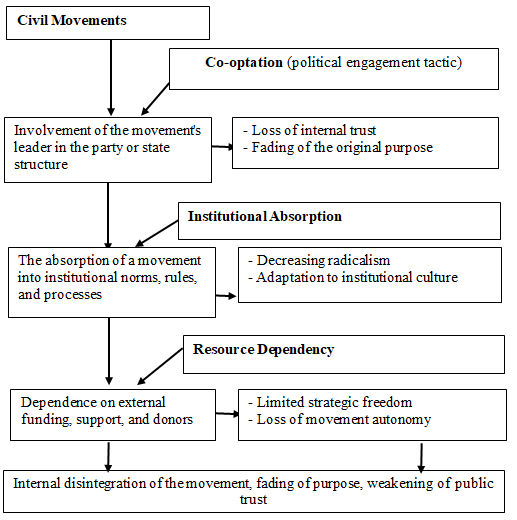
The figure highlights the following dynamics. First, co-optation operates as a short-term political tactic through which movement leaders are incorporated into party or state structures, thereby neutralizing opposition. Second, institutional absorption functions as a long-term process that embeds movements within formal rules, norms, and procedures, transforming them into components of the existing system. Third, resource dependency restricts strategic autonomy and gradually obscures original goals. The cumulative outcome of these processes is a fragmentation dynamic characterized by blurred objectives, weakened internal cohesion, and declining public trust.
The relationship between civil movements and political parties in Mongolia during the period 2004–2009 produced several negative consequences. As movements became increasingly absorbed into party interests, their original goals were diluted and their independent civic voice weakened. This dynamic manifested through co-optation mechanisms that transformed movements into instruments of political public relations. As a result, public trust declined and the quality of civic participation deteriorated.
In particular, cases in which parties instrumentalized movement demands during shifts in political positioning or power competition—only to later disregard them—contributed to declining support and internal fragmentation. Over time, civic engagement increasingly shifted toward partisan alignment rather than autonomous, critical participation. In the long run, this trend undermined democratic quality by weakening mechanisms of accountability, transparency, and public trust.
Finally, when transparency is lacking or when cooperation between movements and parties devolves into political bargaining, systemic trust erodes and the risk of renewed social conflict increases. If such relationships remain unregulated, they may ultimately destabilize the political system itself, with tensions between parties and movements becoming a potential trigger for broader political crises.
Conclusion
This study has sought to provide a theoretically integrated explanation of the institutional and political factors shaping the mobilization, decline, and eventual fragmentation of civil movements in Mongolia between 2004 and 2009. The findings suggest that the weakening of civil movements was not primarily the result of achieving their stated objectives nor of direct repression or coercive dissolution. Rather, it emerged as the cumulative outcome of multi-layered processes embedded in interactions with the political system, including co-optation, institutional absorption, and resource dependency.
Specifically, political parties and state institutions engaged civil movements as instruments of extra-parliamentary pressure, incorporated movement leaders into formal political structures, and generated dependencies through financial and logistical support. These practices progressively eroded the autonomy and moral authority of civil movements, leading to internal fragmentation, goal dilution, and declining public trust. Institutional absorption neutralized the radical and transformative potential of protest by integrating movements into the routines and norms of the political system, while resource dependency constrained strategic autonomy and encouraged a shift toward project-based, donor-driven forms of participation.
Accordingly, safeguarding the quality of democracy and the sustainable development of civil society in Mongolia requires policy and legal frameworks that protect the autonomy of civil movements, clearly delineate the boundaries between political parties and civil society actors, and institutionalize transparent and accountable modes of interaction. Without such safeguards, the instrumentalization of civil movements risks undermining civic trust, weakening participatory citizenship, and ultimately diminishing the democratic capacity of the political system.
References
- Bachrach, P., & Baratz, M. S. (1962). Two faces of power. American Political Science Review, 56(4), 947–952. DOI ↗ Google Scholar ↗
- Batbold , T., & Otgonbayar , N. (2024). On the standardization and use of the term "political patronage". Mongolian Journal of Applied Linguistics, 9(No 1). DOI ↗ Google Scholar ↗
- DiMaggio, P. J., & Powell, W. W. (1983). The iron cage revisited: Institutional isomorphism and collective rationality in organizational fields. American Sociological Review, 48(2), 147–160. DOI ↗ Google Scholar ↗
- Emerson, R. M. (1962). Power-dependence relations. American Sociological Review, 27(1), 31–41. DOI ↗ Google Scholar ↗
- Kriesi, H. (2015). Party systems and voter alignments in times of crisis. West European Politics, 38(1), 129–154. DOI ↗ Google Scholar ↗
- McAdam, D., Tarrow, S., & Tilly, C. (2001). Dynamics of contention. Cambridge University Press. DOI ↗ Google Scholar ↗
- Meyer, J. W., & Rowan, B. (1977). Institutionalized organizations: Formal structure as myth and ceremony. American Journal of Sociology, 83(2), 340–363. DOI ↗ Google Scholar ↗
- Meyer, D. S., & Tarrow, S. (1998). The social movement society: Contentious politics for a new century. Rowman & Littlefield. DOI ↗ Google Scholar ↗
- Michels, R. (1915). Political parties: A sociological study of the oligarchical tendencies of modern democracy. Free Press. DOI ↗ Google Scholar ↗
- Otgonbayar , N. (2025). Patronage Appointments in the Civil Service: Causes, Current Situation, and Possibly solutions. A Dissertation submitted in Partial Fulfillment of the Requirements for the Degree of Doctor of Philosophy in Political Science, Ulaanbaatar city: School of Political Science, International Relations and Public Administration, The National University of Mongolia. DOI ↗ Google Scholar ↗
- Offe, C. (1985). New social movements: Challenging the boundaries of institutional politics. Social Research, 52(4), 817–868. DOI ↗ Google Scholar ↗
- Pfeffer, J., & Salancik, G. R. (1978). The external control of organizations: A resource dependence perspective. Harper & Row. DOI ↗ Google Scholar ↗
- Selznick, P. (1949). TVA and the grass roots: A study in the sociology of formal organization. University of California Press. DOI ↗ Google Scholar ↗
- Selznick, P. (1957). Leadership in administration: A sociological interpretation. Harper & Row. DOI ↗ Google Scholar ↗
- Tilly, C. (2004). Social movements, 1768–2004. Paradigm Publishers. DOI ↗ Google Scholar ↗
- Phillips, D. (2013). DOI ↗ Google Scholar ↗