Abstract
In the context of accelerating digital transformation, higher education institutions are increasingly required to reconcile technological innovation with long-term sustainability objectives. This study aims to systematically map the research landscape of digital transformation and sustainability in higher education management using a bibliometric approach. Data were retrieved from the Scopus database, yielding 1,605 documents, which were subsequently refined to 671 publications for the period 2020–2025 based on predefined screening criteria. The analysis was conducted using VOSviewer to examine publication trends, subject area distribution, leading publication sources, and keyword co-occurrence patterns. The findings indicate a marked increase in research output, particularly after 2022, suggesting a rapid expansion of scholarly interest in this field. The results further reveal a strongly interdisciplinary structure, with dominant contributions from social sciences, computer science, and environmental science. In addition, journals such as Sustainability (Switzerland) emerge as central publication outlets. Keyword co-occurrence analysis identifies several major thematic clusters, including technology-driven innovation, student-centered learning, and sustainability-oriented governance, alongside emerging topics such as artificial intelligence, academic integrity, and generative AI. Overall, the study suggests that research in this domain is evolving toward a more integrated and multidisciplinary framework. These findings provide both theoretical insights for future research and practical implications for higher education institutions seeking to balance digital transformation with sustainability objectives.
Keywords
Digital transformation; Higher education management; Sustainability; Sustainable development; Artificial intelligence; Bibliometric analysis; VOSviewer.
1. Introduction
In recent years, digital transformation has increasingly been recognized as a key driver reshaping organizational structures and operational practices across multiple sectors, including higher education. Rather than being limited to technological adoption, this transformation appears to involve broader changes in governance, decision-making processes, and institutional strategies. The rapid development of technologies such as artificial intelligence, big data, and digital learning platforms has, in many contexts, fundamentally altered how universities deliver education and interact with stakeholders.
At the same time, higher education institutions are facing growing pressure to align their activities with sustainability agendas, particularly in relation to global initiatives such as the Sustainable Development Goals (SDGs). In this regard, universities are no longer viewed solely as knowledge providers but are increasingly expected to act as key agents of social and environmental transformation. Sustainability considerations are therefore becoming more embedded in governance structures and long-term strategic planning.
Against this backdrop, the intersection between digital transformation and sustainability has emerged as an important area of academic inquiry. Digital technologies are often considered enabling mechanisms that may enhance resource efficiency, support innovative pedagogical approaches, and strengthen institutional governance. However, the extent to which these dimensions are integrated within higher education management remains uneven and, in some cases, insufficiently examined.
Although the body of literature in this area has expanded in recent years, existing studies tend to remain fragmented across disciplinary boundaries. Research has often focused on isolated aspects, such as digital technology adoption or sustainability practices, without fully capturing their interconnections. As a result, a comprehensive understanding of how digital transformation and sustainability co-evolve within higher education management is still lacking.
To address this limitation, this study adopts a bibliometric approach to systematically analyze the research landscape of digital transformation and sustainability in higher education. By examining Scopus-indexed publications, the study aims to identify key trends, dominant subject areas, and emerging thematic structures.
Specifically, this study seeks to answer the following research questions:
(1) How has research on digital transformation and sustainability in higher education evolved over time?(2) What subject areas and publication sources contribute most significantly to this field?(3) What key themes and emerging topics can be identified through keyword co-occurrence analysis?
By providing a structured overview of the field, this study contributes to the literature by clarifying research directions and identifying emerging issues. From a practical perspective, the findings may also support higher education managers in designing strategies that integrate digital transformation with long-term sustainability objectives.
2. Methodology
2.1. Data collection
This study employs a bibliometric approach to examine research on digital transformation and sustainability in higher education management. The dataset was collected from the Scopus database, which is widely recognized for its comprehensive coverage of peer-reviewed publications.
To ensure relevance, the following search string was applied in the TITLE-ABS-KEY field:
TITLE-ABS-KEY ("higher education") AND TITLE-ABS-KEY ("digital transformation" OR digitalization OR "digital technologies" OR "artificial intelligence") AND TITLE-ABS-KEY (sustainab*)
The initial search yielded 1,605 documents, representing a broad spectrum of studies related to digital transformation and sustainability in higher education.
2.2. Data screening and refinement
To enhance analytical consistency, several filtering criteria were applied. First, the time frame was restricted to 2020–2025 to capture recent developments in digital transformation and artificial intelligence. Second, only articles and review papers were included to ensure academic rigor. Third, the dataset was limited to English-language publications to maintain consistency in interpretation.
After applying these criteria, the dataset was reduced from 1,605 to 671 documents, which were considered suitable for subsequent analysis.
2.3. Data analysis using VOSviewer
The refined dataset was exported in CSV format and analyzed using VOSviewer, a specialized software tool for constructing and visualizing bibliometric networks. In this study, VOSviewer was used to perform keyword co-occurrence analysis in order to identify major research themes and their interrelationships.
A minimum occurrence threshold was applied to filter keywords, ensuring that only the most relevant and frequently occurring terms were included in the network. In the visualization, node size represents keyword frequency, while link strength indicates the degree of association between keywords.
In addition to network analysis, descriptive statistics based on Scopus data were used to examine publication trends, subject area distribution, and leading publication sources. This combined approach enables a systematic understanding of the structure and evolution of research on digital transformation and sustainability in higher education.
3. Results
3.1. Publication trends over time
Source: Authors’ elaboration based on Scopus database.
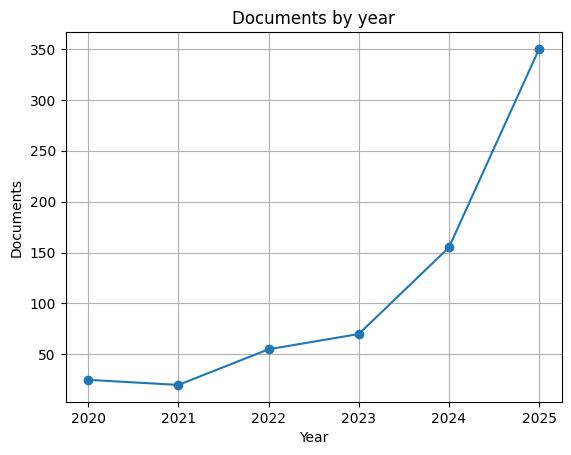
The analysis of publication output indicates a clear and sustained upward trajectory in research on digital transformation and sustainability within higher education. As illustrated in Figure 1, the number of publications increased progressively over the observed period, although the pace of growth appears to vary across different stages.
In the initial phase, research activity remained relatively limited, with approximately 25 publications recorded in 2020, followed by a slight decline in 2021. This pattern may suggest that the field was still in an early stage of development, characterized by exploratory and fragmented contributions.
However, from 2022 onwards, a more pronounced expansion becomes evident. The number of publications rose to around 55 documents in 2022 and continued to increase in 2023, indicating a gradual consolidation of research interest. Notably, the most significant growth is observed in the later years, with publication output increasing sharply to approximately 155 documents in 2024 and reaching nearly 350 documents in 2025.
This accelerated growth may reflect the increasing relevance of digital transformation in higher education, particularly in response to rapid technological advancements and evolving sustainability agendas. More broadly, the observed trend suggests that the field is transitioning from an emerging research domain to a more established and rapidly expanding area of scholarly inquiry.
3.2. Distribution by subject area
Source: Authors’ elaboration based on Scopus database.
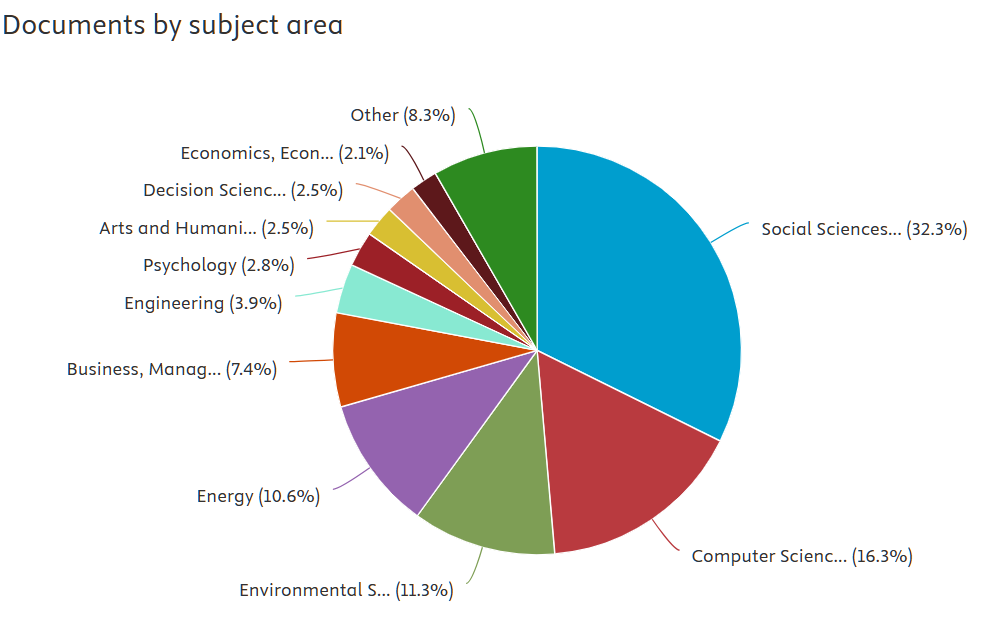
The distribution of publications across subject areas highlights the inherently interdisciplinary nature of research in this field. As shown in Figure 2, Social Sciences account for the largest share, representing approximately 32.3% of the total publications. This dominance suggests that the topic is primarily approached from perspectives related to education, governance, and policy.
Computer Science constitutes the second-largest contribution (16.3%), reflecting the growing role of digital technologies, artificial intelligence, and data-driven systems in shaping higher education practices. This pattern indicates that technological innovation is increasingly embedded within educational research rather than being treated as a separate domain.
In addition, Environmental Science (11.3%) and Energy (10.6%) contribute substantial proportions, underscoring the strong connection between sustainability research and environmental concerns within higher education contexts. These findings suggest that sustainability is not merely conceptual but is often linked to tangible issues such as resource management and energy efficiency.
From a managerial perspective, Business, Management and Accounting account for 7.4% of the publications, indicating a growing interest in governance, strategic decision-making, and institutional performance in the context of digital transformation. Although smaller in proportion, other fields such as Engineering, Psychology, Arts and Humanities, Decision Sciences, and Economics provide complementary insights that enrich the overall understanding of the topic.
Taken together, these findings suggest that research on digital transformation and sustainability in higher education is characterized by a convergence of multiple disciplinary perspectives, with increasing integration between technological, managerial, and sustainability-oriented approaches.
3.3. Leading publication sources
Source: Authors’ elaboration based on Scopus database.
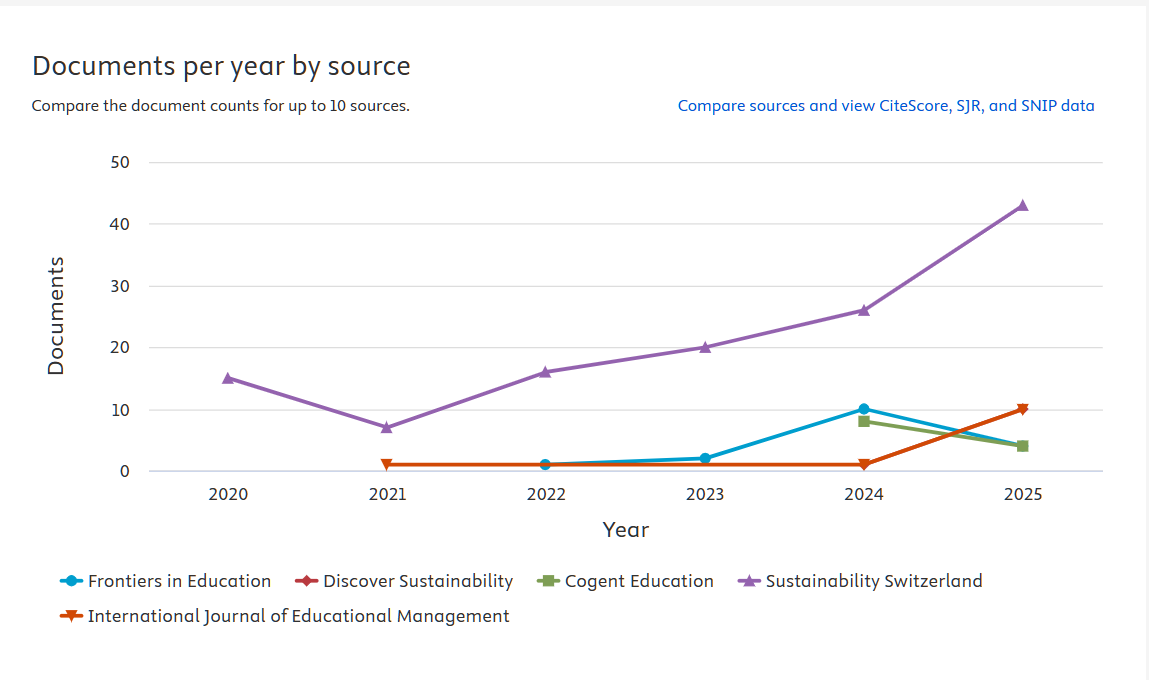
The analysis of publication sources reveals that a relatively small number of journals play a prominent role in disseminating research in this field. As indicated in Figure 3, Sustainability (Switzerland) emerges as the most influential outlet over the observed period.
The number of publications in this journal shows a consistent upward trend, increasing from approximately 15 documents in 2020 to more than 40 documents in 2025. This pattern suggests that sustainability-oriented journals have become key platforms for interdisciplinary research that connects digital transformation with environmental and social dimensions.
More broadly, the concentration of publications in a limited set of journals may indicate the gradual consolidation of the research field, where certain outlets function as central hubs for scholarly exchange. At the same time, this pattern also reflects the increasing institutionalization of sustainability-related research within higher education.
3.4 Keyword co-occurrence
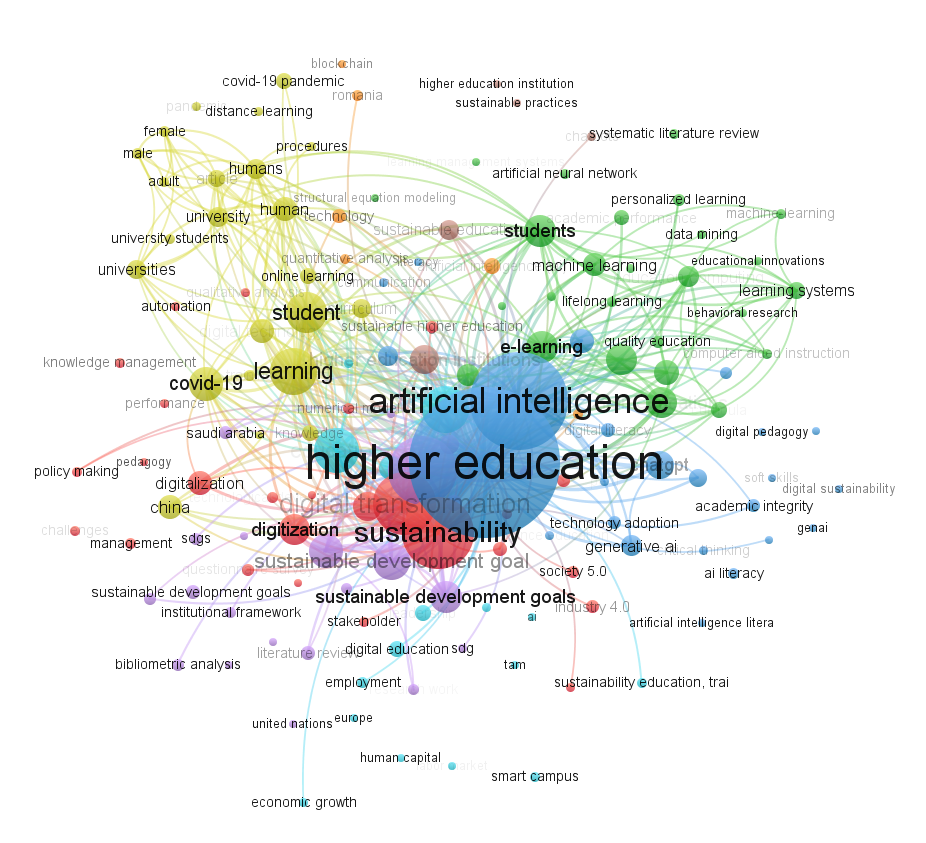
The keyword co-occurrence network provides insights into the intellectual structure and thematic evolution of the research field. As shown in Figure 4, several keywords most notably higher education, digital transformation, sustainability, and artificial intelligence occupy central positions within the network, indicating their dominant role in shaping the field.
The network is organized into several clusters, each representing a distinct yet interconnected research theme.
The first cluster, which can be characterized as technology-oriented, includes keywords such as artificial intelligence, machine learning, learning systems, and data mining. This cluster reflects a strong focus on the application of advanced technologies to enhance educational processes and institutional performance.
The second cluster centers on learning and student-related issues, incorporating terms such as learning, students, online learning, and COVID-19. This suggests that a substantial portion of the literature examines how digital transformation influences pedagogical practices and student engagement, particularly in response to external disruptions.
The third cluster is associated with sustainability and policy dimensions, including keywords such as sustainability, sustainable development goals, digitalization, and policy. This cluster highlights the integration of sustainability agendas into higher education governance and strategic frameworks.
In addition, an emerging cluster can be identified, linking concepts such as academic integrity, AI literacy, and generative AI. The presence of these terms suggests a growing awareness of ethical considerations and digital competencies in the context of rapidly evolving technologies.
Overall, the keyword co-occurrence analysis indicates that the research field is evolving toward a more integrated and multidimensional framework. The strong interconnections between clusters suggest that digital transformation in higher education should be understood not only as a technological shift but also as a broader socio-institutional transformation aligned with long-term sustainability objectives.
Source: Authors’ elaboration based on data retrieved from the Scopus database and visualized using VOSviewer software.
4. Discussion
The findings of this study provide several insights into the evolving research landscape of digital transformation and sustainability in higher education management. Rather than reflecting a linear development, the results suggest a field that is expanding in both scope and conceptual complexity.
First, the substantial increase in publication output, particularly after 2022, indicates that digital transformation has become a central concern within higher education research. This growth may be associated not only with the rapid advancement of digital technologies especially artificial intelligence, but also with structural shifts triggered by the COVID-19 pandemic, which accelerated the adoption of digital learning environments. In this sense, digital transformation appears to be moving beyond a temporary response toward a more institutionalized and long-term strategic orientation.
Second, the subject area distribution underscores the interdisciplinary character of the field. While Social Sciences remain dominant, reflecting a strong emphasis on governance, policy, and educational practices, the notable contributions from Computer Science and Environmental Science point to an increasing convergence between technological innovation and sustainability concerns. This convergence suggests that digital transformation in higher education should not be understood solely as a technical process, but rather as a socio-technical transformation embedded within broader institutional and sustainability frameworks.
Third, the concentration of publications in a relatively small number of journals, particularly Sustainability (Switzerland), indicates the emergence of specialized publication outlets that serve as central nodes within the research ecosystem. This pattern may reflect a gradual consolidation of the field, where interdisciplinary research is increasingly channeled through journals that explicitly integrate environmental, technological, and educational perspectives. At the same time, the continued presence of education-focused journals suggests that the managerial and pedagogical implications of digital transformation remain an important area of scholarly attention.
Fourth, the keyword co-occurrence analysis provides further evidence of the evolving intellectual structure of the field. The prominence of keywords such as higher education, artificial intelligence, and sustainability confirms the central thematic focus, while the identification of multiple clusters highlights the coexistence of several research trajectories. In particular, the emergence of themes such as AI literacy, academic integrity, and generative AI suggests a shift toward more critical and reflective perspectives on the implications of digital technologies. These developments indicate that the discourse is gradually expanding beyond efficiency and innovation toward ethical and governance-related considerations.
Overall, the findings suggest that research on digital transformation and sustainability in higher education is moving toward a more integrated and holistic framework. Digital transformation increasingly appears to function as a strategic and governance-driven process that interacts with sustainability objectives, rather than as a purely technological upgrade. Future research may therefore benefit from exploring how higher education institutions can balance innovation with ethical responsibility and long-term sustainability goals.
5. Conclusion
This study provides a comprehensive bibliometric overview of research on digital transformation and sustainability in higher education management based on Scopus-indexed publications from 2020 to 2025. By analyzing a dataset of 671 documents, the study offers a structured understanding of the evolution, intellectual structure, and emerging trends within this rapidly developing research domain.
The findings reveal a substantial increase in research output, particularly in recent years, suggesting that the integration of digital transformation and sustainability has become an increasingly prominent topic in higher education research. This trend reflects both the accelerated adoption of digital technologies, including artificial intelligence, and the growing global emphasis on sustainable development within educational systems.
In addition, the results highlight the interdisciplinary nature of the field, with strong contributions from social sciences, computer science, and environmental science. This pattern indicates that digital transformation in higher education is shaped not only by technological innovation but also by governance, policy frameworks, and sustainability considerations.
The analysis of publication sources and keyword co-occurrence further suggests that the field is structured around several interconnected themes, including technology-driven innovation, student-centered learning, and sustainability-oriented governance. The emergence of topics such as AI literacy, academic integrity, and generative AI also points to a shift toward more critical and forward-looking research directions.
From a practical perspective, the findings imply that higher education institutions may need to adopt a more integrated approach that aligns digital transformation strategies with sustainability objectives. This involves not only investing in technological infrastructure but also addressing ethical challenges, enhancing digital competencies, and embedding sustainability principles into institutional governance.
Despite its contributions, this study has several limitations. The analysis is based solely on the Scopus database and limited to English-language publications, which may exclude relevant studies from other sources. Furthermore, the focus on a relatively recent time period may not fully capture earlier developments in the field.
Future research could extend this work by incorporating multiple databases, applying more advanced analytical techniques, or examining specific dimensions such as governance models, digital capabilities, and the role of emerging technologies in sustainable higher education systems.
References
- Aria, M., & Cuccurullo, C. (2017). Bibliometrix: An R-tool for comprehensive science mapping analysis. Journal of Informetrics, 11(4), 959–975. DOI ↗ Google Scholar ↗
- Donthu, N., Kumar, S., Mukherjee, D., Pandey, N., & Lim, W. M. (2021). How to conduct a bibliometric analysis: An overview and guidelines. Journal of Business Research, 133, 285–296. DOI ↗ Google Scholar ↗
- Holmes, W., Bialik, M., & Fadel, C. (2019). Artificial intelligence in education: Promise and implications for teaching and learning. Center for Curriculum Redesign. DOI ↗ Google Scholar ↗
- Leal Filho, W., Shiel, C., & Paço, A. (2019). The role of higher education institutions in sustainability initiatives. Journal of Cleaner Production, 235, 131–144. DOI ↗ Google Scholar ↗
- Lozano, R., Lukman, R., Lozano, F. J., Huisingh, D., & Lambrechts, W. (2013). Declarations for sustainability in higher education: Becoming better leaders, through addressing the university system. Journal of Cleaner Production, 48, 10–19. DOI ↗ Google Scholar ↗
- Matt, C., Hess, T., & Benlian, A. (2015). Digital transformation strategies. Business & Information Systems Engineering, 57(5), 339–343. DOI ↗ Google Scholar ↗
- Selwyn, N. (2011). Schools and schooling in the digital age: A critical analysis. Routledge. DOI ↗ Google Scholar ↗
- Selwyn, N. (2016).Education and technology: Key issues and debates. Bloomsbury Academic. DOI ↗ Google Scholar ↗
- Siemens, G. (2005).Connectivism: A learning theory for the digital age. International Journal of Instructional Technology and Distance Learning, 2(1), 3–10. DOI ↗ Google Scholar ↗
- United Nations. (2015). Transforming our world: The 2030 Agenda for Sustainable Development. United Nations. DOI ↗ Google Scholar ↗
- Urbach, N., & Röglinger, M. (2019). Digitalization cases: How organizations rethink their business for the digital age. Springer. DOI ↗ Google Scholar ↗
- van Eck, N. J., & Waltman, L. (2010). Software survey: VOSviewer, a computer program for bibliometric mapping. Scientometrics, 84(2), 523–538. DOI ↗ Google Scholar ↗
- Westerman, G., Bonnet, D., & McAfee, A. (2014). Leading digital: Turning technology into business transformation. Harvard Business Review Press. DOI ↗ Google Scholar ↗
- Williamson, B. (2017). Big data in education: The digital future of learning, policy and practice. Sage. DOI ↗ Google Scholar ↗
- Zawacki-Richter, O., Marín, V. I., Bond, M., & Gouverneur, F. (2019). Systematic review of research on artificial intelligence applications in higher education. International Journal of Educational Technology in Higher Education, 16(1), 1–27. DOI ↗ Google Scholar ↗