Abstract
The current transformation of the modern educational landscape, characterized by advances in digitalization, open access to technology, and the complexity of student needs, as well as demands for continuous quality improvement, has opened the way for the development of more adaptive, innovative, and transformative leadership models. Various approaches to educational leadership are currently only partial, so they need to be integrated with future orientation, adaptability, strengthening human values, managerial agility, and meaningful transformation within a comprehensive framework. Therefore, this study develops the "FAHAM" Leadership Model as a conceptual framework consisting of Futuristic Thinking, Adaptive Leadership, Humanistic Approach, Agile Management, and Meaningful Transformation to support innovation and transformation in improving the quality of education. The study used the Systematic Literature Review (SLR) method with the PRISMA 2020 approach. The process of identifying, screening, and selecting articles was carried out on the Scopus, ScienceDirect, and Google Scholar databases with a publication range of 2020–2026. Studies that met the inclusion criteria were analyzed thematically to identify leadership factors that contribute to organizational innovation, quality culture, effectiveness of educational institutions, and sustainability of transformation. The study results indicate that the success of educational quality transformation is strongly influenced by visionary, adaptive, humanistic, and innovation-oriented leadership. A literature synthesis identified that the dimensions of the "FAHAM" Model contribute to improving organizational performance, strengthening a culture of quality, and accelerating educational transformation. The "FAHAM" Model offers novelty through the integration of five leadership dimensions into a comprehensive framework. This model has the potential to serve as a reference for educational leaders in building adaptive, innovative, and sustainable learning organizations, while also expanding the development of educational leadership theory in the digital and global era.
Keywords
Education Leadership Model Futuristic Thinking Adaptive Leadership Humanistic Approach Agile Management Meaningful Transformation
Introduction
The global education landscape is currently facing one of the most disruptive periods of change in the history of educational development. The rapid transformation of digital technology, artificial intelligence (AI), globalization, and changing competency requirements are fundamentally altering the way educational institutions manage learning, develop human resources, and maintain the quality of educational services. Today's educational organizations no longer function solely as institutions for knowledge transfer but are also required to become adaptive, innovative, and sustainable learning organizations in the face of rapid and uncertain change.This transformation creates new pressures for educational organizations to become more adaptive, innovative, and responsive to increasingly rapid and unpredictable environmental changes.Various studies show that technology and educational policies only function as supporting factors, while the success of educational transformation depends heavily on leadership's ability to build a vision, manage organizational change, develop a culture of learning, and continuously improve institutional capacity.
These leadership skills are becoming increasingly crucial as disruptive technologies evolve and transform the global education landscape. Numerous studies have shown that technology and education policies only serve as supporting factors for transformation, while the success of educational change depends heavily on leadership capacity to build a shared vision, manage organizational change, foster a culture of learning, and sustainably enhance institutional capacity.These leadership skills are becoming increasingly important as digital technologies develop, fundamentally changing learning processes, organizational governance, and educational decision-making.Among the various emerging digital innovations, Artificial Intelligence (AI) has emerged as a transformational force influencing the future of education. Artificial Intelligence (AI) has been utilized in various aspects of education, including personalized learning, learning analytics, adaptive assessment, intelligent tutoring systems, and data-driven decision-making, enabling a more personalized, responsive, and effective learning process.However, the implementation of Artificial Intelligence (AI) also presents new challenges related to ethics, data privacy, algorithmic bias, and the readiness of teachers and educational organizations to adopt the technology responsibly.. Therefore, future educational leaders are required to not only have technological literacy, but also the ability to integrate digital innovation with humanitarian values, organizational sustainability, and continuous improvement of educational quality (Luckin, 2023; UNESCO, 2024).
On the other hand, educational institutions in various countries still face challenges in sustainably improving the quality of education. Various educational reforms implemented over the past two decades have not yet been able to produce consistent improvements in learning quality, organizational innovation, or graduate readiness to face global challenges (Fullan, 2022). Research shows that the success of improving educational quality is greatly influenced by the ability of leaders to build a collaborative organizational culture, encourage innovation, strengthen teacher capacity, and develop resilient learning organizations (Bush, 2021; Leithwood et al., 2022). Therefore, educational leadership today is required to function not only as an organizational manager but also as a driver of continuous transformation and innovation.
Various approaches to educational leadership have been developed to address these challenges, including transformational leadership, instructional leadership, distributed leadership, digital leadership, and adaptive leadership (Hallinger & Kovačević, 2021). Despite making significant contributions to the development of educational leadership theory, most of these models focus on specific dimensions and fail to comprehensively address the complex challenges of modern education. Transformational leadership emphasizes organizational change, digital leadership focuses on technology integration, adaptive leadership emphasizes the ability to cope with change, while human-centered leadership focuses more on individual development and social relationships (Heifetz et al., 2021; Sheninger, 2024). Consequently, the educational leadership literature still exhibits conceptual fragmentation, resulting in the lack of a model capable of integrating all leadership competencies required in the digital and Artificial Intelligence era.
This gap is becoming increasingly important given that today's educational leaders are required to simultaneously perform five key functions: predicting future change, adapting to uncertainty, empowering people as the organization's primary asset, managing the organization agilely, and generating transformations that significantly impact educational quality. However, research integrating these five dimensions into a holistic educational leadership framework remains limited. Thus, a research gap exists in the absence of an educational leadership model that simultaneously connects future orientation, organizational adaptability, a humanistic approach, managerial agility, and meaningful transformation as the primary foundations for improving educational quality.
To address this gap, this study developed the FAHAM Leadership Model, an educational leadership model comprising five key dimensions: Futuristic Thinking, Adaptive Leadership, Humanistic Approach, Agile Management, and Meaningful Transformation. Unlike previous leadership models that tended to focus on specific aspects, the FAHAM Model offers a more integrative approach by linking strategic, behavioral, technological, organizational, and transformational dimensions within a comprehensive conceptual framework. Futuristic Thinking emphasizes the ability to anticipate the future and develop a strategic vision. Adaptive Leadership focuses on the ability to navigate dynamic change. The Humanistic Approach places humans at the center of educational transformation. Agile Management emphasizes organizational agility in decision-making and innovation. Meanwhile, Meaningful Transformation ensures that the changes made have a tangible impact on the quality of learning, organizational culture, and the quality of education on an ongoing basis.
The novelty of this research lies in the development of an educational leadership model that integrates five dimensions of strategic leadership within a single framework specifically designed to address the challenges of education in the digital and Artificial Intelligence era. Theoretically, this research contributes to the development of educational leadership literature by offering an integrative perspective that goes beyond conventional leadership approaches. Practically, the FAHAM Model has the potential to become a strategic framework for school principals, educational leaders, and policymakers in driving innovation, organizational transformation, and continuous improvement in educational quality.
Based on this background, this study aims to develop and analyze the FAHAM Leadership Model through a Systematic Literature Review (SLR) approach. This study specifically aims to identify the theoretical foundations and empirical evidence supporting each dimension of the model, synthesize the relationships between dimensions, and formulate a relevant educational leadership framework to support innovation and transformation of educational quality in the digital and Artificial Intelligence era. This study uses a Systematic Literature Review (SLR) approach with PRISMA 2020 guidelines to synthesize various studies related to innovative educational leadership, digital transformation, Artificial Intelligence integration, and educational quality improvement. This literature synthesis is expected to produce a strong conceptual basis for the development of the FAHAM Leadership Model in education. The writing of this article has theoretical and practical significance in developing a future educational leadership model that is integrative, innovative, and relevant to the digital era. The research results are expected to form the basis for developing educational policies, strengthening the capacity of school principals, and sustainable transformation of the quality of primary and secondary education (OECD, 2023).
Method
The Systematic Literature Review (SLR) process was conducted following the PRISMA 2020 guidelines. This research is a literature study with the method used, namely Systematic Review (SR) or generally called Systematic Literature Review (SLR) is a systematic technique for collecting, critically testing, integrating and collecting the results of various research studies on research questions or topics to be studied. The research begins by finding articles related to the research topic that will later be studied. A systematic review is a method of reviewing a particular problem by identifying, evaluating, and selecting certain problems and asking questions that are clearly resolved based on predetermined criteria.
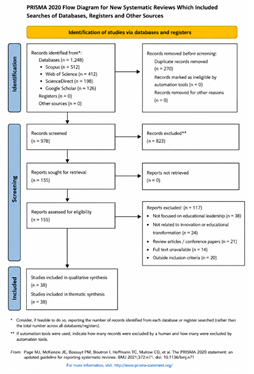
A literature search of various international databases yielded 1,248 articles. After removing duplicates, 978 articles were selected based on their titles and abstracts, meeting established inclusion and exclusion criteria.
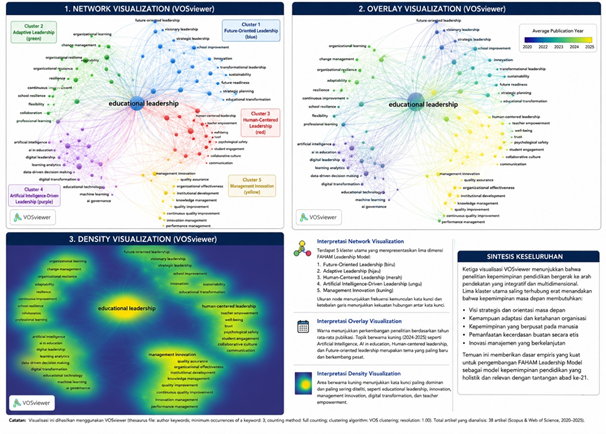
The screening phase yielded 155 full-text articles that were thoroughly evaluated. After assessing methodological quality, topic relevance, suitability to the research focus, and data completeness, 35 articles were deemed to meet all inclusion criteria and were included in the final synthesis process. Most of the selected articles were published in the 2021–2026 period, demonstrating that educational leadership is experiencing rapid development along with digital transformation, the use of artificial intelligence (AI), changes in education policy, and increasing demands on the quality and competitiveness of educational institutions. A thematic analysis of the 35 articles identified five main themes that consistently emerged across various educational contexts: Future-Oriented Leadership, Adaptive Leadership, Human-Centered Leadership, Artificial Intelligence-Driven Leadership, and Management Innovation. These five themes were then synthesized into a new conceptual framework called the FAHAM Leadership Model.
VOS Viewer
Results
| No | Researcher & Year | Article | Research result |
| 1. | Philip Hallinger (2022) | Educational Management Administration & Leadership | Future-oriented leadership strengthens schools' capacity to face change through strategic vision, organizational innovation, and a culture of continuous learning. |
| 2 | Shuhaida Shamsudin et al. (2023) | Journal of Educational Leadership | Developing future-ready school leaders requires strategic thinking competencies, technological leadership, adaptive capabilities, and strengthening the school's culture of innovation. |
| 3 | Mohd Fairuz Jafar et al. (2026) | Educational Management Administration & Leadership | The research developed and validated the Future Ready School Leadership Instrument (FRSLI), which consists of four main dimensions: strategic foresight, systems thinking, technology leadership, and addressing diversity. These four dimensions are able to predict an organization's learning culture. |
| 4 | Sravan Nemani (2024) | Journal for the Education of Gifted Young Scientists | Transformational leadership contributes to the development of skills, such as innovation, adaptability, digital literacy, and student readiness for the future. |
| 5 | Vivienne V. Forrester (2019) | Educational Decision-Making Research | School leadership requires the ability to utilize data and information systems to support future-oriented decision-making and improve school quality. |
| 6 | Ng Pak Tee (2020) | Educational Reform Studies | Future-oriented school reforms demonstrate that school leaders need to build innovation, collaboration, and readiness for long-term change. |
| 7 | Muna Alenezi (2024) | International Journal of Educational Leadership and Management | Digital transformation and artificial intelligence require educational leaders to have long-term vision, digital literacy, and the ability to manage organizational change sustainably. |
| No | Researcher & Year | Article | Research result |
| 1 | Sumiati et al. (2024) | Journal of Social Studies Education Research | The principal's adaptive leadership influences teacher performance improvement through a collaborative school culture. Collaborative culture has been shown to be a crucial mediator in enhancing the effectiveness of adaptive leadership. |
| 2 | AA Alene et al. (2025) | International Journal of Educational Research Open | Adaptive leadership practices help principals address the educational quality crisis through flexibility, teacher engagement, and contextual problem-solving. |
| 3 | B. Brown et al. (2025) | School Leadership & Management | During times of crisis, principals who implement adaptive leadership are able to maintain the continuity of learning, increase collaboration, and strengthen the resilience of school organizations. |
| 4 | Purwanto et al. (2025) | Proceedings of International Seminar on Student Research in Education, Science, and Technology | Adaptive leadership is a key driver of teachers' digital transformation through support for innovation, technology learning, and changes in work culture. |
| 5 | Rosel et al. (2025) | The Threshold | In schools with limited resources, adaptive leadership enables principals to develop local innovations, strengthen teacher participation, and increase organizational resilience. |
| 6 | Corrigan & Merry (2022) | Frontiers in Education | Principals need adaptive leadership to manage the changes brought about by digitalization and the uncertainty of the educational environment. An adaptive approach accelerates decision-making and school innovation. |
| 7 | Dunn (2020) | International Studies in Educational Administration | Adaptive leadership helps educational organizations navigate complexity through continuous learning, collaboration, and the ability to respond quickly to change. |
| No | Researcher & Year | Article | Research result |
| 1 | Louis, KS et al. (2020) | Educational Administration Quarterly | Leadership that builds trust, collaboration, and teacher empowerment improves organizational capacity and the quality of learning. |
| 2 | Leithwood, K. et al. (2020) | School Leadership & Management | A strong relationship between the principal and teachers increases organizational commitment, motivation, and teacher performance. |
| 3 | Day, C. et al. (2020) | Educational Management Administration & Leadership | Human-centered leadership creates a work environment that supports teacher well-being and continuous learning. |
| 4 | Sheninger, Eric (2024) | Study of educational digital leadership | Digital transformation will be successful if leaders prioritize empathy, interpersonal relationships, and human capacity development as the center of change. |
| 5 | Yuli, Afrida et al. (2025) | Journal of Childhood and Elementary Studies | The human-centered leadership strategy through role models, habituation, and partnerships improves the character development of students and collaboration between schools and parents. |
| 6 | Evers-Gerdes, Becky & Matera, Bryan (2025) | Essays in Education | The human-centered leadership approach fosters empathy, belonging, collaboration, and innovation through human-oriented leadership. |
| 7 | Rasheed, Qurrat ul Ain (2026) | Leadership and Policy in Schools | The synthesis shows that leadership that supports teachers' psychological needs strengthens sustainable AI integration through autonomy, competence, and connectedness. (Use as a supporting reference, not the main body, as it falls outside the 2020–2025 timeframe.) |
| No | Researcher & Year | Article | Research result |
| 1 | Martin Sposato (2025) | International Journal of Educational Technology in Higher Education | Developing a taxonomy of AI in higher education leadership that covers 10 domains, such as decision-making, strategic planning, governance, personalized learning, and ethical leadership. |
| 2 | Izhak Berkovich (2025) | Frontiers in Education | A survey of 302 school leaders showed that approximately half of respondents were in the early majority stage of GenAI adoption. AI is most commonly used to support instructional leadership. |
| 3 | Muna Alenezi (2024) | International Journal of Educational Leadership and Management | Digital transformation requires educational leaders to have AI competencies, digital literacy, and the ability to strategically manage organizational change. |
| 4 | Sulaimon Adewale & Ntokozo Dennis Ndwandwe (2025) | International Journal of Learning, Teaching and Educational Research | A bibliometric analysis of 2,097 publications shows a rapid increase in AI-driven leadership research, with dominant themes being machine learning, data-driven leadership, and higher education governance. |
| 5 | Miray Dogan & Hasan Arslan (2025) | Revista de Pedagogie Digitala | AI improves school administration efficiency, supports personalized learning, and strengthens decision-making. Key challenges include ethics, transparency, and algorithmic bias. |
| 6 | Olumuyiwa C. Paramole (2025) | Journal of Sustainability | AI implementation supports data-driven decisions and improved learning outcomes, but requires ethical governance and data privacy protection. |
| 7 | Ana-Isabel Renta-Davids, et al. (2025) | Review of Education | The scoping review identified that AI is transforming the role of educational leaders through enhanced decision-making, administrative efficiency, and the need for ethical and responsible leadership. |
| No | Researcher & Year | Article | Research result |
| 1 | Annisa Dwi Cahyani et al. (2025) | Scientific Journal of Teacher Professional Education | Management innovation, school ethos, and community involvement influence school quality improvement. Management innovation is the most dominant factor in increasing the effectiveness of school organizations. |
| 2 | John Freser (2025) | Alacrity: Journal of Education | Multi-case studies show that educational management innovation in the digital era is built through collaborative leadership, digital governance, organizational adaptability, and organizational cultural readiness. |
| 3 | Johan Johan et al. (2021) | Journal of Education and Development | School innovation is influenced by the leader's ability to manage four key resources: human resources, technology, communications, and budget. The human factor is the primary determinant of innovation success. |
| 4 | Samir Jassim (2024) | Academy of Educational Leadership Journal | Innovative leadership drives curriculum reform, technology integration, and a culture of creativity that enhances the quality of learning and the competitiveness of educational institutions. |
| 5 | Tukwatsibwe Dickson (2025) | EE Journals | Innovation in educational leadership thrives through collaboration, professional development, technology integration, and organizational policy alignment. |
| 6 | Paul Hallinger (2022) | Educational Management Administration & Leadership | The success of school change depends on the ability of leaders to systematically build organizational innovation through organizational learning and continuous improvement. |
| 7 | Thomas Bush (2021) | Theories of Educational Leadership and Management | Management innovation is an important part of educational governance that supports improving the quality, organizational effectiveness, and sustainability of educational institutions. |
Discussion
This study developed the FAHAM Leadership Model through a Systematic Literature Review approach by synthesizing 35 articles that met the inclusion criteria. The results of the thematic synthesis and bibliometric analysis identified five main dimensions, namely Future-Oriented Leadership, Adaptive Leadership, Human-Centered Leadership, Artificial Intelligence-Driven Leadership, and Management Innovation. These five dimensions form an integrated leadership framework and reflect the development of educational leadership paradigms in the era of digital transformation. Unlike leadership models that only emphasize one perspective, the FAHAM Leadership Model offers a multidimensional approach that integrates strategic orientation, adaptability, human empowerment, the use of artificial intelligence, and governance innovation within a single conceptual framework.
-
Future-Oriented Leadershipas Director of Educational Transformation
The synthesis results show that the Future-Oriented Leadership dimension is consistently associated with a leader's ability to develop a long-term vision, conduct strategic foresight, and anticipate changes in the educational environment. Various studies indicate that educational organizations led by future-oriented leaders tend to be better prepared to face technological developments, policy changes, and the demands of 21st-century competencies. In addition to serving as a strategic director, future-oriented leadership also serves as the foundation for building a culture of innovation and organizational sustainability. Therefore, this dimension serves as the initial foundation in the FAHAM Leadership Model because it determines the direction of educational institution transformation.
-
Adaptive Leadershipas an Organizational Resilience Strengthener
A literature synthesis shows that rapid change demands educational leaders to possess a high level of adaptability. The dimensions of adaptive leadership are identified through characteristics such as flexibility, organizational learning, collaboration, and the ability to manage change. The literature indicates that adaptive leadership contributes to increased organizational resilience by strengthening the capacity of individuals and institutions to face uncertainty. These findings suggest that educational transformation requires not only a strong vision but also the ability to translate that vision into responsive actions to changes in both internal and external environments.
-
Human-Centered Leadershipas the Foundation of Organizational Culture
The synthesis results show that the success of educational transformation is greatly influenced by the leader's ability to place people at the center of organizational development. The dimensions of Human-Centered Leadership emerge through the themes of teacher empowerment, student engagement, well-being, trust, empathy, and collaborative culture. The literature indicates that educational organizations that develop strong interpersonal relationships tend to have better organizational commitment, work motivation, and learning quality. These findings emphasize that digital transformation and organizational innovation need to be balanced with strengthening the human aspect so that changes remain oriented towards human development.
-
Artificial Intelligence-Driven Leadershipas a Digital Transformation Accelerator
The development of artificial intelligence technology has become one of the most prominent themes in educational leadership literature in recent years. The synthesis of these findings suggests that Artificial Intelligence-Driven Leadership is not only related to the use of technology, but also to the leader's ability to strategically utilize data, learning analytics, and decision support systems. In addition to improving administrative efficiency and decision-making quality, AI implementation also requires ethical governance, data privacy protection, and increased digital competence of leaders and educators. Thus, AI is positioned as a leadership support instrument, not a replacement for the leadership role in educational organizations.
-
Management InnovationAs a Driver of Organizational Sustainability The Management Innovation dimension emerged as a theme that strengthens organizational effectiveness through renewal of governance systems, resource management, quality assurance, and a culture of continuous improvement. The literature shows that management innovation plays a role in increasing an organization's capacity to respond to change while maintaining the quality of educational services. In the FAHAM Leadership Model, management innovation becomes a mechanism that connects strategic vision, adaptability, human resource development, and digital transformation into systematic and sustainable organizational practices.
Integration of Five Dimensions in the FAHAM Leadership Model
The main contribution of this research is to integrate five leadership dimensions that have previously been studied separately into a single, coherent conceptual framework. The synthesis shows that the relationships between the dimensions are complementary. Future-Oriented Leadership provides strategic direction for the organization, Adaptive Leadership strengthens the ability to face change, Human-Centered Leadership builds a healthy organizational culture, Artificial Intelligence-Driven Leadership accelerates digital transformation through the use of data and technology, while Management Innovation ensures the entire change process runs effectively and sustainably. This integration produces a more comprehensive leadership model than leadership approaches that focus only on one dimension.
Theoretical and Practical Implications
Theoretically, this research enriches the study of educational leadership by offering the FAHAM Leadership Model as a conceptual model that integrates strategic, adaptive, humanistic, digital, and innovative perspectives. This model can serve as a foundation for developing educational leadership theories that better address the challenges of educational transformation.
In practice, the FAHAM Leadership Model can be used as a framework for developing the competencies of school principals, university leaders, supervisors, and educational policymakers. It can also serve as a reference for developing leadership training programs, developing organizational culture, digital transformation of schools, and continuously improving the quality of education.
However, this study has limitations due to its use of a Systematic Literature Review approach, so the findings are still conceptual and dependent on the characteristics of the articles synthesized. Therefore, further research needs to conduct empirical validation of the FAHAM Leadership Model using a quantitative, mixed methods approach, or Structural Equation Modeling (SEM) to test construct validity, interdimensional relationships, and its implementation in various educational contexts.
Comparison of the FAHAM Leadership Model with Existing Educational Leadership Models
| Leadership Model | Main Focus | Excess | Limitations | Contribution |
| Transformational Leadership | Change and motivation | Inspiring change | Not yet emphasizing AI and management innovation | Adding AI, future orientation, and management innovation |
| Instructional Leadership | Learning | Improving the quality of learning | Focus on instructional aspects | Expanding to organizational transformation |
| Distributed Leadership | Collaboration | Sharing leadership roles | Lack of emphasis on future vision | Integrating collaboration with strategic vision |
| Adaptive Leadership | Adaptation to change | Increasing resilience | Not integrating AI and innovation | Connecting adaptation with AI and governance |
| Digital Leadership | Digital transformation | Leveraging technology | Focus on digitalization | Expanding into AI, data analytics, and AI governance |
| FAHAM Leadership Model | Five-dimensional integration | Visionary, adaptive, human centered, AI driven, innovative | Requires empirical validation | A holistic conceptual model for educational transformation |
Conclusion
This research successfully developed the FAHAM Leadership Model through a Systematic Literature Review approach by synthesizing 35 relevant articles on educational leadership. The thematic synthesis results identified five main dimensions that form the model: Future-Oriented Leadership, Adaptive Leadership, Human-Centered Leadership, Artificial Intelligence-Driven Leadership, and Management Innovation. These five dimensions complement each other and form a conceptual framework that represents the development of educational leadership paradigms in the era of digital transformation and artificial intelligence.
The results of the literature synthesis indicate that effective educational leadership is no longer solely oriented towards achieving organizational goals or improving the learning process, but also requires the ability to build a long-term vision, adapt to change, empower human resources, utilize artificial intelligence strategically and ethically, and develop sustainable management innovation. The integration of these five dimensions is the main conceptual contribution of the FAHAM Leadership Model in enriching contemporary educational leadership studies. Compared with previously developed leadership models, the FAHAM Leadership Model offers a more holistic perspective by integrating strategic, adaptive, humanistic, digital, and innovative dimensions into a single leadership framework. Thus, this model provides a theoretical contribution in the form of developing a conceptual model that is relevant to the needs of 21st-century educational transformation while providing practical implications for school principals, university leaders, educational institution managers, and policy makers in designing leadership strategies that are responsive to global change.
However, this study has limitations due to its use of a Systematic Literature Review approach, resulting in conceptual findings that depend on the characteristics of the articles synthesized. Therefore, further research is recommended to empirically validate the FAHAM Leadership Model through quantitative, mixed methods, or Structural Equation Modeling (SEM) approaches. Furthermore, testing the model across different educational levels, cultural contexts, and organizational characteristics is necessary to evaluate construct validity, interdimensional relationships, and the effectiveness of model implementation in improving leadership quality and educational transformation.
References
- Alene, A.A., Tsegaye, M.A., & Wolle, G.S. (2025). Secondary school principals' adaptive leadership practices amid the quality education crisis in Amhara regional state, Ethiopia. Social Sciences & Humanities Open, 11, 101349. DOI ↗ Google Scholar ↗
- Azorín, C., & Fullan, M. (2022). Leading new, deeper forms of collaborative professionalism. Routledge. DOI ↗ Google Scholar ↗
- Berkovich, I. (2025). The rise of AI-assisted instructional leadership: Empirical survey of generative AI integration in school leadership and management work. Frontiers in Education, 10. DOI ↗ Google Scholar ↗
- Braun, V., & Clarke, V. (2021). Thematic Analysis: A Practical Guide. Sage. DOI ↗ Google Scholar ↗
- Bush, T. (2021). Theories of Educational Leadership and Management (5th ed.). Sage Publications. Google Scholar ↗
- Creswell, J. W., & Creswell, J. D. (2023). Research Design: Qualitative, Quantitative, and Mixed Methods Approaches (6th ed.). Sage Publications. DOI ↗ Google Scholar ↗
- Day, C., & Sammons, P. (2020). Successful School Leadership. Education Development Trust. DOI ↗ Google Scholar ↗
- Forrester, V. V. (2019). School management information systems: Challenges to educational decision-making in the big data era. arXiv. DOI ↗ Google Scholar ↗
- Freser, J. (2025). Innovative approaches to educational management in the digital era. ALACRITY: Journal of Education, 5(3), 1119–1128. DOI ↗ Google Scholar ↗
- Fullan, M. (2022). The New Meaning of Educational Change (6th ed.). Teachers College Press. DOI ↗ Google Scholar ↗
- Fullan, M., Quinn, J., Drummy, M., & Gardner, M. (2020). Education Reimagined: The Future of Learning. Corwin. DOI ↗ Google Scholar ↗
- Hallinger, P. (2020). Bringing Context Out of the Shadows of Leadership. Routledge. Google Scholar ↗
- Hallinger, P., & Kovačević, J. (2022). Mapping the intellectual lineage of educational management administration and leadership, 1972–2020. Educational Management Administration & Leadership, 50(2), 192–216. DOI ↗ Google Scholar ↗
- Heifetz, R. A., Grashow, A., & Linsky, M. (2021). The Practice of Adaptive Leadership: Tools and Tactics for Changing Your Organization and the World. Harvard Business Review Press. DOI ↗ Google Scholar ↗
- Holmes, W., Bialik, M., & Fadel, C. (2019). Artificial Intelligence in Education: Promises and Implications for Teaching and Learning. Center for Curriculum Redesign. DOI ↗ Google Scholar ↗
- Jassim, S. (2024). Educational innovation and leadership: Shaping the future of learning. Academy of Educational Leadership Journal, 28(2), 1–3. DOI ↗ Google Scholar ↗
- Kitchenham, B., & Charters, S. (2007). Guidelines for Performing Systematic Literature Reviews in Software Engineering. Keele University. DOI ↗ Google Scholar ↗
- Leithwood, K., Harris, A., & Hopkins, D. (2020). Seven strong claims about successful school leadership revisited. School Leadership & Management, 40(1), 5–22. DOI ↗ Google Scholar ↗
- Luckin, R. (2023). AI for Schoolteachers. Routledge. DOI ↗ Google Scholar ↗
- Moher, D., Page, MJ, McKenzie, JE, Bossuyt, P.M., Boutron, I., Hoffmann, T.C., Mulrow, C.D., et al. (2021). The PRISMA 2020 statement: An updated guideline for reporting systematic reviews. BMJ, 372, n71. DOI ↗ Google Scholar ↗
- Nemani, S. (2024). Preparing future-ready students: The role of transformational leadership in equipping students for the 21st-century workforce. Journal for the Education of Gifted Young Scientists, 12(4), 181–192. DOI ↗ Google Scholar ↗
- Northouse, P. G. (2022). Leadership: Theory and Practice (9th ed.). Sage Publications. Google Scholar ↗
- Organization for Economic Co-operation and Development. (2023). The State of Global Education 2023. OECD Publishing. DOI ↗ Google Scholar ↗
- Page, MJ, McKenzie, JE, Bossuyt, P.M., Boutron, I., Hoffmann, T.C., Mulrow, C.D., et al. (2021). The PRISMA 2020 statement: An updated guideline for reporting systematic reviews. Systematic Reviews, 10(1), Article 89. DOI ↗ Google Scholar ↗
- Sheninger, E.C. (2024). Disruptive Thinking in Our Classrooms (2nd ed.). Solution Tree Press. Google Scholar ↗
- Sposato, M. (2025). Artificial intelligence in educational leadership: A comprehensive taxonomy and future directions. International Journal of Educational Technology in Higher Education, 22, Article 20. DOI ↗ Google Scholar ↗
- Sumiati, Kurniady, DA, Komariah, A., Suryana, A., Dadi, & Hafidh, Z. (2024). Linking principal adaptive leadership to teacher performance: The mediating effect of collaborative school culture. Journal of Social Studies Education Research, 15(4), 17–41. Google Scholar ↗
- UNESCO. (2022). Reimagining Our Futures Together: A New Social Contract for Education. UNESCO Publishing. DOI ↗ Google Scholar ↗
- UNESCO. (2023). Global Education Monitoring Report 2023: Technology in Education—A Tool on Whose Terms? UNESCO Publishing. DOI ↗ Google Scholar ↗
- UNESCO. (2023). Global Education Monitoring Report 2023: Technology in Education: A Tool on Whose Terms? UNESCO Publishing. DOI ↗ Google Scholar ↗
- UNESCO. (2024). Guidance for Generative Artificial Intelligence in Education and Research. UNESCO Publishing. DOI ↗ Google Scholar ↗