Abstract
The engineering properties of sandy soil, specifically its ability to support structures, are significantly influenced by its composition, including the presence of fine particles (fines). While the relationship between certain soil properties like SPT N-value, internal friction angle, and density is well-understood for cohesionless soils, the impact of varying amounts of fines on sand behavior remains less explored.This research investigates the effects of non-plastic fines on the shear strength properties of sand-silt mixtures. It has also attempted to establish a relationship between the proportion of sand-silt mixture and shear strength.Sand used during the experimentation is classified as poorly graded (SP) as per the Unified Soil Classification System (USCS). Non-plastic fines are obtained locally, having liquid limit (LL) is 21.4%, plasticity index (PI) is less than 4 (PI<4), and contain 97.43% silt particles, 1.77% clay, and sand= 0.8% particles. Laboratory experiments were conducted to determine the maximum and minimum densities of the sand-silt mixtures at various fines contents (i.e. 0%, 10%, 20%, 30%, 40%, and 50%). Additionally, direct shear tests were performed to assess the shear strength parameters under different normal stresses (i.e. 50,100, and 200 KPa) and relative density conditions (i.e. 30, 60, and 90%) at the shear displacement rate of 1mm/min under the dry state.The analysis of the experimental data revealed a critical fines content range, termed the Limiting Fines Content (LFC), between 21% and 27%. Below this LFC, increasing the fines content leads to an increase in the angle of internal friction, enhancing the soil's shear strength. However, beyond the LFC, the angle of internal friction decreases as the fine-grained behavior becomes dominant. In conclusion, the study demonstrates that the proportion of fines in sand-silt mixtures significantly impacts their engineering properties. Understanding this study is crucial for accurate geotechnical assessments and design considerations.
Keywords: Sand-non-plastic silt mixture, Limiting fines content, Dry condition, Direct shear test.
Introduction
Bangladesh is predominantly a mega delta, formed by the convergence of the Ganges, Brahmaputra, and Meghna rivers. These rivers have deposited massive amounts of fluvial-deltaic sediments over millions of years, creating the vast, flat plains that characterize much of the country.
So, the most dominant feature of Bangladesh's subsurface is the thick layer of fluvio-deltaic sediments. The type of this soil is alluvial soil. The alluvial soils are formed by the sediments deposited by the major rivers and their tributaries. They cover about 80% of the country’s area and are mostly found in the floodplains. These soils are sandy-loamy to silty-clayey in texture. Research paper (Islam 2017), studies about 12 types of soil texture were present in all around of Bangladesh. Produced map of the soil texture of Bangladesh (Fig.1.0). It shows subsurface soil types according to the district
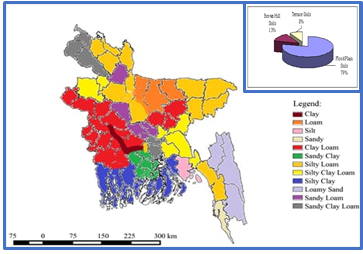
The stability and safety of structures built on sandy soil rely on the soil's ability to resist deformation and shear forces. Many factors, including particle size, shape, the presence of fine particles, soil density, and drainage conditions, influence the soil's shear strength. During the reclamation process, sand often contains varying amounts of fine particles, making it crucial to understand how these fines affect the engineering properties of the soil.
Many previous studies [1-20] have explored the behavior of clean sand through extensive experiments and analysis. However, only a few studies [1–3, 8 & 11-14] have specifically investigated the impact of fine particles on the shear strength of sand. The mechanical behavior of clean sands was investigated first by Coulomb in the 18th century (Coulomb 1776), and the mechanical behavior of pure clays was investigated first by Terzaghi in the 20th century (Terzaghi 1925). While pure sands, clays, or silts are rare in nature, most natural soils are a mixture of these components in various proportions. Understanding the properties of sands with fine particles is crucial for geotechnical engineering. Research has shown that the behavior of sands is significantly affected by the amount of fines present (Salgado et al. 2000) and the type of mineral particles present (Carraro et al. 2009) both of which have been conducted by drained triaxial tests. (Karim, M.E., and Alam, M.J., 2017) conducted undrained triaxial tests, and (Patharia, S., 2021) conducted drained direct shear tests to study the effect of non-plastic fines on the engineering properties of sand-silt mixtures. Table 1.0 summarizes the findings of previous research, including the Limiting Fine Content (LFC) values. However, there are inconsistencies in these findings. To provide a clearer understanding and guide design engineers, further research is needed to investigate the behavior of these specific mixtures.
Table 1.0: A list of conclusions of effects of non-plastic fines on shear strength properties of sand-silt mixes soil developed by various researchers.
| Reference | Finding |
| Salgado & Karim (2000) | At constant relative density and stress state, increased silt content increases the drained peak shear strength and the critical-state friction angles. |
| Carraro, & Salgado (2009) | Adding non-plastic fine particles to sand increased the sand's drained peak shear strength. |
| Karim, & Alam (2017) | As the amount of silt in the mixture increases, the undrained peak shear strength decreases until the Limiting Fine Content (LFC) of 30% is reached. Beyond this point, the strength remains relatively constant up to a pure silt sample. |
| Pathariya (2021) | The angle of internal friction initially increases with the addition of up to 5% non-plastic fines, both in dry and saturated conditions. However, further additions of fines lead to a decrease in the internal frictional angle. |
LFC is Limiting fines content
Experimental Program
2.1 Materials
In this study, samples are prepared by locally available normal silica sand which was collected from Gazipur and Fines soil was collected from the Padma River in Seismic Zone-2 (Z=0.20) of Bangladesh. (Location: Char of River Padma near Harding Bridge at Rooppur in Iswardi Upazila of Pabna District, Bangladesh). Figure 2.1 shows the grain size distribution curve of sand and fines soil. It is classified sand as poorly graded sand (SP) and fines soil as non-plastic fines (silt), according to the Unified soil classification system (USCS). Some of the index properties of sand and silt required in the present study are determined by conducting Sieve analysis, Specific gravity and Fineness modulus (FM) tests for sand and Hydrometer analysis, Specific gravity and Atterberg limits tests for silt. The required index properties of sand and silt are presented in Table 2.1. From the result of hydrometer analysis, fines soil contains 0.80% of sand particles, 97.43% of silt particles and 1.77% of clay particles. Hence, also according to USDA, this fines soil is silt.
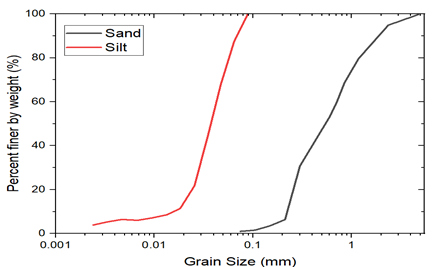
Table 2.1: Index properties of sand and silt are used in the present study
| Properties | Clean sand | Silt |
| USCS classification symbol | Poorly graded sand | Non-plastic silt |
| Mean grain size D50 (mm) | 0.54 | 0.08 |
| Uniformity Coefficient (Cu) | 3.17 | 5.59 |
| Coefficient of gradation (Cc) | 0.57 | 0.49 |
| Fineness Modulus (FM) | 2.11 | - |
| Specific gravity (Gs) | 2.62 | 2.70 |
| Liquid limit (%) | ND | 21.4 |
| Plastic limit (%) | ND | ND |
| Plasticity Index (%) | ND | NP (PI<4) |
| i.e. ND= not determinable & NP= non-plastic |
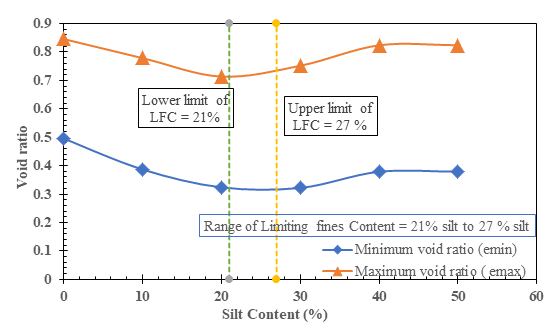
This study aimed to understand the relationship between the ratio of sand and silt in a mixture and its shear strength. To achieve this, various sand-silt mixtures were made in a laboratory by combining clean sand with non-plastic silt. These mixtures contained 0%, 10%, 20%, 30%, 40%, and 50% silt by weight. The mixtures were thoroughly mixed to ensure homogeneity. Vibration table tests were then conducted to determine the maximum and minimum void ratios of each mixture. Figure 2.2 visually presented the results of the minimum and maximum index density test of samples.
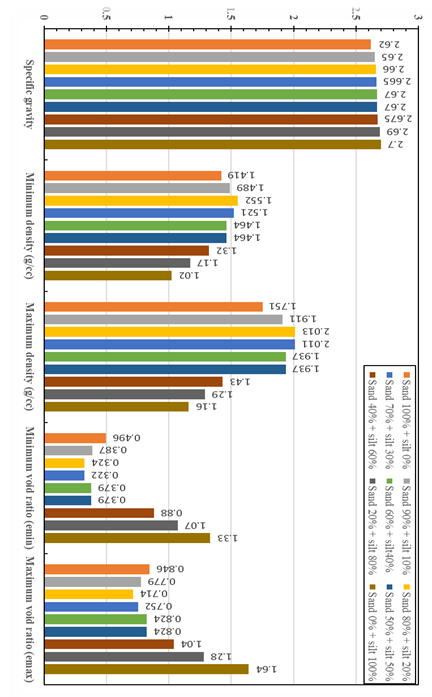
Figure 2.2: Visually presented the results of the minimum and maximum index density test of samples by the vibration table method.
2.2 Test Method
The effect of non-plastic fines on shear strength and volumetric behavior of sand was studied by conducting direct shear tests in consolidated drained conditions under the displacement-controlled mode. Tests were performed at a shear displacement rate of 1.00 mm/min under dry soil conditions and test procedures were performed on specimens of different cases: a) based on different relative densities such as 30%, 60%, and 90% b) different normal pressure such as 50kpa, 100Kра, and 200Kpa.
Table 2.2: Summary of the Direct shear test conducted under the present study.
| Soil type | Relative density, Dr (%) | Normal stress, σ (KPa) | No. of experiment |
| Clean sand (i.e. 100% sand) | 30, 60, 90 | 50, 100, 200 | 9 |
| 90% sand + 10% silt | 30, 60, 90 | 50, 100, 200 | 9 |
| 80% sand + 20% silt | 30, 60, 90 | 50, 100, 200 | 9 |
| 70% sand + 30% silt | 30, 60, 90 | 50, 100, 200 | 9 |
| 60% sand + 40% silt | 30, 60, 90 | 50, 100, 200 | 9 |
| 50% sand + 50% silt | 30, 60, 90 | 50, 100, 200 | 9 |
| Total | 54 |
Results And Discussion
Results from various laboratory tests conducted in this study are presented and discussed in this chapter. The main motive of the laboratory experimental program was to investigate the influence of non-plastic silt content on the shear strength characteristics of sand-silt mixtures. And developed correlations between the mixing ratio of sand and non-plastic silt with shear strength.
3.1 Effect of non-plastic silt content on maximum and minimum dry density
Figure 3.1 illustrates the relationship between maximum and minimum dry density and silt content. Both densities increase with increasing silt content up to the Limiting Fine Content (LFC) of 23.5%. Beyond this point, both densities decrease. This trend aligns with findings from other studies [2 & 3]. However, it differs from (Karim 2017) study, which used a water method for minimum density tests. Our study determined a maximum dry density of 2.03 g/cc and a minimum dry density of 1.55 g/cc at the LFC of 23.5%.
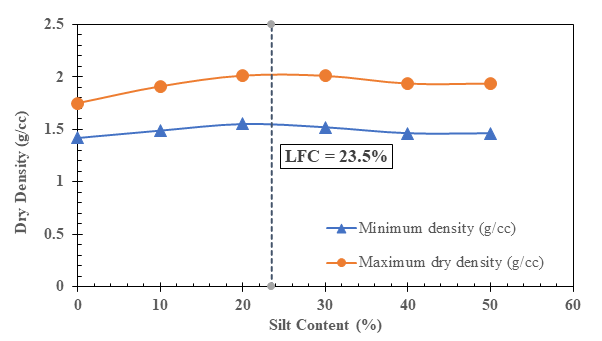
3.2 Effect of non-plastic silt content on maximum and minimum void ratio
This study used a vibration table method to determine the maximum and minimum void ratios of sand-silt mixtures with varying silt content. Figure 3.2 shows the relationship between these void ratios and silt content. Both the maximum and minimum void ratios decrease with increasing silt content until the Limiting Fine Content (LFC) is reached. Beyond the LFC, both void ratios increase. Based on the maximum and minimum void ratio curves, the LFC range for this sand-silt mixture is estimated to be between 21% and 27%. This range is consistent with previous studies, which typically report LFC values between 20% and 30% for sand-silt mixtures [12, 14 & 18] and below 20% for sand-clay mixtures [5].
3.3 Effect of non-plastic silt content on shear strength
In the present study conducting direct shear tests in consolidated drained conditions at a displacement rate of 1.00 mm/min under dry soil conditions and test procedures were performed on specimens of different cases: a) based on different relative densities such as 30%, 60%, and 90% b) different normal pressure such as 50kpa, 100Kра, and 200Kpa.
3.3.1 Constant relative density method
Three different initial relative densities, 30%, 60%, and 90%, were used for the sand-silt mixtures in this research. The behavior of each mixture was analyzed separately based on its initial relative density.
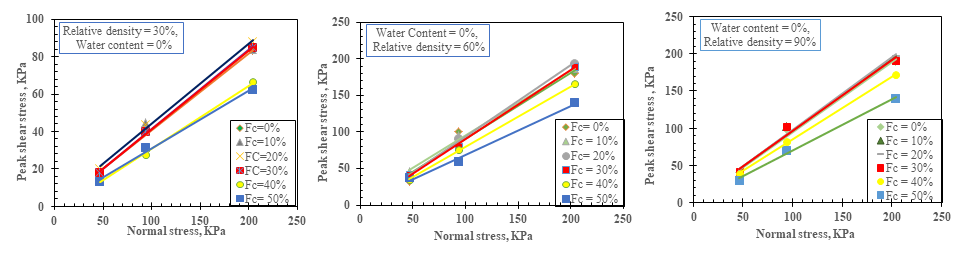
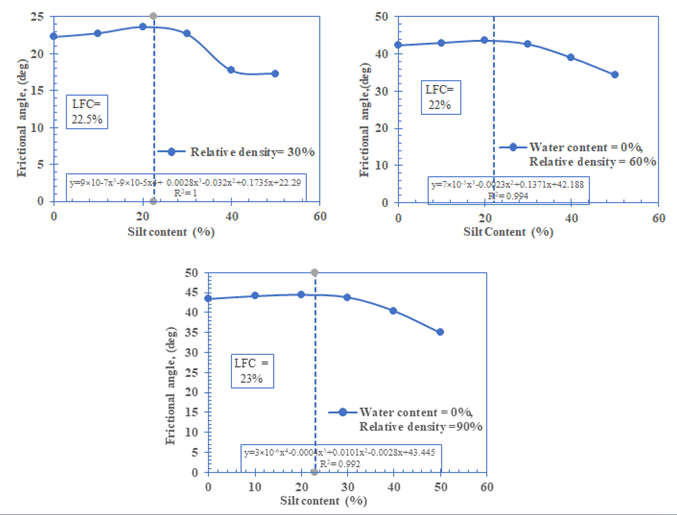
Figure 3.3 shows the relationship between shear stress and normal stress for sand-silt mixtures with different silt contents at (a) relative density = 30%, (b) relative density = 60% and (c) relative density = 90%. Figure 3.4 illustrates how the angle of internal friction changes with varying silt content at (a) relative density = 30%, (b) relative density = 60% and (c) relative density = 90%. It is observed that at a constant relative density and dry state, the peak shear strength increases with increasing silt content up to the LFC. Beyond this point, the peak shear strength decreases. The value of LFC are 22.5%, 22% and 23% for relative density of 30%, 60% and 90% respectively.
3.3.2 Constant normal stress method
During the direct shear tests, three different normal stresses (50 kPa, 100 kPa, and 200 kPa) were applied to both loose and dense sand-silt mixtures. The behavior of these mixtures was analyzed separately for each applied normal stress.
3.3.2.1 Response at relative density of 30% (Loose state)
Figure 3.5 shows the shear stress-shear displacement plots obtained from consolidated drained Direct Shear Test of sand-silt mixtures of different silt content at relative density of 30% (i.e. loose sample) under the (a) normal stress = 50KPa, (b) normal stress = 100KPa and (c) normal stress = 200KPa. Figure 3.6 shows the variation of peak shear strength of sand-silt mixture with change in percent of silt content in sand-silt mixtures at relative density of 30% (i.e. loose sample) under the (a) normal stress = 50KPa, (b) normal stress = 100KPa and (c) normal stress = 200KPa. It can be observed that at constant normal stress, increase in silt content increases the drained peak shear strength till LFC and further increase of silt content, the peak shear strength decreases. And also observed that at constant relative density, increase in normal stress decreases LFC of sand-silt mixtures.
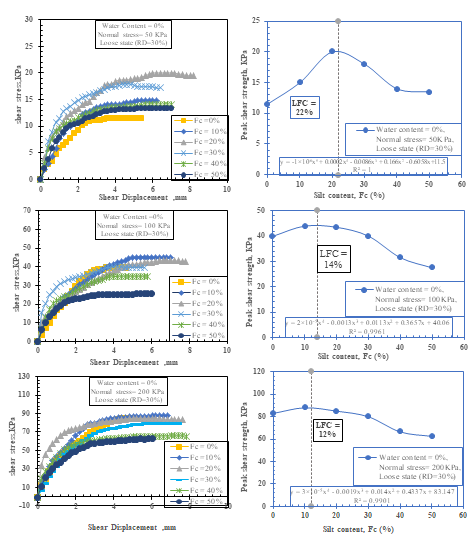
Figure 3.6: Effect of silt content on the mechanical behavior of sand at relative density of 30% (loose state) under the (a) normal stress = 50 KPa; (b) normal stress = 100 KPa and (c) normal stress = 50 KPa: friction angle versus silt content
3.3.2.2 Response at relative density of 90% (Dense state)
Figure 3.7 shows the shear stress-shear displacement plots obtained from consolidated drained Direct Shear Test of sand-silt mixtures of different silt content at relative density of 90% (i.e. dense sample) under the (a) normal stress = 50KPa, (b) normal stress = 100KPa and (c) normal stress = 200KPa. Figure 3.8 shows the variation of peak shear strength of sand-silt mixture with change in percent of silt content in sand-silt mixtures at relative density of 90% (i.e. dense sample) under the (a) normal stress = 50KPa, (b) normal stress = 100KPa and (c) normal stress = 200KPa. It can be observed that at constant normal stress, increase in silt content increases the drained peak shear strength till LFC and further increase of silt content, the peak shear strength decreases. And also observed that at constant relative density, increase in normal stress decreases LFC of sand-silt mixtures. Compare between loose and dense samples, LFC values lower for dense samples than loose samples
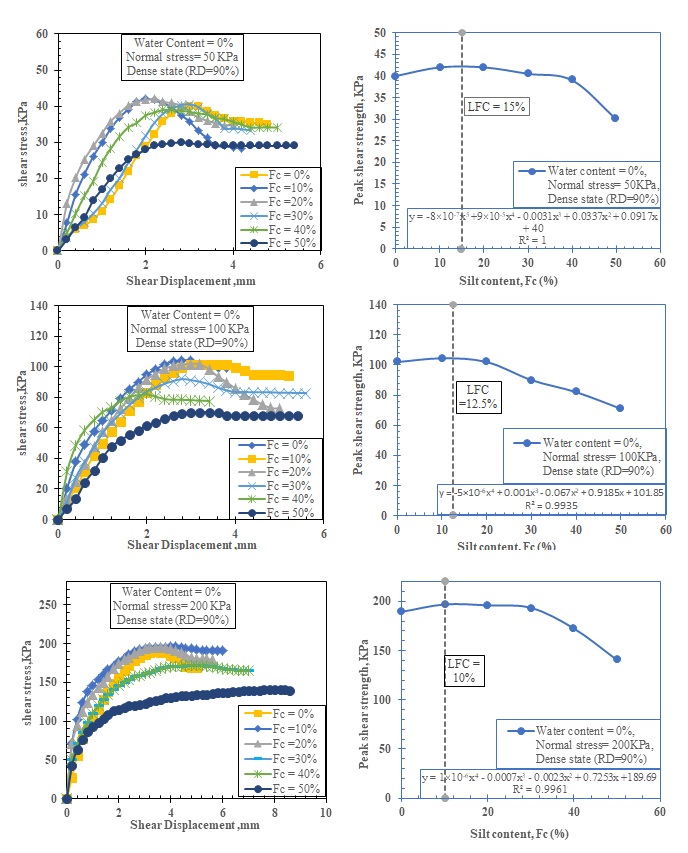
3.3.3 Correlation between peak shear strength and silt content
Table 3.1 shows the summary of the obtained correlations from the regression analysis at constant relative density. Table 3.2 shows the summary of the obtained correlations from the regression analysis at constant normal stress. From Table 3.1, considering the regression coefficients of these fitted lines, the 𝑅2 values decrease with increase in relative density. It indicates that the lower relative density sample will give least error in predicting the shear strength of sand-silt mixtures. Table 3.2 shows that the 𝑅2 values decrease with increase in normal stress for both loose state and dense state. However, it requires more extensive studies before use of correlation equations.
Table 3.1: Correlation between peak frictional angle and silt content in sand-silt mixture at constant relative density.
| Relative density (%) | Correlations | 𝑅2 |
| 30 | y=9×10-7x5-9×10-5x4+0.0028x3-0.032x2+0.1735x+22.29 | 1.00 |
| 60 | y=7×10-5x3-0.0023x2+0.1371x+42.188 | 0.994 |
| 90 | y=3×10-6x4-0.0004x3+0.0101x2-0.0028x+43.445 | 0.992 |
| i.e. y= Internal frictional angle (°); x= Silt content (%) |
Table 3.2: Correlation between peak shear strength and silt content in sand-silt mixture at constant normal stress.
| Normalstress, KPa | Sample | Correlations | 𝑅2 |
| 50 | Loose state | y = -1×10-6x5 + 0.0002x4 - 0.0086x3 + 0.166x2 - 0.6058x +11.5 | 1.00 |
| Dense state | y = -8×10-7x5 +9×10-5x4 - 0.0031x3 + 0.0337x2 + 0.0917x + 40 | 1.00 | |
| 100 | Loose state | y = 2×10-5x4 - 0.0013x3 + 0.0113x2 + 0.3657x + 40.06 | 0.9961 |
| Dense state | y = -5×10-6x4 + 0.001x3 - 0.067x2 + 0.9185x + 101.85 | 0.9935 | |
| 200 | Loose state | y = 3×10-5x4 - 0.0019x3 + 0.014x2 + 0.4337x + 83.147 | 0.9901 |
| Dense state | y = 1×10-6x4 - 0.0007x3 - 0.0023x2 + 0.7253x + 189.69 | 0.9961 | |
| i.e. y= Peak shear strength (KPa); x= Silt content (%) |
3.4 Effect of non-plastic silt content on volumetric behavior
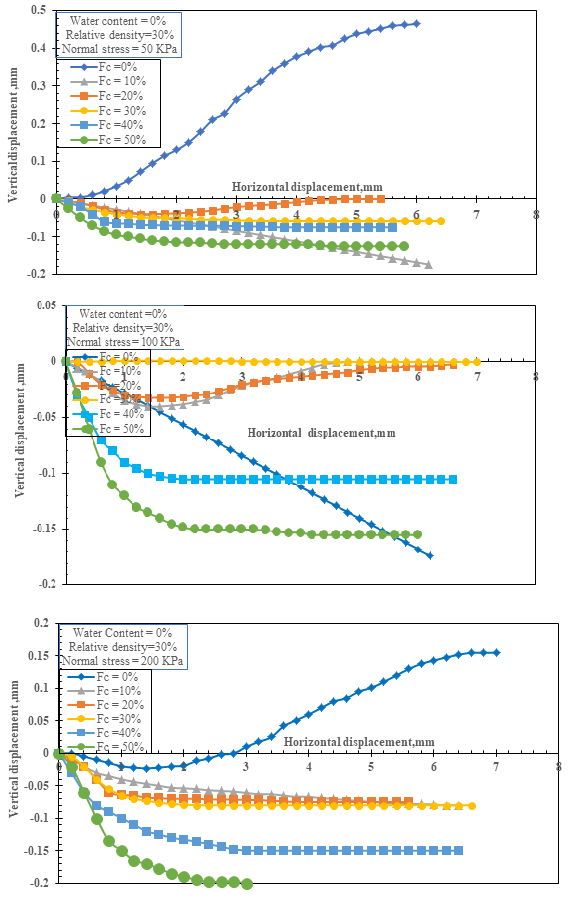
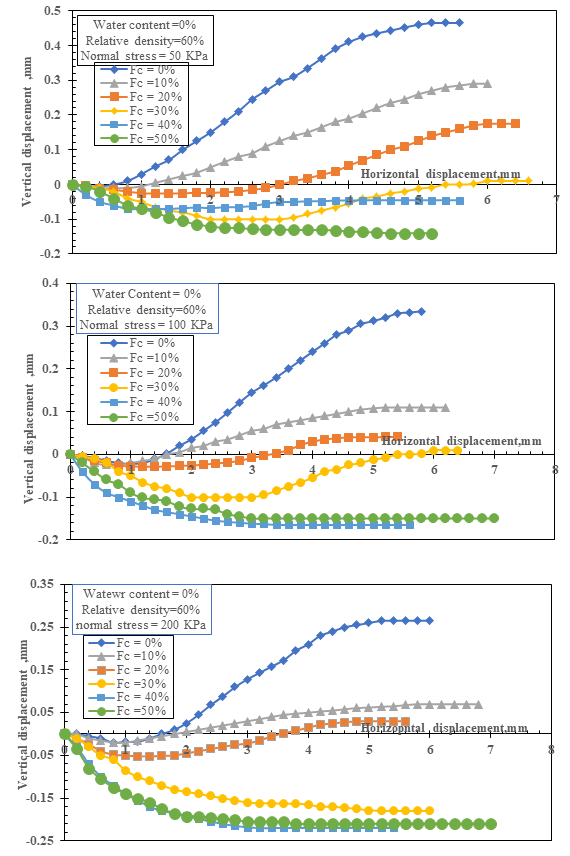
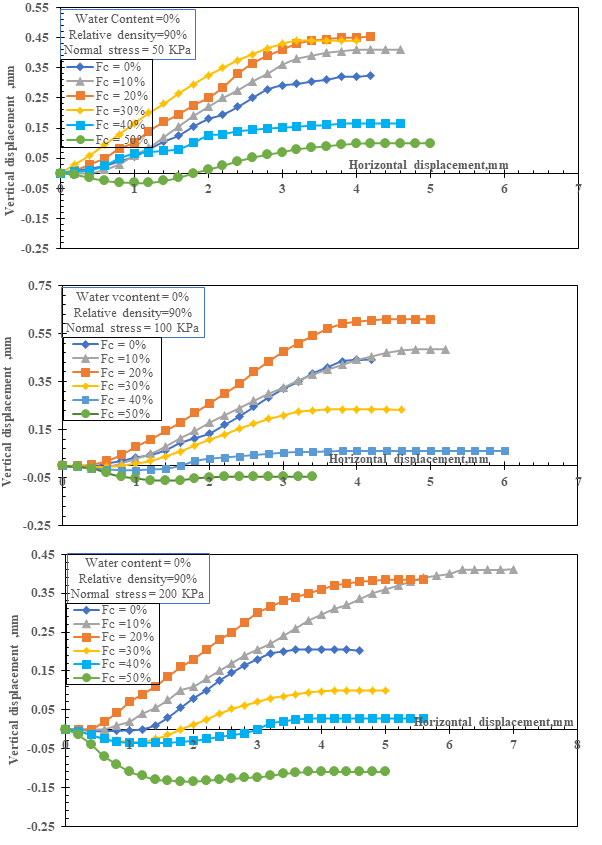
The volumetric behavior of the soil can be understood by analyzing the plots of vertical displacement against horizontal displacement. Figure 3.9 to Figure 3.11 show the vertical displacement versus horizontal displacement curves of different silt content in sand-silt mixture under the different normal stress at constant relative density 30%, 60% and 90% respectively. Figure 3.9 & Figure 3.10 can be observed that at constant normal stress, increase in silt content decreases the dilatancy phase (i.e. increases the contractancy phase) and at constant silt content, increases in normal stress decrease the dilatancy phase (i.e. increases the contractancy phase). But Figure 3.11 observes that at constant normal stress, increased silt content increases dilation till a fixed silt content (such as σ= 50KP silt content = 30%; σ= 100KP silt content = 20%; σ= 200KP silt content = 20%) then for further increase of silt content decreases. However, the addition of non-plastic fine particles (silt) seems to hinder the ability of sand particles to expand or dilate, which negatively impacts the overall shear strength of the mixture.
Conclusion
An experimental study was conducted to examine how the addition of non-plastic fine particles affects the shear strength and volume change behavior of sand. Based on the results of this study, the following conclusions can be drawn:
The maximum and minimum dry density increases with increase in silt content till the Limiting fines content (LFC= 23.5%) and for further increments of silt content, both decrease.
The maximum and minimum void ratio decreases with increase in silt content till the Limiting fines content, and for further increments of silt content, both increase. The range of LFC is 21 to 27%.
At a constant relative density, the peak shear strength increases as the silt content increases, up to the Limiting Fine Content (LFC). Beyond this point, any further increase in silt content results in a decrease in peak shear strength.
At Relative density = 30%, LFC= 22.5%
At Relative density = 60%, LFC= 22%
At Relative density = 90%, LFC= 23%
At a constant normal stress, the peak shear strength increases with increasing silt content up to the Limiting Fine Content (LFC). Beyond this point, the peak shear strength decreases for both loose and dense samples.
For Loose state:- At Normal stress = 50 KPa, LFC = 22%
At Normal stress = 100 KPa, LFC = 14%
At Normal stress = 200 KPa, LFC = 12%
For Dense state:- At Normal stress = 50 KPa, LFC = 15%
At Normal stress = 100 KPa, LFC =12.5%
At Normal stress = 200 KPa, LFC = 10%
Correlation between peak shear strength and silt content of sand-silt mixture for different types of conditions will be given in Table 3.1 & Table 3.2
At Constant normal stress,
For relative density = 30% and 60%, increased silt content decreases the dilatation phase (i.e. increases the contraction phase).
For relative density= 90%, with increased silt content increases dilation till a defined silt content (i.e. for σ= 50KP silt content = 30%; σ= 100KP silt content = 20%; σ= 200KP silt content = 20%) than for further increase of silt content decreases.
Acknowledgments
The authors are grateful to their supervisor, Dr. Md. Mokhlesur Rahman, Professor, Department of Civil Engineering, Dhaka University of Engineering & Technology, Gazipur for his inspiration, encouragement, continuous guidance, and important suggestions during the various stages of this research. The authors would like to thank Mr. Md. Abdur Razzak of the Geotechnical Engineering Laboratory, DUET for their technical support and assistance during the laboratory tests.
References
- Carraro, J. A. H., Prezzi, M., & Salgado, R. 2009. "Shear strength and stiffness of sands containing plastic or nonplastic fines." Journal of geotechnical and geoenvironmental engineering, 135 (9): 1167-1178. ) DOI ↗ Google Scholar ↗
- Dash, H. K., & Sitharam, T. G. 2011. "Undrained cyclic and monotonic strength of sand-silt mixtures." Geotechnical and Geological Engineering, 29: 555-570. DOI ↗ Google Scholar ↗
- Dash, H. K., & Sitharam, T. G. 2011. "Undrained monotonic response of sand-silt mixtures: effective of nonplastic fines.".Geomechanics and Geoengineering: An International Journal, 6 (1): 47-58. DOI ↗ Google Scholar ↗
- Durga Prasad, B., Hari Prasad, C., and Umashankar B. 2014. "Shear strength of IS sand under various normal stress." Indian Geotechnical Conference (IGC-2014) Kakinada, 109-113. DOI ↗ Google Scholar ↗
- Georgiannou, V. N., Hight, D. W., & Burland, J. B. 1991. "Behaviour of clayey sands under undrained cyclic triaxial loading." Géotechnique, 41 (3): 383-393. DOI ↗ Google Scholar ↗
- Hazirbaba, K. 2005. "Pore pressure generation characteristics of sands and silty sands: a strain approach." DOI ↗ Google Scholar ↗
- Islam, M. A., Hasan, M. A., & Farukh, M. A. 2017. "Application of GIS in general soil mapping of Bangladesh. Journal of Geographic Information System." Journal of Geographic Information System, 9 (5): 604-621. DOI ↗ Google Scholar ↗
- Karim, M. E., & Alam, M. J. 2017. "Effect of nonplastic silt content on undrained shear strength of sand–silt mixtures." International Journal of Geo-Engineering, 8: 1-26. DOI ↗ Google Scholar ↗
- Lade, P. V., Liggio, C. D., & Yamamuro, J. A. 1998. "Effects of non-plastic fines on minimum and maximum void ratios of sand." Geotechnical testing journal, 336-347. DOI ↗ Google Scholar ↗
- Mijic, Z., Bray, J. D., Riemer, M. F., Rees, S. D., & Cubrinovski, M. 2021. "Cyclic and monotonic simple shear testing of native Christchurch silty soil." Soil Dynamics and Earthquake Engineering, 148: 106834. DOI ↗ Google Scholar ↗
- Pathariya, S. 2021. "An Experimental Study on Effects of Non-plastic Fines on Engineering Properties of Sand–Silt Mixture." In Proceedings of the Indian Geotechnical Conference 2019: IGC-2019, 3: 409-419. DOI ↗ Google Scholar ↗
- Polito, C. P., & Martin II, J. R. 2001. "Effects of nonplastic fines on the liquefaction resistance of sands." Journal of geotechnical and geoenvironmental engineering, 127 (5): 408-415. ) DOI ↗ Google Scholar ↗
- Salgado, R., Bandini, P., & Karim, A. 2000. "Shear strength and stiffness of silty sand." Journal of geotechnical and geoenvironmental engineering, 126 (5): 451-462. ) DOI ↗ Google Scholar ↗
- Singh, S. 1996. "Liquefaction characteristics of silts." Geotechnical & Geological Engineering, 14: 1-16. DOI ↗ Google Scholar ↗
- Thevanayagam, S. 1998. "Effect of fines and confining stress on undrained shear strength of silty sands." Journal of geotechnical and geoenvironmental engineering, 124 (6): 479-491. ) DOI ↗ Google Scholar ↗
- Thevanayagam, S., Mohan, S. 2000. "Intergranular state variables and stress-strain behavior." Geotechniques, 50 (1): 1-23. DOI ↗ Google Scholar ↗
- Umaharathi, N., Bhargav Kumar, K. P., & Umashankar, B. 2019. "Effect of Plastic Fines on Shear Strength of Sands." In Geotechnical Characterization and Geoenvironmental Engineering: IGC 2016, 1: 51-58. DOI ↗ Google Scholar ↗
- Vaid, Y. P. 1994, October. "Liquefaction of silty soils." In Ground failures under seismic conditions, ASCE, 1-16. DOI ↗ Google Scholar ↗
- Yang, S., Lacasse, S., & Sandven, R. 2006. "Determination of the transitional fines content of mixtures of sand and non-plastic fines." Geotechnical Testing Journal, 29 (2): 102-107. DOI ↗ Google Scholar ↗
- Zlatović, S., & Ishihara, K. 1995. "On the influence of nonplastic fines on residual strength." 1st International conference on earthquake geotechnical engineering, Netherlands, 239-244. DOI ↗ Google Scholar ↗