Abstract
The purpose of this research is to analyze the direct influence of strategic planning, innovation management, and operational efficiency, and to examine whether innovation management mediates the relationship between strategic planning and operational efficiency at United Bank for Africa, Nigeria. Specifically, the study analyzes the direct influence of strategic planning on operational efficiency, the direct influence of strategic planning on innovation management, the direct influence of innovation management on operational efficiency, and the mediating effect of innovation management on the relationship between strategic planning and operational efficiency. This is quantitative research using survey method, and the data analysis is a mediation analysis with SPSS and PROCESS Macro. The conclusion of this research shows that there is a direct positive influence of strategic planning on operational efficiency. There is also a direct positive influence of strategic planning on innovation management. However, innovation management does not have a significant direct effect on operational efficiency when strategic planning is controlled. Mediation analysis reveals that innovation management does not significantly mediate the relationship between strategic planning and operational efficiency. These findings emphasize the critical role of direct strategic planning in achieving operational efficiency within the banking sector.
Keywords: Innovation management, Mediation, Operational efficiency, Strategic planning
Introduction
Operational efficiency is a critical indicator of a bank's capacity to provide superior services and maintain competitiveness in a swiftly evolving landscape. In the banking sector, operational efficiency denotes the effectiveness with which a firm employs its resources to deliver prompt, economical, and flexible services. A major element affecting operational efficiency is strategic planning. Strategic planning encompasses environmental scanning, strategy creation, and strategy implementation, allowing firms to foresee market trends, allocate resources judiciously, and achieve objectives efficiently (George et al., 2023; Wolf & Floyd, 2024). Robust strategic planning enables banks to effectively respond to technological advancements, regulatory mandates, and evolving client expectations.
Research shows that just having a strategic plan doesn't always lead to better results, especially in fast-changing and uncertain situations. This has resulted in an increasing emphasis on innovation management as a crucial element for attaining efficiency. Innovation management denotes an organization's capacity to cultivate an environment that fosters novel ideas, endorses experimentation, and embraces new technology (Aas et al., 2020; Kijek & Kijek, 2022). Financial institutions that promote innovation tend to be nimbler and more capable of optimizing procedures; hence, they implement novel solutions that improve performance.
Despite the acknowledged significance of strategic planning and innovation management, there is a limited comprehension of their interaction and its impact on operational efficiency in African banks. Previous studies have mostly looked at these factors separately or focused on their direct relationships, instead of exploring how innovation management might influence the connection between strategic planning and operational efficiency. Within the framework of the United Bank for Africa (UBA), the amalgamation of strategic planning and innovation management is particularly vital due to the demands of digital transformation and intensified competition.
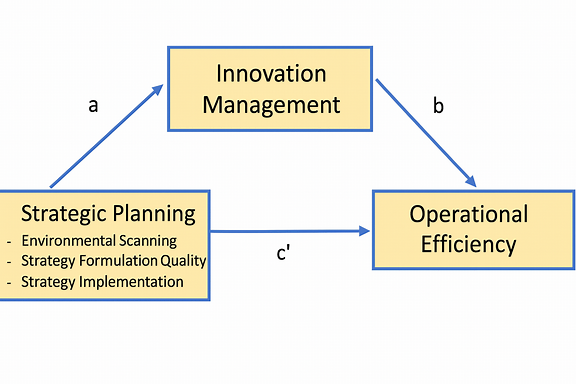
This study examines the direct and indirect linkages among strategic planning, innovation management, and operational efficiency at UBA, Nigeria. The objective is to ascertain if innovation management mediates the relationship between strategic planning and operational efficiency, thereby offering novel insights for both scholarly study and practical management within the banking sector.
Objectives
The purpose of this research is to analyze the direct influence of strategic planning on operational efficiency, to examine the direct effect of strategic planning on innovation management, to assess the direct impact of innovation management on operational efficiency, and to investigate the mediating effect of innovation management on the relationship between strategic planning and operational efficiency within United Bank for Africa, Nigeria
Literature review
Operational Efficiency
Operational efficiency refers to an organization's capacity to optimize its resources, procedures, and systems to deliver services effectively while maximizing output and minimizing waste or costs. Bakar and Ahmad (2020) assert that operational efficiency entails the proficient management of operations to guarantee prompt service delivery and elevated output. Fahimnia et al. (2021) assert that operational efficiency is demonstrated by an organization’s capacity to optimize operations, minimize superfluous costs, and uphold quality standards. Mhlanga (2022) elucidates that operational efficiency allows firms to swiftly adjust to fluctuations in consumer requirements and operational demands, therefore preserving a competitive advantage in dynamic circumstances.
Operational efficiency denotes the degree to which an organization attains optimal performance by effective resource use, consistent service quality, and adaptability to change. Key indicators of operational efficiency include (1) timely delivery of services, (2) high quality of service output, (3) effective control of operational costs, and (4) organizational adaptability. Consequently, operational efficiency is a vital determinant of organizational success, sustainability, and competitiveness, especially in industries like banking where service speed, precision, and cost control are essential.
Strategic Planning
Strategic planning is a crucial managerial function that allows firms to establish their long-term trajectory and maintain sustained performance in a dynamic environment. The process entails the deliberate formulation of an organizational mission and vision, the establishment of explicit goals, and the development of executable strategies that align internal resources with external opportunities and obstacles. Dhlamini (2024) and Bryson et al. (2021) emphasize that strategic planning transcends routine operational choices, functioning as a framework for adaptation and enduring competitive advantage.
Contemporary literature characterizes strategic planning as a multi-phase process encompassing environmental analysis, strategy development, and strategy execution. Environmental scanning enables firms to track trends, regulatory changes, and technology innovations, thereby diminishing uncertainty and facilitating proactive decision-making (George et al., 2023; Wolf & Floyd, 2024). The formulation step focuses on converting information from the external environment into coherent strategic choices, ensuring the organization leverages its strengths and addresses its weaknesses to achieve its objectives (Madume et al., 2024; Dhlamini, 2024). Implementation emphasizes executing strategies via effective leadership, coordinated actions, and ongoing communication, thus closing the divide between plans and concrete outcomes (George et al., 2023; Bryson et al., 2021).
Moreover, strategic planning is acknowledged as a continuous, adaptive process necessitating constant evaluation and modification to address both internal and external changes (George et al., 2023). Empirical studies consistently demonstrate a correlation between comprehensive strategic planning and improved organizational performance, encompassing enhanced operational efficiency and long-term sustainability, although the extent of this impact may differ according to context, industry, and capabilities (Madume et al., 2024; Dhlamini, 2024; Bryson et al., 2021). Consequently, strategic planning is a fundamental concept and practice for firms aiming to manage uncertainty and attain enduring success. This paradigm is based on previous literature, including Dhlamini (2024), Bryson et al. (2021), and George et al. (2023).
Environmental scanning
Environmental scanning denotes the systematic and ongoing process through which firms collect and analyze information regarding internal and external elements that may influence strategic decisions and overall performance. Environmental scanning is a crucial component of strategic planning that allows businesses to foresee changes in their operational environment, identify potential opportunities and risks, and reduce ambiguity in decision-making (Kraus et al., 2022). Through rigorous environmental analysis, firms can improve strategic understanding and proactively adjust to changing market conditions.
Academic viewpoints distinguish between external scanning, which concentrates on observing changes in political, economic, social, technological, legal, and competitive domains, and internal scanning, which examines a firm's own resources, capabilities, and organizational frameworks (Rothaermel, 2021; Hitt et al., 2020). External scanning enables firms to remain informed about changes in market trends, regulatory environments, and technology progress, whilst internal scanning guarantees that strategic solutions are customized to the organization's own strengths and weaknesses.
Studies show that firms employing thorough and methodical environmental scanning techniques exhibit enhanced strategic agility and superior performance results (Kunc & O’Brien, 2023). This approach is particularly essential in heavily regulated and competitive sectors like banking, where continuous environmental scanning facilitates regulatory compliance, risk management, and operational efficiency (Mikalef et al., 2021). Moreover, environmental scanning frequently establishes the basis for innovation-driven decisions by recognizing nascent technologies and novel market opportunities, thereby enhancing the efficacy of strategy development and execution (Vrontis et al., 2022). This discourse on environmental scanning is grounded in established literature, including Kraus et al. (2022), Rothaermel (2021), and Hitt et al. (2020).
Strategy formulation Quality
Strategy formulation is a crucial phase in the strategic planning process, during which businesses develop defined action plans based on thorough studies of internal and external environments. This phase involves defining strategic objectives, assessing alternative methods, and choosing strategies that optimally connect the organization’s capabilities with existing opportunities and limitations in the external environment (Rothaermel, 2021). Effective strategy formulation delineates a clear organizational direction and serves as the foundation for coordinated operations across divisions.
The quality of strategy formulation is crucial, as it dictates the realism, coherence, and adaptability of the selected solutions in response to environmental uncertainty. A high-quality formulation integrates meticulous analytical methods with prudent managerial judgment, guaranteeing that strategy decisions are evidence-based and aligned with the organization’s long-term goal (George et al., 2023). Researchers assert that engaging stakeholders at various levels during the formulation process improves strategic clarity and commitment to implementation, hence augmenting the likelihood of attaining desired results (Wolf & Floyd, 2024).
In continuously evolving and technology-driven sectors like banking, the quality of strategy creation necessitates the incorporation of innovation-related factors. This entails adopting digital transformation, distinguishing services, and restructuring procedures to maintain competitiveness and responsiveness (Vrontis et al., 2022). Empirical evidence indicates that businesses emphasizing clarity, adaptability, and an innovative attitude during strategy formation are more likely to achieve operational efficiency and maintain a competitive edge over time (Kunc & O’Brien, 2023).
Strategy implementation
Strategy implementation is the pivotal phase in which formulated strategies are transformed into specific plans and operational actions aimed at achieving corporate goals. This process involves the distribution of essential resources, the creation of appropriate organizational frameworks, the formulation of control systems, and the integration of human and technological resources to realize strategic objectives (Hrebiniak, 2021). The efficacy of strategy implementation acts as the conduit between strategic formulation and concrete outcomes, rendering it a critical determinant in the overall success of any strategic undertaking.
The successful execution relies on robust leadership dedication, clear communication of strategic aims, and the alignment of organizational frameworks with overarching objectives. Research indicates that even the most well-crafted strategies can fail if not implemented effectively, frequently owing to insufficient execution, organizational resistance to change, or a misalignment between strategic intentions and operational reality (Wolf & Floyd, 2024; George et al., 2023). In intricate contexts like the banking sector, these issues are exacerbated by regulatory requirements, outdated systems, and complex decision-making structures.
Recent studies highlight the significance of adaptation and organizational learning during the implementation process, especially in volatile circumstances marked by swift technology progress. Organizations that incorporate feedback systems, continuous performance evaluation, and a culture of perpetual enhancement are more adept at attaining operational efficiency and adapting to environmental changes (Kunc & O’Brien, 2023). The effective execution of strategy in banking is intricately linked to improved service delivery, increased cost efficiency, and process optimization, hence underscoring its pivotal role in achieving and maintaining exceptional organizational performance. This idea is based on the works of George et al. (2023), Wolf & Floyd (2024), and Rothaermel (2021).
Innovation management
Innovation management entails the intentional and methodical orchestration of actions that enable organizations to conceive, develop, and execute original ideas, processes, technologies, and services, all focused on augmenting value creation and overall performance. It includes cultivating a culture that promotes innovation, creating systematic avenues for idea development, and facilitating the efficient integration of new technologies in accordance with organizational objectives (Aas et al., 2020; Kijek & Kijek, 2022). Innovation management is essential for enhancing organizational agility and maintaining competitiveness in continuously evolving circumstances.
Recent literature emphasizes that innovation management attains its maximum efficacy when amalgamated with strategic planning. This alignment enables firms to convert strategic objectives into significant operational enhancements via continuous learning, experimentation, and a dedication to perpetual improvement (Leal-Rodríguez et al., 2023; Kraus et al., 2022). Empirical research indicates that companies with effective innovation management techniques typically achieve superior operational efficiency, enhance their processes, and exhibit significant adaptability to external environmental changes (Vrontis et al., 2022).
The importance of innovation management in the banking business has escalated due to swift digital transition, the emergence of fintech competitors, and more complex client demands. Studies demonstrate that banks utilizing digital platforms, automation, and data-driven technologies in their innovation management strategies achieve increased efficiency, superior service quality, and improved agility (Chatterjee et al., 2021; Nevhonda & Barros, 2024). When innovation management is not closely aligned with strategic plans, initiatives become fragmented, leading to minimal performance improvements, which highlights the importance of strategic alignment for maximizing the benefits of innovation (Kraus et al., 2022).
Conceptual framework
Research methodology
This study employs a quantitative approach through the survey technique. The study population comprises 555 employees in the Head Office of United Bank for Africa (UBA) in Lagos, Nigeria. A sample size of 232 respondents was calculated using Yamane’s technique, employing proportional stratified random sampling to guarantee representation across departments. Data were gathered using a standardized questionnaire employing a five-point Likert scale. Mediation analysis was employed using SPSS software and the PROCESS Macro to examine the effect of strategic planning, innovation management, on operational efficiency.
Result
Mediation Analysis Using Baron and Kenny’s (1986) Stepwise Approach
This section examines whether Innovation Management (IM) mediates the relationship between Strategic Planning (SP) and Operational Efficiency (OE) using Baron and Kenny’s (1986) four-step procedure, complemented with bootstrap analysis.
Step 1: Direct Effect of Strategic Planning on Operational Efficiency (Without Mediator)
| Variable | β | Std. Error | t-value | p-value |
| Constant | 4.843 | 1.097 | 4.416 | 0.000 |
| Strategic Planning (SP) | 0.58 | 0.079 | 7.285 | 0.000 |
Model Summary:
R = 0.581 R² = 0.338 F = 54.326 p < 0.001 N = 216
Interpretation:Strategic Planning has a positive and statistically significant effect on Operational Efficiency (β = 0.580, p < 0.01). This satisfies the first condition for mediation, indicating that strategic planning independently predicts operational efficiency at UBA.
Step 2: Effect of Strategic Planning on Innovation Management (Mediator)
| Variable | β | Std. Error | t-value | p-value |
| Constant | 4.723 | 0.899 | 5.252 | 0.000 |
| Strategic Planning (SP) | 0.123 | 0.01 | 12.973 | 0.000 |
Model Summary:R = 0.664 R² = 0.440 F = 168.304 p < 0.001 N = 216
Interpretation:Strategic Planning exerts a strong and statistically significant influence on Innovation Management (β = 0.123, p < 0.001). This satisfies the second condition for mediation, confirming that effective strategic planning enhances innovation-related practices at UBA.
Step 3: Effect of Innovation Management on Operational Efficiency (Controlling for Strategic Planning)
| Variable | β | Std. Error | t-value | p-value |
| Constant | 4.843 | 1.097 | 4.416 | 0.000 |
| Strategic Planning (SP) | 0.106 | 0.015 | 7.285 | 0.000 |
| Innovation Management (IM) | 0.058 | 0.079 | 0.744 | 0.458 |
Model Summary:R = 0.581 R² = 0.338 F = 54.326 p < 0.001 N = 216
Interpretation: While Strategic Planning remains statistically significant (β = 0.106, p < 0.001), Innovation Management does not significantly predict Operational Efficiency when controlling for Strategic Planning (β = 0.058, p > 0.05). This indicates that the third mediation condition is not satisfied.
Step 4: Test of the Indirect (Mediated) Effect Using Bootstrapping
| Mediating Path | Indirect Effect | Boot SE | Boot LLCI | Boot ULCI |
| SP → IM → OE | 0.007 | 0.008 | -0.01 | 0.024 |
Bootstrap Samples: 5,000
Confidence Level: 95%
Interpretation:The bootstrap confidence interval includes zero, indicating that the indirect effect is statistically insignificant. Thus, Innovation Management does not mediate the relationship between Strategic Planning and Operational Efficiency
Based on Baron and Kenny’s (1986) criteria and bootstrap analysis, Innovation Management does not mediate the relationship between Strategic Planning and Operational Efficiency at UBA. Strategic Planning remains the primary driver of operational efficiency outcomes.
Discussion
Effect of Strategic Planning on Operational Efficiency
Strategic planning has a direct positive effect on operational efficiency. This means that as the effectiveness of strategic planning increases within the organization, operational efficiency is also enhanced. The findings of this study are supported by research from George, Walker, and Monster (2023), who found that structured and deliberate strategic planning significantly improves organizational performance, including operational outcomes, in various sectors. Similarly, Wolf and Floyd (2024) emphasize that organizations with systematic strategic planning processes are better positioned to allocate resources efficiently, coordinate activities, and respond proactively to changes in their environment.
This empirical evidence indicates that the ability to clearly define organizational direction, set achievable goals, and implement well-formulated strategies is essential for optimizing processes and minimizing waste. In the context of the banking sector, effective strategic planning enables institutions to improve service delivery speed, maintain cost control, and adapt to shifting market conditions. The positive impact of strategic planning on operational efficiency is consistent with the Resource-Based View, which highlights the value of coordinated organizational resources and capabilities in achieving superior performance (Barney, 1991). Therefore, organizations that invest in comprehensive strategic planning are more likely to achieve higher levels of operational efficiency and sustain a competitive advantage in dynamic environment.
Effect of Strategic Planning on Innovation Management
Strategic planning has a direct positive effect on innovation management. This means that as organizations engage in more effective strategic planning, their capacity to manage and implement innovation is strengthened. The results of this study are supported by findings from Leal-Rodríguez et al. (2023), who demonstrated that clear and structured strategic planning processes help guide innovation efforts within an organization, ensuring that innovative ideas are aligned with broader organizational goals. Similarly, Kraus et al. (2022) stress that the integration of strategic planning and innovation management allows firms to proactively identify opportunities for innovation and allocate resources effectively to support creative initiatives.
The empirical evidence suggests that when strategic planning is robust, it provides a clear framework and direction for innovation activities. This alignment ensures that innovation is not a random or isolated occurrence but a deliberate and coordinated effort that contributes directly to organizational objectives. In the banking sector, effective strategic planning helps foster an environment that encourages experimentation, supports the adoption of new technologies, and promotes continuous improvement. As highlighted by Aas et al. (2020), organizations with strong strategic planning practices are better equipped to develop an innovation-oriented culture and respond swiftly to market changes. Therefore, the positive impact of strategic planning on innovation management reinforces the importance of aligning innovation initiatives with the organization’s overall strategy to achieve sustained growth and competitive advantage.
Effect of Innovation Management on Operational Efficiency
Innovation management is often expected to have a direct positive effect on operational efficiency. This suggests that when organizations effectively coordinate the development and implementation of new ideas, processes, and technologies, they should be able to streamline operations, reduce costs, and improve service quality. However, the findings of this study indicate that, within the context of United Bank for Africa (UBA), innovation management does not have a statistically significant direct effect on operational efficiency when controlling for strategic planning.
Previous research, such as that by Vrontis et al. (2022), supports the general view that organizations with robust innovation management systems tend to achieve higher levels of operational efficiency, process optimization, and responsiveness to environmental changes. Chatterjee et al. (2021) also highlight that in sectors like banking, digital innovation and the effective management of new technologies contribute to improved service delivery and cost effectiveness.
Despite these general findings, the present study’s results suggest that, at UBA, the benefits of innovation management may be indirect or dependent on its integration with other organizational systems, such as strategic planning. This lack of direct significance may be due to the current stage of innovation maturity within the bank, possible organizational resistance to change, or the need for stronger alignment between innovation initiatives and core operational processes.
In summary, while the literature underscores the potential for innovation management to enhance operational efficiency, the empirical evidence from this study reveals that such benefits may only be realized when innovation efforts are closely linked with and supported by strategic planning. Therefore, organizations should focus on not only fostering innovation but also ensuring that innovative practices are embedded within their strategic and operational frameworks to achieve measurable improvements in efficiency.
Test of the Indirect (Mediated) Effect Using Bootstrapping
The mediating effect of innovation management on the relationship between strategic planning and operational efficiency was tested using the bootstrapping method. The analysis produced an indirect effect coefficient of β = 0.007, with a bootstrapped standard error of 0.008 and a 95% confidence interval ranging from −0.01 to 0.024. Because the confidence interval includes zero, the result indicates that the indirect effect is not statistically significant at the 0.05 level. Therefore, the hypothesis that innovation management significantly mediates the relationship between strategic planning and operational efficiency is not supported. This finding suggests that, in the context of United Bank for Africa (UBA), the impact of strategic planning on operational efficiency occurs primarily through direct pathways rather than through innovation management as an intervening mechanism.
Recommendation
UBA is encouraged to strengthen its strategic planning by making environmental scanning a regular practice, ensuring that strategy formulation is data-driven and inclusive, and supporting effective implementation through strong leadership and clear objectives. Although innovation management was not found to have a direct impact on operational efficiency, it remains a vital area; UBA should continue to nurture an innovative culture, encourage collaboration, and more thoroughly embed innovation into daily operations. By closely aligning innovation efforts with overall strategic objectives and incorporating specific goals, timelines, and accountability measures, these initiatives can become more effective and measurable. Additionally, UBA should enhance the integration between innovation outcomes and operational processes by piloting, expanding, and consistently reviewing innovation projects to maximize their contribution to efficiency. For future research, conducting longitudinal or comparative studies across different banks or sectors could shed light on contextual factors and the sustained effects of innovation management. Employing qualitative or mixed-methods approaches may also offer a deeper understanding of how strategic planning, innovation, and operational outcomes are interconnected.
References
- Aas, T. H., Breunig, K. J., Hydle, K. M., & Pedersen, P. E. (2020). Innovation management practices in production-intensive service firms. International Journal of Innovation Management, 24(2), 2050014. DOI ↗ Google Scholar ↗
- Bakar, L. J. A., & Ahmad, H. (2020). Improving organizational performance through employee engagement and innovative work behavior. International Journal of Productivity and Performance Management, 69(5), 871-889. DOI ↗ Google Scholar ↗
- Barney, J. (1991). Firm resources and sustained competitive advantage. Journal of Management, 17(1), 99-120. DOI ↗ Google Scholar ↗
- Baron, R. M., & Kenny, D. A. (1986). The moderator–mediator variable distinction in social psychological research: Conceptual, strategic, and statistical considerations. Journal of Personality and Social Psychology, 51(6), 1173–1182. DOI ↗ Google Scholar ↗
- Bryson, J. M., Edwards, L. H., & Van Slyke, D. M. (2021). Getting strategic about strategic planning research. Public Management Review, 23(11), 1595–1608. DOI ↗ Google Scholar ↗
- Chatterjee, S., Chaudhuri, R., Vrontis, D., & Hassanein, E. E. (2021). Digital transformation and operational efficiency: Evidence from the banking sector. Technological Forecasting and Social Change, 167, 120729. DOI ↗ Google Scholar ↗
- Dhlamini, N. (2024). Strategic planning and organizational performance: Evidence from the banking sector. Journal of Business Strategy, 45(1), 56–68. DOI ↗ Google Scholar ↗
- Fahimnia, B., Marra, M., & Sarkis, J. (2021). Quantitative models for managing supply chain risks: A review. European Journal of Operational Research, 294(2), 395–409. DOI ↗ Google Scholar ↗
- George, G., Walker, R. M., & Monster, J. (2023). Strategic management in turbulent times: Dynamic capabilities and organizational performance. Academy of Management Journal, 66(1), 123–147. DOI ↗ Google Scholar ↗
- Hitt, M. A., Ireland, R. D., & Hoskisson, R. E. (2020). Strategic management: Concepts and cases: Competitiveness and globalization (13th ed.). Cengage Learning. DOI ↗ Google Scholar ↗
- Hrebiniak, L. G. (2021). Making strategy work: Leading effective execution and change (3rd ed.). Pearson. DOI ↗ Google Scholar ↗
- Kijek, T., & Kijek, A. (2022). Innovation management and performance: Empirical evidence from the banking sector. Journal of Business Research, 145, 135–146. DOI ↗ Google Scholar ↗
- Kraus, S., Durst, S., Ferreira, J. J., Veiga, P. M., Kailer, N., & Weinmann, A. (2022). Digital transformation and entrepreneurship: A systematic review of the literature. Journal of Small Business Management, 60(6), 1460–1497. DOI ↗ Google Scholar ↗
- Kunc, M., & O’Brien, F. A. (2023). Strategic planning: A review of the literature. Long Range Planning, 56(1), 102237. DOI ↗ Google Scholar ↗
- Leal-Rodríguez, A. L., Eldridge, S., Roldán, J. L., & Ortega-Gutiérrez, J. (2023). Linking strategic planning and innovation: The role of organizational learning. European Management Journal, 41(2), 234–246. DOI ↗ Google Scholar ↗
- Madume, J., Adeoye, A., & Ogunbiyi, T. (2024). Strategic planning processes and firm performance: Evidence from Nigerian banks. African Journal of Economic and Management Studies, 15(1), 88–103. DOI ↗ Google Scholar ↗
- Mhlanga, D. (2022). The role of operational efficiency in sustaining competitive advantage: Evidence from commercial banks. International Journal of Economics and Financial Issues, 12(3), 45–53. DOI ↗ Google Scholar ↗
- Mikalef, P., Krogstie, J., Pappas, I. O., & Pavlou, P. A. (2021). Investigating the effects of big data analytics capabilities on firm performance: The mediating role of dynamic capabilities. Information & Management, 58(3), 103410. DOI ↗ Google Scholar ↗
- Nevhonda, M., & Barros, O. (2024). Digital innovation and operational performance in banking. Journal of Financial Services Marketing, 29(1), 44–58. DOI ↗ Google Scholar ↗
- Rothaermel, F. T. (2021). Strategic management (5th ed.). McGraw-Hill Education. DOI ↗ Google Scholar ↗
- Vrontis, D., Christofi, M., Pereira, V., Tarba, S., Makrides, A., & Trichina, E. (2022). Innovation strategies, digital transformation, and competitive advantage: A review. Technological Forecasting and Social Change, 177, 121528. DOI ↗ Google Scholar ↗
- Wolf, C., & Floyd, S. W. (2024). Strategic planning research: Toward a theory-driven agenda. Strategic Organization, 22(1), 12–28. DOI ↗ Google Scholar ↗