Abstract
This paper aims to assess the factors influencing the development of the night-time economy in Sam Son and propose solutions to enhance its effectiveness. the study focuses on five key factors: legal policies, safety, service quality, infrastructure and transportation, and service pricing. The research data was collected between April and August 2025 through surveys targeting various stakeholders in the night-time economy, including tourists, business owners in the tourism sector, workers in the industry, and local government representatives. Research results indicate that legal policies have the strongest impact on the development of the night-time economy, followed by safety, while service quality, infrastructure and transportation, and service pricing also play significant roles. Based on these findings, the paper proposes practical solutions to improve policy frameworks, enhance security, upgrade service quality, develop infrastructure, and regulate pricing, thereby fostering the sustainable growth of the night-time economy in Sam Son.
Keywords: Night – time economy, factors affecting, Sam Son ward, Thanh Hoa province.
Introduction
The night-time economy encompasses services, businesses, and activities that take place between 6 pm and 6 am (Tran, 2021). These include entertainment-related businesses catering to tourists as well as various activities designed to meet the business, consumption, and leisure demands of local residents.
The growing focus on night-time economic development stems from its ability to optimize time usage, diversify economic activities, and enhance the quality of life for residents. additionally, it serves as a magnet for tourists and fosters economic growth. with a wide range of services operating at night, there is a rising demand for workers across multiple job roles, thereby generating numerous employment opportunities. moreover, the expansion of the night-time economy can attract more investment in entertainment and retail sectors, ultimately boosting financial resources for local economic development.
However, the night-time economy in Vietnam has not yet been given significant attention, and the range of night-time products and services remains limited and relatively monotonous, failing to attract both domestic and international tourists. The current development model of the night-time economy in Vietnam is still in its early stages, with pilot programs mainly concentrated in major cities such as Hanoi, Ho Chi Minh city, and Da Nang. In most other areas, night-time services are scarce, leaving tourists—especially international visitors—feeling uninspired due to the lack of entertainment and leisure options after dark.
In response to this situation, developing the night-time economy has been recognized as one of Vietnam's key strategies, particularly in tourism hubs such as Sam Son ward, Thanh Hoa province. Sam Son is a well-known coastal tourist destination with a long-standing history of development, possessing numerous favorable conditions for fostering the night-time economy. these advantages include abundant tourism resources, a rich cultural, artistic, and culinary heritage, a young and dynamic population with high levels of global integration, and relatively pleasant nighttime weather—all of which create an ideal environment for expanding this sector.
However, in recent years, the development of Sam Son’s night-time economy has not yet fully matched its potential, reducing the overall economic efficiency of the city and limiting its capacity to maximize the benefits of night-time activities. Additionally, while the night-time economy offers significant economic advantages, improper development and weak management may lead to negative consequences, such as disruptions to local residents, noise and light pollution, and an increased risk of social issues emerging at night (Tang, 2024).
Given this reality, our research team has chosen to study factors influencing the development of the night-time economy in Sam Son ward, Thanh Hoa province to assess the impact of various factors on its growth. Based on the findings, this study proposes several policy recommendations for the Sam Son ward government and relevant authorities to support the sustainable development of the night-time economy in the coming years.
Theoretical Basis And Research Method
2.1. Theoretical basis of the Night - time economy and Development of the Night-Time Economy
Night - time economy
In the fields of finance, economics, and banking, the concept of the "night-time economy" has been defined in various ways. Initially, the term referred to a broad spectrum of nighttime activities, not only limited to entertainment and alcohol consumption but also including other aspects of economic activity after dark (Phan & Nguỹen, 2023).
The night-time economy can be understood on both a broader and narrower scale. In a general sense, it includes all social and economic activities that take place during the night. More specifically, it covers a range of leisure and business activities such as dining, drinking establishments, karaoke, cultural institutions, creative industries, and retail services. These activities typically occur between 6 PM and 6 AM the following day (Tran, 2021). In other countries, the considered time frame for economic activity at night can be from 5:00 p.m. to 4:00 a.m. the next morning. The definition of economic night time varies from country to country (Pham & Le, 2023)
In this study, the term "night economy" refers to all economic activities taking place between 6:00 PM and 6:00 AM the next day. These activities play a role in urban renewal and economic development, encompassing the operation and management of bars, clubs, night markets, cinemas, theaters, festivals, cultural events, as well as banking and financial services.
Development of the Night-Time Economy
Development is a continuous process in every society and ethnic community, guided by leadership and governance through strategies and policies that align with historical, political, economic, cultural, and social contexts. This process involves the creation, mobilization, and management of both natural and human resources to achieve sustainable outcomes that are fairly distributed among members of society, ultimately enhancing their quality of life.
From an economic perspective, growth refers to quantitative changes in an object, phenomenon, or entity, whereas development encompasses both quantitative and qualitative transformations.
In this study, the development of the night-time economy is defined as the expansion and improvement in the scale and quality of economic activities taking place between 6:00 PM and 6:00 AM. To evaluate this development, specific indicators are needed to measure changes in both the quantity and quality of these activities. Common indicators include policies supporting night-time economic growth, the variety of night-time services, the economic contributions of night-time activities, and risk management within the sector. These factors are often analyzed over time, depending on the scope and objectives of the study.
2.2. Factors affecting the development of night - time economy
Legal Policy
Legal policy is the legal framework related to the night economy, from: overall regulation, market orientation, environmental management, infrastructure, to the main tools that can link to the time frame, security and order, specific products and services. A country or a locality has clear regulations on conditions for night-time economic activities for businesses and business households; or have regulations on operating hours that will cooperate in developing the night economy in a positive direction. The more complete and clear the legal regulations are, the more the night-time economy develops and vice versa.
Hypothesis H1: Legal policy positively affects the development of night - time economy in Sam Son ward.
The quality of tourism services
Tourism products encompass all tangible and intangible elements that tourists can access, experience, and utilize during their journey (Buhalis, 2008). The quality of tourism services is derived from the quality of both tangible and intangible tourism products (Pham, 2011). Notably, when assessing the quality of a tourist destination, it is essential to consider the quality of the product chains provided by the destination and the degree of synchronization among these chains (Tran, 2013). This factor plays a fundamental role in attracting tourists to a specific destination, thereby laying the foundation for tourism-driven economic development, particularly the nighttime economy. The diversity, richness, and quality of tourism products and services not only contribute to the growth of the nighttime economy but are also influenced by it. Therefore, this study proposes a positive relationship between the quality of tourism products/services and the development of the nighttime economy.
Hypothesis H2: The quality of tourism services positively affect the development of night - time economy
Safety issues
Safety plays a vital role in promoting the development of the nighttime economy, as tourists are more likely to engage in nighttime activities when they feel secure. The safety concerns of tourists participating in night tourism (Hsieh & Chang, 2006; Thinh & Huynh, 2014) directly influence their willingness to explore and spend in nighttime destinations. Moreover, well-implemented policies for nighttime services at tourist destinations (Song & Zhou, 2020; Tran, 2022) contribute to creating a safe and regulated environment, enhancing visitor confidence. A well-maintained security system, including law enforcement presence, surveillance, and emergency response mechanisms, not only ensures public order but also encourages greater participation in nighttime economic activities. As a result, improved safety measures have a positive impact on the development of the nighttime economy by fostering higher tourist engagement, increased spending, and overall economic growth. Therefore, the hypothesis is formulated as follows:
Hypothesis H3: Safety issues positively affect the development of night - time economy
Infrastructure and transportation
Infrastructure plays a crucial role in fostering the development of the nighttime economy (Christou et al., 2022; Hsieh & Chang, 2006). A modern electric lighting system and convenient transportation networks are essential factors in attracting tourists to nighttime destinations (Pinke-Sziva et al., 2019). Moreover, the expansion of the nighttime economy generates revenue that can contribute to accelerating local urbanization (Olt et al., 2021). Therefore, regulatory authorities should establish clear strategies for investing in transportation infrastructure in key development areas (Son et al., 2023).
Le et al. (2023) further demonstrated a positive relationship between infrastructure and the development of the nighttime economy in Da Nang, Vietnam. Based on this foundation, the following research hypothesis is proposed:
Hypothesis H4: Convenient infrastructure and transportation positively affects the development of night - time economy
Service Price
Christou et al. (2022) hypothesized that service costs would have a certain impact on the development of the nighttime economy. When service fees are set at a reasonable level and pricing is transparently disclosed, tourists are more likely to revisit nighttime activities. Similarly, Nguyen (2023) asserted that tourists tend to spend more at night if service prices are reasonable and provide them with a satisfying experience.
Le et al. (2023) further established a positive relationship between service pricing and the growth of the nighttime economy in Da Nang, Vietnam. Their study surveyed 346 domestic tourists and employed SPSS quantitative analysis software. The findings identified five key factors that positively influence the nighttime economy: the development of a diverse range of services, legal and safety regulations, cultural experience opportunities, infrastructure and transportation, and service pricing. This implies that affordable and appropriately priced services contribute significantly to nighttime economic development. Based on these findings, the following hypothesis is proposed:
Hypothesis H5: Service Price positively affect the development of night - time economy
Research methodology
Research process
Step 1: Identifying the Research Problem. The author begins by reviewing prior studies related to the theoretical foundations, definitions, characteristics of the nighttime economy, and the factors influencing its development in various countries and regions with distinct features. Through this review, the author identifies research gaps. Based on these gaps, the author formulates a suitable research design and methodology to address the research questions and determine the relevant factors that should be considered in this study.
Step 2: Developing a Conceptual Model and Constructing a Scale. Building on the identified research gaps, the author establishes a conceptual research model. Next, a set of independent and dependent variables is defined based on insights from the literature. This process leads to the creation of the initial version of the questionnaire (draft scale). The author then consults experts in tourism, entertainment, and related fields to assess the relevance of the first draft, making necessary adjustments and refinements to better define key concepts. As a result, a revised version of the questionnaire is produced, which is then finalized in preparation for subsequent research steps.
Step 3: Conducting a Preliminary Test of the Questionnaire. At this stage, the author distributes a survey to tourists who have visited Sam Son ward and participated in nighttime tourism activities. The respondents must have visited Sam Son ward at least once. The questionnaire is designed using a 5-point Likert scale. The collected data undergoes cleaning and processing using SPSS 22 software. This preliminary test allows the author to perform statistical analyses, including regression and hypothesis testing, as a trial run before working with the full dataset.
Step 4: Conducting the Main Study. In this phase, the author distributes the final survey primarily through direct interviews to a larger sample of tourists. Once all responses are collected, the author proceeds with data analysis and necessary statistical tests. Table 1 shows synthesis of factors, number of scales and sources of formation of this research.
| Factor | Abbreviation symbol | Number of scales | Reference source |
| Legal Policies | LP | 5 | Pham & Le (2023), Bui (2023); |
| The quality of tourism services | QTS | 5 | Le Et el (2023); Bui (2024) |
| Safety issue | SAI | 4 | Hsieh & Chang, (2006); Thinh & Huynh, (2014) Song & Zhou, (2020); Tran, (2022); Le Et el (2023); |
| Infrastructure andtransportation | INTR | 3 | Hsieh and Chang (2006) Christou et al. (2022); Le Et el (2023); Son et al., 2023). |
| Service Price | SEPR | 4 | Christou et al. (2022);Nguyen (2023); Le Et el (2023) |
| The development of night – time economy | DNTE | 5 | Hsieh and Chang (2006) Christou et al. (2022); Nguyen (2023); Le Et el (2023); |
(Source: Author`s summary)
Research mothodology
In this study, data collection was conducted through two methods: direct interviews and indirect interviews, to examine the factors influencing the development of the nighttime economy in Sam Son ward. Direct interviews were carried out with owners of accommodation establishments and service businesses to gather insights from those directly involved in nighttime economic activities. Meanwhile, indirect interviews were conducted with tourists through accommodation establishments to assess their perspectives on the factors affecting their nighttime tourism experiences. The survey was conducted from April 2024 to August 2024. A total of 260 questionnaires were distributed, with 210 responses collected. After data screening and cleaning, 191 valid questionnaires were included in the analysis, ensuring the accuracy and reliability of the research findings.
In this study, SPSS 22 software is utilized to perform quantitative analysis techniques to assess the impact of various factors on the development of the nighttime economy in Sam Son ward. First, the reliability of the scale is tested using Cronbach’s Alpha to eliminate unsuitable variables and ensure measurement consistency. Next, the Kaiser-Meyer-Olkin (KMO) test and Bartlett’s Test are applied to evaluate the suitability of the dataset for Exploratory Factor Analysis (EFA). Factor Loading analysis helps determine the contribution level of each observed variable to the overall factor, ensuring that statistically significant variables are retained in the model. The Durbin-Watson coefficient is used to check for autocorrelation in the regression model, while the adjusted R² coefficient evaluates the explanatory power of the model regarding the variance of the dependent variable.
The application of these techniques ensures the accuracy and reliability of the research model while identifying key factors influencing the development of the nighttime economy in Sam Son. This provides a solid foundation for policy recommendations and strategic decision-making.
Research model
Based on the above analysis, the author proposes the research model as illustrated in Figure 1 below.
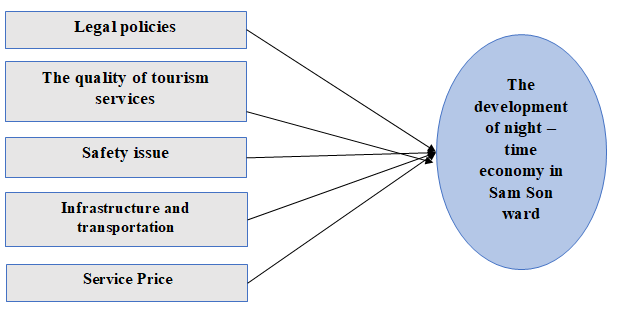
(Source: Author`s suggestion)
Research Results And Discussion
4.1. Testing the reliability of the scale
The results of testing the reliability coefficient of the Cronbach Alpha scale of each group of factors affecting the development of night – time economy in Table 2, all reached a value of 0.704 and higher, showing that the factor groups are reliable and qualified for testing.
| Variable | Cronbach's Alpha | N of Items | |
| 1 | Legal Policies | .802 | 5 |
| 2 | The quality of tourism services | .756 | 5 |
| 3 | Safety issue | .766 | 4 |
| 4 | Infrastructure and transportation | .704 | 3 |
| 5 | Service Price | .738 | 4 |
| 6 | The development of night – time economy | .715 | 5 |
(Source: Authors Analysis)
4.2. Exploratory factor analysis
KMO (Keiser-Meyer-Olkin) index analysis is an index used to examine the suitability of factors, the result reached 0.823 with a significance level of Sig=0.000, showing that the application of exploratory factor analysis here is completely appropriate (See Table 3).
| Kaiser-Meyer-Olkin Measure of Sampling Adequacy. | .823 | |
| Bartlett's Test of Sphericity | Approx. Chi-Square | 2845.190 |
| Df | 351 | |
| Sig. | .000 |
(Source: Authors Analysis)
The results of Rotated Component Matrix analysis show that there are 5 factors with Eigenvalues >1, indicating that the research model is influenced by 5 factors. The factor analysis is based on Varimax rotation and on the Communility ≥0.5 standard, the Factor Loading coefficients of the factors all have a value >0.5 with statistical significance, satisfying the selection criteria as well as the variables all have a positive relationship with the research aspect (See Table 4).
| Component | ||||||
| 1 | 2 | 3 | 4 | 5 | 6 | |
| LP5 | .815 | |||||
| LP1 | .773 | |||||
| LP3 | .765 | |||||
| LP2 | .749 | |||||
| LP4 | .690 | |||||
| QTS3 | .888 | |||||
| QTS1 | .876 | |||||
| QTS4 | .787 | |||||
| QTS2QTS5 | .777.765 | |||||
| SAI1 | .706 | |||||
| SAI4 | .701 | |||||
| SAI3 | .689 | |||||
| SAI2 | .675 | |||||
| INTR3 | .741 | |||||
| INTR2 | .737 | |||||
| INTR1 | .727 | |||||
| ASQ3 | .648 | |||||
| SEPR4 | .884 | |||||
| SEPR3 | .825 | |||||
| SEPR1 | .788 | |||||
| SEPR2 | .723 | |||||
| DNTE3 | .791 | |||||
| DNTE4 | .778 | |||||
| DNTE2 | .722 | |||||
| DNTE1DNTE5 | .701.754 | |||||
| Extraction Method: Principal Component Analysis.Rotation Method: Varimax with Kaiser Normalization. | ||||||
| a. Rotation converged in 6 iterations. |
(Source: Authors Analysis)
4.3. Regression analysis
The regression analysis results show that the adjusted R2 value (R square) is 0.592>50%, which means that the research results have a variation within the range of 60.3%, and Sig =0.00 is appropriate, 5 independent variables explain 60.3% of the variation of the dependent variable. The value of the Durbin-Watson coefficient in table 5 is 2.159, which is between 1 and 3 shows that there is no correlation between the variables and no multicollinearity because the F test gives the result Sig = 0.00<0.05, the Coefficients table has VIF coefficients all <10.
| Model | R | R Square | Adjusted R Square | Std. Error of the Estimate | Change Statistics | Durbin-Watson | ||||
| R Square Change | F Change | df1 | df2 | Sig. F Change | ||||||
| 1 | .781a | .621 | .603 | .42833 | .623 | 52.312 | 5 | 183 | .000 | 2.159 |
| a. Predictors: (Constant), LP, QTS, SAI, INTR, SEPR | ||||||||||
| b. Dependent Variable: DNTE |
(Source: Authors Analysis)
| Model | Unstandardized Coefficients | Standardized Coefficients | t | Sig. | Collinearity Statistics | |||
| B | Std. Error | Beta | Tolerance | VIF | ||||
| 1 | (Constant) | -.557 | .259 | -2.639 | .009 | |||
| LG | .225 | .046 | .321 | 5.996 | .000 | .822 | 1.332 | |
| SAI | .269 | .061 | .270 | 5.035 | .000 | .825 | 1.327 | |
| QTS | .232 | .054 | .268 | 5.018 | .000 | .834 | 1.313 | |
| SEPR | .226 | .064 | .211 | 3.970 | .000 | .873 | 1.259 | |
| INTR | .240 | .061 | .226 | 4.522 | .000 | .968 | 1.144 | |
| a. Dependent Variable: DNTE |
(Source: Authors Analysis)
Discussions and recommendations
Legal policies have the strongest impact on the development of the night-time economy in Sam Son ward, as shown by regression results. Regulations on operating hours, business licensing, taxation, and public order management play a decisive role in either promoting or restricting this economic model. inconsistent or overly restrictive policies can hinder business expansion, while supportive legal frameworks—such as extending operating hours, streamlining licensing procedures, and offering tax incentives—can drive significant growth in the night-time economy, contributing to the city’s overall economic development. to fully leverage its potential, Sam Son authorities should collaborate with Thanh Hoa province and the department of culture, sports, and tourism to refine relevant legal policies. Key recommendations include extending business hours until 2–3 am in major tourism zones, simplifying licensing procedures for night markets, pedestrian streets, and entertainment venues, offering tax reductions or fee exemptions for businesses in the early stages, and actively promoting night-time tourism through partnerships with travel agencies and cultural events. with comprehensive and supportive policies, Sam Son can maximize its coastal tourism advantages and establish itself as a vibrant night-time economic hub, boosting local economic growth and improving residents’ livelihoods.
To ensure the safety of tourists participating in night-time activities in sam son and support the sustainable development of the night-time economy, local authorities should implement several key measures. First, security forces should be strengthened in night-time economic zones by deploying dedicated police patrols and mobile security stations at pedestrian streets, night markets, entertainment venues, and beaches. Second, smart surveillance technology should be applied by installing high-quality security cameras in crowded areas, integrated with a central monitoring system for quick incident response, and developing a mobile safety alert application for tourists to contact authorities in emergencies. Third, awareness campaigns should be conducted to educate tourists on safety precautions and to train business owners and staff in handling emergency situations. Lastly, stricter regulations should be enforced on night-time businesses, particularly bars, karaoke venues, and restaurants, to prevent scams, overpricing, and harassment, while also setting safety standards for night-time transportation services such as taxis, electric cars, and ride-hailing services. with these comprehensive and effective measures, Sam Son can create a safe and welcoming night-time tourism environment, enhancing visitor experiences and driving economic growth.
Regression results indicate that the quality of tourism products and services is one of the key factors positively influencing the development of the night-time economy in Sam Son. To enhance quality and diversify tourism offerings, the city can implement several strategic measures. First, improving the quality of night-time dining by establishing dedicated food streets, ensuring food safety standards, and promoting local specialties. second, expanding and developing diverse night-time entertainment options such as street performances, live music, light festivals, and nighttime beach sports to attract visitors. Third, creating vibrant shopping spaces and night markets offering local products and souvenirs, combined with cultural and artistic experiences to extend tourists’ stay. fourth, upgrading accommodation services by ensuring hotels and homestays meet high standards and offering night-oriented amenities such as rooftop bars, nighttime spas, and city night tours. Lastly, promoting digital transformation in tourism by integrating cashless payment systems, online booking services, and digital platforms to provide real-time travel information. These initiatives will not only enhance the visitor experience but also contribute to the sustainable growth of the night-time economy in Sam Son.
Infrastructure and transportation are key factors influencing the development of the night-time economy in Sam Son. With investments from Thanh Hoa province, the city’s infrastructure has improved significantly. However, to ensure sustainability and maximize support for the night-time economy, further measures are needed to enhance maintenance and efficiency. First, the city should focus on the regular maintenance of key roads, especially those serving night-time tourism such as pedestrian streets, night markets, and coastal areas, to ensure smooth and safe mobility for both locals and visitors. Second, public lighting systems should be upgraded with energy-efficient technology, ensuring adequate illumination in night-time activity zones to enhance security and improve the overall tourist experience. Third, the development of night-time public transportation should be prioritized by expanding the operation of electric vehicles and tourist buses, along with strategically placed stops to facilitate easy movement between attractions. Fourth, the city could consider establishing smart parking areas near tourism hotspots to reduce traffic congestion and optimize urban space. Lastly, policies should be introduced to encourage businesses to participate in infrastructure maintenance and development, while also integrating smart technology for traffic monitoring and management to enhance operational efficiency. These solutions will contribute to building a modern infrastructure system that supports the sustainable and dynamic growth of the night-time economy in Sam Son.
Service pricing is a crucial factor influencing the development of the night-time economy in Sam Son. While service prices in the city are generally reasonable, instances of price gouging and overcharging still occur, negatively affecting the city’s tourism image. To effectively regulate prices and ensure tourists feel confident using local services, several measures should be implemented. First, the local government should establish and publicly display price ceilings for common tourism services such as dining, accommodation, transportation, and entertainment to ensure transparency and prevent unfair pricing practices. Second, a monitoring and complaint system should be introduced through a hotline or a smart tourism app, allowing visitors to report price-related issues easily. Third, inspection efforts should be strengthened, with strict penalties imposed on businesses found guilty of overpricing or deceiving customers. A public listing of violators can also serve as a deterrent. Fourth, businesses should be encouraged to participate in a “standardized pricing tourism program,” committing to fair and transparent pricing, which will enhance their reputation and attract more customers. Lastly, promotional efforts should focus on highlighting reputable service providers and standardized establishments, helping tourists make informed choices and avoid price manipulation.
Conclusion
This study analyzes the factors influencing the development of the night-time economy in sam son, identifying legal policies, safety, service quality, infrastructure and transportation, and service pricing as key determinants. regression results indicate that legal policies have the strongest impact, followed by safety, while the remaining factors also play significant roles in promoting the sustainable growth of the night-time economy.
However, the study has certain limitations. First, data collection was conducted between April and August 2025, which may not fully capture seasonal variations and long-term trends. Second, the sample size is relatively limited, meaning it may not comprehensively represent all stakeholder groups involved in the night-time economy of Sam Son. Third, there may be additional factors outside the model that influence the development of the night-time economy but were not included in this study. These limitations present opportunities for future research. Subsequent studies could extend the data collection period to account for seasonal fluctuations, increase the sample size to enhance representativeness, and incorporate additional factors such as tourist consumption behavior, the impact of digital technology, and socio-cultural elements. this would provide a more comprehensive understanding of the development of the night-time economy in Sam Son and other localities.
References
- Buhalis, D., & Law, R. (2008). Progress in information technology and tourism management: 20 years on and 10 years after the Internet. The state of eTourism research, 29(4), 609-623. DOI ↗ Google Scholar ↗
- Christou, P., Pericleous, K., & Papatheodorou, A. (2022). Dazzled by the strobe lights: Tourist experience and complexity in the night economy. Journal of Hospitality and Tourism Management, 52, 452-458. DOI ↗ Google Scholar ↗
- Chinh, P. M., & Hoàng, V. Q. (2009). Kinh tế Việt Nam: Thăng trầm và đột phá. Chính trị Quốc gia Publishing. DOI ↗ Google Scholar ↗
- G. Han, T. Zhou, Y. Sun, & S. Zhu. (2022). The relationship between night-time light and socioeconomic factors in China and India. Retrieved from DOI ↗ Google Scholar ↗
- Guo, Q., et al. (2011). The development of urban night tourism based on the nightscape lighting projects – A case study of Guangzhou. Energy Procedia, 5(40771002), 477–481. DOI ↗ Google Scholar ↗
- Hair, J. F., Black, W. C., Babin, B. J., & Anderson, R. E. (2009). Multivariate data analysis (7th ed.). Pearson. DOI ↗ Google Scholar ↗
- Hsieh, A. T., & Chang, J. (2006). Shopping and tourist night markets in Taiwan. Tourism Management, 27(1), 138-145. DOI ↗ Google Scholar ↗
- Hoàng Trọng, & Chu Nguyễn Mộng Ngọc. (2005). Phân tích dữ liệu nghiên cứu với SPSS. Thống kê Publishing. DOI ↗ Google Scholar ↗
- Le, T. A., Anh, V. P. G., Huyen, T. N. T., & Ha, N. M. Q. (2023). Factors affecting night economy development: A case study in Da Nang City, Vietnam. GeoJournal of Tourism and Geosites, 50(4), 1373–1381. DOI ↗ Google Scholar ↗
- Lưu Thanh Tâm. (2020). Phát triển kinh tế ban đêm tại các thành phố của Việt Nam. Retrieved from DOI ↗ Google Scholar ↗
- Nguyễn Đức Bảo, & Trần Đức Hiệp. (2021). Kinh nghiệm phát triển kinh tế ban đêm tại một số quốc gia. Tạp chí Tài chính, 748(1). DOI ↗ Google Scholar ↗
- Nguyễn Đức Dũng. (2020). Kinh tế đêm & phi chính thức [Night & Informal Economy]. Thế giới Publishing. DOI ↗ Google Scholar ↗
- Nguyen, T. T. T. (2023). Factors influencing Vietnam youth’s participation in the nighttime economy. Journal of Eastern European and Central Asian Research (JEECAR), 10(3), 515-526. DOI ↗ Google Scholar ↗
- Olt, G., Smith, M. K., Csizmady, A., & Sziva, I. (2021). Gentrification, tourism, and the night-time economy in Budapest’s district VII–The role of regulation in a post-socialist context. Tourism and the Night, 24-36. Routledge. DOI ↗ Google Scholar ↗
- Pham Dinh Tho. (2011). Tourism service quality management textbook: Part 1. VungTau Tourism Vocational College, Ba Ria - Vung Tau. DOI ↗ Google Scholar ↗
- Pinke-Sziva, I., Smith, M., Olt, G., & Berezvai, Z. (2019). Overtourism and the night-time economy: A case study of Budapest. International Journal of Tourism Cities, 5(1), 1-16. DOI ↗ Google Scholar ↗
- Phan Thi Hang Nga, & Nguyen Thi Canh. (2023). Factors affecting the development of the night-time economy in Mekong Delta provinces. Tạp chí Nghiên cứu tài chính-Marketing, 87. DOI ↗ Google Scholar ↗
- Song, H., Miseong, K., & Chanyul, P. (2020). Temporal distribution as a solution for over-tourism in night tourism: The case of Suwon Hwaseong in South Korea. Sustainability (Switzerland), 12(6), 5–7. DOI ↗ Google Scholar ↗
- Song, Y., & Zejiong, Z. (2020). Study on the development of the night tourism economy in Qingdao. Scientific Journal of Economics and Management Research, 2(4), 1–5. DOI ↗ Google Scholar ↗
- Son, N. N., Thu, N. T. P., Dung, N. Q., Huyen, B. T. T., & Xuan, V. N. (2023). Determinants of the sustained development of the night-time economy: The case of Hanoi, capital of Vietnam. Journal of Risk and Financial Management, 16(8), 351. DOI ↗ Google Scholar ↗
- Selly, V., et al. (2020). Local wisdom-based on development of the environment and atmosphere aspect of Berastagi night tourism. International Journal of Architecture and Urbanism, 4(2), 144–155. DOI ↗ Google Scholar ↗
- Thinh, N. T. P., & Huynh, T. H. (2014). Đánh giá thực trạng hoạt động của mô hình chợ đêm trên địa bàn quận Ninh Kiều, thành phố Cần Thơ. Tạp chí Khoa học Trường Đại học Cần Thơ, 32, 109–116. ) DOI ↗ Google Scholar ↗
- Tran, D. H. (2013). Decentralized management of cultural heritage and tourist attractions. Hanoi University of Culture. DOI ↗ Google Scholar ↗
- Tran, T. T. H. (2021). Night-time economy development in Vietnam. International Journal of Advanced Engineering and Management Research, 6(3). DOI ↗ Google Scholar ↗
- Tuong, N. T. (2022). Developing night-time economy: International experience and policy implications for Da Nang City, Vietnam. Journal of Language and Linguistic Studies, 18(1), 1157-1180. http://www.jlls.org/index.php/jlls/article/view/4172/1171 DOI ↗ Google Scholar ↗
- Vietnamese Government. (2020). Quyết định số 1129/QĐ-TTg của Thủ tướng Chính phủ: Phê duyệt Đề án phát triển kinh tế ban đêm ở Việt Nam [Decision No. 1129/QD-TTg of the Prime Minister: Approving the Project to Develop the Night Economy in Vietnam]. Retrieved from DOI ↗ Google Scholar ↗
- Zmyslony, P., & Pawlusiński, R. (2020). Tourism and the night-time economy: The perspective article. Tourism Review, 75(1), 194-197. DOI ↗ Google Scholar ↗