Abstract
The Fourth Industrial Revolution is driving the inevitable shift towards a digital education ecosystem. However, the current practical implementation of digital transformation at high schools is often narrowed down to the procurement of hardware equipment, leading to fragmentation and inefficiency. Previous studies have primarily focused on examining the technological competencies of teachers while leaving open the systemic governance role and the "e-Leadership" mindset of the Principal. To fill this gap, the article proposes an integrated theoretical framework for the management of digital transformation activities in teaching at high schools. The theoretical framework is built upon the intersection of 3 core pillars: (1) Integrating digital teaching content with advanced pedagogical models; (2) Integrating the 4 management functions (Planning, Organizing, Directing, Controlling) from a digitalization perspective and data-driven decision making; (3) Integrating a synchronized support ecosystem to address the challenge of technological disparity. The study asserts that digital transformation is not merely a "technology project" but a process of profound change in organizational culture. The article provides practical managerial implications, helping the School Management Board orient their strategies, avoid technology overload, and lead the school's digital transformation in a deep, substantive, and sustainable manner.
Keywords
Educational management Digital transformation in teaching Integrated theoretical framework e-Leadership High school
1. Introduction
The Fourth Industrial Revolution is reshaping the entire global education system. The shift from traditional education to a digital education ecosystem is no longer an option but an inevitable trend aimed at personalizing the learning experience and developing digital competencies for learners (OECD, 2021; UNESCO, 2022). At the high school level, a crucial stage for career orientation and preparing human resources for the future, digital transformation increasingly requires a comprehensive change in both pedagogical methods and school governance models (García-Morales et al., 2021).
However, the current practical implementation of digital transformation in high schools still reveals many limitations and a lack of synchronization. Although digital transformation is identified as an inevitable trend with a clear legal framework (Nguyen Van Anh & Nguyen Van Tam, 2023), many educational institutions still misunderstand its nature, narrowing this process down to the procurement of hardware equipment. Surveying the current reality in Vietnamese high schools, Tran (2025) and Nguyen (2026) both point out that: the application of digital technology has initially enhanced interaction, but the implementation process remains fragmented, and the infrastructure is not yet synchronized. In particular, the digital competencies of the teaching staff still have many limitations, leading to confusion and the use of technology merely at a basic, formalistic level to display lectures without truly redefining learning activities (Vu, 2024; Phan, 2025).
In essence, change cannot occur on its own with only technological tools. Recent international publications all affirm: educational innovation is a systemic change process, in which leadership capacity and management play a decisive role in creating sustainable development (Gouëdard et al., 2020; World Journal of Advanced Research and Reviews, 2024). Nevertheless, when looking at the current research landscape, studies are primarily focusing on surveying teachers' technological competencies or proposing isolated online management measures, lacking a comprehensive systemic perspective.
Stemming from those urgent theoretical and practical gaps, this article aims to propose an integrated theoretical framework for the management of digital transformation activities in teaching at high schools. The article expects to fill the current research gap, providing a comprehensive managerial perspective, helping educational managers have a solid scientific basis to orient strategies and lead the school's digital transformation in a deep and substantive manner.
2. Literature review and identification of theoretical gaps
2.1. International research trends
In the context of globalization and the development of digital technology, the topic of digital transformation in education has been extensively studied by many international organizations and scholars, creating foundational theoretical frameworks.
From a macro perspective, the reports by the Organization for Economic Co-operation and Development (OECD, 2021) and UNESCO (2022) both affirm that digital transformation is not merely the digitization of documents, but a process of comprehensive restructuring of the education system, from the curriculum and teaching methods to management approaches. To actualize this process, many theoretical models have been proposed. The most typical in evaluating the level of technology integration into teaching is the SAMR model developed by Puentedura (2012). This model divides the application of technology into 4 levels (Substitution, Augmentation, Modification, and Redefinition), providing a basis for teachers and managers to evaluate the depth of technology application. In parallel, to support the teaching staff, the European Commission has developed the Digital Competence Framework for Educators DigCompEdu (Redecker, 2017), clearly defining the 6 core competence areas that a teacher needs to have in a digital education environment.
However, educational management scholars emphasize that technology or teacher competencies cannot be effective on their own without the role of managers. Fullan (2019) pointed out that digital transformation is essentially a process of profound change in organizational culture, in which leadership capacity plays a decisive role. More recently, García-Morales et al. (2021) continued to affirm the role of management in building a synchronized digital education ecosystem, including infrastructure, learning platforms, and support policies.
2.2. Research trends in Vietnam
In Vietnam, studies on digital transformation in education are developing strongly and closely following the major policies of the nation. From a macro perspective, digital transformation is identified as an inevitable trend that changes the management mindset and educational activities to meet the National Digital Transformation Program (Nguyen & Nguyen, 2023). However, studies also frankly point out that the current infrastructure of the smart learning environment still lacks synchronization, and data connection between platforms remains highly limited (Tran et al., 2019).
Delving into the practice of teaching organization, current domestic studies focus heavily on innovating interaction methods and testing and assessment. Typically, Le and Nguyen (2021) emphasized the trend of assessing learner competencies through learning management systems (LMS) and computerized adaptive testing (CAT). Besides, the digitization and sharing of industry-wide electronic learning resources were also mentioned by Pham Hai Son (2023) as a core solution to improve teaching efficiency. Most recently, the emergence of artificial intelligence (AI) has created a new wave of research, focusing on the impact of AI on restructuring curricula, designing lectures, and innovating assessment methods (Le & Tran, 2024; Huynh et al., 2025).
Particularly for the high school level, research trends focus on dissecting the specific difficulties in the process of applying technology. Luong (2021) and Nguyen (2026) share the view that integrating digital technology does not change the nature of education but has drastically changed the space, time, and method of teaching organization. Surveying the current reality in high schools, Tran (2025) noted that technology helps enhance the level of interaction and interest in self-study, but the implementation process remains fragmented. Agreeing with this viewpoint, when delving into the reality of a specific subject, Phan (2025) pointed out that teachers' application of digital technology is still heavily formalistic, primarily stopping at displaying documents without exploiting the depth of interactive learning platforms.
Precisely because of the above barriers, a dominant research direction in Vietnam today is evaluating and proposing the development of "digital competencies". Most authors agree that the digital competencies of the teaching staff and students are still highly limited (Vu, 2024). To address this issue, Nguyen (2022) emphasized the need to foster teachers' ability to design digital lectures, while Nguyen (2024) specifically developed a digital competence framework for high school students associated with career orientation and scientific research.
Overall, the research landscape in Vietnam is diverse, but primarily focuses on describing the current situation, addressing technical barriers, and enhancing the personal capabilities of teachers and learners.
2.3. Identification of research gaps
A comparison between the international theoretical foundation and research practices in Vietnam shows that the topic of managing digital transformation activities in teaching at high schools still has significant gaps that need to be filled:
First, there is a lack of a unified and integrated theoretical framework. Current domestic studies are dispersed in nature. Some works have initially proposed management measures, but they are primarily based on practical experience and have not yet been placed within a solid theoretical system. The lack of combination between technology application models (such as SAMR) and change management theory makes the proposed solutions isolated, failing to solve the root of the problem.
Second, there is an imbalance in research subjects. Most studies only stop at surveying teachers' digital competencies or the technical barriers they encounter. However, a systematic review study by Dexter and Richardson (2020) has proven that: if schools only focus on training technological skills for teachers while ignoring the systemic governance and coordination capacity of the School Management Board, the technology integration process will inevitably fall into fragmentation and failure. The absence of studies on the systemic governance role in Vietnam today is a major bottleneck preventing digital transformation from achieving depth.
Third, the "digital leadership" role of the Principal has not been comprehensively analyzed. While international studies have affirmed the importance of the leader in creating a digital culture (Fullan, 2019), in Vietnam, specialized studies on the digital transformation management capacity of high school Principals remain highly limited. Studies have not specifically pointed out how the Principal must perform the functions (Planning, Organizing, Directing, Controlling) from a digitalization perspective. The lack of this standardized guiding framework has caused many Principals in Vietnam today to face confusion in strategic execution, leading to fragmentation in technology application.
From identifying the aforementioned gaps, the article affirms the necessity of developing an integrated theoretical framework, connecting international models with management practices in Vietnam, in order to provide a systemic approach for digital transformation management in high schools.
3. Conceptual foundation
To develop an integrated theoretical framework, this study needs to clarify two core foundational concepts: Digital transformation activities in teaching and Management of digital transformation activities in teaching.
3.1. Digital transformation activities in teaching
Viewed from a general perspective, digital transformation is the process of creating significant changes in an organization's operations through the application and integration of digital technologies to improve efficiency and create new value (Vial, 2019). When applied to the field of education, Selwyn (2016) argues that this is the process of integrating digital technologies into teaching and learning activities to expand opportunities for knowledge access, support learners in developing self-study capacity, and enhance interactivity.
Building upon those viewpoints and contextualizing them within high schools, the article defines: Digital transformation activities in teaching are not merely the digitization of documents (converting from paper books to PDF/Word files). In essence, this is a process of deep and broad integration of digital technology (through advanced models such as Blended Learning, Flipped Classroom, and Project-Based Learning - PBL) aiming to fundamentally innovate methods and organizational forms of teaching and to personalize the learner's experience.
3.2. Management of digital transformation activities in teaching
Technology in itself cannot change the quality of education without systemic administration. In Vietnam, the study by Luong (2021) emphasizes that managing digital transformation in high schools is the optimization of educational activities through the application of technology in management, teaching, and testing and assessment. Sharing this viewpoint, Nguyen (2026) argues that this process does not change the nature of education but requires flexible management to adapt to the drastic changes in space, time, and interaction methods. From an international perspective, Benavides et al. (2020) also affirm that the management of digital transformation activities needs to be implemented systematically. From an implementation perspective, Boelens et al. (2017) clearly point out that this management activity is manifested through the deployment of learning management systems (LMS), the development of digital learning resource strategies, the organization of blended learning, and capacity building for the staff.
However, digital transformation management is not merely an administrative management task in terms of providing equipment or installing software. From the perspective of change management, the study by Blau and Presser (2013) on "e-Leadership" has proven that: for technology to truly take root and be effective, the Principal must transform from an administrative manager into a "digital leader". The concept of e-Leadership requires the Principal to be the one who directly creates the vision, builds a synchronized digital culture, and leads the change in the pedagogical mindset of the entire staff, instead of merely entrusting technological responsibilities to the technical department or informatics teachers. Without this leadership mindset, the school's technology application process will forever remain at a formalistic and fragmented level.
From the above analyses, the core concept of the article is defined as follows: The management of digital transformation activities in teaching at high schools is a systematic innovation process in the methods of leading, organizing, coordinating, and controlling, assessing teaching activities based on digital technology platforms and digital data. This process places the Principal in a central role to create a flexible, modern educational environment and optimize interaction in teaching.
4. Proposing an integrated theoretical framework for the management of digital transformation activities in teaching at high schools
From identifying the gaps in previous studies (which primarily take a fragmented approach between administrative governance and technology application), the article proposes an integrated theoretical framework for the management of digital transformation activities in teaching at high schools. This theoretical framework does not view technology merely as a supporting tool, but considers it a catalyst to comprehensively restructure the system.
This integrated model is built upon the intersection of 3 core pillars: (1) Integrating digital teaching content, (2) Integrating the 4 management functions from a digitalization perspective, and (3) Integrating the ecosystem of supporting factors.
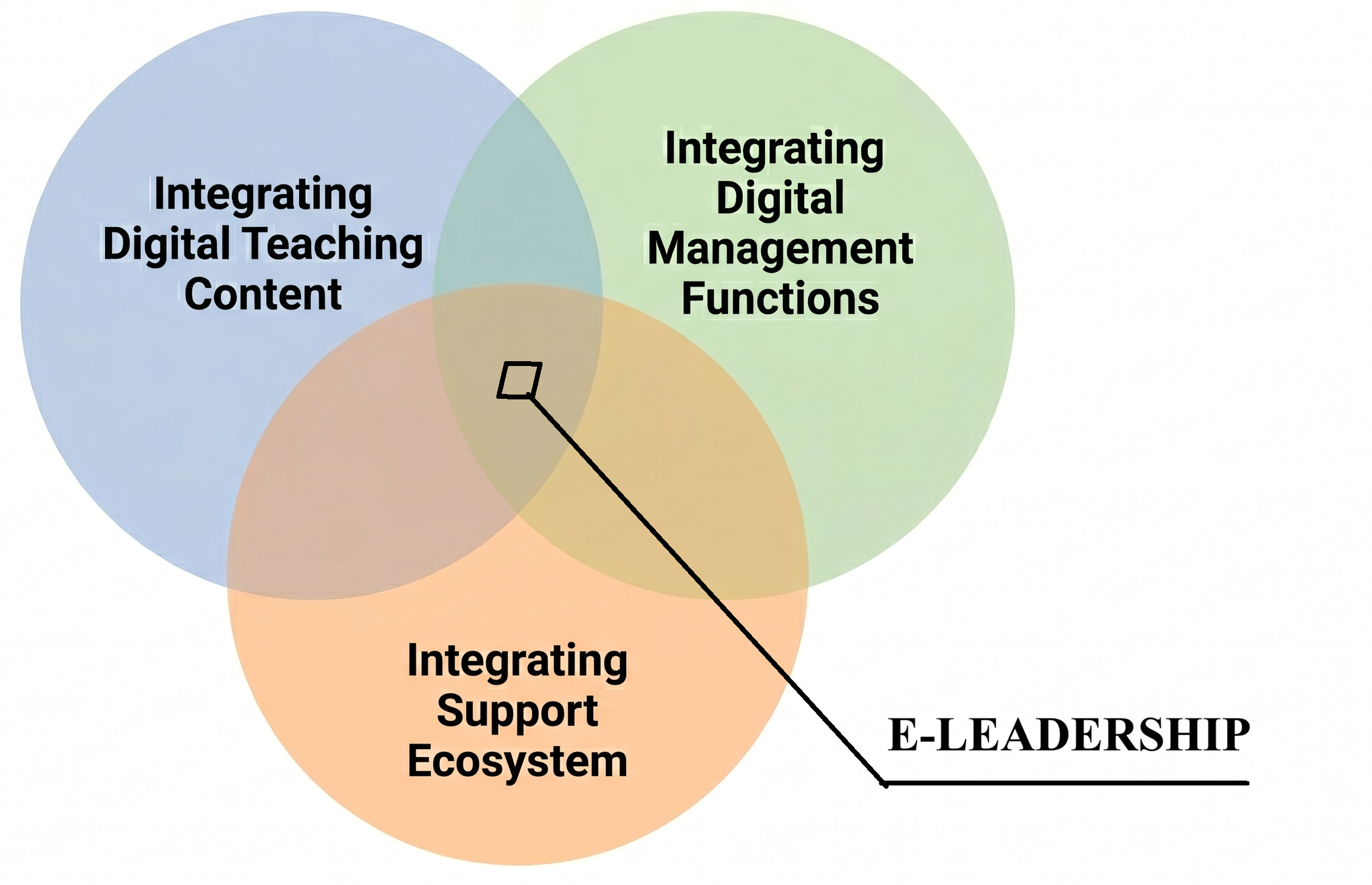
4.1. Pillar 1: Integrating the core contents of digital teaching
Digital transformation management must first stem from managing the shift in pedagogical models. According to Laurillard (2012), digital technology requires educators to redesign learning activities, shifting from one-way transmission to multi-dimensional interaction. Therefore, the first pillar requires managers to direct the successful integration of the following core contents:
Transforming teaching methods and models: Managing the shift from traditional teaching to advanced models such as Blended Learning, Flipped Classroom, and Project-Based Learning. This requires technology to be applied at the "Modification" and "Redefinition" levels according to Puentedura's SAMR model (2012), creating entirely new learning spaces.
Developing and managing the digital learning resource ecosystem: Organizing the development, storage, and exploitation of open educational resources (OER) and multimedia learning materials, helping to personalize the students' process of accessing knowledge (Bates, 2015).
4.2. Pillar 2: Integrating the 4 management functions from a digitalization perspective
If Pillar 1 is the "content", then Pillar 2 is the "operational method". Inheriting Fayol's (1949) classical management theory, this theoretical framework proposes digitizing the 4 core management functions of the Principal:
Digital Planning: Not merely the procurement of equipment, digital planning requires the Principal to build a strategic vision, digitize the planning process, and allocate resources based on data platforms (Benavides et al., 2020). Practice has proven that a plan, if solely focused on upgrading technology while neglecting the human factor, will lead to serious consequences. Affirming this, the study by Sancho-Gil et al. (2020) pointed out a notable reality: many digital transformation initiatives and plans in schools have fallen into "predictable failure" and caused a massive waste of budget resources. The core reason is that managers made the mistake of only focusing on procuring hardware and technological equipment while completely lacking a pedagogical vision as well as a cultural transformation strategy, leading to the purchased equipment not being exploited or only being used at a formalistic level.
Organizing: Includes establishing the technological infrastructure, especially a solid learning management system (LMS) software (Al-Fraihat et al., 2020), and organizing the development of digital competencies for the staff. This process can take the Digital Competence Framework for Educators DigCompEdu (Redecker, 2017) as a reference standard to foster teachers, helping them transition from a state of apprehension to proactively using technology.
Directing and leading change (Directing): This is the decisive stage. According to Fullan (2019), the principal must not only manage administratively but must become a leader of change. Directing includes establishing a digital culture, promulgating clear internal regulations, inspiring, and helping the teaching staff overcome their apprehension and psychological barriers.
Controlling and data-driven assessment (Controlling): Shifting from subjective, periodic assessments to a decision-making model based on learning data. The application of learning analytics allows managers and teachers to track progress and detect students' difficulties in real-time for timely intervention.
4.3. Pillar 3: Integrating conditions and impacting factors
According to Voogt et al. (2015), the effectiveness of applying information and communication technology never occurs independently in a vacuum. It depends entirely on the synchronization of an ecosystem of surrounding conditions. Therefore, the Principal's digital transformation management process must essentially involve interacting with and flexibly handling subjective and objective factors:
Integrating subjective factors: This involves managing the readiness of internal elements within the school. The Principal needs to continuously evaluate and foster the digital competencies of the School Management Board, the qualifications and receptive attitudes towards innovation of the teachers, as well as the self-study capacity of the students in the digital environment.
Integrating objective factors: The management process needs to make the most of the legal framework and digital transformation policies of the Vietnamese education sector (Pham, 2023), while simultaneously solving the problems of infrastructure, financial resources, and the companionship of parents as well as technology enterprises (García-Morales et al., 2021).
In particular, establishing this support ecosystem requires the Principal to face the biggest challenge regarding inequality in technology access to ensure fairness. Educational researchers such as Beaunoyer et al. (2020) have warned that the shift to a digital learning environment always comes with the risk of exacerbating educational inequality and widening the learning gap among student groups.
Clarifying this challenge from a managerial perspective, the study by Harris and Jones (2020) provided clear evidence: even within the same large urban community with developed telecommunications infrastructure, there always exists a profound inequality in the conditions for accessing hardware equipment and high-speed internet in each student's home. The authors concluded that this disparity poses a major leadership challenge. If the Principal only focuses on building a digital ecosystem based on the unrealistic assumption that all students have equal technological conditions, the school will unintentionally exacerbate educational inequality. Therefore, the implication of this pillar is that the School Management Board must have a management mindset oriented towards equity, establishing flexible support mechanisms such as: lending equipment, diversifying learning platforms from online to offline, and having specific intervention strategies for disadvantaged students, to ensure that no student is left behind when the school undergoes digital transformation.
In summary, this integrated theoretical framework shows that the management of digital transformation activities in teaching at high schools does not occur in a one-way manner, but is a continuous and flexible process. The close combination of pedagogical innovation (Pillar 1) and the functional governance capacity of the Principal (Pillar 2), placed within an equitable and synchronized support ecosystem (Pillar 3), is the key for digital transformation to proceed in a deep, substantive, and sustainable manner.
5. Discussion and managerial implications for high schools
5.1. Discussion on the value of the Integrated Theoretical Framework
The integrated theoretical framework proposed in this study has solved a major gap in the research landscape of digital education in Vietnam. As analyzed, previous studies have often tended to separate the technological platform from governance work, leading to the situation where high schools invest heavily in infrastructure but teachers' digital competencies remain limited, resulting in confusion and the use of technology merely at a basic, formalistic level (Vu, 2024; Tran, 2025).
Affirming the correctness and urgency of this systemic approach, a large-scale quantitative study by Sailer et al. (2021) provided specific empirical evidence. By surveying and applying structural equation modeling, the authors proved that: schools applying a synchronized integrated management model (closely combining the vision of the School Management Board, pedagogical support, and technological infrastructure) have a success rate of teachers applying technology many times higher than schools that only focus on distributing hardware equipment. The research team concluded that the presence of physical equipment accounts for only a very small part of the success, while the school's systemic governance and coordination mechanism is the strongest predictive variable for digital transformation to become substantive.
5.2. Managerial implications for Principals and School Management Boards
From the theoretical framework above, the study draws core managerial implications for Principals and management staff at high schools to successfully lead the digital transformation process:
First, shifting from "Administrative management" to "Leading change": The Principal cannot merely play the role of an approver of equipment procurement budgets. According to Fullan (2019), the principal must be a "leader of change". This implies that the School Management Board must be the one who directly creates the vision, inspires, and helps the teaching staff overcome their apprehension and psychological barriers, shifting from rigidly forcing the use of technology from the top down to "building a digital culture" that is voluntary and created from within.
Second, investing in parallel between "Hardware" (Infrastructure) and "Software" (Human capacity): Owning expensive learning management systems (LMS) will become meaningless if teachers do not know how to design pedagogy on that platform (Al-Fraihat et al., 2020). The managerial implication here is that the school needs to allocate resources to develop digital competencies for teachers based on standard frameworks such as DigCompEdu (Redecker, 2017). Managers need to create professional learning communities where teachers are safe to experiment with and share digital teaching methods without fear of strict evaluation in the early stages.
Third, building a synchronized digital education ecosystem: High schools need to avoid the situation of using fragmented software (each subject, each teacher using a different application). According to García-Morales et al. (2021), the School Management Board needs to direct the development of a unified digital ecosystem, including a shared LMS system, the school's open educational resources (OER) repository, and seamless data connection. This not only helps students avoid being overwhelmed by too many platforms but also helps the school easily control quality. Affirming the importance of this synchronization, the empirical study by Dong et al. (2020) warned of a serious consequence called overload and stress due to the use of technology. According to the authors, when the school lacks a unified ecosystem, lacks synchronized governance support, and leaves teachers to struggle with multiple fragmented applications, both teachers and learners fall into a state of overload, exhaustion, and a severe decline in motivation to apply technology. Therefore, the managerial implication here is that the School Management Board must play the role of the overall designer and director, planning the digital system into a unified platform (such as a Single Sign-On mechanism) to optimize the experience, minimize technical barriers, and protect the psychological well-being of the entire school community.
Fourth, shifting to data-driven decision making (Data-driven decision making): This is an important innovation in management. The School Management Board needs to utilize the learning analytics feature (Learning Analytics) from digital platforms to change the method of testing and assessment. Instead of evaluating teachers and students subjectively or through periodic exams, the principal needs to use real-time data (access duration, level of interaction, online assignment results) for timely and transparent pedagogical intervention.
In summary, the most significant managerial implication is the affirmation: Technology is merely a tool; humans are the decisive factor. The success of digital transformation activities at high schools depends largely on the systemic management mindset and the digital leadership capacity of the head of the school.
6. Conclusion
The digital transformation process in teaching at high schools is not merely the mechanical upgrading of network infrastructure or the procurement of hardware equipment. In essence, this is a systemic change process, requiring a comprehensive shift in pedagogical methods, organizational culture, and especially the management mindset.
Stemming from the identification of gaps in research and practice – when schools often fall into a state of fragmented technological investment, budget waste, and lack of direction, this article has proposed an integrated theoretical framework for management work. This theoretical framework is built upon the combination of 3 solid pillars: innovating digital teaching content and methods (Pillar 1), digitizing the 4 core management functions (Pillar 2), and building a synchronized, equitable support ecosystem (Pillar 3).
Through this model, the study affirms that technology plays the role of a supporting tool, while the "e-Leadership" capacity of the Principal is the decisive factor for success or failure. The synchronized application of this theoretical framework will provide School Management Boards with a comprehensive operational method. It helps the school avoid software fragmentation, prevent technology overload for both teachers and students, and solve the problem of disparity in technological conditions. From there, the digital transformation process can truly achieve depth, maximizing the efficiency of teaching and learning.
Although a solid theoretical foundation system has been proposed, this article still bears certain limitations of a theoretical foundation study. Therefore, the next research direction needs to focus on conducting empirical studies. Surveying, measuring, and evaluating the current management reality based on this theoretical framework at high schools in areas with different socio-economic conditions will help verify and perfect the model. At the same time, delving into researching and standardizing the set of evaluation criteria for the Principal's "digital leadership" capacity is also an urgent direction in the future.
References
- Al-Fraihat, D., Joy, M., Masa'deh, R. E., & Sinclair, J. (2020). Evaluating E-learning systems success: An empirical study. Computers in human behavior, 102, 67-86. Google Scholar ↗
- Bates, T. (2015). Teaching in a Digital Age. Tony Bates Associates Ltd. Google Scholar ↗
- Beaunoyer, E., Dupéré, S., & Guitton, M. J. (2020). COVID-19 and digital inequalities: Reciprocal impacts and mitigation strategies. Computers in human behavior, 111, 106424. Google Scholar ↗
- Benavides, L. M. C., Tamayo Arias, J. A., Arango Serna, M. D., Branch Bedoya, J. W., & Burgos, D. (2020). Digital transformation in higher education institutions: A systematic literature review. Sensors, 20(11), 3291. Google Scholar ↗
- Blau, I., & Presser, O. (2013). e‐L eadership of school principals: Increasing school effectiveness by a school data management system. British Journal of Educational Technology, 44(6), 1000-1011. Google Scholar ↗
- Boelens, R., De Wever, B., & Voet, M. (2017). Four key challenges to the design of blended learning: A systematic literature review. Educational research review, 22, 1-18. Google Scholar ↗
- Dan, T. C. (2025). Applying digital technology in teaching at high schools: current reality and orientation. Journal of Science of Hanoi Open University, 490-490. Google Scholar ↗
- Dexter, S., & Richardson, J. W. (2020). What does technology integration research tell us about the leadership of technology?. Journal of Research on Technology in Education, 52(1), 17-36. Google Scholar ↗
- Dong, Y., Xu, C., Chai, C. S., & Zhai, X. (2020). Exploring the structural relationship among teachers’ technostress, technological pedagogical content knowledge (TPACK), computer self-efficacy and school support. The Asia-Pacific Education Researcher, 29(2), 147-157. Google Scholar ↗
- Fayol, H. (1949). General and Industrial Management. Pitman Publishing. Google Scholar ↗
- Fullan, M. (2019). Leading in a Culture of Change. Jossey-Bass. Google Scholar ↗
- García-Morales, V. J., Garrido-Moreno, A., & Martín-Rojas, R. (2021). The transformation of higher education after the COVID disruption: Emerging challenges in an online learning scenario. Frontiers in psychology, 12, 616059. Google Scholar ↗
- Gouëdard, P., Pont, B., & Viennet, R. (2020). Education responses to COVID-19: Implementing a way forward. OECD Education Working Papers, No. 224. Google Scholar ↗
- Harris, A., & Jones, M. (2020). COVID 19–school leadership in disruptive times. School leadership & management, 40(4), 243-247. Google Scholar ↗
- Hue, N. T. (2026). Digital Transformation in High School Teaching and Learning in Our Country: Current Reality and Solutions. Journal of Science of Hanoi Pedagogical University 2: Educational Sciences Special Issue, 1(05), 82-82. Google Scholar ↗
- Lan, T. V. T. T. (2024). Digital Transformation in Vietnam's Education: Current Reality and Solutions. Vietnam Integration Electronic Journal of Science, (339). Google Scholar ↗
- Laurillard, D. (2013). Teaching as a design science: Building pedagogical patterns for learning and technology. Routledge. Google Scholar ↗
- Le Anh Vinh, T. M. N. (2024). The Impact of Artificial Intelligence (AI) on the Global Education System and Vietnam's Education. Vietnam Journal of Educational Sciences, 20(5), 1-11. Google Scholar ↗
- Le Thai Hung, N. T. H. (2021). Trends in Testing and Assessing Learner Competencies on Technological Platforms. Vietnam Journal of Educational Sciences, 42, 1-6. Google Scholar ↗
- Nguyen, T. G. (2022). Proposing Several Measures to Develop "Digital Competencies" for the Teaching Staff in the Context of the Fourth Industrial Revolution. Journal of Education, 22(19), 25-28. Google Scholar ↗
- Nhung, P. T. T. (2025). The Current Reality of Applying Digital Technology in Teaching Literature at High Schools. Journal of Educational Psychology. Google Scholar ↗
- OECD. (2021). Digital Education Outlook: Pushing the Frontiers with AI, Blockchain and Robots. OECD Publishing. Google Scholar ↗
- Puentedura, R. R. (2012). SAMR Model: A Framework for Integrating Technology into Teaching. Google Scholar ↗
- Phong, T. C., Lan, N. T., Anh, C. T., Canh, T. X., Van, N. T. H., Thai, L. V., & Lan, Đ. Đ. (2019). Digital Transformation in Education. Vietnam Journal of Educational Sciences, 17(5), 1-10. Google Scholar ↗
- Quoc, N. B. (2024). The Relationship Between the Digital Competence Framework and Scientific Research Capacity and Career Orientation of High School Students. Vietnam Journal of Educational Sciences. Google Scholar ↗
- Redecker, C. (2017). European Framework for the Digital Competence of Educators: DigCompEdu. Publications Office of the European Union. Google Scholar ↗
- Sailer, M., Murböck, J., & Fischer, F. (2021). Digital learning in schools: What does it take beyond digital technology? Teaching and Teacher Education, 103, 103346. Google Scholar ↗
- Sancho-Gil, J. M., Rivera-Vargas, P., & Miño-Puigcercós, R. (2020). Moving beyond the predictable failure of Ed-Tech initiatives. Learning, Media and Technology, 45(1), 61-75. Google Scholar ↗
- Selwyn, N. (2016). Is technology good for education?. John Wiley & Sons. Google Scholar ↗
- Son, H. V., Khuong, N. V., Vu, G. T., & Tai, P. H. (2025). Innovating teacher training programs and educational methods in the context of digital transformation and the impact of artificial intelligence. Journal of Foreign Language Science, (84), 120-135. Google Scholar ↗
- Son, P. H. (2023). Legislation on Digital Transformation in the Education Sector in Vietnam Today. Journal of Science of Hong Bang International University, 153-162. Google Scholar ↗
- Toi, L. V. (2021). Digital Transformation in Management, Teaching, Learning, Testing and Assessment at High Schools. Vietnam Journal of Educational Sciences, 20-28. Google Scholar ↗
- UNESCO. (2022). Reimagining Our Futures Together: A New Social Contract for Education. UNESCO Publishing. Google Scholar ↗
- Van Anh, N., & Tam, N. V. (2023). Digital transformation: an inevitable trend for educational development. Journal of Science, Hanoi Metropolitan UniversiEd. Google Scholar ↗
- Vial, G. (2021). Understanding digital transformation: A review and a research agenda. Managing digital transformation, 13-66. Google Scholar ↗
- Voogt, J., et al. (2015). ICT in Education: Policy and Practice. International Encyclopedia of the Social & Behavioral Sciences. Google Scholar ↗
- World Journal of Advanced Research and Reviews. (2024). Strategies for Effective Digital Transformation in Education, Vol. 21. Google Scholar ↗