Abstract
The quality of public service is a real reflection of the psychological condition of the apparatus who serves the public every day. This study aims to analyze the job stress and job satisfaction on customer service quality (servqual) mediated by organizational commitment and employee performance in Banda Aceh city government offices, specifically the Human Resources Development (BKPSDM) and the Population and Civil Registration Office (Disdukcapil) Offices. A quantitative approach was used by involving 110 employees as respondents through a census method. Data were collected using questionnaire and analyzed using SEM-AMOS. The results proved that significantly stress negatively affects customer servqual, commitment, and performance. Conversely, satisfaction significantly increased commitment and performance, although its direct effect on customer service quality is shown to be insignificant. Commitment was proven to partially mediate the stress impact on customer servqual, while performance fully mediated the satisfaction impact on customer servqual. These findings confirm that the quality of public service cannot be separated from the psychological condition of the apparatus and the effectiveness of their daily performance.
Keywords
job stress job satisfaction customer service quality organizational commitment employee performance
Introduction
Organizations can no longer succeed by merely accumulating resources. In today's highly competitive environment, delivering excellent public service is essential for success. In particular, customer service quality (servqual) is an essential factor in establishing sustainable public satisfaction and trust in the provision of public services. Multiple studies have recently shown that internal employee variables such as job stress, job satisfaction, organizational commitment, and employee performance have a substantial impact on servqual. Consumer expectation of the quality and reliability of the service received, known as customer servqual gap (the difference between customers' expectations and their perceptions of how well their needs have been met by actual service delivery). On the other hand, employees under high work pressure experience a decrease in motivation and productivity, while those satisfied with their work tend to perform more productively and achieve service promises, resulting in stronger organizational commitment. For the present study, job satisfaction is defined as how much a person likes their job, and having their needs being met by the organization where they work acts as a buffer against risks related to work stress.
This phenomenon is clearly evident in several government agencies in Banda Aceh city, such as the Civil Service and Human Resources Development Office (BKPSDM), followed by the Population and Civil Registration Office (Disdukcapil). BKPSDM bears the strategic responsibility for the state civil apparatus (ASN) management effort, including the transfer and promotion of competency developments, service to the employees' hands, public complaints, indicating ways in services, and the lack of responsiveness of employees, which is actually a real challenge for consistency in quality of public services. Disdukcapil is a provider of administrative services with high demand, serving two ends that directly support fulfilling basic needs, such as recording electronic identity cards (e-KTP), issuing birth certificates, and other population documents. Structurally, BKPSDM has 59 employees, and Disdukcapil has 51 employees, which are divided into five work areas.
At a global scale, the pressing need to enhance the quality of public services has also captured broad attention. Combined results of a meta-analysis by (Muzaki et al., 2023) proved that teamwork mechanisms in service organizations added value to customer service quality. (Chauhan et al., 2023) found that service characteristics such as personalization and complexity also moderate the relationship between servqual and organizational performance. (Song et al., 2022) added that e-servqual is a key determinant of user satisfaction and loyalty, a reality that is increasingly relevant as digital transformation takes place in various Indonesian public institutions, including the Disdukcapil and the BKPSDM of Banda Aceh city. A pre-survey of 30 respondents representing employees of both institutions showed an average customer servqual of 4.52; job stress 4.69; satisfaction 4.54; commitment 4.44; and employee performance 4.43. Although employee conditions are generally positive, variations in values between indicators suggest that servqual is not yet evenly distributed, particularly in the dimensions of physical facilities, timeliness, and clarity of service information.
This study aims to analyze the job stress and satisfaction impact on customer servqual mediated by commitment and employee performance in Banda Aceh city government offices. In explaining the relationship between variables, this study is based on Job Demands–Resources Theory (JD-R Theory), which groups job elements into job demands in the form of demands that have the potential to cause work stress as a multi-structure risk factor (Hartono et al., 2022) and job resources that drive employee motivation and satisfaction. Organizational commitment refers to the strength of a person's identification and involvement with their organization as a whole (Fantahun et al., 2023), while employee performance is understood as a combination of abilities, efforts, and opportunities evaluated based on the results achieved over a certain period. This study offers novelty through the application of an integrative model that combines the five variables in the context of a regional public service agency, an approach that is still rarely used compared to similar studies in the private sector. Initial findings indicate that although employees face work pressures and more pragmatic commitments, high job satisfaction and employee performance act as a counterbalance in maintaining optimal public servqual.
Literature
2.1 Job Demands-Resources Theory as A Theoretical Basis
(Bakker, A. B., & Demerouti, 2007) developed the Job Demands-Resources Theory (JD-R Theory) as a conceptual framework explaining the relationship between job characteristics and employee well-being and performance through two main components: job demands and job resources. In this research, job stress represents job demands, while job satisfaction reflects employees' perceived job resources. An imbalance between the two determines employees' psychological well-being, which in turn influences commitment, employee performance, and customer servqual.
2.2 Customer Servqual
Servqual is perceptual, where customers evaluate services based on a comparison between expectations and actual experiences received. Rauch et al. define servqual as an organization's ability to meet or exceed customer expectations. (A. P. Parasuraman et al., 1988) introduced the servqual model with five main measurement dimensions: reliability, responsiveness, tangibility, empathy, and assurance. This model also identifies five gaps that affect servqual, ranging from the knowledge gap to the servqual gap. In the public sector, (Kim et al., 2024) emphasize that servqual includes accessibility, efficiency, responsiveness, and transparency. In this study, service quality will often be referred to as just servqual, to simplify the terminology.
2.3 Job Stress
(Wang et al., 2023) define job stress as a multi-structural risk factor consisting of various job stressors. (Yoeung et al., 2024) state that stress conditions arise when work demands exceed an individual's capacity to manage them. Measurement of job stress includes four main constructs: workload, role conflict, role ambiguity, and skill utilization, which are operationalized through indicators such as time pressure, task volume, unclear responsibilities, and exhaustion due to job demands. In studies on, job stress will often be referred to as just stress, to simplify the terminology.
2.4 Job Satisfaction
(Yoeung et al., 2024) define job satisfaction as an employee's emotional state and behavioral expression, formed from their assessment of their work and its values. Factors influencing job satisfaction include compensation, environmental conditions, interpersonal relationships, career development opportunities, job security, and the suitability of the job to personal interests. Measurement indicators include job attractiveness, satisfaction with the work environment, relationships with coworkers, job responsibilities, and relationships with their immediate superiors. In this study, job satisfaction will often be referred to as just satisfaction, to simplify the term.
2.5 Organizational Commitment
(Fantahun et al., 2023) describe organizational commitment as the strength of an individual's identification with and involvement in their organization as a whole. (Kim et al., 2024) divide this construct into three dimensions: affective (emotional attachment), continuance (rational consideration of costs and benefits), and normative (moral obligation). Satisfaction, motivation, leadership, and the work environment are factors that contribute to organizational commitment. In this study, organizational commitment will often be referred to as simply commitment, to simplify the term.
2.6 Employee Performance
Employee performance is the work results achieved by individuals in carrying out tasks according to organizational standards. (Yoeung et al., 2024) operationalize performance through four main indicators: work quantity, work quality, time utilization, and collaboration. (Partoip et al., 2025) add productivity and goal achievement as complementary indicators. (Diamantidis & Chatzoglou, 2019) emphasize that performance is influenced by internal factors such as motivation and commitment, as well as external factors such as leadership style and work environment. In this study, employee performance will often be referred to as just performance, to simplify the term.
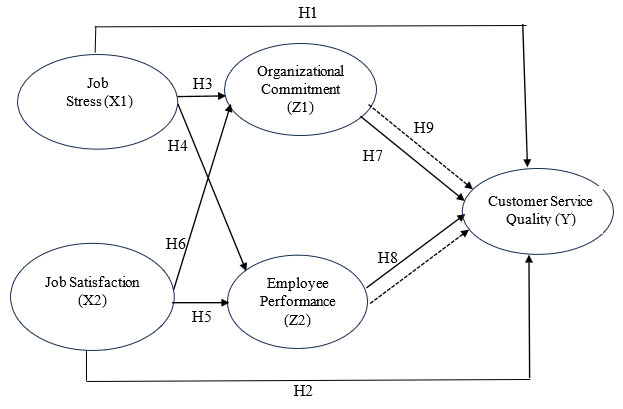
2.7 Hypothesis and Research Model
Based on several literatures, the following hypotheses were formulated:
H1 : significantly job stress affects customer servqual;
H2 : significantly satisfaction affects customer servqual;
H3 : significantly job stress affects commitment;
H4 : significantly job stress affects performance;
H5 : significantly satisfaction affects commitment;
H6 : significantly job stress affects performance;
H7 : significantly commitment affects customer servqual;
H8 : significantly performance affects customer servqual;
H9 : significantly commitment mediates the job stress effect on customer servqual;
H10 : significantly performance mediates the satisfaction effect on customer servqual
Method
This research was conducted at the Banda Aceh city government office. The variables studied included job stress (X1) and satisfaction (X2) as independent variables, customer servqual (Z) as the dependent variable, and commitment and employee performance as mediating variables (Y). The population was all employees of the BKPSDM and the Disdukcapil of Banda Aceh city, totaling 110 people. The sampling technique used the census method, in which all members of the population were made respondents. This approach was chosen because the population size was relatively small, so that all elements could be fully reached, and the average value of the sample was identical to the population average (Sekaran & Bougie, 2019). Data were collected through a questionnaire distributed online using Google Forms. Primary data was obtained directly from respondents through the questionnaire, while secondary data was supporting data obtained from other parties. The measurement instrument uses a Likert scale (Sekaran & Bougie, 2019). The operationalization of the variables in this study is presented briefly as follows.
| Variables | Key Indicators | Scale |
|---|---|---|
| Customer Servqual (Z) | Tangibles, Reliability, Responsiveness, Assurance, Empathy (A. Parasuraman et al., 1988) | Intervals 1–5 |
| Job Stress (X1) | Workload, Role Conflict, Role Ambiguity, Utilization of Skills (Wang et al., 2023) | Intervals 1–5 |
| Satisfaction (X2) | Vision-mission, work facilities, social relations, team spirit (Gumasing & Ilo, 2023) | Intervals 1–5 |
| Commitment (Y1) | Affective, Continuance, Normative Commitment (Fantahun et al., 2023) | Intervals 1–5 |
| Performance (Y2) | Quantity, quality, time utilization, cooperation (Yoeung et al., 2024) | Intervals 1–5 |
Validity testing was conducted to ensure each indicator was able to measure the intended construct (Sugiyono, 2019). Reliability testing was conducted to ensure the consistency of the measuring instrument throughout the data collection period (Hair et al., 2019). Descriptive analysis was used to describe the distribution of respondents' answers in the form of frequency tables and percentages. Hypothesis testing was conducted using Structural Equation Modeling (SEM) using AMOS software (Ghozali, 2021).
Result And Discussion
4.1 Result
4.2.1 Respondent Characteristics
This study involved 110 employees at the BKPSDM and the Disdukcapil of Banda Aceh city using a census technique. Based on Table 2, the respondents were predominantly female (59.1%), aged 40.9% and over 35 years, with a bachelor's degree (76.4%), with an income above Rp5,000,000 (46.4%), and with a work experience of 6–10 years (50.9%).
| Description | Frequency | Percentage |
| Man | 45 | 40.9% |
| Woman | 65 | 59.1% |
| Age >35 years | 45 | 40.9% |
| Bachelor's Degree Education | 84 | 76.4% |
| Income >Rp5,000,000 | 51 | 46.4% |
| Work Period 6–10 Years | 56 | 50.9% |
4.1.2 Instrument Test
All indicators were declared valid because the correlation coefficient value exceeded the critical value of 0.187 (N=110). Reliability testing using Cronbach's Alpha showed all variables were reliable with values above 0.60. The job stress variable obtained an alpha of 0.978, satisfaction 0.979, commitment 0.954, performance 0.908, and customer servqual 0.967. These results confirm that the research instrument meets the eligibility requirements for further analysis.
-
Descriptive Analysis
Respondents’ perceptions of job stress showed an overall average of 4.14 (good category), indicating that employees do not experience excessive work pressure. The satisfaction variable obtained an average of 4.35 (very good), reflecting employee satisfaction with the organization’s vision, workload, and relationships between colleagues. Commitment averaged 4.24 (very good), performance averaged 4.23 (very good), and customer servqual averaged 4.15 (good), indicating that the quality of public service has been perceived positively by respondents from the aspects of tangibles, reliability, responsiveness, assurance, and empathy.
4.1.4 Confirmatory Factor Analysis (CFA)
The measurement model was tested using Confirmatory Factor Analysis (CFA). In the initial test, five indicators had loading factor values below 0.5, namely OC10, CSQ17, CSQ18, CSQ20, and CSQ21, so they were eliminated. After elimination, all indicators met the convergent validity requirements with loading factors > 0.5 (Hair et al., 2017). The initial goodness of fit (GoF) evaluation showed inadequate results (poor marginal). After respecification based on Modification Indices (MI), the final model met all eligibility criteria as presented in Table 3.
| GoF | Cut-off | Results | Evaluation |
| Chi-Square | < 1914,141 | 1746,015 | Good |
| RMSEA | ≤ 0.08 | 0.061 | Good |
| GFI | ≥ 0.90 | 0.959 | Good |
| AGFI | ≥ 0.90 | 0.902 | Good |
| CMIN/DF | ≤ 2.00 | 1,335 | Good |
| TLI | ≥ 0.90 | 0.918 | Good |
| CFI | ≥ 0.90 | 0.932 | Good |
4.1.5 SEM Hypothesis Testing Results
Hypothesis testing was conducted using SEM-AMOS based on the Critical Ratio (CR). Complete results are presented in Table 4.
| Influence | Estimate | Sig. | Information |
| Job Stress → Servqual | -0.288 | 0,000 | Accept H1 |
| Satisfaction → Servqual | 0.138 | 0.100 | Reject H2 |
| Job Stress → Commitment | -0.321 | 0,000 | Accept H3 |
| Job Stress → Performance | -0.337 | 0,000 | Accept H4 |
| Satisfaction → Commitment | 0.534 | 0,000 | Accept H5 |
| Satisfaction → Performance | 0.423 | 0,000 | Accept H6 |
| Commitment → Servqual | 0.262 | 0.011 | Accept H7 |
| Performance → Servqual | 0.368 | 0,000 | Accept H8 |
| Job Stress → Servqual via Commitment | -0.084 | 0.006 | Accept (Partial) H9 |
| Satisfaction → Servqual via Performance | 0.110 | 0.001 | Accept (Full) H10 |
4.2 Discussion
4.2.1 Job Stress on Customer Servqual
The research findings demonstrate that significantly job stress negatively affects customer servqual (estimate = -0.288; p < 0.001), thus H1 is accepted. Work pressure stemming from excessive workloads, complex bureaucratic procedures, and limited service time impacts employee emotional stability and cognitive capacity. This condition results in reduced friendliness, empathy, and responsiveness of officials in serving the public. These align with the findings of (Liestyanti & Prawiraatmadja, 2021), who demonstrated that job stress negatively impacts customer servqual, both directly and through weakened commitment. (Liu et al., 2025) also emphasized that work pressure unbalanced by managerial support worsens service interactions between officials and the public. Therefore, managing job stress is a strategic prerequisite for sustainably improving the quality of public services.
4.2.2 Satisfaction on Customer Servqual
In contrast to the proposed hypothesis, the analysis results show that satisfaction does not significantly affect customer servqual (estimate = 0.138; p = 0.100), thus H2 is rejected. Although the direction of the relationship is positive, the effect is not statistically strong enough. This condition can be explained by the character of public organizations that rely on standardized procedures and bureaucratic regulations, so that servqual is more determined by the implementation of tasks according to operational standards than solely the psychological condition of the individual. (Kim et al., 2024) stated something similar, that satisfaction can only influence customer servqual indirectly through commitment and performance. (Fantahun et al., 2023) also emphasized that the clarity of work processes and the performance of the apparatus are more dominant in shaping the perception of public servqual. Satisfaction acts as an enabling factor, not a direct determinant of customer servqual.
4.2.3 Job Stress on Commitment
Significantly and negatively, job stress affects commitment (estimate = -0.321; p < 0.001), proving H3 was accepted. Continuous pressure at the workplace leads to emotional exhaustion and undermines trust towards the institution, so that it would significantly erode affective and normative commitment. (Liu et al., 2025) confirmed loss of psychological attachment to the organization in employees with high work stress. (Chauhan et al., 2023) noted that commitment considerably declines with mismanagement of job stress. This suggests that the stability of employee commitment in the public service sector depends on effective work stress management.
4.2.4 Job Stress on Performance
Significantly and positively job stress affects performance (estimate = -0.337; p < 0.001), thus H4 is accepted. Excessive workload and time pressure disrupt concentration, reduce work effectiveness, and increase the potential for administrative errors. (Kim et al., 2024) explain that unmanaged stress disrupts employee cognitive function and behavior. (Kim et al., 2024) consistently found that job stress decreases employee performance and subsequently impacts servqual. This finding emphasizes the importance of proportional workload distribution in government environments.
4.2.5 Satisfaction on Commitment
Significantly and positively, satisfaction affects commitment (estimate = 0.534; p < 0.001), thus H5 is accepted. Those employees who enjoy the job, work atmosphere, and relationships with colleagues tend to feel a sense of belonging to their organization, which motivates them to give their best to its growth. (Fantahun et al., 2023) provided support to the fact that satisfaction is one of the main predictors of commitment in the public sector. This is corroborated by (Gumasing & Ilo, 2023), who confirmed that satisfaction is among the most influential factors of commitment. Findings highlight that it is a good practice to strengthen satisfaction in a bid to retain employee.
4.2.6 Satisfaction on Performance
Significantly and positively, satisfaction affects performance (estimate = 0.423; p < 0.001), thus H6 is accepted. As per Herzberg's Two-Factor Theory, satisfaction is a result of distinctive factors like achievement and recognition that create continued performance development. (Yoeung et al., 2024) and (Fantahun et al., 2023). Satisfaction with clear and transparent communication and feedback remained a positive contributing factor to employee performance throughout the entire span of the research. This emphasizes the point that satisfaction is an internal motivator for civil servants to perform their jobs more efficiently and responsibly.
4.2.7 Commitment on Customer Servqual
Significantly and positively, commitment affects customer servqual (estimate = 0.262; p = 0.011), thus H7 is accepted. Employees with high performance work behaviors and citizenship behaviors approach their obligations more informally, expressing concern, responsiveness, and a commitment to serving the public. (Kim et al., 2024) confirmed that commitment accentuates the relationship between public servant work behavior and perceived public servqual. Commitment is a key factor in efforts to continuously improve servqual.
4.2.8 Performance on Customer Servqual
Significantly and positively, performance affects customer servqual (estimate = 0.368; p < 0.001), thus H8 is accepted. High-performing civil servants are able to provide fast, accurate, and professional services, which are directly felt by the public. (Kim et al., 2024) emphasized that employee performance is the main path in shaping customer servqual. This finding emphasizes that improving the quality of public services cannot be separated from systematic efforts to improve civil servant performance.
4.2.9 Mediating Role of Commitment and Performance
The Sobel test shows that commitment partially mediates the job stress effect on customer servqual (coefficient = -0.084; p = 0.006), meaning that the direct effect of job stress remains significant despite being mediated (accept H9). Conversely, performance fully mediates the satisfaction effect on customer servqual (coefficient = 0.110; p = 0.001), considering that the direct effect of satisfaction is insignificant (reject H10). (Kim et al., 2024) confirmed that employee performance is the main mediating mechanism that bridges the psychological condition of employees with the quality of service perceived by the public. In the context of public organizations in Banda Aceh city, increasing satisfaction needs to be accompanied by effective performance management so that the benefits can be felt tangibly by service users.
Conclusion
The results reveal job stress affects customer servqual, commitment, and employee performance at the Banda Aceh city government office. Conversely, satisfaction is proven to be able to significantly increase commitment and employee performance, although its direct effect on customer servqual is not statistically significant. Commitment partially mediates the job stress impact on customer servqual, while employee performance fully mediates the satisfaction impact on customer servqual. These findings confirm that the quality of public service is largely determined by the psychological condition of the apparatus and how effectively they work in their daily lives. This finding can strengthen academic references regarding the evidence of causality found in the studied model.
Several practical recommendations are provided from the findings. The Banda Aceh city government, particularly the BKPSDM and the Disdukcapil, needs to take concrete steps to manage employee workload pressure through fairer workload distribution and structured managerial support. Improving job satisfaction should also be a priority, for example through career development, recognition for achievement, and continuous improvement of the work environment. Given that employee performance has been proven to be a key mediating pathway to good customer servqual, organizations need to design a transparent performance evaluation system oriented toward service improvement. Future research is recommended to expand the scope of agencies and consider additional contextual variables such as leadership style or organizational culture.
References
- Bakker, A. B., & Demerouti, E. (2007). The job demands-resources model: State of the art. Journal of Managerial Psychology, 22(3), 309–328. DOI ↗ Google Scholar ↗
- Chauhan, R. S., Howe, D. C., & Nachmias, S. (2023). Organizational commitment: an ever-shifting concept forever changed by COVID-19. Human Resource Development International, 26(2), 232–239. DOI ↗ Google Scholar ↗
- Diamantidis, A. D., & Chatzoglou, P. (2019). Factors affecting employee performance: an empirical approach. International Journal of Productivity and Performance Management, 68(1), 171–193. DOI ↗ Google Scholar ↗
- Fantahun, B., Dellie, E., Worku, N., & Debie, A. (2023). Organizational commitment and associated factors among health professionals working in public hospitals of southwestern Oromia, Ethiopia. BMC Health Services Research, 23(1), 1–9. DOI ↗ Google Scholar ↗
- Ghozali, I. (2021). Aplikasi analisis multivariate dengan program IBM SPSS 26 (10th ed.). Badan Penerbit Universitas Diponegoro. DOI ↗ Google Scholar ↗
- Gumasing, M. J. J., & Ilo, C. K. K. (2023). The Impact of Job Satisfaction on Creating a Sustainable Workplace: An Empirical Analysis of Organizational Commitment and Lifestyle Behavior. Sustainability (Switzerland), 15(13). DOI ↗ Google Scholar ↗
- Hair, J. F., Risher, J. J., Sarstedt, M., & Ringle, C. M. (2019). When to use and how to report the results of PLS-SEM. European Business Review, 31(1), 2–24. DOI ↗ Google Scholar ↗
- Hartono, R., Moeryati, & Purwanto, A. (2022). The Influence of Organizational Support and Commitment on User Satisfaction with the Role of Service Quality as an Intervening Variable. Widyagama National Conference on Economics and Business (WNCEB), 3(1), 1508–1522. DOI ↗ Google Scholar ↗
- Kim, L., Maijan, P., & Yeo, S. F. (2024). Developing customer service quality: Influences of job stress and management process alignment in banking industry. Sustainable Futures, 8, 100311. DOI ↗ Google Scholar ↗
- Liestyanti, A., & Prawiraatmadja, W. (2021). Service Quality in The Public Service: A Combination of SERVQUAL and Importance-Performance Analysis. Journal of International Conference Proceedings, 4(3), 320–331. DOI ↗ Google Scholar ↗
- Liu, Y., Yang, H., Wu, X., & Ma, H. (2025). Am I satisfied with the organization? The moderating effects of organizational career management, altruism and job stress on juvenile criminal justice social workers’ job satisfaction. Acta Psychologica, 261, 105867. DOI ↗ Google Scholar ↗
- Muzaki, F. I., Sari, W. U., Putri, I. K., Arianto, R. S., & Putra, R. S. (2023). Factors Affecting Performance Employees: Motivation, Leadership, Environment Work, Organizational Culture, and Achievement Work. GREENOMIKA, 5(1), 52–60. DOI ↗ Google Scholar ↗
- Parasuraman, A. P., Zeithaml, V. A., & Berry, L. L. (1988). SERVQUAL: A multiple- Item Scale for measuring consumer perceptions of service quality. Journal of Retailing, 64(1 Spring), 12–40. DOI ↗ Google Scholar ↗
- Parasuraman, A., Zeithaml, V. A., & Berry, L. (1988). SERVQUAL: A multiple-item scale for measuring consumer perceptions of service quality. 1988, 64(1), 12–40. DOI ↗ Google Scholar ↗
- Partoip, S. K., Kamaara, M., & Ombui, K. (2025). The Role of Performance Measurement in Enhancing Employee Performance: Evidence from Kenyan State Corporations. European Journal of Business and Management Research, 10(2), 143–150. DOI ↗ Google Scholar ↗
- Sekaran, U., & Bougie, R. (2019). Research Methods For Business A Skill Building Approach (7th Ed.). John Wiley & Sons. DOI ↗ Google Scholar ↗
- Song, Y. K., Choi, B., Oh, J. M., Kwak, A., & Kim, K. (2022). Employee Perspectives on Onsite Health Clinics in Semiconductor Company in South Korea. International Journal of Environmental Research and Public Health, 19(3), 1433. DOI ↗ Google Scholar ↗
- Sugiyono. (2019). Metodologi Penelitian Untuk Bisnis. Salemba Empat. DOI ↗ Google Scholar ↗
- Wang, R., Yu, X., Chen, H., Hu, F., Xu, C., Liu, Y., Liu, S., Jin, L., Li, M., & Cai, Y. (2023). How Job Stress and Psychological Adaptation Predicting Interpersonal Needs Among Female Migrant Manufacturing Workers in China: A Structural Equation Model. Safety and Health at Work, 14(2), 222–228. DOI ↗ Google Scholar ↗
- Yoeung, S., Ung, P., Lay Loun, S. S., & Vang, R. (2024). Influencing Dimensions of Organizational Commitment on Job Satisfaction and Employee Performance: Evidence from the Five-Star Hotel. European Journal of Business and Management, 16(9), 64–76. DOI ↗ Google Scholar ↗