Abstract
Work-related Musculoskeletal Disorders (WMSDs) is one of the main causes of disability, which is considered a significant world-wide public health problem that requires in-service health care. With specific reference to Sewing Machine Operators (SMOs), an occupational group that have been reported to have high prevalence of WMSDs, several relevant human factors pertaining to the SMOs in formal work-systems have been addressed. However, the SMOs in the informal work-systems seem neglected in occupational health research. This therefore necessitates a better understanding of their occupational hazards alongside the control measures because it has the potential for positive impact on the SMOs' quality of life and their productivity. Consequently, this study is focused on understanding the work systems and the nature of the job of SMOs in low-income systems. Sequel to the questionnaire responses from about 100 Custom Tailors (CTs), an observational study was carried out on a sample of 10 CTs’ work-systems. The detailed work study involved video recording and analysis of the different motions involved in informal work-system garment production. Special attention was paid to the work-layout, tools, tailoring tasks as well as the work method. The CTs’ still pictures were taken alongside their hand pictures based on the pain complaint cum evidence on the hand during questionnaire administration. Further on, one adroit CT amongst these 10 was chosen to produce a UK size 10 skirt suit for detailed video and still picture recording Using Ovako Working-posture Analysis System (OWAS), the recorded movies were analysed to draw the organogram of the work-system and determine the level of contribution of each work-posture to the CTs’ discomfort. Reported self-assessment showed that an average CT works for 72 hours a week without annual vacation. The OWAS classified the observed postures into those requiring ‘no corrective action’ (Category-1), ‘near future corrective action’ (Category-2) and ‘as soon as possible corrective action’ (Category-3). Poor physical workplace and equipment design, awkward postures, inadequate breaks as well as incongruent work methods are some of the musculoskeletal risk factors found in this study. The findings of this study add to the understanding of the working conditions of SMOs in informal work-systems. The SMOs in the informal garment work-systems are highly susceptible to WMSDs and therefore require ergonomic interventions to improve their work-systems.
Keywords
Informal work-system Garment production Sewing machine operators Custom tailors Work-related musculoskeletal disorders
Introduction
Work-related Musculoskeletal Disorders (WMSDs) are a significant world-wide public health problem that are considered one of the main causes of disability, absenteeism and requests for in-service health care (Punnett & Herbert 2000, Sluiter et al. 2001, Nabi et al., 2021, Chen et al., 2025, Rahman et al., 2025, Trujillo-Guerrero et al., 2025, Wang et al., 2025, Gerditschke et al., 2026, Ito and Kokubun, 2026, Zahra et al, 2026). The financial costs to society do not only comprise the ones for healthcare, sick leave, workers’ compensation and pensions, but also the ultimate costs for training of a new work force and replacement of vacant ones. In the United States of America (USA), WMSDs affect an estimated 19 million individuals per year, and are responsible for more than one third of lost workday cases, and account for the majority of workers’ compensation costs (Bernard 1997; U.S. Department of Labour, 2003). Essentially, WMSDs cost employers more than $15 billion annually, and up to $54 billion a year if other related expenses are added (U.S. Department of Labour, 1999). In France, as much as 1.3 billion Euros was the cost of low back pain in 1990 (INSERM 2000). Therefore, prevention of WMSDs from the source is the key rather than medical treatment that is not cost effective (Sarder et al., 2006). This can only be successfully done when the causes of the disorders are well understood.
With specific reference to Sewing Machine Operators (SMOs), an occupational group that have been reported to have high prevalence of WMSDs, several relevant human factors pertaining to the SMOs in industrial systems have been addressed (Vihma et. al. 1982, Schibye, et. al. 1995, Herbert, et. al., 2001, Wang, et. al. 2007, Ozturk & Esin 2011, Deyyas & Tafese 2014, Dianat, et. al., 2015). Interestingly, these studies from various countries like USA, Turkey, Ethiopia and Iran among others, cover topics like components of physical workload (Vezina 1992); work-organization and personal factors; Musculoskeletal Disorders (MSDs) amongst SMOs (Vihma et. al, 1982, Blader et.al. 1991, Anderson et.al. 1993, schibye et. al. 1995, Kaergaard & Andersen, 2000, Ozturk & Esin 2011, Dianat et al. 2015); work hour as a risk factor (Wersted, 1991); review of disorders, risk factors and preventive measures (Muggleton et. al., 1999); ageing, work hours and work ability (Costa & Sartori, 2007); speed control of sewing machines (Singleton 1960, Curry & Leamon 1993); joint labour ergonomic interventional programs for SMOs (Herbert, et. al. 2001); participatory ergonomics program (Halpern & Dawson 1997); work-station adjustment, posture and SMO’s perception (Delleman & Dull 2002); SMOs’ workplace evaluation (Sarder et. al. 2006), and prevention of MSDs in garment workers (Chan et. al., 2002). Notably, these studies were carried out on formal work systems of garment production.
However, in the Developing Countries (DCs), SMO jobs are mostly Small and Medium Enterprises (SMEs) and one report shows that SMEs in these countries are a major and evidently neglected sector in occupational health research (McCann, 1996). Meanwhile, the occupational health and safety programs in the DCs have mainly focused on large-scale industries. This necessitates a better understanding of the occupational hazards and their control measures in the DCs because it has the potential for positive impact on national productivity and workers' quality of life (Dianat et al., 2015). Artisanal custom tailoring is, as a rule, a sole proprietary business in most DCs. The SMOs in the developing countries do not operate in formal industrial complexes, but, rather in the informal systems. These SMOs in addition, do not operate the division of labour in their garment manufacturing tasks; but each SMO carries out every task involved in garment production from fabric/anthropometric measurements and the like down to final product packaging. They do not mass produce garments either, but their production is bespoke, being specific to the anthropometric dimensions of each client and are therefore regarded as Custom Tailors (CTs) since their production is customized for every client. Sequel to the foregoing on research reports garnered from the literature, there appears to be such a big gap in the understanding of the ergonomic issues of these unrepresented CTs as an indispensable group of workers. Therefore, this study is focused on understanding the work systems and the nature of the job of SMOs in low-income systems. Assessment of the contribution of work-organizational factors to the prevalence of self-reported neck–shoulder and distal upper extremity pain in CTs was done.
Informal work system CTs versus SMOs
The number of workers (labourers) in low and middle-Income Countries (LMIC) engaged in informal work is huge, representing a significant proportion of the workforce. Yet there is insufficient information about their work-systems regarding relevant human factors, as well as injuries and their associated risks (Duric, et. al., 2018). The informal works in these industrially developing countries, could be in goods or service production such as laundry services, shoe making, hair dressing, cloth weaving, welding and garment production among others. In the informal work-systems of CTs, garment making is not mass produced but, rather, customised for reasons ranging from lack of standardised indigenous anthropometric data to the lack of basic uninterrupted electric power supply to effectively run their different machines. Nevertheless, these same CTs meet the clothing needs of some 70% of Nigeria’s more than 200million people. Although some of them belong to some amorphous, uncensored trade unions, the rest, the majority really, are not known to belong in any workers’ association(s). For those who do belong in some artisanal professional associations, these trade unions operate independently in different communities with no corporate administration, and this makes gathering information about the relevant human factors in their work-systems a herculean task. This, indeed, might be something deserving of another scientific inquiry on its own. In the meantime, some of the identified Nigerian trade unions include Nigerian Union of Tailors (NUT), Fashion Designers Association of Nigeria (FADAN), Tailoring Association of Nigeria, Association of Tailors and Fashion Designers (ATFAD), Nigeria Society of Professional Tailors, Lagos State Tailors and Fashion Designers Association of Nigeria (LASTFADAN), Kaduna State Tailors Union and National Union of Textile Garment and Tailoring Workers of Nigeria (NUTGTWN). Although these associations purport maintenance of professional standards, and among a few other gregarious roles sometimes contribute money for members’ healthcare, it does not appear that they place much premium on the optimization of their members’ work-systems. (Andrea and Beckman, 2013).
Nigeria ranks high globally among countries importing textiles and clothing (wits.worldbank.org), which end up with CTs as materials for new products (outfits or household items) or adjustments. The CTs in low-income work systems are not into mass production, they produce for final markets rather than being a part of a production and distribution chain (Andrea & Beckman, 2011). Customers normally take their own fabric of choice to these SMOs who will take the customers’ anthropometric data, cut the fabric to pieces without templates, sew the pieces together to get the desired outfit, iron the outfit and deliver to customers. These SMOs in the low-income systems multitask while those in the industrialised countries have specialised operations. The CTs are minimum-wage, unrepresented set of workers that operate in an informal work system where there is neither Workplace Safety and Insurance Board (WSIB) nor Bureau of Labor Statistics. The CTs differ greatly from factory SMOs because they are not governed by labour laws but each CT sets up a suitable informal work system, works at his/her own pace and determines his/her service price. This informal work-system tailoring requires a sewing machine operator to carry out every task involved in outfit production, that is, taking clients’ anthropometry, fabric measurement and cutting, sewing, ironing, packaging and delivery to client. Since CTs, with only a few exceptions, have no savings, gratuity or pension, they are constrained to work as much as the maximum hours that their respective body systems would allow. Thus, they work far into old age, as a rule, until they die or switch occupation.
Methodology
Sequel to the questionnaire responses from about 100 Custom Tailors (CTs), a convenient, purposive sample of 10 CTs with a minimum of 10-year work experience post-apprenticeship each were selected for this observational study. This eligibility criterion was to ensure a reasonable level of experience and perfect knowledge of all the procedures involved in outfit making. A detailed work study, video recording and analysis of purposely samples of 10 individuals drawn from these were done. A Camcorder was used to capture the different motions involved in the tailoring tasks on videotape during video recording of each participant at work. Attention was paid to the work-layout, tools, tailoring tasks as well as the work method. The CTs’ still pictures were taken alongside their hand pictures based on the pain complaint cum evidence on the hand during questionnaire administration. Much care was taken during video recording not to interfere with the CT’s job and each move from one task area to another was carefully monitored. In some cases, lack of clearance in some workshop layout called for adjustment of the camcorder, thereby truncating continuity briefly. Monitored recordings of work activity permitted observations of different postures and movement of the relevant body parts. The recorded movies were later analysed with the Ovako Working Posture Analysis (OWAS) software. Subsequent to the analysis of the motion picture recorded, categorisation of the tailors’ various tasks was done. Further on, one comparatively adroit CT amongst these 10 was chosen to produce a UK size 10 skirt suit from “lycra” fabric for detailed video recording (as well as still pictures) which lasted 8 hours. Then, still and motion picture recording were carefully taken. These were later analysed for different task duration and the various postures involved in the garment production process. The CTs’ tools- and equipment-usage were studied in the video analysis as well as the different tasks involved in garment production. The latter was then used to draw the CTs’ garment production organogram.
Results And Discussion
3.1 Results
CT’s work system, tasks and learning method
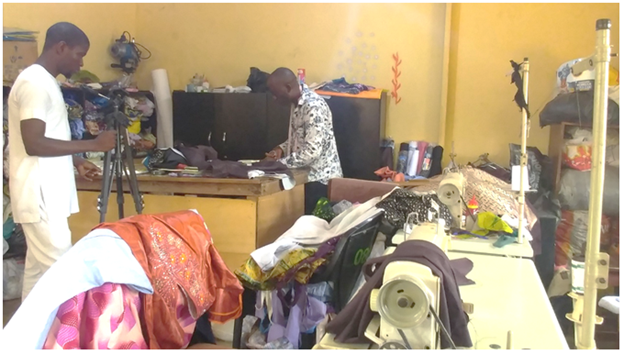
The observational study showed that, the CTs’ work systems consist of some bare essential parts, crudely designated working stations for fabric cutting, ironing, sewing and storage. The cutting station has a plain wooden table; the ironing station has a wooden table with folded fabrics to cover the top; the sewing station consists of a sewing table with built-in sewing machine that is to be manually pedaled or electrically driven while sitting on a non-adjustable wooden stool or chair (plastic, wooden or household). In some cases, the cutting table also serves as the ironing table. The storage section contained any sac on the floor for waste fabric pieces, wooden hanger on the wall or wooden cabinet for clients’ fabric and finished outfits. Whatever the arrangement was, each CT’s workshop was littered with uncut and in-process fabrics pieces. Fabrics are draped over chairs, sewing machines, stored in sacks, leaned against the walls or piled on wooden cabinets. Work-flow and material organisations were visibly missing. The CTs’ tools are mostly wooden stool, cutting table, ironing machine, right-handed manual scissors (left-handed apprentices learnt to cut with the right hand, as a rule), graded measuring tape, Interlocking and sewing machines. Bandsaw and other electrically or pneumatically operated fabric cutting tools are prominent in advanced countries but are luxuries in developing countries where electric power is not readily available. Moreover, there is dearth of standardised indigenous anthropometric data for mass production of garments that requires the use of templates and bandsaw. The CTs’ tasks include measurement and recording of clients’ anthropometry, fabric measurement and chalk marking of fabric, fabric cutting to desired pieces, sewing of fabric pieces to desired outfit, stay/ linen attachment, interlocking, hemming, accessories attachment (button/zip), finishing touches, ironing and packaging, and lastly, delivery to clients. The CTs sometimes get involved in fabric purchasing for clients.
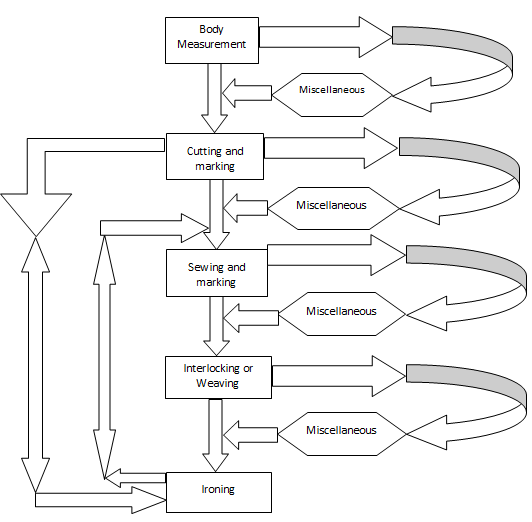
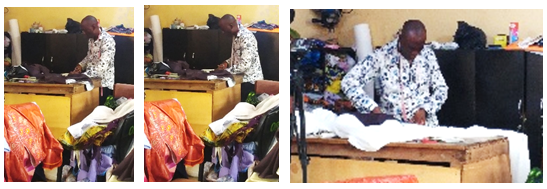
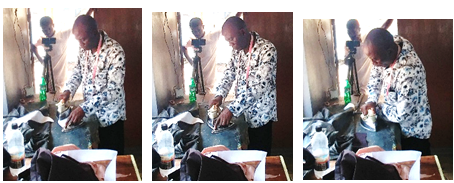
It was observed that custom tailoring is not capital intensive, requires low levels of formal training and learning is by apprenticeship in agreement with the findings of Andrea and Beckman (2013). Response analysis of questionnaire showed that this on–the-job training could last between three and seven years before freedom (graduation), after which the apprentice can now start his/her own business and train others. Most tasks are manually done, and these require the use of manual scissors at several stages of outfit production. Tasks like hemming, buttoning are manually done and still require scissors usage in thread cutting. The CTs do not use patterns for fabric cutting. Rather, they mark out client’s anthropometry on fabric and trace out the desired shape with tailor’s chalk before free hand cutting with manual scissors along the chalk-drawn shapes. Response showed that an average CT makes about 6 simple outfits a day, but each would have to be separately cut according to the client’s anthropometry. Approximately, CTs spend about 30% of their working time cutting using manual scissors. The activities of the job of CTs are summarised using the flowchart in Figure 1. Figures 2 to 6 give a summary of the garment production tasks (cutting, sewing, Ironing, accessory fixing, packaging and fabrics storage) of CTs.




3.2 Discussion
Flowchart of tailoring job
The identified tasks that characterize the job of CTs are presented in the flowchart in Figure 1. For all practical purposes, the observed work is haphazard as each task was truncated by miscellaneous activities like phone calls, sewing material searching, and instruction given among others. There is no direct flow of work as indicated by the downward pointing vertical arrows. Depending on each CT style, fabric cutting could be followed by ironing before sewing. Alternatively, tailors proceed to sewing after cutting.
Task description and posture
All the garment production tasks (cutting, sewing, Ironing, accessory fixing and packaging) are done with neck flexion of various degrees (Figures 2-6), and sometimes hyperflexion. Different awkward positions of the trunk and upper limbs (flexion, abduction, pinching) are also common during these monotonous, repetitive tasks. Figures 4-6 show the different stages of production of the Lycra suit and the various awkward postures involved at every stage. Every CT observed had a media player on, either listening to a radio program or music as motivation. The video study showed CTs’ garment production sewing task as a highly repetitive, high precision task that requires the CT to lean forward to observe the sewing operation, simultaneously controlling the fabric feeding to the needle using the hands and continuously operating the foot and knee pedals (Figure 2). This agrees with the observations in formal systems by Andersen & Gaardboe (1993), Blader (1991), -----. For most CTs, the sewing machine is manual, which means the operator runs the pedal with the fixed feet moving back and forth around the ankle. This involves the calf muscles of the lower leg(s), using continuous planter flexion and extension to produce the machine sewing motion. Some CTs use just one leg for pedaling while others use two. Observation showed that CTs really do not have heavy physical efforts nor do they lift heavy loads as required in the OWAS categorisation, but they have physical isometric load which includes awkward body and arm postures (Figures 3-6). Some observed risk factors for work-related Musculoskeletal Disorders (WMSDs) development in the CTs include awkward postures, high repetition and prolonged sitting at sewing task station. This agrees with the study reports on SMOs in the formal work-systems by (Dianat et al., 2015, Nabi et al., 2021, Abate and Hailemariam 2022). Other risk factors that are possibly not known in the formal systems are sitting on backless wooden stool (Figure 2) and manual leg-pedaling of sewing machine (leading to body parts pain), sewing on a machine with no illumination (leading to sight impairment with time), working in a poorly ventilated and illuminated environment at about 35℃ and incessant cutting with Manual Scissors (MS) leading to development of finger contusions. Like most work-related injuries in informal systems that go unreported (Duric et. al., 2018), finger contusions therefore plagues CTs (Figure 8) and its severity depends on work exposure (Adeleye, 2012). It gradually develops as repeated micro-trauma and progressively damage the soft tissues of the fingers. Interestingly, Nigeria’s health care financing model is an out‑of‑pocket payment which prevents people from seeking medical care (Yates, 2009; Adewole et. al., 2015; Adeleye et. al., 2016). This is peculiar to informal work-systems and possibly not known in the formal SMO work-systems where there is division of labour and cutters use powered tools to cut enmass.
Some work imposed postures found in tailoring jobs
Figures 2-6 show some awkward postures found in CTs working at different stations. These include neck and trunk bending, twisting and flexion. Shoulder elevation, arm hyper-adduction, finger-gripping and pinching amongst others. Upward elevation of the shoulders were common during sewing tasks which also included fabric pinching, pulling and pushing through the sewing machines with the left arm in semi prone and the right arm in pronation movement. These are all in agreement with the findings from SMOs in formal garment producing factories (----ref---). However, some findings that are peculiar to only CTs are the frequent finger extension and flexion motions used in manual scissors cutting tasks. This produced contact stress between CTs’ fingers and the manual tool cutting scissors. Another peculiarity is the dorsiflexion and planter flexion motion of the feet used to power the sewing machine (one foot is sometimes used though).
Identified Causes of the Awkward Work Postures Adopted By The CTs
The unfavourable work postures of adapting themselves to their work adopted by the CTs as observed in this study are because of the incompatibility of the CTs’ anthropometry with their equipment, insufficient work-space and poor illumination. In addition to high repetitive motions, constrained and sustained work postures on backless seats as well as strong visual demands were observed in this study (Figures 1and 5). These would lead to low back pain and have been reported to decrease productivity and overall inefficiency in SMOs in formal system (Sarder et al., 2006; Abate and Hailemariam 2022) and may account for lack of the ‘just-in-time’ delivery services in CTs’ services. Although numerous body postures were observed at the different tasks, it turns out that even so, every posture required neck flexion of between 100 – 450 (Figures 2-6). This accounts for the CTs’ neck pain in the self-reported questionnaires in agreement with the studies of Das et al. (2023) Bizuneh and Kidanemariam (2025). Pressure points (local contact stress) and visual effort were other major risk factors observed in tailoring during cutting and sewing tasks. The CTs experienced eye strain and assumed awkward posture of bent neck and twisted trunk because of blocked field of vision (Figures 4-6). This happened when checking for straight stitches on materials being sewn. Environmental factors such as stench (from drainage), air-pollution, poor illumination, high noise level and high temperature were equally part of risk factors facing the CTs. It was noticed that CTs use electric generator machines because of poor power supply and this sometimes emit potentially harmful exhaust fumes directly into the workshop. Since ventilation was not particularly good in the shops, the exhaust inhaled by the workers may increase the probability of fatigue occurrence, if not outright health hazards (Mijinyawa et. al, 2012).
Conclusion, Limitation And Recommendations
Conclusions
The WMSD at the neck and waist regions of CTs is due to awkward work posture which conforms to the findings of Abaraogu et al (2012) and Sarder et al (2006). In agreement with the findings of Lengsfeld et al. (2000) and Sarder et al. (2006), the WMSD of the waist was partly due to prolonged sitting on unpadded stool without backrest. The unhealthy postures assumed at work by CTs were found to be a function of the incongruity of their anthropometric features with respect to their seat and work-surface height as confirmed by Keyserling (1990) and Buckle and Devereux (2002). Motion picture analysis of tools and work methods indicated the use of awkward postures at different tasks and forceful exertion in cutting (Figure 3). These could lead to the development of MSDs as confirmed by the still pictures and the results of the self-assessment questionnaires. The motion pictures and organogram also revealed why productivity was low: so much time was wasted and work methods were haphazard (Figure 1). Although the video showed the various postures used at work by CTs but OWAS could not fully analyse the postures as expected. This was because the software was initially designed for postures involved in manual material handling works. Since most CTs are self-employed, one could speculate that the costs of their WMSDs are shown in their absenteeism at work, disappointment to customers, inability to meet up with demand, lack of progress or expansion of business and indulgence in self-treatment to reduce the pain caused as a result of their working postures and movements. There is no limit to which this damage could go in terms of health hazards as there is no legal body regulating the kind of medication taken to rid the CTs of their reported pain.
The findings from this research will help to better understand the working conditions of the CTs’ jobs, assist in introducing preventative measures and developing guidelines for this informal work system. This might also inform work practices in other developing nations with similar work systems.
Study limitations
In informal systems, information is jealously guarded and not easily given out partly because some people could not see any immediate benefits for their participation in the research. Work-rest ratio was difficult to calculate because work-rest pattern is inconsistent with all the CTs observed. The study could not ascertain the number of CTs in Ibadan and only the leg-operated sewing machine work-systems were considered.
Recommendations
Dissemination of the findings of this study to the CTs is of utmost importance because ergonomics education can reduce the exposure to risk factors of WMSDs in the informal workplace. Motion time study of this informal work-system is needful to find the best methods of performing the tailoring tasks, eliminate delays, establish work standards and minimise task-imposed postures in the system
References
- Abate, A. E., & Hailemariam, S. S. (2022). Improving work-related musculoskeletal disorders for sewing machine operators in Ethiopia. International Journal of Occupational Safety and Ergonomics, 29(2), 573–585. DOI ↗ Google Scholar ↗
- Adeleye, A.O., Jite, I.E. and Smith, O.A. 2016. A tale of two acute extradural hematomas. Surgical Neurology International 7:54. http://surgicalneurologyint.com/A-tale-of-two-acute-extradural-hematomas/ DOI ↗ Google Scholar ↗
- Adewole, D.A., Adebayo, A.M., Udeh, E.I., Shaahu, V.N., Dairo, M.D. 2015. Payment for health care and perception of the national health insurance scheme in a rural area in Southwest Nigeria. Am J Trop Med Hyg 93:648-54. DOI ↗ Google Scholar ↗
- Andersen, J. H. and Gaardboe, O. 1993 (a). Prevalence of persistent neck and upper limb pain in a historical cohort of sewing machine operators. American journal of industrial medicine 24 (6): 677-687. DOI ↗ Google Scholar ↗
- Andersen, J. H. and Gaardboe, O. 1993 (b). Musculoskeletal disorders of the neck and upper limb among sewing machine operators: A clinical investigation. American journal of industrial medicine 24:689-700. DOI ↗ Google Scholar ↗
- Ayandipo, O.O., Adeleye, A.O., Ulasi, I.B. and Ogundiran, T.O. 2019. Outcome of Cerebral Metastasectomy in Select Cases of Brain Metastases from Breast Cancer in Ibadan, Nigeria World Neurosurgery 127: 186-193. DOI ↗ Google Scholar ↗
- Bizuneh, B., & Kidanemariam, B. (2025). Prevalence of musculoskeletal disorders among industrial sewing machine operators and their associated factors. International Journal of Occupational Safety and Ergonomics, 1–15. DOI ↗ Google Scholar ↗
- Blader, S., Barck-Holst, U., Danielsson, S., Ferhm, E., Kalpamaa, M., Leijon, M., Lindh, M. and Markhede, G. 1991. Neck and shoulder complaints among sewing-machine operators. A study concerning frequency, symptomatology and dysfunction. Applied Ergonomics 22(4):251-257. DOI ↗ Google Scholar ↗
- Bongers, P.M., Kremer, A.M. and Jolanda ter Laak, J. 2002. Are Psychosocial Factors, Risk Factors for Symptoms and Signs of the Shoulder, Elbow, or Hand/Wrist?: A Review of the Epidemiological Literature. AMERICAN JOURNAL OF INDUSTRIAL MEDICINE 41:315–342 (2002). DOI ↗ Google Scholar ↗
- Bulduk, S., Bulduk, E. Ö., & Süren, T. (2016). Reduction of work-related musculoskeletal risk factors following ergonomics education of sewing machine operators. International Journal of Occupational Safety and Ergonomics, 23(3), 347–352. DOI ↗ Google Scholar ↗
- Chaiklieng, S., and H. Thanyawat. 2019. Incidence and postural risk factors for low back pain among informal garment female workers. International Conference on Applied Human Factors and Ergonomics, Springer, Cham. DOI ↗ Google Scholar ↗
- Chan, J., Janowitz, I., Lashuay, N., Stern, A., Fong. K. and Harrison, R. 2002. Preventing musculoskeletal disorders in garment workers: Preliminary results regarding ergonomic risk factors and proposed interventions among sewing machine operators in the San Francisco Bay area. Applied Occupational and Environmental Hygiene, 17(4):247-253. DOI ↗ Google Scholar ↗
- Chen, Y.L. and Zhang, L.P. (2025) Postural Variability in Sitting: Comparing Comfortable, Habitual, and Correct Strategies Across Chairs. Appl. Sci. 2025, 15, 7239. DOI ↗ Google Scholar ↗
- Costa, G. and Sartori, S. 2007. Aging, working hours and work ability. Ergonomics, 50(11): 1914-1930. DOI ↗ Google Scholar ↗
- Curry, Z.A. and Leamon, T.B. 1993.An alternative speed control for industrial sewing machines. Applied Ergonomics 24 (4):284-288. DOI ↗ Google Scholar ↗
- Curry, Z.A. and Leamon, T.B. 1993.An alternative speed control for industrial sewing machines. Applied Ergonomics 24 (4):284-288 DOI ↗ Google Scholar ↗
- Das, S., Krishna Moorthy, M., & Shanmugaraja, K. (2023). Analysis of Musculoskeletal Disorder Risk in Cotton Garment Industry Workers. Journal of Natural Fibers, 20(1). DOI ↗ Google Scholar ↗
- Delleman, N.J. and Dul, J. 2002. Sewing machine operation: workstation adjustment, working posture and workers’ perceptions. International Journal of Industrial Ergonomics 30:341-353. DOI ↗ Google Scholar ↗
- Deyyas, W.K. and Tafese, A. 2014. Environmental and organizational factors associated with elbow/forearm and hand/wrist disorder among sewing machine operators of garment industry in Ethiopia. Journal of Environmental and Public Health, doi:. DOI ↗ Google Scholar ↗
- Dianat, I., Kord, M., Yahyazade, P. and Karimi M.A. 2015.Assocition of individual and work -related risk factors with musculoskeletal symptoms among Iranian sewing machine operators. Applied Ergonomics 51: 180-188. DOI ↗ Google Scholar ↗
- Gerditschke, L., Antosiak, C., McDonald, L.S, Rae E.E.C and, Forman, D.A. (2026). Forearm support is associated with reduced upper arm muscle activity during direction-specific isometric wrist exertions in young healthy adults. Journal of Electromyography and Kinesiology Vol. 88 (103130). DOI ↗ Google Scholar ↗
- Gunilla Andrae, G and Beckman, B. 2013. ASR FORUM: ENGAGING WITH AFRICAN INFORMAL ECONOMIES. Lagos Tailors, Trade Unions, and Organizations in the Informal Economy. African Studies Review 56 (3): 191-208. doi:. DOI ↗ Google Scholar ↗
- Gunilla Andrae, G and Björn Beckman, B. 2011. Trade Unions, Tailors, and Civil Society. LABOUR, Capital and Society 44:1 DOI ↗ Google Scholar ↗
- Halpern, C.A. and Dawson, K.D. 1997. Design and implementation of a participatory ergonomics program for machine sewing tasks. International Journal of Industrial Ergonomics 20:429-440 DOI ↗ Google Scholar ↗
- Hemphala, H. and Eklund, J. 2012. A visual ergonomics intervention in mail sorting facilities: effects on the eyes, muscles and productivity. Applied Ergonomics 43: 217-229 . DOI ↗ Google Scholar ↗
- Herbert, R., Dropkin, J., Warren, N., Sivin, D., Doucette, J., Kellogg, L., Bardin, J., Kass, D. and Zoloth. S. 2001. Impact of a joint labor-management ergonomics program on upper extremity musculoskeletal symptoms among garment workers Applied Ergonomics 32: 453–460. DOI ↗ Google Scholar ↗
- Herberta, R., Dropkina, J., Warrenb, N., Sivinc, D., Doucettea, J., Kellogg, L., Bardine, J., Kassf, D. and Zoloth. S. 2001. Impact of a joint labor-management ergonomics program on upper extremity musculoskeletal symptoms among garment workers Applied Ergonomics 32 : 453–460. DOI ↗ Google Scholar ↗
- Ito, T. and Kokubun, T. (2026). The movement patterns of the wrist and metacarpal joints in spatial planes during typing as a foundation of possible kinematic risk factor of hand musculoskeletal disorders. Journal of Hand Therapy. DOI ↗ Google Scholar ↗
- Jakobsen, E.L.T., Biering, K., Kaergaard, A. and Andersen, J.H. 2018. Neck-shoulder pain and work status among former sewing machine operators: A 14-year follow-up study. J Occupational Rehabbil 28(1):80-88. DOI ↗ Google Scholar ↗
- Kaergaard, A. and Andersen, J. H. 2000. Musculoskeletal disorders of the neck and shoulders in female sewing machine operators: prevalence, incidence, and prognosis. Occup Environ Med ; 57:528–534 . DOI ↗ Google Scholar ↗
- Kaergaard, A. and Andersen, J. H. 2000. Musculoskeletal disorders of the neck and shoulders in female sewing machine operators: prevalence, incidence, and prognosis. Occup Environ Med ;57:528–534 . DOI ↗ Google Scholar ↗
- Karasek, R.A. 1991.The Political Implications of Psychosocial Work Redesign: A Model of the Psychosocial Class Structure pg. 177 in J. V. Johnson and G. Johansson (Eds.), The Psychosocial Work Environment: Work Organization, Democratization, and Health, 1991, Amityville, NY: Baywood. Copyright 1989 by Baywood Publishing Company. DOI ↗ Google Scholar ↗
- Ke Xu, K., Evans, D.B., Carrin, G., Aguilar-Rivera, A.M., Musgrove, P. and Timothy Evans, T. 2007. Protecting Households from Catastrophic Health Spending. Health Affairs 26:4. DOI ↗ Google Scholar ↗
- Kim, J.Y. and Chan, M. 2013. Poverty, health, and societies of the future poverty, health, and societies of the future view point. JAMA 310:901-2. DOI ↗ Google Scholar ↗
- Kong Y., Lowe B.D, Lee S and Krieg E.F. 2008. Evaluation of handle shapes for screwdriving. Applied Ergonomics 39:191-198. DOI ↗ Google Scholar ↗
- Li G., Haslegrave, C.M. and Corlett, E.N. 1995. Factors affecting posture for machine sewing tasks. The need for changes in sewing machine design. Applied Ergonomics 26(1):35-46. DOI ↗ Google Scholar ↗
- Li, G., Haslegrave, C.M. and E. Nigel Corlett, E.N. 1995. Factors affecting posture for machine sewing tasks. The need for changes in sewing machine design. Applied Ergonomics 26(1):354 . DOI ↗ Google Scholar ↗
- Mahendran, S., & Tiwari, R. R. (2023). Prevalence of work-related musculoskeletal disorders and quality of life assessment among garment workers in Tiruppur district, Tamil Nadu. International Journal of Occupational Safety and Ergonomics, 30(1), 146–152. DOI ↗ Google Scholar ↗
- Muggleton, J.M, Allen, R and Chappell, P.H. 1999. Hand and arm injuries associated with repetitive manual work in industry: a review of disorders, risk factors and preventive measures. Ergonomics 42(5): 714-739. DOI ↗ Google Scholar ↗
- Nabi, M. H., Kongtip, P., Woskie, S., Nankongnab, N., Sujirarat, D., & Chantanakul, S. (2021). Factors Associated with Musculoskeletal Disorders Among Female Readymade Garment Workers in Bangladesh: A Comparative Study Between OSH Compliant and Non-Compliant Factories. Risk Management and Healthcare Policy, 14, 1119–1127. DOI ↗ Google Scholar ↗
- Ozturk, N. and Esin, M. E. 2011. Investigation of musculoskeletal symptoms and ergonomic risk factors among female sewing machine operators in Turkey. International Journal of Industrial Ergonomics 41:585-591. DOI ↗ Google Scholar ↗
- Rahman, M.S., Yazaki, T., Chihara, T. and Sakamoto, J. (2025). Effect of Working Heights on Body Postures During Wall Construction Tasks: Investigation of Bending and Twisting Movements. Proceedings of the 15th International Conference on Industrial Engineering and Operations Management Singapore, February 18-20, 2025 DOI ↗ Google Scholar ↗
- Rossi, J., Berton, E., Grélot, L., Barla, C., Vigouroux, L. 2012. Characterisation of forces exerted by the entire hand during the power grip: effect of the handle diameter. Ergonomics 55:6. DOI ↗ Google Scholar ↗
- Rossi, J., Berton, E., Grélot, L., Barla, C., Vigouroux, L. 2012. Characterisation of forces exerted by the entire hand during the power grip: effect of the handle diameter. Ergonomics 55:6 DOI ↗ Google Scholar ↗
- Sarder, B., Imrhan, S.N. and Mandahawi, N. 2006. Ergonomic workplace evaluation of an Asian garment factory. J. Human Ergol 35:45-51. DOI ↗ Google Scholar ↗
- Schibye,B., Skov, T.,Ekner, D., Christiansen, J. U. and Sjggaard, G. 1995. Musculoskeletal symptoms among sewing machine operators. Scand J Work Environ Health 1995:2 1:427-34. DOI ↗ Google Scholar ↗
- Singleton, W. T. 1960. An experimental investigation of speed controls for sewing machines. Ergonomics 3 (4) 365-375. DOI ↗ Google Scholar ↗
- Trujillo-Guerrero, M.F., Venegas-Toro, W., Cruz-Guevara, D.D. , Zambrano-Orejuela, Pozo, A.P. and Santos-Cuadros, S. (2025). A Biomechanical Analysis of Posture and Effort During Computer Activities: The Role of Furniture. Safety, 11, 122. DOI ↗ Google Scholar ↗
- Vezina, N., Tierney, D. and Messing, K. 1992. When is light work heavy? Components of the physical workload of sewing machine operators working at piecework rates. Applied Ergonomics 23(4): 268-276. DOI ↗ Google Scholar ↗
- Vihma, T., Nurminen, M., and Mutanen, P. 1982. Sewing Machine operators’ work and musculo-skeletal complaints. Ergonomics, 25(4): 295-298. DOI ↗ Google Scholar ↗
- Wang, P.C., Rempel, D. M., Harrison, R.J., Chan, J and Ritz, B.R. 2007. Work-organizational and personal factors associated with upper body musculoskeletal disorders among sewing machine operators. Occupational Eviron Med 64:806-813. Doi:. DOI ↗ Google Scholar ↗
- Wang, P.C., Rempel, D.M., Harrison, R.J, Chan, J. and Ritz, B.R. 2007. Work-organizational and personal factors associated with upper body musculoskeletal disorders among sewing machine operators. Occup Environ Med 64: 806-813. DOI ↗ Google Scholar ↗
- Wang, Y., Kim, Y., Jeon, H. (2025). Comparison of musculoskeletal pain in neck, trunk, and upper limbs among Korean and Chinese smartphone users by posture: A cross-sectional survey. Journal of Back and Musculoskeletal Rehabilitation Vol. 38(3): 483-493. DOI ↗ Google Scholar ↗
- Wersted M. and Westgaard, R.H. 1991. Working hours as a risk factor in the development of musculoskeletal complaints. Ergonomics 34 (3):265-276. DOI ↗ Google Scholar ↗
- Yates R. 2009. Universal health care and the removal of user fees. Lancet 373 (9680): 2078 – 2081. DOI ↗ Google Scholar ↗
- Zahra, S. M., Zaid, M., Imran, R., Noor-e-Sehar, S., Saleem, H., Ilyas, R., Awais, M., Bilal, M., Sarwar, A., Arif, A. and Bilal, M. (2026). Impact of Text Neck Posture on Cervical Muscle Fatigue and Neck Disability Among Lapto[ Users. Journal of Medical &Health Sciences Review Vol. 3(2):91-97. DOI ↗ Google Scholar ↗