Abstract
This study examines how the Technology–Organization–Environment (TOE) framework shapes Fintech adoption in the Moroccan banking sector by identifying the main technological, organizational, and environmental determinants influencing adoption decisions. Using a qualitative design, the research draws on in-depth semi-structured interviews with banking professionals involved in Fintech decision-making and implementation. Thematic analysis shows that adoption is driven by an interaction of factors. Technological drivers include clear relative advantage, while trust, compatibility with core banking systems, and security requirements are essential conditions for scaling solutions beyond pilot stages. Organizational adoption depends on internal IT resources, executive sponsorship, firm size, and sufficient financial capacity to support implementation and long-term sustainability. Environmental pressures, particularly competitive rivalry, partner expectations, and regulatory support, further shape adoption urgency and reduce uncertainty. Overall, the findings confirm the relevance of TOE for explaining Fintech adoption dynamics in a regulated banking context.
Keywords
Fintech adoption TOE framework Banking sector qualitative study organizational readiness regulatory support
1. Introduction
Fintech (financial technology) refers to the application of advanced technologies to deliver financial services to individuals and organizations [1]. Over the past decade, Fintech has become a salient driver of change in the financial sector, reshaping how payments, lending, investing, and customer service are designed and delivered. Fintech solutions are typically positioned as practical, secure, and accessible across time and place, enabling users to execute many financial tasks through digital channels and mobile interfaces [2]. A commonly cited promise of Fintech is the democratization of access to finance: compared with traditional financial institutions that may be reluctant to serve specific segments, Fintech can provide tailored products and services for underserved groups, including low-income individuals and small businesses, thereby expanding the reach of financial services [2].
Fintech innovation is also closely linked to the recombination of multiple technologies—such as blockchain, machine learning, cloud computing, and distributed ledger technologies—into new financial products, processes, and platforms [3]. Blockchain technology (BT), in particular, is frequently characterized as a distributed digital ledger that can provide transparency, traceability, and security [4]. Beyond the financial sector, prior work illustrates how such attributes can improve transaction recording and information sharing across multiple actors, reduce administrative costs, and strengthen trust in multi-party systems [4], [5], [6]. These characteristics are relevant for financial services because Fintech is increasingly built on digital transactions, real-time information exchange, and platform-based ecosystems—features that can enhance operational speed and reduce transaction frictions while enabling new business models [3]. At the same time, the diffusion of Fintech raises strategic and governance questions for organizations, including how technology choices and organizational capabilities interact with competitive and regulatory conditions to shape adoption outcomes.
The acceleration of Fintech is often accompanied by evidence of growing investment and market uptake. For instance, McKinsey & Company (2019) reports that worldwide investment in Fintech expanded substantially over the previous ten years, reaching over $100 billion in 2018, and a survey by EY indicates that more than half of consumers in the US use Fintech products and services. While these indicators underscore the scale and momentum of Fintech, they do not, by themselves, explain why adoption succeeds in some organizations and contexts but not others. In practice, Fintech adoption is shaped by multiple determinants, including technical, organizational, and environmental influences that can condition whether Fintech delivers the expected improvements in organizational financial performance [7], [8]. More broadly, technology adoption can enhance competitive advantage by helping organizations better understand customer needs and classify customers according to potential risk [1], [9], [10].
Despite these opportunities, Fintech adoption also brings material risks. The growth of digital transactions increases exposure to fraud, theft, and cyberattacks, intensifying concerns around data security and privacy and elevating the need for effective cybersecurity safeguards [11]. In addition, Fintech may have ambiguous implications for financial inclusion: even when Fintech expands access for historically underserved groups, low-income households may still face barriers to affordable financial services, raising the question of whether Fintech reduces or exacerbates existing inequities [11]. These tensions reinforce the importance of understanding the determinants that enable organizations to adopt Fintech responsibly and effectively, while also aligning adoption with performance and inclusion objectives.
[12]To address this need, the Technology-Organization-Environment (TOE) framework offers a structured lens for analyzing organizational technology adoption. Initially proposed by Tornatzky and Fleischer [12], TOE distinguishes three contexts that jointly shape adoption: the technological context, the organizational context, and the environmental context. Prior research has used this perspective to examine technology adoption in organizations [13]. In Fintech settings, TOE is particularly useful because adoption decisions rarely depend on technical attributes alone; they also depend on organizational readiness and leadership support, as well as external pressures such as competition, market dynamics, and regulation. For example, research on blockchain adoption in operational contexts highlights that adoption may be influenced by perceived relative advantage, complexity, top management support, cost, competitive pressure, market dynamics, and regulatory approval [14]. Such determinants map naturally onto TOE categories and illustrate how adoption decisions emerge from the interplay of technology characteristics, organizational capabilities, and environmental forces.
In parallel, the broader technology-adoption literature shows that multiple theoretical lenses can be brought to bear on adoption decisions. Prior work (in other domains of organizational technology adoption) has drawn on the Resource-Based View [15], [16], Transaction Cost Theory [17], and Institutional Theory [18], each emphasizing different mechanisms—capabilities and resources, cost/coordination efficiencies, and coercive/mimetic/normative pressures, respectively. However, TOE provides an integrative organizing framework that can accommodate drivers across technological, organizational, and environmental contexts [19]. This breadth is valuable in Fintech adoption research because Fintech implementation typically involves technology integration (e.g., interoperability with legacy systems), internal governance and change management (e.g., top management support and organizational preparedness), and external dependencies (e.g., competitive pressure and regulatory expectations). Moreover, studies utilizing TOE in innovation adoption contexts have reported that findings can be fragmented, motivating further research that clarifies which antecedents are most salient and under what conditions [20].
2. Theoretical framework
2.1 Technological factors
The technological dimension of the Technology–Organization–Environment (TOE) framework refers to the pool of internal and external technologies available to a firm and managers’ perceptions of their characteristics, such as usefulness, compatibility, complexity, and usage [21]. This dimension plays a central role in shaping technology adoption decisions, as it captures both existing technological capabilities and new solutions that may support organizational processes. Despite its importance, relatively few studies have examined in depth the impact of technological characteristics on information and communication technology (ICT) adoption, particularly in small and medium-sized enterprises (SMEs) [22].
Within the technological context, adoption decisions are largely influenced by how organizations perceive key technological attributes. Drawing on Diffusion of Innovation theory [23], prior research commonly identifies relative advantage, compatibility, complexity, trialability, and observability as core technological factors influencing adoption [21], [24]. These attributes have been widely validated in studies on ICT and enterprise application (EA) adoption in SMEs [25], [26], [27], [28].
Relative advantage refers to the degree to which an innovation is perceived as superior to existing practices [23]. Technologies perceived as improving productivity, business processes, or reducing operating and administrative costs are more likely to be adopted [29], [30]. Compatibility, defined as the consistency of an innovation with existing values, experiences, and infrastructure, is also a key determinant of adoption, particularly in SMEs where resistance to change may be pronounced [22], [23].
Complexity reflects the perceived difficulty of understanding and using a technology [23]. High complexity increases uncertainty and perceived risk, which may hinder adoption decisions [31], especially in resource-constrained SMEs [25], [32]. Trialability, or the extent to which a technology can be tested on a limited basis, helps reduce uncertainty and has been shown to positively influence adoption of new technologies [23], [32]. Observability refers to the visibility of an innovation’s outcomes; while its direct effect is mixed, visible benefits within an industry may foster favorable perceptions [23].
In technology-specific contexts such as blockchain technology (BT) adoption in supply chain management (SCM), the technological dimension of TOE is adapted to reflect the distinctive features of the technology. It enables the examination of both internal and external technologies influencing adoption decisions, including software, networks, and hardware, and their alignment with organizational procedures [33]. Given the limited empirical research on BT adoption in SCM, recent studies identify relative advantage, trust, compatibility, and scalability as key technological attributes.
Relative advantage in this context reflects the extent to which blockchain enhances supply chain efficiency, transparency, and product or process quality [14], [34], [35], [36], [37], [38].
Overall, the technological context remains a foundational component of the TOE framework, shaping organizational perceptions of innovation value, feasibility, and risk across both established and emerging technologies.
2.2 Organizational factors
The organizational factor of the Technology–Organization–Environment (TOE) framework refers to the internal characteristics and resources of a firm that influence its capacity and willingness to adopt new technologies [21], [39]. This context includes both tangible and intangible resources, as well as structural and managerial attributes shaping organizational behavior. Prior research highlights that organizational factors are particularly influential in technology adoption decisions, especially in small and medium-sized enterprises (SMEs) [22].
Top management support is consistently identified as a critical organizational determinant. Senior leaders play a central role in initiating and legitimizing technological change by articulating a clear vision, allocating resources, and fostering a supportive climate [25]. Empirical studies show that top management support is one of the strongest predictors of ICT adoption [31], [40], [41], a role that is even more pronounced in SMEs where decision-making is highly centralized.
Organizational readiness also plays a fundamental role and refers to the availability of financial, technical, and human resources required for adoption [42]. Limited financial capacity and insufficient technical expertise have been identified as major barriers to ICT adoption in small firms [26]. Readiness is commonly reflected through ICT sophistication and monetary resources, which determine a firm’s ability to invest in and implement new technologies [43], [44].
Prior ICT experience further shapes adoption behavior, as firms with existing technological infrastructure and accumulated knowledge tend to perceive lower adoption risks [27], [45]. Similarly, firm size has been widely recognized as an important organizational determinant, as larger firms generally possess greater resources, skills, and absorptive capacity to manage technological change [40], [46].
Beyond resource-based factors, organizational structure and culture also influence adoption decisions. Elements such as managerial structure, formalization, internal communication, leadership behavior, human resource quality, and internal slack resources shape organizational flexibility and responsiveness to technological change [21], [47], [48].
2.3 Environmental factors
The environmental factor of the Technology–Organization–Environment (TOE) framework refers to external conditions and pressures that influence firms’ technology adoption decisions [21]. These factors arise from the industry environment, market scope, competitive dynamics, regulatory influences, and the availability of external technological support. Prior studies highlight the significant role of environmental context in shaping enterprise application (EA) and information and communication technology (ICT) adoption, particularly in small and medium-sized enterprises (SMEs).
Industry characteristics constitute a key environmental determinant, as the nature of the sector influences both the type and intensity of ICT usage [49]. Service industries tend to rely heavily on ICT for information processing [50], while retail firms emphasize point-of-sale systems [51]. Manufacturing firms, in contrast, make greater use of enterprise resource planning (ERP) systems. ICT usage has also been shown to vary not only across industries but within sub-sectors of the same industry
Market scope further shapes adoption decisions. Firms operating in wider geographic markets face increased legal, cultural, and coordination complexity, which encourages the extension of ICT infrastructure beyond organizational boundaries through inter-organizational systems [52], [53], [54].
Competitive pressure is widely recognized as a strong driver of ICT adoption. Competition within an industry positively influences adoption decisions, particularly when new technologies directly affect firms’ competitive positions [27], [31], [55]. In such cases, technology adoption may become a strategic necessity [56]. Pressure from business and trading partners further reinforces adoption by increasing the need for coordination and compatibility within value chains.
Regulatory influences and external ICT support also play a critical role. Government regulation shapes firms’ incentives and constraints [21], while the availability of external ICT support reduces implementation uncertainty and encourages adoption [31], [45], [57]. As outsourcing and third-party support become more prevalent, firms are increasingly willing to adopt new technologies when adequate external support is available.
2.4 Fintech adoption
Fintech adoption refers to the integration of technological innovation into financial services to transform the design, delivery, and accessibility of financial products. Although definitions vary slightly, the literature consistently describes Fintech as the application of digital technologies and platforms to improve service quality, reduce costs, and reshape traditional financial business models [58], [59], [60]. Fintech solutions rely heavily on information technology to support a wide range of financial activities and channels.
At the organizational level, Fintech adoption involves embedding technology into banking operations to enhance efficiency, reduce operational and transaction costs, and introduce innovative financial services [29], [61], [62]. Empirical studies provide strong evidence that Fintech adoption positively affects banking performance, including profitability, efficiency, stability, and sustainability [59], [63], [64]. [29] further show that Fintech adoption improves the effective use of technology in the banking sector.
The rapid diffusion of Fintech has significantly altered competitive dynamics in financial services. Fintech firms exert competitive pressure on traditional banks by offering fast, user-friendly, and technology-driven services that align with evolving customer expectations [65], [66], [67]. In response, banks increasingly integrate Fintech solutions into their operational environments, such as mobile banking, to maintain competitiveness and expand financial inclusion [68].
Broader technological and institutional developments further support Fintech adoption. Increased automation and digital networking are transforming organizational processes and skill requirements [69], while supportive regulatory responses and new digital business models have facilitated the expansion of Fintech services [62]. Overall, Fintech adoption has become a strategic priority for banks, offering substantial potential to improve performance and competitive advantage, although its effects may vary across organizational and contextual settings.
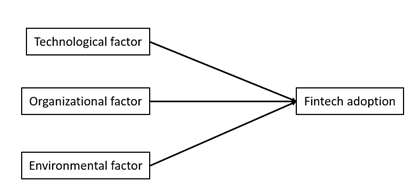
Drawing on the theoretical insights and empirical evidence presented in the literature review, this study develops a conceptual framework illustrated in Figure 1. The proposed framework formulates hypotheses that examine the effects of TOE factors on the Fintech adoption in the Moroccan banking sector.
3. Methodology
This qualitative study examines how the Technology–Organization–Environment (TOE) framework influences Fintech adoption within the banking sector. Data were collected through in-depth individual interviews with professionals working in Moroccan banking institutions who are directly involved in Fintech-related decision-making or implementation processes.
Semi-structured interviews were employed to capture participants’ perspectives on Fintech adoption decisions, including perceived technological benefits, organizational readiness, leadership support, and external pressures such as competition and regulation (see Table 1). Interviews were conducted either face-to-face or via online platforms, audio-recorded with participants’ consent, and subsequently transcribed verbatim to ensure accurate and systematic analysis.
The collected data were analyzed using thematic analysis in order to identify recurring patterns and themes related to the technological, organizational, and environmental dimensions of the TOE framework.
Ethical considerations were rigorously observed throughout the research process. All participants provided informed consent, and strict measures were taken to ensure confidentiality and anonymity.
Overall, the qualitative design and analytical approach adopted in this study provide rich insights into how TOE-related factors shape Fintech adoption in Moroccan banks. The findings highlight the interplay between technological characteristics, internal organizational conditions, and external environmental forces in enabling or constraining Fintech adoption, offering a nuanced understanding of digital transformation dynamics in the banking sector.
| Respondant code | Gender | Years of experience | Position | Role in Fintech adoption | Estimated interview length |
| R1 | Male | 20+ years | Chief Financial Officer (CFO) | Final decision-maker (budget, ROI approval) | 70 minutes |
| R2 | Female | 15–20 years | Director of Digital Transformation | Strategic decision-maker (digital & Fintech initiatives) | 65 minutes |
| R3 | Male | 15–20 years | Chief Information Officer (CIO) | Final decision-maker (IT architecture & integration) | 60 minutes |
| R4 | Female | 12–18 years | Director of Digital Banking & Channels | Decision-maker (deployment of digital & Fintech solutions) | 55 minutes |
| R5 | Male | 15–20 years | Director of Payments & Transaction Services | Decision-maker (payments and Fintech platforms) | 55 minutes |
| R6 | Female | 12–18 years | Director of Compliance & Regulatory Affairs | Decision-maker (regulatory validation) | 60 minutes |
| R7 | Male | 18–25 years | Chief Risk Officer (CRO) | Decision-maker (risk acceptance & governance) | 60 minutes |
| R8 | Female | 10–14 years | Head of Fintech Partnerships & Innovation | Strategic contributor (Fintech ecosystem & partnerships) | 55 minutes |
| R9 | Male | 8–12 years | Senior Digital Banking Manager | Senior contributor (implementation & user adoption) | 50 minutes |
| R10 | Female | 7–11 years | Senior Data & Analytics Manager (Banking) | Senior contributor (data capability & technological readiness) | inutes |
4. Analysis and discussion of the results
The examination of the results has uncovered several significant findings concerning the relationship between TOE factors and Fintech adoption. These findings delve into the three core components of the TOE framework: Tehchnology, Oranizational and Environmental (see Table 2).
| TOE dimensions | Sub-factors | Quote revealing impact on Fintech adoption | Respondant |
| Technology | Relative Advantage | “Once we saw that the solution significantly reduced onboarding time and improved customer activation, the decision to adopt was straightforward. The relative advantage clearly justified moving from pilot to full deployment.” | R4 |
| “The investment was approved because the benefits were measurable. Lower transaction costs and faster processing directly influenced our decision to adopt the Fintech solution.” | R1 | ||
| Trust | “Adoption was delayed until we were confident about auditability and accountability. Trust was a prerequisite—without it, the project would not have been approved.” | R6 | |
| “We only moved forward once governance and third-party risk controls were validated. That level of trust was essential for adoption at scale.” | R7 | ||
| Compatibility & Security | “The solution was adopted because it integrated smoothly with our core banking systems. Any lack of compatibility would have stopped the adoption process immediately.” | R3 | |
| “Even though the solution was innovative, we approved adoption only after confirming it met our security and architecture standards.” | R8 | ||
| Organization | IT Resources | “We postponed adoption until internal IT capabilities were strengthened. Without sufficient resources, adopting the solution would have created operational risks.” | R3 |
| “Our internal data and integration maturity enabled us to adopt the Fintech solution faster and with fewer implementation issues.” | R9 | ||
| Authority Support | “Once top management formally supported the initiative, adoption accelerated. Executive backing removed internal barriers and enabled faster decision-making.” | R2 | |
| “Without executive sponsorship, the project would have remained at pilot stage. Leadership commitment was decisive for full adoption.” | R4 | ||
| Firm Size | “As a large bank, we had the capacity to absorb risk and fund multiple workstreams, which made large-scale Fintech adoption feasible.” | R1 | |
| “Our size allowed adoption, but only after multiple validation layers. Smaller banks might move faster, but our governance ensures controlled adoption.” | R7 | ||
| Monetary Resources | “Adoption was conditional on securing the full budget, including integration and security costs. Without financial commitment, the project could not proceed.” | R1 | |
| “We approved the Fintech solution only when lifecycle costs were clearly funded, ensuring sustainable adoption rather than short-term experimentation.” | R5 | ||
| Environment | Rivalry Pressure | “Competitive pressure played a major role. Seeing competitors advance digitally pushed us to accelerate Fintech adoption to avoid losing market share.” | R4 |
| “The speed at which other banks adopted similar solutions forced us to shorten our decision cycles and move faster toward adoption.” | R2 | ||
| Business Partner Pressure | “Client and partner expectations for real-time services directly influenced our decision to adopt Fintech solutions.” | R5 | |
| “Adoption became unavoidable as ecosystem partners required higher levels of interoperability and digital responsiveness.” | R8 | ||
| Regulatory Support | “Clear regulatory guidance reduced uncertainty and allowed us to proceed with adoption confidently and within compliance boundaries.” | R6 | |
| “Supportive regulatory signals facilitated risk acceptance and enabled us to formally approve the Fintech adoption.” | R7 |
From a technological perspective, the findings show that perceived relative advantage plays a central role in Fintech adoption. Banks are more likely to adopt Fintech solutions when they clearly enhance operational efficiency, reduce costs, improve service quality, or accelerate processes compared to existing systems. When technological benefits are tangible and measurable, decision-makers perceive Fintech as a value-creating investment rather than a speculative innovation, which significantly increases adoption likelihood.
Trust, compatibility, and security also emerge as critical technological enablers of Fintech adoption. Respondents emphasized that adoption is contingent on confidence in the reliability, transparency, and governance of Fintech solutions. Compatibility with core banking systems and alignment with existing IT architectures are viewed as non-negotiable prerequisites. Similarly, strong cybersecurity standards and data protection mechanisms are essential to mitigate operational and reputational risks. When these technological conditions are met, banks are more willing to progress from pilot initiatives to large-scale deployment.
At the organizational level, internal resources strongly influence Fintech adoption outcomes. Banks with mature IT infrastructures, skilled human resources, and robust data capabilities are better positioned to implement and scale Fintech solutions effectively. The availability of such resources reduces implementation risks and facilitates smoother integration into existing operations. Conversely, limited internal capabilities tend to delay adoption or restrict it to experimental use cases.
Top management and authority support further play a decisive role in translating technological potential into actual adoption. The findings indicate that executive sponsorship accelerates decision-making, facilitates cross-functional coordination, and helps overcome organizational resistance to change. When Fintech initiatives are endorsed at the highest managerial level, they are more likely to receive adequate funding, priority, and institutional legitimacy.
Firm size and financial capacity also shape adoption dynamics. Larger banks benefit from greater financial flexibility, enabling them to absorb risks, fund parallel workstreams, and sustain long-term Fintech investments. Adequate monetary resources allow banks to cover not only initial implementation costs but also ongoing expenses related to integration, compliance, security, and system maintenance. As a result, financial readiness emerges as a key organizational condition for sustainable Fintech adoption.
From an environmental standpoint, external pressures significantly influence adoption decisions. Competitive rivalry encourages banks to accelerate Fintech adoption in order to maintain market relevance and meet rising customer expectations for digital and seamless financial services. The findings suggest that observing competitors’ digital advancements creates a sense of urgency that shortens internal approval cycles and increases openness to innovation.
Pressure from business partners, including corporate clients, payment networks, and technology providers, further reinforces the need for Fintech adoption. Increasing demands for interoperability, real-time services, and digital integration push banks to adopt Fintech solutions that align with ecosystem expectations and industry standards.
Finally, regulatory support plays a pivotal role in enabling Fintech adoption. Clear regulatory guidelines and supportive supervisory signals reduce uncertainty and compliance-related risks, allowing banks to proceed with adoption more confidently. When regulatory expectations are well defined, banks are better able to design appropriate control mechanisms and formally approve Fintech initiatives within their governance frameworks.
Overall, the findings confirm that Fintech adoption in the banking sector is the outcome of a complex interaction between technological benefits, organizational readiness, and environmental pressures. The TOE framework provides a comprehensive lens for understanding how these dimensions jointly influence adoption decisions, highlighting that successful Fintech adoption requires not only innovative technology but also strong organizational support and a conducive external environment.
5. Conclusion
5.1 Theoretical implications
This research aims to make a meaningful contribution to the understanding of how the Technology–Organization–Environment (TOE) framework explains Fintech adoption within the banking sector. As financial services continue to undergo rapid digital transformation, driven by technological innovation and evolving market conditions, this study sheds light on the complex mechanisms through which technological capabilities, organizational readiness, and environmental pressures jointly shape Fintech adoption decisions. By doing so, it highlights how banks evaluate, legitimize, and operationalize Fintech initiatives within their decision-making processes.
By examining Fintech adoption through the TOE lens, this study enriches the existing body of knowledge on digital transformation in banking. It provides empirical insights into how banking decision-makers assess the relative benefits of Fintech solutions, mobilize internal resources, secure executive support, and respond to competitive and regulatory forces. In particular, the findings illustrate the extent to which banks rely on Fintech-enabled solutions to enhance efficiency, improve service quality, and maintain competitiveness in an increasingly digital financial ecosystem. This contributes to broader scholarly discussions on technology adoption, innovation diffusion, and performance outcomes in financial institutions [11], [70], [71], [72], [73].
Moreover, by considering Fintech adoption across different organizational settings and environmental conditions within the banking industry, this research offers opportunities to refine and extend existing adoption frameworks. The findings may help advance TOE-based theories by illustrating how contextual factors interact in practice, particularly in highly regulated and competitive environments such as banking. As such, the study contributes to both theoretical development and practical understanding of Fintech adoption, offering a structured perspective that can inform future research and managerial decision-making in digital finance.
5.2 Managerial implications
The findings of this study offer several important implications for banking managers seeking to better understand and manage Fintech adoption within their organizations. By applying the Technology–Organization–Environment (TOE) framework, the results highlight that successful Fintech adoption is not driven solely by technological innovation, but rather by the alignment of technological value, organizational readiness, and external pressures.
From a technological perspective, managers should focus on clearly articulating the relative advantage of Fintech solutions. Adoption decisions are more likely to be approved and scaled when the benefits of Fintech—such as efficiency gains, cost reduction, or service improvement—are concrete and measurable. Rather than treating Fintech as an experimental initiative, banks should evaluate it through structured business cases that demonstrate tangible value. In addition, trust, compatibility, and security emerge as fundamental prerequisites for adoption. Managers should therefore prioritize governance mechanisms, system integration capabilities, and cybersecurity standards early in the adoption process. When these technological conditions are addressed upfront, banks are more likely to move confidently from pilot projects to full deployment.
At the organizational level, the study underscores the importance of internal resources and leadership support. Banks with stronger IT capabilities, skilled personnel, and mature data infrastructures are better positioned to implement and sustain Fintech solutions. Managers should view investments in internal digital capabilities not as supporting activities, but as central enablers of adoption. Moreover, top management support plays a decisive role in accelerating adoption by reducing internal resistance and facilitating coordination across departments. Clear executive sponsorship helps transform Fintech initiatives from isolated projects into strategic priorities. Financial capacity also matters, as sustainable adoption requires sufficient monetary resources to cover not only implementation costs but also long-term integration, compliance, and maintenance efforts.
From an environmental perspective, competitive and institutional pressures significantly influence Fintech adoption decisions. Increasing rivalry within the banking sector pushes managers to adopt Fintech solutions in order to remain relevant and meet evolving customer expectations. Similarly, pressure from business partners and clients encourages banks to enhance interoperability and digital responsiveness. Managers should therefore view Fintech adoption as part of a broader ecosystem strategy rather than a purely internal transformation. In addition, regulatory support plays a critical enabling role. Clear and supportive regulatory frameworks reduce uncertainty and allow banks to adopt Fintech solutions with greater confidence. Managers are encouraged to engage proactively with regulatory requirements and integrate compliance considerations into the early stages of Fintech adoption
5.3 Limits
Despite its contributions, this study is subject to several limitations that should be acknowledged when interpreting the findings. First, the research adopts a qualitative approach based on semi-structured interviews with a limited number of respondents within the Moroccan banking sector. While this method allows for an in-depth understanding of Fintech adoption decisions and provides rich contextual insights, the findings cannot be generalized statistically to all banks or financial institutions. Instead, the results should be interpreted as analytically generalizable, offering conceptual rather than universal conclusions.
Second, the study focuses primarily on senior decision-makers and key contributors involved in Fintech adoption. Although this choice is justified by the strategic nature of adoption decisions, it may limit the perspective on operational challenges experienced at lower organizational levels. Insights from frontline employees or technical teams could further enrich understanding of implementation-related issues that emerge after adoption decisions are made.
Third, the research is context-specific, as it is conducted within the Moroccan banking environment. Regulatory frameworks, market structures, and levels of technological maturity may differ across countries and regions. Consequently, caution should be exercised when transferring the findings to other banking systems or financial markets with different institutional and competitive conditions.
Fourth, the study examines Fintech adoption through the TOE framework, which, while comprehensive, may not capture all possible determinants of adoption. Factors such as organizational culture, individual user attitudes, or customer-level perceptions were not explored in depth. Integrating complementary theoretical perspectives in future research could provide a more holistic understanding of Fintech adoption dynamics.
References
- A. F. Alshira’h, M. Alsqour, A. Lutfi, A. Alsyouf, and M. Alshirah, “A Socio-Economic Model of Sales Tax Compliance,” Economies, vol. 8, no. 4, p. 88, Dec. 2020, . DOI ↗ Google Scholar ↗
- A. M. K. Alkhazaleh and A. Marei, “Would irregular auditing implements impact the quality of financial reports: Case study in jordan practice,” Journal of Management Information and Decision Sciences, vol. 24, pp. 1–14, June 2021. DOI ↗ Google Scholar ↗
- E. H. Feyen, “Fintech and the Future of Finance-Overview,” 2022. DOI ↗ Google Scholar ↗
- S. Kamble, A. Gunasekaran, and H. Arha, “Understanding the Blockchain technology adoption in supply chains-Indian context,” International Journal of Production Research, vol. 57, no. 7, pp. 2009–2033, 2019, . DOI ↗ Google Scholar ↗
- A. Banerjee, “Blockchain Technology: Supply Chain Insights from ERP,” in Advances in Computers, 2018. . DOI ↗ Google Scholar ↗
- N. Kshetri, “1 Blockchain’s roles in meeting key supply chain management objectives,” International Journal of Information Management, vol. 39, pp. 80–89, Apr. 2018, . DOI ↗ Google Scholar ↗
- N. Shaheen, S. Al-Haddad, A. Marei, and L. Daoud, “The Effect of Creativity on Entrepreneurial Behavior: The Moderating Role of Demographics,” Information Sciences Letters, vol. 12, no. 3, Apr. 2023, [Online]. Available: DOI ↗ Google Scholar ↗
- N. T. Matsepe and E. van der Lingen, “Determinants of emerging technologies adoption in the South African financial sector,” South African Journal of Business Management, vol. 53, no. 1, p. 12, Feb. 2022, . DOI ↗ Google Scholar ↗
- S. A. Shatnawi, A. Marei, M. M. Hanefah, M. Eldaia, and S. Alaaraj, “Audit Committee and Financial Performance in Jordan:The Moderating Effect of Ownership Concentration,” Montenegrin Journal of Economics, 2021, . DOI ↗ Google Scholar ↗
- H. Hassani, S. Unger, and C. Beneki, “Big Data and Actuarial Science,” Big Data and Cognitive Computing, vol. 4, no. 4, p. 40, Dec. 2020, . DOI ↗ Google Scholar ↗
- A. Marei, J. Ali Mustafa, M. Othman, L. Daoud, A. Lutfi, and A. Al-Amarneh, “The Moderation of Organizational Readiness on the Relationship Between Toe Factors and Fintech Adoption and Financial Performance,” Journal of Law and Sustainable Development, vol. 11, p. e730, Aug. 2023, . DOI ↗ Google Scholar ↗
- J. Eveland and L. G. Tornatzky, “Technological Innovation as a Process,” 1990, pp. 27–50. DOI ↗ Google Scholar ↗
- A. Lutfi, “Factors Influencing the Continuance Intention to Use Accounting Information System in Jordanian SMEs from the Perspectives of UTAUT: Top Management Support and Self-Efficacy as Predictor Factors,” Economies, vol. 10, no. 4, p. 75, Apr. 2022, . DOI ↗ Google Scholar ↗
- L.-W. Wong, L.-Y. Leong, J.-J. Hew, G. W.-H. Tan, and K.-B. Ooi, “Time to seize the digital evolution: Adoption of blockchain in operations and supply chain management among Malaysian SMEs,” International Journal of Information Management, vol. 52, p. 101997, June 2020, . DOI ↗ Google Scholar ↗
- J. Benitez-Amado and R. Walczuch, “Information Technology, the Organizational Capability of Proactive Corporate Environmental Strategy and Firm Performance: A Resource-Based Analysis,” European Journal of Information Systems, vol. 21, Nov. 2012, . DOI ↗ Google Scholar ↗
- V. Dao, I. Langella, and J. Carbo, “From green to sustainability: Information Technology and an integrated sustainability framework,” The Journal of Strategic Information Systems, vol. 20, no. 1, pp. 63–79, Mar. 2011, . DOI ↗ Google Scholar ↗
- D. Nedbal and M. Stieninger, “Exploring the economic value of a cloud computing solution and its contribution to green IT,” International Journal of Business Process Integration and Management, vol. 7, no. 1, pp. 62–72, Apr. 2014, . DOI ↗ Google Scholar ↗
- R. Gholami, A. Sulaiman, T. Ramayah, and A. Molla, “Senior managers’ perception on green information systems (IS) adoption and environmental performance: Results from a field survey,” Information & Management, vol. 50, pp. 431–438, Jan. 2013. DOI ↗ Google Scholar ↗
- R. Bose and X. (Robert) Luo, “Integrative framework for assessing firms’ potential to undertake Green IT initiatives via virtualization-A theoretical perspective,” J. Strategic Inf. Sys., vol. 20, pp. 38–54, Mar. 2011, . DOI ↗ Google Scholar ↗
- K. Sophonthummapharn, “A Comprehensive Framework for the Adoption of Techno-Relationship Innovations Empirical Evidence from eCRM in Manufacturing SMEs,” Jan. 2008. DOI ↗ Google Scholar ↗
- L. G. Tornatzky, M. Fleischer, and A. K. Chakrabarti, The Processes of Technological Innovation. in Issues in organization and management series. Lexington Books, 1990. [Online]. Available: DOI ↗ Google Scholar ↗
- G. Premkumar, “A Meta-Analysis of Research on Information Technology Implementation in Small Business,” Journal of Organizational Computing and Electronic Commerce, vol. 13, pp. 91–121, June 2003, . DOI ↗ Google Scholar ↗
- E. M. Rogers, Diffusion of Innovations. Free Press of Glencoe, 1962. [Online]. Available: DOI ↗ Google Scholar ↗
- G. C. Moore and I. Benbasat, “Development of an Instrument to Measure the Perceptions of Adopting an Information Technology Innovation,” Information Systems Research, vol. 2, no. 3, pp. 192–222, 1991, . DOI ↗ Google Scholar ↗
- J. Y. L. Thong, “An Integrated Model of Information Systems Adoption in Small Businesses,” Journal of Management Information Systems, vol. 15, no. 4, pp. 187–214, Mar. 1999, . DOI ↗ Google Scholar ↗
- P. B. Cragg and M. King, “Small-Firm Computing: Motivators and Inhibitors,” MIS Quarterly, vol. 17, no. 1, pp. 47–60, Mar. 1993, . DOI ↗ Google Scholar ↗
- “Kuan, K. K., & Chau, P. Y. (2001). A Perception-Based Model for EDI Adoption in Small Businesses Using a Technology-Organization-Environment Framework. Information & Management, 38, 507-521. - References - Scientific Research Publishing.” Accessed: Feb. 15, 2026. [Online]. Available: DOI ↗ Google Scholar ↗
- J. Pearson, “Electronic commerce adoption: An empirical study of small and medium US businesses,” Information & Management, vol. 42, pp. 197–216, Dec. 2004, . DOI ↗ Google Scholar ↗
- C.-C. Lee, X. Li, C.-H. Yu, and J. Zhao, “Does fintech innovation improve bank efficiency? Evidence from China’s banking industry,” International Review of Economics & Finance, vol. 74, pp. 468–483, July 2021, . DOI ↗ Google Scholar ↗
- “M. L. Markus and C. Tanis, ‘The Enterprise System Experience-from Adoption to Success,’ In R. W. Zmud, Ed., Framing the Domains of IT Management Projecting the Future through the Past, Chapter 10, Pinnaflex Educational Resources Inc., Cincinnati, 2000, pp. 173-207. - References - Scientific Research Publishing.” Accessed: Feb. 15, 2026. [Online]. Available: DOI ↗ Google Scholar ↗
- G. Premkumar and M. Roberts, “Adoption of new information technologies in rural small businesses,” Omega, vol. 27, no. 4, pp. 467–484, Aug. 1999, . DOI ↗ Google Scholar ↗
- “Receptivity of Singapore’s SMEs to electronic commerce adoption | Request PDF.” Accessed: Feb. 15, 2026. [Online]. Available: DOI ↗ Google Scholar ↗
- J. Aslam, A. Saleem, N. T. Khan, and Y. B. Kim, “Factors influencing blockchain adoption in supply chain management practices: A study based on the oil industry,” Journal of Innovation and Knowledge, vol. 6, no. 2, pp. 124–134, Apr. 2021, . DOI ↗ Google Scholar ↗
- J. Tipmontian, J. Alcover, and M. Rajmohan, “Impact of Blockchain Adoption for Safe Food Supply Chain Management through System Dynamics Approach from Management Perspectives in Thailand,” Proceedings, vol. 39, p. 14, Jan. 2020, . DOI ↗ Google Scholar ↗
- K. Francisco and D. Swanson, “The Supply Chain Has No Clothes: Technology Adoption of Blockchain for Supply Chain Transparency,” Logistics, vol. 2, no. 1, p. 2, Jan. 2018, . DOI ↗ Google Scholar ↗
- P. Helo and Y. Hao, “Artificial intelligence in operations management and supply chain management: an exploratory case study,” Production Planning & Control, vol. 33, pp. 1–18, Apr. 2021, . DOI ↗ Google Scholar ↗
- M. Risius and K. Spohrer, “A Blockchain Research Framework: What We (don’t) Know, Where We Go from Here, and How We Will Get There,” Business & Information Systems Engineering, vol. 59, pp. 385–409, Dec. 2017, . DOI ↗ Google Scholar ↗
- S. Yadav and S. P. Singh, “Blockchain critical success factors for sustainable supply chain,” Resources, Conservation and Recycling, vol. 152, p. 104505, Jan. 2020, . DOI ↗ Google Scholar ↗
- “(PDF) A study of the current situation of adoption of Cloud based services in Indian SMEs.” Accessed: Feb. 15, 2026. [Online]. Available: DOI ↗ Google Scholar ↗
- A. Jeyaraj and M. Lacity, “A Review of the Predictors, Linkages, and Biases in IT Innovation Adoption Research,” JIT, vol. 21, pp. 1–23, Jan. 2006, . DOI ↗ Google Scholar ↗
- V. Grover and M. Goslar, “Toward An Empirical Taxonomy and Model of Evolution for Telecommunications Technologies,” Journal of Information Technology, vol. 8, no. 3, pp. 167–176, Sept. 1993, . DOI ↗ Google Scholar ↗
- C. L. Iacovou, I. Benbasat, and A. S. Dexter, “Electronic Data Interchange and Small Organizations: Adoption and Impact of Technology,” MIS Quarterly, vol. 19, no. 4, pp. 465–485, Dec. 1995, . DOI ↗ Google Scholar ↗
- “Formal specification – an analytic tool for (management) information systems - Swatman - 1992 - Information Systems Journal - Wiley Online Library.” Accessed: Feb. 15, 2026. [Online]. Available: DOI ↗ Google Scholar ↗
- P. Chwelos, I. Benbasat, and A. Dexter, “Research Report: Empirical Test of an EDI Adoption Model,” Information Systems Research, vol. 12, pp. 304–321, Sept. 2001, . DOI ↗ Google Scholar ↗
- D. Fink, “Guidelines for the Successful Adoption of Information Technology in Small and Medium Enterprises,” International Journal of Information Management, vol. 18, no. 4, pp. 243–253, Aug. 1998, . DOI ↗ Google Scholar ↗
- “Does Size Matter? Small Firms’ Use of E-Business Tools in the Supply Chain | Semantic Scholar.” Accessed: Feb. 15, 2026. [Online]. Available: DOI ↗ Google Scholar ↗
- M. K. Moch and E. V. Morse, “Size, Centralization and Organizational Adoption of Innovations,” American Sociological Review, vol. 42, no. 5, pp. 716–725, 1977, . DOI ↗ Google Scholar ↗
- I.-L. Wu and J.-L. Chen, “Knowledge management driven firm performance: the roles of business process capabilities and organizational learning,” Journal of Knowledge Management, vol. 18, no. 6, pp. 1141–1164, Oct. 2014, . DOI ↗ Google Scholar ↗
- “Does Size Matter? Small Firms’ Use of E-Business Tools in the Supply Chain | Semantic Scholar.” Accessed: Feb. 15, 2026. [Online]. Available: DOI ↗ Google Scholar ↗
- “An analysis of the business characteristics of adopters and non‐adopters of World Wide Web technology.” Accessed: Feb. 15, 2026. [Online]. Available: DOI ↗ Google Scholar ↗
- G. Premkumar and W. R. King, “The evaluation of strategic information system planning,” Information & Management, vol. 26, no. 6, pp. 327–340, June 1994, . DOI ↗ Google Scholar ↗
- “(PDF) Working Knowledge: How Organizations Manage What They Know.” Accessed: Feb. 15, 2026. [Online]. Available: DOI ↗ Google Scholar ↗
- “Strategy as a field of study: Why search for a new paradigm? - Prahalad - 1994 - Strategic Management Journal - Wiley Online Library.” Accessed: Feb. 15, 2026. [Online]. Available: DOI ↗ Google Scholar ↗
- G. Buonanno, P. Faverio, F. Pigni, A. Ravarini, D. Sciuto, and M. Tagliavini, “Factors affecting ERP system adoption: A comparative analysis between SMEs and large companies,” Journal of Enterprise Information Management, vol. 18, no. 4, pp. 384–426, Aug. 2005, . DOI ↗ Google Scholar ↗
- “Technology Diffusion: An Empirical Test of Competitive Effects - Hubert Gatignon, Thomas S. Robertson, 1989.” Accessed: Feb. 15, 2026. [Online]. Available: DOI ↗ Google Scholar ↗
- “The Role of Interorganizational and Organizational Factors on the Decision Mode for Adoption of Interorganizational Systems* - Premkumar - 1995 - Decision Sciences - Wiley Online Library.” Accessed: Feb. 15, 2026. [Online]. Available: DOI ↗ Google Scholar ↗
- “‘Determinants of Success for Computer Usage in Small Business’ by William DeLone.” Accessed: Feb. 15, 2026. [Online]. Available: DOI ↗ Google Scholar ↗
- K. Gai, M. Qiu, and X. Sun, “A survey on FinTech,” Journal of Network and Computer Applications, vol. 103, pp. 262–273, Feb. 2018, . DOI ↗ Google Scholar ↗
- H. Kharrat, Y. Trichilli, and B. Abbes, “Relationship between FinTech index and bank’s performance: a comparative study between Islamic and conventional banks in the MENA region,” Journal of Islamic Accounting and Business Research, vol. 15, no. 1, pp. 172–195, 2023. DOI ↗ Google Scholar ↗
- T. Puschmann and R. Alt, “Sharing Economy,” Business & Information Systems Engineering: The International Journal of WIRTSCHAFTSINFORMATIK, vol. 58, no. 1, pp. 93–99, 2016. DOI ↗ Google Scholar ↗
- K. A. Oweis and O. F. Alghaswyneh, “The Antecedents of Electronic Banking Adoption in Saudi Arabia: Using Diffusion of Innovation Theory,” MMI, no. 4, pp. 160–171, 2019, . DOI ↗ Google Scholar ↗
- I. Blohm and J. M. Leimeister, “Gamification Design of IT-Based Enhancing Services for Motivational Support and Behavioral Change,” Business & Information Systems Engineering, vol. 5, pp. 275–278, June 2013, . DOI ↗ Google Scholar ↗
- A. B. Siddik, L. Yong, and M. N. Rahman, “The role of Fintech in circular economy practices to improve sustainability performance: a two-staged SEM-ANN approach,” Environ Sci Pollut Res, vol. 30, no. 49, pp. 107465–107486, Oct. 2023, . DOI ↗ Google Scholar ↗
- H. Baker, T. Kaddumi, M. Nassar, and R. Muqattash, “Impact of Financial Technology on Improvement of Banks’ Financial Performance,” Journal of Risk and Financial Management, vol. 16, p. 230, Apr. 2023, . DOI ↗ Google Scholar ↗
- M. Affinito and A. Franco Pozzolo, “The interbank network across the global financial crisis: Evidence from Italy,” Journal of Banking & Finance, vol. 80, no. C, pp. 90–107, 2017. DOI ↗ Google Scholar ↗
- Y. Akinwale and A. Kyari, “Factors influencing attitudes and intention to adopt financial technology services among the end-users in Lagos State, Nigeria,” African Journal of Science, Technology, Innovation and Development, vol. 14, pp. 1–8, Dec. 2020, . DOI ↗ Google Scholar ↗
- X. Vives, “The Impact of Fintech on Banking,” European Economy. Accessed: Feb. 15, 2026. [Online]. Available: DOI ↗ Google Scholar ↗
- “(PDF) Entrepreneurial Orientation, Access to Financial Resources and SMEs’ Business Performance: The Case of the United Arab Emirates*.” Accessed: Feb. 15, 2026. [Online]. Available: DOI ↗ Google Scholar ↗
- B. Lanz, S. Dietz, and T. Swanson, “Global Population Growth, Technology and Malthusian Constraints: A Quantitative Growth Theoretic Perspective,” CIES Research Paper series, Art. no. 25–2014, May 2016, Accessed: Feb. 15, 2026. [Online]. Available: DOI ↗ Google Scholar ↗
- A. Alrsheedi and Y. H. P. Iskandar, “Key factors influencing fintech adoption among Saudi banks: a conceptual framework,” Humanit Soc Sci Commun, vol. 12, no. 1, p. 1194, July 2025, . DOI ↗ Google Scholar ↗
- M. Najib, W. J. Ermawati, F. Fahma, E. Endri, and D. Suhartanto, “FinTech in the Small Food Business and Its Relation with Open Innovation,” Journal of Open Innovation: Technology, Market, and Complexity, vol. 7, no. 1, p. 88, Mar. 2021, . DOI ↗ Google Scholar ↗
- J. L. Chong and K. Olesen, “A Technology-Organization-Environment Perspective on Eco-effectiveness: A Meta-analysis,” AJIS, vol. 21, Mar. 2017, . DOI ↗ Google Scholar ↗
- V. Chittipaka, S. Kumar, U. Sivarajah, J. L.-H. Bowden, and M. M. Baral, “@for reference TOE - Blockchain Technology for Supply Chains operating in emerging markets: an empirical examination of technology-organization-environment (TOE) framework,” Ann Oper Res, vol. 327, no. 1, pp. 465–492, Aug. 2023, . DOI ↗ Google Scholar ↗