Abstract
This study aims to analyze the role of personality in students’ Higher Order Thinking Skills (HOTS) in solving mathematical problems. The focus is on two personality clusters: Cluster 1 (confused, panic, tense, and stressed students) and Cluster 2 (pessimistic students). This research uses a quantitative approach with multiple linear regression analysis. The results show that personality significantly affects HOTS-based problem-solving ability in both clusters. In Cluster 1, personality has a moderate effect (β = 0.523, p < 0.05), while in Cluster 2, personality has a stronger effect (β = 1.899, p < 0.05). The findings indicate that students with pessimistic traits show a stronger dependency on personality factors compared to students experiencing emotional instability. This study highlights the importance of understanding personality differences to improve students’ HOTS performance in mathematics.
Keywords
Personality Personality cluster Students’ Higher Order Thinking Skills (HOTS) Mathematical Problem Solving
1. Introduction
Higher Order Thinking Skills (HOTS) have become a central focus in modern education, especially in mathematics learning. In the 21st century, students are not only required to remember and understand concepts, but also to analyze, evaluate, and solve complex problems in various contexts. These skills are essential to prepare students for real-life challenges and global competition (Thornhill-Miller et al., 2023). Mathematics, as a subject that emphasizes reasoning and problem solving, plays an important role in developing HOTS. However, despite its importance, many students still struggle to achieve a high level of thinking. They often rely on memorization and routine procedures rather than deep understanding and critical thinking (Dwyer, 2023). This situation indicates that developing HOTS is not an easy process and requires attention to various influencing factors.
In classroom practice, students show different responses when they face difficult mathematical problems. Some students feel confused, panic, tense, and stressed, especially when dealing with non-routine or HOTS-based questions. These emotional conditions can reduce concentration and limit their ability to think clearly. On the other hand, some students show pessimistic attitudes. They tend to believe that they cannot solve the problem even before trying. This lack of confidence can lead to low motivation and avoidance behavior in learning (Stavropoulou et al., 2025). These differences indicate that personality and emotional characteristics play an important role in students’ learning processes. Therefore, understanding personality differences is necessary to explain why some students succeed while others struggle in developing HOTS.
Previous studies have explored the relationship between personality and academic performance. For example, research by Poropat (2009) found that personality traits, especially conscientiousness, significantly influence academic achievement. However, this study mainly focused on general academic outcomes and did not specifically examine HOTS or higher-level cognitive skills. As a result, it does not fully explain how personality affects students’ ability to analyze and solve complex problems. This limitation shows that more specific research is needed to understand the role of personality in HOTS.
Other studies have emphasized the role of emotional factors in learning. Córdova et al. (2023) explained that negative emotions such as anxiety and stress can negatively affect students’ performance. Students who experience high levels of anxiety tend to have difficulty concentrating and processing information. While this finding is important, the study did not differentiate between different types of emotional conditions. For example, students who feel panic and stress may behave differently from those who are pessimistic. Without this distinction, the analysis becomes too general and cannot explain the specific impact of each emotional type on HOTS.
In addition, research by Ferradás et al. (2019) highlighted that pessimistic individuals tend to have lower achievement because they expect failure and avoid challenges. This suggests that pessimism can influence learning outcomes. However, this study did not specifically investigate whether pessimistic students always perform poorly in HOTS tasks. It is possible that some pessimistic students still develop certain strategies to solve problems, even though they lack confidence. Therefore, the relationship between pessimism and HOTS needs further investigation.
Furthermore, Bandura (1997) emphasized the importance of self-efficacy in learning. Students with high self-efficacy are more likely to engage in problem solving and persist in difficult tasks. While this concept is closely related to learning success, personality was not deeply analyzed as a separate factor in many studies on self-efficacy. This creates a gap in understanding how personality and self-belief interact in influencing HOTS performance.
Another study by Rentzios et al. (2025) discussed the role of psychological factors in learning, including motivation and self-regulation. Although this study provided a comprehensive framework, it did not classify students into specific personality clusters. As a result, the findings remain general and do not capture the unique characteristics of different student groups. This lack of classification limits the ability to design targeted interventions for different types of learners.
From these previous studies, it can be seen that most research treats personality as a single variable. Researchers often measure personality using general traits without distinguishing between different emotional or cognitive characteristics. This approach oversimplifies the complexity of human behavior. In reality, students may have different personality profiles, such as emotional instability (confusion, panic, stress) or pessimism, which may influence their learning in different ways. Therefore, a more detailed classification of personality is needed to better understand its impact on HOTS.
Based on this issue, there is a clear research gap. First, there is limited research that classifies personality into specific clusters, especially in the context of mathematics learning. Second, few studies compare the effects of different personality types on HOTS. Most studies only examine general relationships without identifying which type of personality has a stronger or weaker influence. Third, there is a lack of research that focuses specifically on HOTS-based mathematical problem solving. Since mathematics requires high-level thinking, it is important to explore how personality affects students’ ability in this area.
Therefore, this study aims to fill these gaps by focusing on two specific personality clusters. The first cluster consists of students who often feel confused, panic, tense, and stressed when facing mathematical problems. These students represent emotional instability, which may affect their cognitive performance. The second cluster consists of pessimistic students who tend to have negative expectations about their abilities. By comparing these two clusters, this study seeks to understand how different personality characteristics influence HOTS-based mathematical problem solving.
Understanding the role of personality in HOTS is important for improving mathematics education. By identifying how different personality types affect learning, teachers can design more effective strategies to support students. This study provides a more detailed analysis by focusing on personality clusters, which is expected to contribute to both theory and practice in education.
2. Method
This study employed a quantitative research design to examine the effect of personality on students’ Higher Order Thinking Skills (HOTS) in mathematical problem solving. A quantitative approach was chosen because it allows the researcher to measure relationships between variables objectively and to test hypotheses using statistical analysis. In this study, multiple linear regression analysis was used to determine the extent to which personality influences students’ HOTS-based problem-solving ability. This method is appropriate because it can analyze the contribution of one or more independent variables to a dependent variable in a structured and measurable way.
The participants of this study were students who were categorized into different personality clusters based on their characteristics. The grouping process was conducted by identifying dominant personality traits shown by the students during learning activities. Specifically, students were classified into two main clusters. The first cluster consisted of students who frequently experienced emotional instability, such as feeling confused, panic, tense, and stressed when facing mathematical problems. The second cluster consisted of students who showed pessimistic tendencies, such as lack of confidence and negative expectations toward their ability to solve problems. This classification aimed to provide a clearer understanding of how different personality types influence HOTS performance.
In this study, the main variables consisted of one independent variable and one dependent variable. The independent variable was personality, which was analyzed based on the identified clusters. Personality in this context refers to students’ emotional and cognitive tendencies when dealing with mathematical tasks. The dependent variable was students’ HOTS-based mathematical problem-solving ability. This variable represents students’ ability to analyze, evaluate, and solve complex mathematical problems that require higher-order thinking skills. By focusing on these two variables, the study aimed to explore the direct effect of personality on students’ performance in solving HOTS problems.
The data analysis in this study was conducted through several stages to ensure the validity and reliability of the results. First, classical assumption tests were performed, including tests of normality, heteroscedasticity, and multicollinearity. The normality test was used to determine whether the data were normally distributed, which is an important requirement for regression analysis. The heteroscedasticity test was conducted to examine whether the variance of errors was consistent across all levels of the independent variable. Meanwhile, the multicollinearity test was used to ensure that there was no strong correlation among independent variables that could affect the accuracy of the regression model.
After the classical assumptions were fulfilled, multiple linear regression analysis was applied to identify the effect of personality on HOTS-based problem-solving ability. This analysis produced regression coefficients that indicate the direction and strength of the relationship between variables. To further test the significance of the results, both t-tests and F-tests were conducted. The t-test was used to examine the partial effect of the independent variable on the dependent variable, while the F-test was used to test the simultaneous effect of all variables in the model.
Finally, the coefficient of determination (R²) was calculated to measure how much variance in the dependent variable could be explained by the independent variable. This value provides an indication of the overall explanatory power of the regression model. Through these systematic procedures, the study aimed to produce valid and reliable findings regarding the influence of personality on students’ HOTS in mathematical problem solving.
3. Results
3.1 Cluster 1 (Confused, Panic, Tense, Stress)
| Variable | B | Sig. |
| Personality | 0.523 | 0.045 |
| Psychology | 1.692 | 0.000 |
| Self-efficacy | 1.012 | 0.013 |
| R | 0.966 | |
| R² | 0.934 |
The results in Table 1 show that all independent variables have a significant effect on students’ HOTS-based mathematical problem-solving ability in Cluster 1 (p < 0.05). Personality has a regression coefficient of 0.523 with a significance value of 0.045, indicating that personality has a positive and statistically significant effect on HOTS. This means that when personality improves by one unit, students’ HOTS ability increases by 0.523 units, assuming other variables remain constant.
However, when compared to other variables, personality has a relatively smaller effect. The psychology variable shows the strongest influence (B = 1.692, p = 0.000), indicating that emotional conditions such as confusion, panic, tension, and stress play a dominant role in determining students’ performance. Self-efficacy also contributes significantly (B = 1.012, p = 0.013), suggesting that students’ confidence in their ability is an important factor in solving HOTS problems.
Furthermore, the model summary shows a very high correlation coefficient (R = 0.966), indicating a very strong relationship between the independent variables and HOTS ability. The coefficient of determination (R² = 0.934) means that 93.4% of the variance in HOTS-based problem-solving ability can be explained by the variables included in the model. This suggests that the model has a very high explanatory power for Cluster 1.
3.2 Cluster 2 (Pessimistic)
| Variable | B | Sig. |
| Personality | 1.899 | 0.021 |
| Psychology | 0.789 | 0.024 |
| Self-efficacy | 1.001 | 0.032 |
| R | 0.864 | |
| R² | 0.747 |
Table 2 presents the regression results for Cluster 2, which consists of pessimistic students. The findings indicate that all variables significantly influence HOTS-based mathematical problem-solving ability (p < 0.05). Personality has a regression coefficient of 1.899 with a significance value of 0.021, showing a strong and significant positive effect. This means that an increase in personality score leads to a substantial improvement in HOTS ability among pessimistic students.
Interestingly, personality becomes the most influential variable in this cluster, unlike in Cluster 1. The psychology variable has a smaller coefficient (B = 0.789, p = 0.024), while self-efficacy also shows a moderate effect (B = 1.001, p = 0.032). These results indicate that pessimistic students rely more on personality factors than on emotional conditions when solving HOTS problems.
The model summary shows a strong correlation (R = 0.864) between the independent variables and HOTS ability. The coefficient of determination (R² = 0.747) indicates that 74.7% of the variance in HOTS ability is explained by the model. Although this value is lower than in Cluster 1, it still reflects a strong explanatory power.
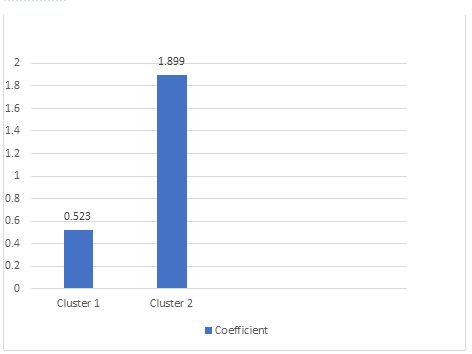
Figure 1 illustrates the comparison of personality effects between the two clusters. It can be clearly seen that the regression coefficient for personality in Cluster 2 (1.899) is much higher than in Cluster 1 (0.523). This indicates that personality has a significantly stronger influence on HOTS-based problem-solving ability among pessimistic students.
This difference suggests that personality plays different roles depending on students’ characteristics. In Cluster 1, emotional factors such as stress and panic are more dominant, reducing the relative impact of personality. In contrast, in Cluster 2, personality becomes the main factor influencing students’ performance. This finding highlights the importance of considering personality differences when analyzing students’ HOTS abilities.
Overall, the results demonstrate that while personality is significant in both clusters, its level of influence varies considerably. This variation provides important insight into how different student characteristics affect learning outcomes, particularly in the context of higher-order thinking skills.
4. Discussion
The findings of this study reveal that personality has a significant effect on students’ Higher Order Thinking Skills (HOTS) in mathematical problem solving in both clusters. However, the strength and pattern of this influence differ between Cluster 1 and Cluster 2. This result confirms that personality is an important factor in learning, especially in tasks that require complex thinking and problem-solving ability. Previous studies have also emphasized that internal factors such as personality, emotion, and self-belief play a crucial role in determining students’ academic performance (Bandura, 1997; Poropat, 2009). Nevertheless, this study extends the existing literature by showing that the effect of personality is not uniform across different student groups.
In Cluster 1, which consists of students who experience confusion, panic, tension, and stress, personality shows a significant but relatively smaller effect compared to psychological factors. This finding suggests that emotional instability plays a more dominant role in influencing HOTS performance in this group. Students who feel anxious or stressed tend to have difficulty focusing and organizing their thoughts when solving complex problems. This condition can reduce their ability to engage in higher-order thinking processes such as analysis and evaluation. This result is consistent with the control-value theory proposed by Erdem et al. (2025), which explains that negative emotions such as anxiety and stress can hinder cognitive processing and reduce academic performance. In this context, personality still contributes to learning outcomes, but its influence is overshadowed by stronger emotional factors.
Furthermore, the dominance of psychological factors in Cluster 1 can be explained by the nature of HOTS tasks, which often require calmness, concentration, and persistence. Students who are easily panicked or stressed may struggle to complete such tasks effectively, even if they have the necessary cognitive ability. This finding also aligns with previous research indicating that emotional regulation is a key factor in successful problem solving (Menefee et al., 2022; Güss & Starker, 2023). Therefore, for students in Cluster 1, improving emotional stability may be more important than focusing solely on personality development. This highlights the need for teachers to create a supportive learning environment that reduces anxiety and helps students manage stress during problem-solving activities.
In contrast, the results for Cluster 2 show that personality has a stronger and more dominant effect on HOTS performance. This cluster consists of pessimistic students who tend to have negative expectations about their abilities. The strong influence of personality in this group indicates that students’ mindset plays a critical role in shaping their learning outcomes. This finding supports the theory of learned optimism proposed by Syed Mustafa et al. (2010) and Ward and Chopik (2025), which suggests that individuals’ explanatory styles—whether optimistic or pessimistic—significantly affect their motivation and performance. Pessimistic students often believe that failure is inevitable, which reduces their effort and persistence when facing challenging tasks.
However, this study provides a new perspective by showing that pessimism does not only reduce performance but also strongly shapes HOTS ability. In other words, personality in the form of pessimism becomes a central factor that determines how students approach and solve problems. Students with pessimistic traits may avoid complex tasks, give up easily, or fail to use effective problem-solving strategies. This explains why personality has a larger regression coefficient in Cluster 2 compared to Cluster 1. While previous studies have acknowledged the negative impact of pessimism on achievement (Córdova et al., 2023), they have not specifically examined its role in HOTS-based problem solving. Therefore, this study contributes to the literature by highlighting the strong connection between pessimistic personality and higher-order thinking performance.
When compared to earlier studies, this research offers a more detailed and nuanced understanding of the role of personality in learning. For example, Abouzeid et al. (2021) found that personality traits are related to academic achievement, but the analysis was limited to general outcomes and did not focus on HOTS. Similarly, Rada et al. (2025) and Weir (2025) emphasized the importance of self-efficacy, but did not separate personality into distinct categories. By classifying students into specific clusters, this study provides a clearer explanation of how different personality types influence learning in different ways. This approach addresses the limitation of previous studies that treated personality as a single, homogeneous variable.
Moreover, the findings confirm the importance of considering individual differences in educational research and practice. Students are not a homogeneous group; they have unique emotional and personality characteristics that affect their learning processes. Ignoring these differences may lead to ineffective teaching strategies that do not meet students’ needs. For example, interventions designed for emotionally unstable students may not be suitable for pessimistic students, and vice versa. Therefore, understanding personality clusters can help teachers design more targeted and effective instructional strategies.
Another important implication of this study is related to the development of HOTS in mathematics education. Since HOTS requires not only cognitive ability but also emotional and motivational support, teachers need to address both aspects simultaneously. For students in Cluster 1, strategies such as stress management, relaxation techniques, and supportive feedback may help improve their performance. On the other hand, for students in Cluster 2, interventions that focus on changing negative mindsets, building confidence, and promoting positive thinking may be more effective. This differentiation is important to ensure that all students have the opportunity to develop their higher-order thinking skills.
In summary, this study provides important insights into the relationship between personality and HOTS. The key finding is that personality influences HOTS in both clusters, but the strength of the effect varies depending on students’ characteristics. Emotional students in Cluster 1 are more influenced by psychological conditions, while pessimistic students in Cluster 2 are more influenced by personality factors. This confirms that personality should not be treated as a single variable, but rather as a complex construct that interacts with other factors in different ways.
Overall, this study contributes to both theory and practice by offering a more comprehensive understanding of how personality affects learning. It highlights the need for a more personalized approach in education, where teaching strategies are adapted to students’ individual characteristics. Future research is recommended to explore other personality clusters and to investigate how interventions can be designed to support different types of learners in developing HOTS.
5. Conclusion
This study concludes that personality plays a significant role in influencing students’ Higher Order Thinking Skills (HOTS) in mathematical problem solving across both clusters. The findings show that personality has a meaningful impact, although the level of influence varies depending on students’ characteristics. In Cluster 1, which consists of emotionally unstable students (confused, panic, tense, and stressed), personality has a moderate effect, while psychological factors appear to be more dominant. In contrast, in Cluster 2, personality has a stronger effect, indicating that pessimistic students are more influenced by their personality traits when solving HOTS-based problems. This finding supports the idea that individual differences, especially personality and mindset, are critical in shaping learning outcomes. Therefore, teachers should consider students’ personality differences when designing instructional strategies to effectively improve HOTS in mathematics learning.
References
- Abouzeid, E., Fouad, S., Wasfy, N. F., Alkhadragy, R., Hefny, M., & Kamal, D. (2021). Influence of personality traits and learning styles on undergraduate medical students' academic achievement. Advances in Medical Education and Practice, 12, 769–777. DOI ↗ Google Scholar ↗
- Bandura, A. (1997). Self-efficacy: The exercise of control. W H Freeman/Times Books/ Henry Holt & Co. DOI ↗ Google Scholar ↗
- Córdova, A., Caballero-García, A., Drobnic, F., Roche, E., & Noriega, D. C. (2023). Influence of stress and emotions in the learning process: The example of COVID-19 on university students: A narrative review. Healthcare, 11(12), 1787. DOI ↗ Google Scholar ↗
- Dwyer, C. P. (2023). An evaluative review of barriers to critical thinking in educational and real-world settings. Journal of Intelligence, 11(6), 105. DOI ↗ Google Scholar ↗
- Erdem, C., Kaya, M., & Polat, M. (2025). The effects of negative emotions and negative personality traits on academic achievement. Dokuz Eylül Üniversitesi Buca Eğitim Fakültesi Dergisi, 65, 124–142. DOI ↗ Google Scholar ↗
- Ferradás, M. D. M., Freire, C., Núñez, J. C., & Regueiro, B. (2019). Associations between profiles of self-esteem and achievement goals and the protection of self-worth in university students. International Journal of Environmental Research and Public Health, 16(12), 2218. DOI ↗ Google Scholar ↗
- Güss, C. D., & Starker, U. (2023). The influence of emotion and emotion regulation on complex problem-solving performance. Systems, 11(6), 276. DOI ↗ Google Scholar ↗
- Menefee, D. S., Ledoux, T., & Johnston, C. A. (2022). The importance of emotional regulation in mental health. American Journal of Lifestyle Medicine, 16(1), 28–31. DOI ↗ Google Scholar ↗
- Poropat, A. E. (2009). A meta-analysis of the five-factor model of personality and academic performance. Psychological Bulletin, 135(2), 322–338. DOI ↗ Google Scholar ↗
- Rada, C., Dina, M. M., & Lunga, R. A. (2025). The impact of personality traits and the mediating role of self-efficacy and self-control on criminogenic behavior among Romanian inmates: A psychological perspective. Scientific Reports, 15(1), 18885. DOI ↗ Google Scholar ↗
- Rentzios, C., Karagiannopoulou, E., & Ntritsos, G. (2025). Academic emotions, emotion regulation, academic motivation, and approaches to learning: A person-centered approach. Behavioral Sciences, 15(7), 900. DOI ↗ Google Scholar ↗
- Stavropoulou, G., Daniilidou, A., & Nerantzaki, K. (2025). Exploring the interplay of motivation, self-efficacy, critical thinking, and self-regulation in predicting academic achievement among university students. F1000Research, 14, 344. DOI ↗ Google Scholar ↗
- Syed Mustafa, S. M., Elias, H., Mohd Noah, S., & Roslan, S. (2010). A proposed model of motivational influences on academic achievement with flow as the mediator. Procedia - Social and Behavioral Sciences, 7, 2–9. DOI ↗ Google Scholar ↗
- Thornhill-Miller, B., Camarda, A., Mercier, M., Burkhardt, J. M., Morisseau, T., Bourgeois-Bougrine, S., Vinchon, F., El Hayek, S., Augereau-Landais, M., Mourey, F., Feybesse, C., Sundquist, D., & Lubart, T. (2023). Creativity, critical thinking, communication, and collaboration: Assessment, certification, and promotion of 21st century skills for the future of work and education. Journal of Intelligence, 11(3), 54. DOI ↗ Google Scholar ↗
- Ward, M. A., & Chopik, W. J. (2025). Optimism/pessimism and associations with life event perceptions. PLoS ONE, 20(4), e0321128. DOI ↗ Google Scholar ↗
- Weir, K. (2025, October 22). Self-efficacy: The theory at the heart of human agency. American Psychological Association. DOI ↗ Google Scholar ↗