Abstract
Objective: To examine whether customer engagement mediates the relationship between Shopee Live social media marketing activities (SMMA) and purchase intention among Generation Z university students in Padang, Indonesia. Methods: A cross-sectional survey of 150 purposively selected respondents was analyzed using partial least squares structural equation modeling (PLS-SEM). SMMA was modeled as a higher-order construct comprising entertainment, interaction, trendiness, customization, and word of mouth. Results: SMMA was positively associated with customer engagement (β = 0.666, p < 0.001) and purchase intention (β = 0.449, p < 0.001). Customer engagement was positively associated with purchase intention (β = 0.351, p < 0.001). The indirect effect was significant (β = 0.234, p < 0.001), indicating complementary partial mediation. The model explained 44.4% of customer engagement and 53.5% of purchase intention variance. Conclusion: Customer engagement is an important behavioral-relational mechanism linking live-commerce marketing activities with purchase intention. The findings support managing Shopee Live not only for reach, but also for relevant content, responsive interaction, customization, and sustained engagement.
Keywords
customer engagement Generation Z live commerce purchase intention social media marketing activities
Introduction
Live commerce has transformed e-commerce from a transactional interface into an audiovisual marketing environment that integrates product demonstrations, real-time interaction, entertainment, promotions, and transactions within a single session. This format is particularly relevant to Generation Z, who routinely obtain information, compare products, and interact through digital platforms. On Shopee Live, consumers can view products, ask questions, read comments, follow hosts, and evaluate information before forming purchase intentions [1][2].
High viewer numbers do not necessarily indicate marketing effectiveness. Consumers may watch because of entertainment, promotions, curiosity, or information needs without progressing to more active engagement. Sellers and hosts therefore need empirical evidence on whether social media marketing activities comprising entertainment, interaction, trendiness, customization, and word of mouth are sufficiently strong to build customer engagement and ultimately encourage purchase intention. Prior studies show that social media marketing activities and live-streaming features are associated with engagement and purchase intention, but the integrative mechanism in the Shopee Live context remains insufficiently clarified [3][5].
This study applies the Stimulus-Organism-Response (S-O-R) framework. Shopee Live marketing activities are positioned as the stimulus, customer engagement as the organism mechanism, and purchase intention as the response. Customer engagement is operationalized in behavioral-relational terms through participation, following hosts, sharing information, and recommending Shopee Live. This distinction is important because the instrument was not designed to comprehensively capture the full cognitive-affective spectrum of engagement [6][7].
The study offers three contributions. First, the five dimensions of Shopee Live marketing activities are modeled as an integrated higher-order marketing construct rather than as separate predictors. Second, customer engagement is tested as a mediating mechanism while retaining the direct path to purchase intention. Third, model evaluation extends beyond path significance by considering measurement quality, explanatory power, predictive relevance, and model limitations. The study therefore examines the effects of Shopee Live marketing activities on customer engagement and purchase intention, the effect of customer engagement on purchase intention, and the mediating role of customer engagement among Generation Z university students in Padang, Indonesia.
The hypotheses were: H1, Shopee Live marketing activities are positively associated with customer engagement; H2, Shopee Live marketing activities are positively associated with purchase intention; H3, customer engagement is positively associated with purchase intention; and H4, customer engagement mediates the association between Shopee Live marketing activities and purchase intention.
Materials and Methods
Study design and participants
This study used an explanatory quantitative approach with a cross-sectional survey design. The population comprised active university students in Padang who belonged to Generation Z, had an active Shopee account, and had watched Shopee Live. Purposive sampling was applied. Inclusion criteria were active university enrollment in Padang, being within the Generation Z birth range, having an active Shopee account, accessing Shopee Live at least three times during the previous three months for at least one minute per session, and having performed at least one engagement action during or after viewing. An a priori analysis indicated a minimum requirement of approximately 68 respondents; 150 respondents were included in the analytical sample to improve estimation stability [8][9].
Measures
Primary data were collected using a structured five-point Likert-scale questionnaire. Shopee Live marketing activities were adapted from Wibowo et al. and specified as a higher-order construct with five reflective dimensions: entertainment, interaction, trendiness, customization, and word of mouth [5]. Customer engagement and purchase intention were adapted from Arisman and Salehudin [6]. Customer engagement was measured using four indicators reflecting information sharing, active participation, recommendation, and following/subscribing to hosts, whereas purchase intention was measured through intention, likelihood, and willingness to purchase via Shopee Live.
Statistical analysis
Data were analyzed using partial least squares structural equation modeling (PLS-SEM) in SmartPLS. PLS-SEM was selected because the model includes a hierarchical construct, mediation paths, and an evaluation objective that combines explanation and prediction, rather than merely because of sample size. Convergent validity was assessed using outer loadings and average variance extracted (AVE); reliability using Cronbach's alpha, rho_A, and composite reliability (rho_C); and discriminant validity primarily using the heterotrait-monotrait ratio (HTMT). The structural model was evaluated using variance inflation factor (VIF), R², f², Q²predict, PLSpredict, and bootstrapping. Standardized root mean square residual (SRMR) and normed fit index (NFI) were reported as supplementary fit information and were not used as the sole basis for evaluating the PLS-SEM model [8][10]. Statistical significance was assessed at p < 0.05.
Ethics and consent
Participation was voluntary and informed consent was obtained from all respondents before questionnaire completion. The approving ethics committee/institutional review board and approval reference number were not provided in the source manuscript and must be inserted before submission to meet IJSRM requirements.
Results
Respondent characteristics
The final sample consisted of 150 Generation Z university students. Female respondents accounted for 86.0% and male respondents for 14.0%. The largest birth-year group was 2006-2008 (46.7%). Universitas Perintis Indonesia (38.7%) and Universitas Andalas (34.0%) represented the two largest institutional groups.
| Characteristic | Category | n | % |
|---|---|---|---|
| Sex | Female | 129 | 86.0 |
| Male | 21 | 14.0 | |
| Birth year | 1997-1999 | 6 | 4.0 |
| 2000-2002 | 23 | 15.3 | |
| 2003-2005 | 51 | 34.0 | |
| 2006-2008 | 70 | 46.7 | |
| University | Universitas Perintis Indonesia | 58 | 38.7 |
| Universitas Andalas | 51 | 34.0 | |
| Other universities | 41 | 27.3 |
Descriptive statistics
Shopee Live marketing activities had a mean score of 3.901, purchase intention 3.729, and customer engagement 3.363. Customization had the highest mean (4.133), followed by trendiness (4.093) and interaction (3.991), whereas word of mouth had the lowest mean (3.520).
| Construct/dimension | Mean | SD | Interpretation |
|---|---|---|---|
| Entertainment | 3.723 | 0.692 | High |
| Interaction | 3.991 | 0.564 | High |
| Trendiness | 4.093 | 0.661 | High |
| Customization | 4.133 | 0.615 | High |
| Word of Mouth | 3.520 | 0.712 | High |
| SMMA Shopee Live | 3.901 | 0.489 | High |
| Customer Engagement | 3.363 | 0.707 | Moderate |
| Purchase Intention | 3.729 | 0.628 | High |
Measurement model
All 18 indicators in the first-order model had outer loadings ranging from 0.776 to 0.939, and the AVE of every construct exceeded 0.50. In the higher-order model, the loadings of the five Shopee Live marketing activity dimensions ranged from 0.738 to 0.792. AVE values were 0.587 for Shopee Live marketing activities, 0.753 for customer engagement, and 0.774 for purchase intention. Internal reliability was adequate because all alpha, rho_A, and rho_C values were within acceptable ranges and no rho_C exceeded 0.95.
| Construct/dimension | Loading/range | Alpha | rho_A | rho_C | AVE |
|---|---|---|---|---|---|
| SMMA Shopee Live | 0.738-0.792 | 0.825 | 0.828 | 0.877 | 0.587 |
| Entertainment | 0.752 | ||||
| Interaction | 0.760 | ||||
| Trendiness | 0.787 | ||||
| Customization | 0.792 | ||||
| Word of Mouth | 0.738 | ||||
| Customer Engagement | 0.792-0.895 | 0.889 | 0.891 | 0.924 | 0.753 |
| Purchase Intention | 0.877-0.882 | 0.854 | 0.854 | 0.911 | 0.774 |
At the main-construct level, HTMT values were 0.809 for SMMA-purchase intention, 0.753 for SMMA-customer engagement, and 0.744 for purchase intention-customer engagement. At the dimension level, word of mouth-customer engagement was 0.884 and trendiness-customization was 0.879.
Structural model and hypothesis testing
VIF values ranged from 1.000 to 1.799. Shopee Live marketing activities explained 44.4% of the variance in customer engagement (R² = 0.444), while marketing activities and customer engagement jointly explained 53.5% of the variance in purchase intention (R² = 0.535). Effect sizes were f² = 0.799 for SMMA on customer engagement, f² = 0.241 for SMMA on purchase intention, and f² = 0.147 for customer engagement on purchase intention. The bootstrapped structural model is shown in Fig. 1.
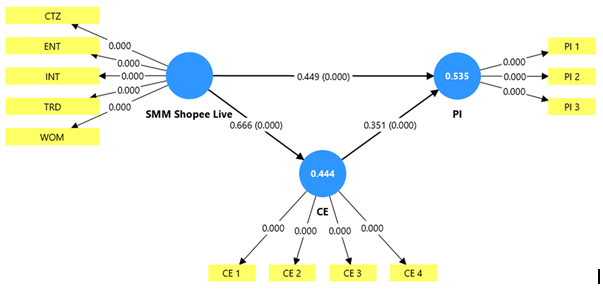
All direct paths were positive and statistically significant. Shopee Live marketing activities were associated with customer engagement (β = 0.666; t = 13.831; p < 0.001) and purchase intention (β = 0.449; t = 6.031; p < 0.001). Customer engagement was associated with purchase intention (β = 0.351; t = 4.543; p < 0.001). The indirect SMMA → customer engagement → purchase intention effect was β = 0.234 (t = 4.146; p < 0.001). The direct path remained significant, indicating complementary partial mediation. Predictive relevance was Q²predict = 0.435 for customer engagement and 0.457 for purchase intention. The higher-order model had SRMR = 0.098 and NFI = 0.760.
Discussion
The findings support the S-O-R mechanism in live commerce. Shopee Live marketing activities were strongly associated with customer engagement, and both marketing activities and customer engagement were associated with purchase intention. The significant indirect effect, together with a significant direct effect in the same direction, indicates complementary partial mediation. This pattern is consistent with earlier live-streaming and digital-marketing studies that position engagement as an important mechanism translating marketing stimuli into behavioral intentions [2][3][7].
The higher-order specification also indicates that customization, trendiness, interaction, entertainment, and word of mouth operate as interconnected components of the live-commerce marketing experience. Customization produced the highest higher-order loading, while word of mouth had the lowest. Descriptively, respondents evaluated customization and trendiness favorably, but customer engagement was only moderate, indicating that favorable perceptions of live-commerce content do not automatically translate into sustained relational behavior.
Discriminant validity requires a cautious interpretation. Although the main constructs satisfied the HTMT < 0.90 criterion, the word of mouth-customer engagement value of 0.884 and trendiness-customization value of 0.879 exceeded the more conservative 0.85 threshold. Several customer-engagement items involve sharing and recommendation behavior, creating potential domain overlap with word of mouth. This overlap is acknowledged rather than resolved through post hoc indicator deletion because such deletion could improve statistics at the expense of content validity [10].
The explanatory results were meaningful, with R² values of 0.444 for customer engagement and 0.535 for purchase intention. Predictive performance was positive but mixed: PLS-SEM outperformed the linear benchmark for four of seven indicators using RMSE and for all purchase-intention indicators but not all customer-engagement indicators using MAE. The model therefore demonstrates moderate rather than uniformly high predictive performance. In addition, SRMR = 0.098 and NFI = 0.760 indicate that the model should not be described as fully fitting; these indices are interpreted as supplementary information alongside measurement validity, structural paths, explanatory power, and prediction [9][11].
Managerially, hosts and sellers should maintain customization and trendiness through current product information, relevant responses, concise demonstrations, and comparisons that help consumers assess product fit. Interaction should be converted into sustained engagement through rapid responses, consistent host schedules, polls, question-and-answer sessions, and clear benefits for followers. Word of mouth should be strengthened through credible and shareable experiences rather than relying only on repost incentives. Live-commerce performance should therefore be evaluated not only by viewer counts but also by interaction quality, product-detail clicks, cart additions, and conversion.
This study has several limitations. Its cross-sectional design does not establish temporal causality, the data are self-reported, women constituted 86.0% of respondents, and the sample was concentrated in two universities. Conceptual proximity between word of mouth and customer engagement and between trendiness and customization also warrants caution. Some entertainment-item wording is outcome-adjacent because it explicitly refers to purchasing. Future research should use stimulus indicators free from purchase wording, separate sharing/recommendation items more clearly from customer engagement, conduct independent content validation, use more balanced probability-based or stratified sampling where feasible, and link survey responses with actual behavioral data in longitudinal or experimental designs.
Conclusion
Shopee Live social media marketing activities were positively associated with customer engagement and purchase intention among Generation Z university students in Padang, and customer engagement showed complementary partial mediation. The model explained 44.4% of customer engagement and 53.5% of purchase intention variance, with moderate and mixed predictive performance. The findings indicate that live-commerce marketing should be managed not only for exposure but also for relevant content, responsive interaction, customization, and engagement-building mechanisms. Interpretation should remain proportionate to the cross-sectional design, sample composition, measurement-domain overlap, and supplementary model-fit indices.
Declarations
Ethics approval: [REQUIRED BEFORE SUBMISSION: insert the approving ethics committee/institutional review board name, approval reference number, and confirmation that the study followed applicable ethical standards/Declaration of Helsinki where required by the journal.]
Informed consent: Informed consent was obtained from all participants before questionnaire completion.
Conflict of interest: The authors declare no conflict of interest.
Funding: The research received no specific funding.
Data availability: The data supporting the findings of this study are available from the corresponding author on reasonable request, subject to appropriate confidentiality safeguards.
Use of AI tools: Generative AI-assisted tools were used for language editing and manuscript formatting. The authors reviewed and approved the final content and remain fully responsible for the accuracy, integrity, and originality of the manuscript.
Author contributions: [TO BE CONFIRMED BY ALL AUTHORS BEFORE SUBMISSION: F.R. - investigation, data curation, formal analysis, writing-original draft; E.B. - supervision, conceptualization, writing-review and editing; A. - supervision, methodology, writing-review and editing.]
Acknowledgements
The authors thank all Generation Z university students who voluntarily participated in the survey.
References
- Lu B, Chen Z. Live streaming commerce and consumers' purchase intention: an uncertainty reduction perspective. Inf Manag. 2021;58(7):103509. doi: DOI ↗ Google Scholar ↗
- Zhang L, Chen M, Zamil AMA. Live stream marketing and consumers' purchase intention: an IT affordance perspective using the S-O-R paradigm. Front Psychol. 2023;14:1069050. doi: DOI ↗ Google Scholar ↗
- Addo PC, Fang J, Asare AO, Kulbo NB. Customer engagement and purchase intention in live-streaming digital marketing platforms. Serv Ind J. 2021;41(11-12):767-786. doi: DOI ↗ Google Scholar ↗
- Jamil K, Dunnan L, Gul RF, Shehzad MU, Gillani SHM, Awan FH. Role of social media marketing activities in influencing customer intentions: a perspective of a new emerging era. Front Psychol. 2022;12:808525. doi: DOI ↗ Google Scholar ↗
- Wibowo A, Chen SC, Wiangin U, Ma Y, Ruangkanjanases A. Customer behavior as an outcome of social media marketing: the role of social media marketing activity and customer experience. Sustainability (Basel). 2021;13(1):189. doi: DOI ↗ Google Scholar ↗
- Arisman A, Salehudin I. Does live stream selling affect customer engagement and purchase intention? The Shopee Live platform case study. ASEAN Mark J. 2022;14(2):142-165. doi: DOI ↗ Google Scholar ↗
- Lee CH, Chen CW. Impulse buying behaviors in live streaming commerce based on the stimulus-organism-response framework. Information (Basel). 2021;12(6):241. doi: DOI ↗ Google Scholar ↗
- Hair JF, Hult GTM, Ringle CM, Sarstedt M. A primer on partial least squares structural equation modeling (PLS-SEM). 3rd ed. Thousand Oaks (CA): SAGE Publications; 2022. DOI ↗ Google Scholar ↗
- Guenther P, Guenther M, Ringle CM, Zaefarian G, Cartwright S. Improving PLS-SEM use for business marketing research. Ind Mark Manag. 2023;111:127-142. doi: DOI ↗ Google Scholar ↗
- Cheung GW, Cooper-Thomas HD, Lau RS, Wang LC. Reporting reliability, convergent and discriminant validity with structural equation modeling: a review and best-practice recommendations. Asia Pac J Manag. 2024;41(2):745-783. doi: DOI ↗ Google Scholar ↗
- Shmueli G, Sarstedt M, Hair JF, Cheah JH, Ting H, Vaithilingam S, et al. Predictive model assessment in PLS-SEM: guidelines for using PLSpredict. Eur J Mark. 2019;53(11):2322-2347. doi: DOI ↗ Google Scholar ↗