Abstract
Riverine solid-waste pollution is an environmental challenge that can disrupt aquatic ecosystems and reduce the ecological and social functions of rivers. The Musi River in Palembang, Indonesia, is exposed to floating materials originating from domestic activities, commerce, riverside settlements, and water transportation. This study examines the composition of floating materials captured by the Musi Trap, a locally developed interception device implemented through the Palembang BELAGAK Program (Bersama Lawan Sampah untuk Lingkungan Berkelanjutan). A descriptive quantitative approach was applied through direct field observation of the mass and composition of materials collected by the device. The captured materials were classified into plastic, water hyacinth, food waste, residues/other materials, and other materials. A total of 1,871 kg of material was captured during the observation period. Water hyacinth accounted for the largest share at 1,200 kg (64.14%), followed by food waste at 194 kg (10.37%), plastic at 187 kg (9.99%), residues/other materials at 160 kg (8.55%), and other materials at 130 kg (6.95%). After excluding water hyacinth as aquatic biomass, plastic represented 27.87% of the remaining captured material. Beyond its ecological function, the Musi Trap demonstrates a circular-economy approach by reusing discarded wooden pallets and plastic bottles as components of the device. The findings indicate that the Musi Trap can function both as a physical interception device and as a monitoring instrument for characterizing floating riverine materials. However, the captured mass should not be interpreted directly as a quantified reduction in river pollution without comparative data on incoming waste loads, escaped materials, operational duration, and hydrological conditions.
Keywords
Musi Trap Musi River floating debris plastic waste circular economy river waste management Palembang BELAGAK
1. Introduction
Rivers perform interconnected ecological, hydrological, economic, and social functions. They provide habitat for aquatic organisms, transport water and materials, support transportation, and sustain human activities. When waste generation and disposal are not adequately managed, these multiple functions can be affected by the accumulation and transport of solid waste.
The Musi River is one of the major aquatic ecosystems in South Sumatra and plays an important role in the life of Palembang's communities. Previous research has identified surface macro-debris in the flow and estuary of the Musi River, indicating that floating debris is an important component of river pollution that requires systematic monitoring (Identification of Surface Macro Debris..., 2019). Plastic is of particular concern because of its persistence and potential fragmentation into smaller particles that may interact with aquatic organisms.
Floating-waste interception devices, including trash traps and trash booms, are among the approaches used to retain debris before it is transported further downstream. Research on macroplastic management in Palembang has highlighted the relevance of interception and management strategies for waste entering the Musi River system (Macroplastic Waste Management Strategies in Palembang City, 2025). However, the performance of interception devices can be influenced by flow conditions, seasonality, installation location, and the physical characteristics of the captured material.
Within this context, the Palembang BELAGAK Program integrates waste reduction and environmental stewardship through the use of the Musi Trap. The device is positioned as both a physical interception mechanism and a source of empirical information on floating materials. From a biological and ecological perspective, its performance should not be assessed solely by the mass of material collected. The composition of captured materials, variation in capture, ecological characteristics of aquatic biomass, and potential interactions with aquatic organisms are also relevant.
2. Theoretical Framework
2.1 Circular Economy Perspective
The study is primarily grounded in the circular economy perspective. Circular economy thinking provides an alternative to the conventional linear model in which resources are extracted, transformed into products, used, and ultimately discarded. Geissdoerfer et al. (2017) describe the circular economy as a regenerative system that minimizes resource input and waste generation by retaining products, components, and materials in use. The framework is relevant to the Musi Trap because discarded materials are redirected into a functional environmental-management application.
The Ellen MacArthur Foundation describes circular economy principles around eliminating waste and pollution, circulating products and materials at their highest value, and regenerating nature. In the Musi Trap, the reuse of wooden pallets and discarded plastic bottles illustrates material circulation through reuse and upcycling rather than immediate disposal.
2.2 Systems Perspective on River-Waste Management
Riverine waste pollution is a system-level problem influenced by waste generation, human activities, hydrological transport, material characteristics, collection practices, and downstream environmental conditions. Accordingly, the Musi Trap is considered not only as a physical device but also as an intervention within a broader river-waste management system. Monitoring the composition of captured materials can provide information for upstream source reduction, sorting, recovery, and future intervention design.
2.3 Sustainable Development and Multidimensional Value
The study also adopts a sustainable-development perspective in which environmental protection, resource efficiency, and social participation are interconnected. The Musi Trap potentially creates ecological value by intercepting floating materials, economic value by extending the useful life of discarded materials and supporting resource recovery, and social value by creating opportunities for community participation in collection, sorting, and material utilization.
3. Methods
This study used a descriptive quantitative approach based on direct field observation of materials captured by the Musi Trap. The analyzed variables included material type, mass, composition, and capture characteristics during the observation period. Each collection interval was identified separately to avoid double counting. The material categories used in the field dataset were plastic, water hyacinth, food waste, residues/other materials, and other materials.
4. Results and Discussion
4.1 Musi Trap Design and Material Reuse
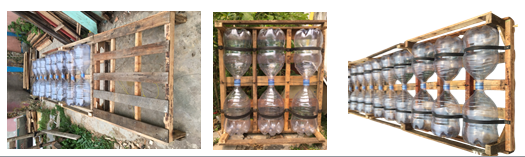
The Musi Trap implemented in the Palembang BELAGAK Program was developed using reused materials, particularly discarded wooden pallets and plastic bottles, together with supporting materials. The wooden pallets function as the main structural frame, while used plastic bottles are positioned as flotation components. This construction approach demonstrates reuse and upcycling by assigning new functional value to materials that could otherwise become waste.
An important feature of the innovation is the relationship between the waste problem and the intervention itself. Plastic bottles, which may become pollutants in aquatic environments, are incorporated into a device designed to intercept floating waste. This creates a direct circular relationship in which a material associated with the environmental problem becomes part of the infrastructure used to address that problem.
4.2 Composition of Captured Materials
| Material | Mass (kg) | Mass (%) | Interpretation |
| Plastic | 187 | 9.99 | Anthropogenic material; persistent pollutant |
| Water hyacinth | 1,200 | 64.14 | Aquatic biomass |
| Food waste | 194 | 10.37 | Biodegradable organic material |
| Residues/other | 160 | 8.55 | Mixed residual material |
| Other materials | 130 | 6.95 | Other captured materials |
| Total | 1,871 | 100.00 | All captured material |
The Musi Trap captured a total of 1,871 kg of material. Water hyacinth was the dominant component, accounting for 1,200 kg (64.14%). Food waste accounted for 194 kg (10.37%), plastic for 187 kg (9.99%), residues/other materials for 160 kg (8.55%), and other materials for 130 kg (6.95%). The dominance of water hyacinth indicates that the captured material was not exclusively anthropogenic waste; a substantial proportion consisted of aquatic biomass.
Because aquatic biomass can contain substantial water and has different physical characteristics from plastic waste, mass dominance should not be interpreted directly as an indication of pollution severity. After excluding water hyacinth, the remaining material totaled 671 kg, of which plastic represented approximately 27.87%. This proportion should be interpreted specifically as the share of plastic among the non-water-hyacinth material captured by the Musi Trap, rather than as the percentage of plastic pollution in the entire Musi River.
4.3 Ecological Significance of Plastic and Aquatic Biomass
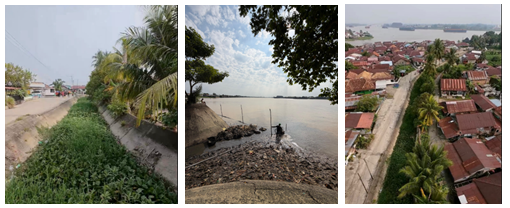
Although plastic represented only 9.99% of the total captured mass, its ecological significance is not proportional to its mass. Plastic is persistent and can fragment into smaller particles, increasing opportunities for ingestion or contact by aquatic organisms. Consequently, plastic interception remains an important component of river-waste management even when biomass dominates the total captured mass.
The 1,200 kg of water hyacinth provides additional information about the physical and biological dynamics of the interception site. Large accumulations of aquatic vegetation may influence light penetration, gas exchange, and habitat conditions when extensive and persistent. However, the present dataset alone cannot establish whether the captured water hyacinth originated locally, was transported from upstream, or accumulated from other locations. Further observations of vegetation coverage, density, water quality, and aquatic communities are required to establish ecological relationships.
4.4 Food Waste and Source-Oriented Management
Food waste accounted for 194 kg (10.37%) of the total captured material. Unlike plastic, food waste is biodegradable; however, large accumulations of organic matter can influence decomposition processes and local water conditions. The presence of food waste therefore provides an indication that river-waste management should not rely exclusively on downstream interception but should also address waste generation and disposal at the source.
Within Palembang BELAGAK, the captured food waste can inform future strategies for source segregation and appropriate organic-waste processing. Depending on its composition and safety characteristics, suitable organic material may be directed toward composting or other forms of biological utilization.
4.5 Economic and Circular Economy Perspective
In addition to its ecological function, the Musi Trap has an economic dimension through the application of circular economy principles. The use of discarded wooden pallets and plastic bottles gives previously discarded materials a new functional role while reducing dependence on newly manufactured materials for the device. This represents a practical example of reuse and upcycling within a river-waste management system.
The economic value of the Musi Trap should not be understood only as the direct market value of recovered waste. It also includes resource efficiency, extension of material service life, potential reduction in the need for new construction materials, improved organization of waste collection, and opportunities for community participation in sorting and material recovery.
The 1,871 kg of captured material represents a potential resource stream that can be differentiated according to material characteristics. Plastic may potentially enter recycling chains, while suitable organic material may be directed toward biological processing. Concentrating floating material at a designated collection point may also make monitoring, collection, and preliminary sorting more efficient and could facilitate collaboration with community groups, waste banks, and material-recovery actors.
The substantial quantity of water hyacinth, 1,200 kg, also provides a basis for future research into environmentally appropriate biomass utilization. Although this study does not assign an economic value to water hyacinth, its quantity indicates an opportunity to investigate potential applications and assess whether such utilization can be conducted safely and sustainably.
Thus, the economic dimension of the Musi Trap is better characterized as a resource-efficiency and value-retention mechanism than as direct revenue generation. This interpretation is consistent with circular economy thinking, in which economic activity seeks to retain material value through reuse, recovery, and recycling while reducing dependence on virgin resources.
4.6 Community and Sustainable Development Implications
The concentration of floating materials at accessible collection points creates an opportunity to connect environmental management with community participation. Future implementation could involve local communities in collection, sorting, recording, and recovery activities, thereby extending the intervention from a technical device into a community-oriented management system.
From a sustainable-development perspective, the Musi Trap creates multidimensional benefits. Ecologically, it intercepts floating materials and generates information about riverine debris. Economically, it promotes material reuse, resource recovery, and resource efficiency. Socially, it can create opportunities for community engagement and local participation in waste management. This multidimensional perspective strengthens the Palembang BELAGAK Program as an integrated environmental initiative rather than a conventional river clean-up activity.
4.7 Limitations and Interpretation of Capture Data
The 1,871 kg of captured material represents material reaching the Musi Trap during the observation period. It should not be interpreted directly as a 1,871 kg reduction in total river pollution or as proof that 187 kg of plastic was completely prevented from entering the river. Quantifying pollution reduction would require comparative data on incoming waste loads before installation, material bypassing or escaping the device, operational duration, and hydrological conditions.
These limitations do not diminish the value of the dataset as an empirical description of material intercepted at the study location. Instead, they indicate that future research should combine capture data with flow measurements, operational records, upstream and downstream observations, and longer-term monitoring.
5. Conclusion
The Musi Trap implemented in the Palembang BELAGAK Program captured 1,871 kg of material during the observation period. Water hyacinth was the dominant component at 1,200 kg (64.14%), followed by food waste at 194 kg (10.37%), plastic at 187 kg (9.99%), residues/other materials at 160 kg (8.55%), and other materials at 130 kg (6.95%). After excluding water hyacinth as aquatic biomass, plastic represented 27.87% of the remaining captured material.
The findings demonstrate that the Musi Trap can serve a dual function as a physical interception device and an environmental monitoring instrument. Its use of discarded wooden pallets and plastic bottles also demonstrates a practical circular-economy approach based on reuse and upcycling. The innovation therefore connects river-waste interception, material recovery, resource efficiency, and potential community participation.
Nevertheless, the captured mass should not be interpreted as a direct measure of overall pollution reduction without comparative and hydrological data. Future studies should investigate capture rates over longer periods, material escape, upstream sources, ecological responses, and the potential utilization of recovered materials. Such developments would strengthen the role of the Musi Trap as a locally based circular river-waste management innovation.
References
- Ellen MacArthur Foundation. (2024, August 21). Circular economy principles. Ellen MacArthur Foundation. DOI ↗ Google Scholar ↗
- Geissdoerfer, M., Savaget, P., Bocken, N. M. P., & Hultink, E. J. (2017). The Circular Economy – A new sustainability paradigm? Journal of Cleaner Production, 143, 757–768. DOI ↗ Google Scholar ↗
- Identification of Surface Macro Debris in River Flow and Estuary of Musi River, South Sumatera Province, Indonesia. (2019). IOP Conference Series: Earth and Environmental Science, 1282, 012106. DOI ↗ Google Scholar ↗
- Macroplastic Waste Management Strategies in Palembang City. (2025). International Journal of Environmental Impacts, 8(3), 435–443. DOI ↗ Google Scholar ↗