Abstract
In the retail sector, building customer loyalty is not solely dependent on offering low prices, delivering consistent and dependable shopping experiences is equally important. This study aims to examine the service quality, price perception, and promotional impact on customer loyalty, with trust as the mediator, among MR. DIY customers in Banda Aceh.. The survey involved a total of 220 respondents, taken by a purposive sampling technique in 4 MR. DIY outlets in Banda Aceh. PLS-SEM was a data analysis technique. Findings reveal that service quality and price perception are significant driving factors of trust and customer loyalty. However, promotions only affect trust and do not directly influence loyalty. Trust positively significantly affects loyalty. Furthermore, it is shown that trust is a mediator of the service quality and promotion influence on loyalty, but does not mediate price perception influence on loyalty.
Keywords
Service Quality Price Perception Promotion Trust Customer Loyalty
1. Introduction
Indonesia’s retail landscape over the last five years has remained on a sustainable growth path, even amid intensifying competition and drastic changes in purchasing behavior. According to BPS (2024) data, the wholesale and retail trade sector consistently contributes a large share of 11.67–12% to the national Gross Domestic Product, with stable growth of 4.9%-5.1% during 2022–2024. According to (Sansome et al., 2025), the first half of 2023 saw modern retail grow by 3.2%. But even as the number of modern retail stores has increased, over 400 have shut down since 2020, signaling that size and rapid expansion alone do not guarantee business sustainability; instead, it is the ability of retailers to retain their customers that matters. In this context, MR. DIY began to be recognized as one of the fastest-growing value-for-money retail chains in Indonesia, with its number of stores increasing from approximately 200 in 2020 to more than 1,000 by 2025 (Yesitadewi & Widodo, 2023). MR.DIY services are also gaining traction in Banda Aceh, where it currently operates multiple active outlets, namely Suzuya Mall Banda Aceh and Hermes Palace Mall. Based on data from BPS Aceh, household consumption expenditure in Banda Aceh City also experienced positive growth during 2022-2024, corresponding with the post-pandemic economic recovery. This condition provides favorable opportunities for modern retailers to grow, but also compels them to control service levels, prices, and promotions more effectively to prevent customers from switching to rivals.
Customer loyalty might be viewed as a multidimensional construct in which loyal is not driven solely by low prices but also by factors such as predictable service quality, fair and transparent price perception, and credible promotion. Service quality is one of the key components in defining love and loyalty towards services as customer perceive services through their experience. The perception of price also serves a strategic purpose. Customers are more likely to identify value in products when prices are seen as reasonable and commensurate with product quality. On the other hand, promotion has been proven to be an effective tool to draw customer attention and influence their purchasing behavior (Sharp et al., 2024). Trust serves as an important psychological mechanism, further minimizing perceived risk and stabilizing customers' long-term loyalty to a retail store. All three components (ability, integrity, and benevolence) together constitute a mental infrastructure that enables customers to resist competitors' offers (Slack et al., 2020).
In fact, a pre-survey of Banda Aceh MR. DIY customers are highly concerned. The average scores for service quality were 3.47, while empathy was the lowest overall performing dimension at 3.07. Price perception averaged 3.53, although price competitiveness stayed low at an average of 3.30. Promotion averaged 3.49, with sales promotion being the poorest indicator (3.30). The average score for Trust was 3.55; however, the weakest dimension of trust was integrity (3.47). The lowest average score was for customer loyalty at 3.27, with the weakest metrics being price tolerance (2.67) and resistance to competitive offers (3.00). According to (Mufidah et al., 2021), this imbalance shows how disparate the psychology is; service price and promotion are good enough but not strong enough to keep customers, and if services are offered at a comparatively low cost, customers will run towards the competitor's offer very easily (Taufik et al., 2022).
Despite a number of past studies that have previously investigated the links between service quality, price promotion, and customer loyalty, there are still significant research gaps. Triggers in contemporary retailing mix research: trust as a mediating variable for these three key drivers in MR. DIY in Banda Aceh is still a rare discussion. The preliminary data reveal that integrity is the least strong and therefore most critical dimension (Tahir et al., 2024), yet prior studies commonly treat satisfaction as a mediator instead of trust. Moreover, modern promotional dimensions have not yet been ascertained in influencing reliability and, more importantly, transforming loyalty. From these motivations, therefore, this study will have the objective to combine service quality dimension, price perception, and promotion as determinants of customer loyalty with brand trust mediating their relationship on value-for-money retail, MR. DIY in Banda Aceh as the case study background.
From an academic approach, this study enhances the literature by exploring the mediating mechanism of trust between customer experience and actual loyalty. Empirically significant benefits, the results offer practical policy guidance on how MR. DIY management in Banda Aceh can focus its improvement efforts on the most impactful dimensions of service quality, namely empathy in addressing service needs, to create a more competitive price and ensure ideal execution consistency across promotional aspects, with the aim of strengthening trust and subsequently boosting customer loyalty. This research novelty is examining three important retail drivers collected concurrently with trust as a single mediator, which has rarely been applied to MR. DIY in, particularly in Banda Aceh. Additionally, this work contributes by helping fill the gap in empirical texts on psychological mechanisms crucial in connecting customer experience with actual loyalty toward shopping experiences in the retail market of Aceh.
2. Method
Research Modeling
This study employed a quantitative approach to test a model of the impact of service quality, price perception, and promotion on customer loyalty, with trust as a mediating variable. This approach was chosen based on the need for testing, with numerical data collected to statistically examine causal relationships between variables (Creswell & Poth, 2017). was used as the testing method, which is a variance-based multivariate analysis approach, is an analytical technique applied because of its compatibility with models that incorporate many indicators and mediating variables, as well as its minimal constraints on the normality assumption.
Population, Sample, and Sampling Technique
The sampling technique used was purposive sampling. The respondent criteria were individual customers who had made at least one transaction at the MR. DIY store in Banda Aceh in the last three months. Existing respondents must also understand the questionnaire instructions and participate voluntarily (informed consent). Respondents who work and are business partners of MR.DIY will be ignored to prevent bias. The determination of sample size follows PLS-SEM guidelines. Based on the conservative rule, the minimum sample size is 10 times the largest number of predictors pointing to an endogenous construct, resulting in a minimum of 40 respondents (10 × 4). Using a power analysis approach with four predictors, α = 0.05, power = 0.80, and a medium effect size (f² = 0.15), the minimum required sample is approximately 85 respondents. As a comparison, Green’s heuristic formula (n ≥ 50 + 8m) yields n ≥ 82. Considering all these approaches, as well as the need for stable bootstrapping estimation in mediation testing, the final sample size is set at 220 respondents. Data collection was conducted across four MR. DIY outlets in Banda Aceh City use a proportional allocation based on estimated daily customer traffic, as shown in Table 1 below.
MR. DIY Outlet in Banda Aceh
| No | MR. DIY Outlet in Banda Aceh | Estimated Daily Visitors (Nᵢ) | Proportion | Target Sample (nᵢ) |
|---|---|---|---|---|
| 1 | Plaza Aceh | 500 | 0.33 | 72 |
| 2 | Seutui | 420 | 0.28 | 62 |
| 3 | Ulee Kareng | 360 | 0.24 | 53 |
| 4 | Jeulingke | 240 | 0.16 | 33 |
| Total | 1.520 | 1.00 | 220 |
The allocation formula used is nᵢ = (Nᵢ / ΣNᵢ) × n, where nᵢ represents the target number of respondents per outlet and n is the total sample size.
Data Collection and Instrument
This research instrument is a questionnaire-based structure that has been translated with changes from previous studies and adjusted for the operation of retail MR. DIY as well in Banda Aceh. The questionnaire uses a five-point Likert-type scale ranging from 1 (Strongly Disagree) to 5 (Strongly Agree). To categorize perceptions for descriptive analyses, we compute the interval as Range = (Max Score − Min Score) / Number of Categories = (5 − 1) / 5 = 0.80. This mean score will then be classified into the following bands: 1.00–1.80 strongly disagree, 1.81–2.60 disagree, 2.61–3.40 somewhat disagree, 3.41–4.20 agree, and 4.21–5.00 strongly agree (Parasuraman, 2018). Two forms were used to collect data: an on-site intercept survey administered after customers paid for their purchases, and an online questionnaire shared via a link or QR code that customers received upon leaving the store. Before the main study, the instrument's wording clarity, preliminary reliability (Cronbach’s Alpha ≥ 0.70), and convergent validity (AVE ≥ 0.50) were assessed using pilot data from a sample of 30 customers representative of the population. To mitigate common method bias (CMB), we randomized the order of questionnaire items, removed construct names from questionnaire headings, and added attention–check items.
Variable Measurement
This study employed all variables using reflective 5-point Likert-scale indicators. The positive exogenous variables are service quality (X₁), which is measured based on the five dimensions: reliability, responsiveness, assurance, empathy, and tangibles. Price perception Definition Price perception (X₂) was measured with four indicators: price affordability, price congruence of quality, price competitiveness, and value for money (Ju et al., 2019). Promotion (X₃) was evaluated through five components of the promotion mix, including advertising, sales promotion, personal selling, public relations, and digital marketing (Saif et al., 2024). On the other hand, the dependent variable is customer loyalty (Y), measured by four dominant indicators, namely repurchase intention, word of mouth, resistance to competitors, and price tolerance (Putra & Pudjoprastyono, 2023).
Data Analysis Technique
The data analysis was performed using a systematic multi-stage approach. Sequence for a Data Pre-processing: Missing Values 1; detection and excision of outliers on z-scores (|z| > 3.29) and caned or straight-lining response patterns Z-score back to Activity_30_days. Excessive Scores removed; items with missing data not over 5% imputed using the median; people excellent without an identifier on a case-wise basis compared to those with data missing over 5%. Next, the outer model (reflective measurement model) was analyzed to assess the validity and reliability of every construct. The criteria used for all latent constructs except those which manifest a true form of inner time itself were: factor loadings (λ ≥ 0.70), Average Variance Extracted (AVE ≥ 0.50), Composite Reliability and ρA (CR and ρA –≥ 0.70), and the Heterotrait-Monotrait Ratio (HTMT < 0.85–0.90) as discriminant validity assessment. The Variance Inflation Factor (VIF) values for indicators were maintained below 3.3–5 to prevent redundancy, as summarized in Table 2.
| No | Index | Threshold | Meaning |
|---|---|---|---|
| 1 | Loading (λ) | ≥ 0.70 | Indicator reliability |
| 2 | AVE | ≥ 0.50 | Convergent validity |
| 3 | CR, ρA | ≥ 0.70 | Internal reliability |
| 4 | HTMT | < 0.85–0.90 | Discriminant validity |
| 5 | VIF (indikator) | < 3.3–5 | No high redundancy |
Third, the evaluation of the inner model (structural model) was conducted after the outer model was confirmed to be valid. The indicators used include the coefficient of determination (R²) with benchmarks of 0.25 (weak), 0.50 (moderate), and 0.75 (strong); effect size (f²) with categories of 0.02 (small), 0.15 (medium), and 0.35 (large); predictive relevance (Q²) obtained from the blindfolding procedure, which must be greater than zero; and comparison of RMSE/MAE values from PLS analysis against a benchmark linear model. The VIF values for the predictors in the inner model were also ensured to remain below the threshold of 3.3–5, as shown in Table 3.
| No | Index | Threshold | Meaning |
|---|---|---|---|
| 1 | VIF (predictor) | < 3.3–5 | No multicollinearity |
| 2 | R² (Adj.) | 0.25 / 0.50 / 0.75 | Model strength |
| 3 | f² | 0.02 / 0.15 / 0.35 | Effect size |
| 4 | Q² | > 0 | Predictive relevance |
| 5 | PLSpredict | RMSE/MAE PLS ≤ LM | Good practical prediction |
In addition to these model evaluations, an Importance-Performance Map Analysis (IPMA) was conducted to map constructs by their importance and performance levels, enabling the formulation of relevant managerial improvement priorities for MR. DIY Banda Aceh.
Hypothesis Testing
Hypothesis testing was carried out using path analysis within the PLS-SEM framework. The decision criteria refer to a significance level of α = 0.05 with a two-tailed test: a hypothesis is accepted if the t-statistic ≥ 1.96 and the p < 0.05. Instrument reliability was first confirmed by calculating Cronbach’s Alpha ≥ 0.70 for each variable. The hypothesis testing consists of two main groups. The first group is the direct effect test, which examines whether service quality, price perception, and promotion each have a significant effect on customer loyalty and trust, and whether trust has a direct effect on loyalty. The second group-the indirect effect test-opens an alternative view to trust based on a mediation framework, which assumes that trust serves as a mediator in the paths from X₁, X₂ and X₃ to Y; the specific indirect effects (meaning the size of specific paths driven through trust) and their 95% confidence intervals are estimated via a bootstrapping procedure over 5000–10,000 subsamples.
In mediation, the interpretation is based on the distinction between direct and indirect effects. Consequently, full mediation occurred when the indirect effect was significant while the direct effect was insignificant; partial mediation occurred when both measures were significant; and no mediation occurred when the indirect effect was not significant. A complement to this is the reported Variance Accounted For (VAF) value: VAF > 80% suggests complete mediation; 20–80% indicates partial mediation; and < 20% indicates weak or no mediation. CMB was assessed using Harman’s single-factor test and full collinearity VIF (Kock), with low CMB indicated by VIF < 3.3 (Fida et al., 2020).
3. Result And Discussion
Result
Respondent Characteristics
This study involved 220 MR. DIY customers in Banda Aceh. The respondents were predominantly female (58.2%), aged 17–29 years (50.9%), held a bachelor’s degree (42.7%), were students (35.5%), had a monthly income of IDR 3,000,000–4,999,999 (39.5%), shopped 3–5 times per month (47.5%), and most frequently visited the Plaza Aceh outlet (33.6%).
Descriptive Analysis of Research Variables
All variables were categorized as good based on the interpretation of mean scores (Henseler et al., 2015). customer loyalty obtained a mean of 4.04; service quality 4.08; trust 3.88; price perception 3.86; and promotion 3.85. The one-sample t-test confirmed that all variables were significant (p = 0.000; see Table 4).
| No. | Variable | T-Statistic | P | Description |
| 1 | Loyalty | 12.812 | 0.000 | Good |
| 2 | Trust | 11.360 | 0.000 | Good |
| 3 | Servqual | 13.788 | 0.000 | Good |
| 4 | Price | 9.294 | 0.000 | Good |
| 5 | Promotion | 10.167 | 0.000 | Good |
Source : Primary Data (processed), 2026
Measurement Model Evaluation (Outer Model)
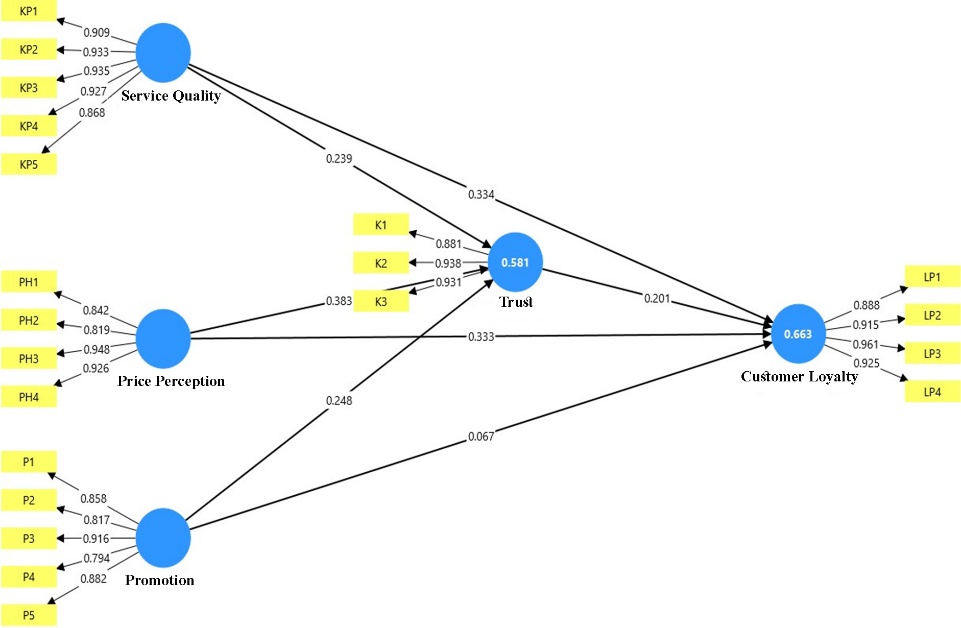
The path diagram from the SmartPLS output presents the outer loadings of all indicators across the constructs of trust (K1–K3), service quality (KP1–KP5), customer loyalty (LP1–LP4), price perception (PH1–PH4), and promotion (P1–P5). All indicators have outer loadings greater than 0.70 and AVEs above 0.50 (see Table 5), indicating convergent validity. Discriminant validity is also satisfied, as the square root of AVE for each construct exceeds its correlations with other constructs (see Table 6), in accordance with the (Fornell & Larcker, 1981). Furthermore, all constructs demonstrate composite reliability > 0.70 and Cronbach’s Alpha > 0.60 (see Table 7), confirming the instrument's reliability (Latan & Ghozali, 2012).
| Indicator | Trust | Servqual | Loyalty | Price | Promotion | AVE |
|---|---|---|---|---|---|---|
| K1 | 0.881 | 0.841 | ||||
| K2 | 0.938 | |||||
| K3 | 0.931 | |||||
| KP1 | 0.909 | 0.837 | ||||
| KP2 | 0.933 | |||||
| KP3 | 0.935 | |||||
| KP4 | 0.927 | |||||
| KP5 | 0.868 | |||||
| LP1 | 0.888 | 0.851 | ||||
| LP2 | 0.915 | |||||
| LP3 | 0.961 | |||||
| LP4 | 0.925 | |||||
| P1 | 0.858 | 0.730 | ||||
| P2 | 0.817 | |||||
| P3 | 0.916 | |||||
| P4 | 0.794 | |||||
| P5 | 0.882 | |||||
| PH1 | 0.842 | 0.784 | ||||
| PH2 | 0.819 | |||||
| PH3 | 0.948 | |||||
| PH4 | 0.926 |
Source: Data processed using SmartPLS, 2026
| Trust | Servqual | Loyalty | Price | Promotion | |
| Trust | 0.917 | ||||
| Servqual | 0.673 | 0.915 | |||
| Loyalty | 0.693 | 0.728 | 0.923 | ||
| Price | 0.671 | 0.615 | 0.711 | 0.885 | |
| Promotion | 0.657 | 0.798 | 0.655 | 0.568 | 0.855 |
Source: Data processed using SmartPLS, 2026
Note: Diagonal values (in bold) represent the square root of AVE
| Construct | Cronbach's Alpha | CR (rho_a) | CR (rho_c) | AVE |
| Trust | 0.905 | 0.905 | 0.941 | 0.841 |
| Servqual | 0.951 | 0.958 | 0.962 | 0.837 |
| Loyalty | 0.942 | 0.943 | 0.958 | 0.851 |
| Price | 0.907 | 0.924 | 0.935 | 0.784 |
| Promotion | 0.908 | 0.918 | 0.931 | 0.730 |
Source: Data processed using SmartPLS, 2026
Structural Model Evaluation (Inner Model)
The R² values for Trust and Customer Loyalty are 0.575 and 0.657, respectively, indicating moderate to substantial explanatory power (Ghozali, 2018). Price Perception has the largest effect size on both Trust (f² = 0.212) and Customer Loyalty (f² = 0.164). The SRMR of 0.069 (< 0.10) and NFI of 0.721 indicate an acceptable model fit (see Tables 8, 9, and 10).
| Variable | R Square |
| Trust | 0.575 |
| Loyalty | 0.657 |
Source: Data processed using SmartPLS, 2026
| Trust | Loyalty | |
|---|---|---|
| Trust | 0.050 | |
| Servqual | 0.044 | 0.103 |
| Price | 0.212 | 0.164 |
| Promotion | 0.052 | 0.005 |
Source: Data processed using SmartPLS, 2026
| Indicator | Saturated Model | Estimated Model |
|---|---|---|
| SRMR | 0.069 | 0.069 |
| d_ULS | 1.109 | 1.109 |
| d_G | 1.775 | 1.775 |
| Chi-Square | 1711.568 | 1711.568 |
| NFI | 0.721 | 0.721 |
Source: Data processed using SmartPLS, 2026
Hypothesis Testing
The path coefficient and mediation analysis are presented in Tables 11 and 12. Most hypotheses are supported, except for the direct effect of promotion on customer loyalty (H4) and the mediating role of trust in the relationship between price perception and customer loyalty (H10).
| Hypothesis Path | Original Sample | T-Statistic | P | Decision |
| Trust → Loyalty | 0.201 | 2.544 | 0.011 | Accepted |
| Servqual → Trust | 0.239 | 3.340 | 0.001 | Accepted |
| Servqual → Loyalty | 0.334 | 3.246 | 0.001 | Accepted |
| Price → Trust | 0.383 | 4.956 | 0.000 | Accepted |
| Price → Loyalty | 0.333 | 3.693 | 0.000 | Accepted |
| Promotion → Trust | 0.248 | 3.134 | 0.002 | Accepted |
| Promotion → Loyalty | 0.067 | 0.753 | 0.451 | Rejected |
Source: Data processed using SmartPLS, 2026
| Mediation Path | Original Sample | T-Statistic | P-Value | Decision |
| Servqual → Trust → Loyalty | 0.048 | 2.531 | 0.011 | Accepted |
| Price → Trust → Loyalty | 0.077 | 1.814 | 0.070 | Rejected |
| Promotion → Trust → Loyalty | 0.050 | 2.031 | 0.042 | Accepted |
Source: Data processed using SmartPLS, 2026
Discussion
Service Quality on Customer Loyalty
Service quality affects customer loyalty positively significantly (original sample = 0.334; p = 0.001). Service elements,, i.e., reliability, responsiveness, assurance, empathy, and tangibility, have been proven to deliver seamless service, which creates strong customer preference and high resistance to competitor offerings. All this drives repeat purchases and long-term positive word of mouth (Hapsari et al., 2016).
Price Perception on Customer Loyalty
Price perception affects customer loyalty positively significantly (original sample = 0.333; p = 0.000). Fair, comparable, and transparent prices provide reassurance in transactions and limit the need for customers to reconsider their selections. On the other hand, negative price perceptions can activate price sensitivity and switching to other stores.
Promotion on Customer Loyalty
Promotion does not affect customer loyalty significantly (original sample = 0.067; p = 0.451). Promotions that are primarily oriented toward short-term incentives are insufficient to transform momentary purchase behavior into long-term commitment. Inconsistent promotions between claims and actual execution may even undermine the trust that has been established.
Service Quality on Trust
Service quality positively significantly affects trust (original sample = 0.239; p = 0.001). Having consistently reliable service and a compassionate response will form confidence in the ability of its services. The consistency of service quality leads to trust because, as opposed to (Alrawad et al., 2023), high-quality interactions reduce risk perceptions. In addition, service quality also stimulates the reconstruction of trust to encourage repurchase intention.
Price Perception on Trust
Price perception positively significantly affects trust (original sample = 0.383; p = 0.000). When a company charges fair and transparent prices, customers see that honest for the goods. As stated by (Alrawad et al., 2023) pricing consistency strengthens trust. Well pricing also leverages good service and hence the level of trust increases. (Sari, 2022) mentions that correct price labeling reinforces customer confidence. In the context of retail in Indonesia, price transparency is thus imperative to build trust.
Promotion on Trust
Promotion positively significantly affects trust (original sample = 0.248; p = 0.002). Promotions provide information that relates directly to real customer experiences, which enhances the credibility of the company. Promotions that deliver on their promises increase trust, whereas deceptive practices, such as bait-and-switch, destroy it. What aids in good promotion is supporting trust, thus reinforcing loyalty (Parasuraman et al., 1988), therefore trust via alignment of online and offline promotion leads to visitors returning.
Trust on Customer Loyalty
Trust positively significantly affects customer loyalty (original sample=0.201; p=0.011). Transaction risk is minimized through trust, which also increases customer retention over the long term. As trust in the company increases, customers show more leniency to minor service failures and more commonly recommend others to the brand who help facilitate a pipeline upon which any loyal base of customers relies making trust an inevitable precursor to long-term loyalty (Alrawad et al., 2023).
Service Quality on Customer Loyalty through Trust
Trust positively significantly mediates the service quality effect on customer loyalty (original sample = 0.048; p = 0.011). The trust is formed from repeated service interactions which act as a psychological bridge that flows transactional satisfaction into long-run relational commitment, both affective and behavioral (Hapsari et al., 2016).
Price Perception on Customer Loyalty through Trust
Trust does not significantly mediate the price perception effect on customer loyalty (original sample = 0.077; p = 0.070). Customers with a favorable price perception remain loyal directly without trust serving as an intermediary construct. In this context, price perception operates as an independent and a direct antecedent to loyalty (Ghani et al., 2023).
Promotion on Customer Loyalty through Trust
Trust significantly mediates the promotion effect on customer loyalty (original sample = 0.050; p = 0.042). Promotions don't necessarily have a direct impact on loyalty, but if done correctly, they can indirectly strengthen loyalty by building trust. Trust transforms promotional incentives into long-term relationship bonds, rather than just occasional transactions. (Zhao et al., 2010).
4. Conclusion
The findings revealed service quality and price perception are significant driving factors of trust and customer loyalty. However, promotion only influences trust and is not a direct influencer of loyalty. Trust positively significantly affects loyalty. Furthermore, it is shown that trust is a mediator of the service quality and promotion impact on loyalty, but trust does not mediate the price perception impact on loyalty. These results explain that promotion is not a direct contributor to customer loyalty. It aids in customer trust, which makes this an indirect contribution. It serves as a psychological bridge, transforming shopping into a lasting commitment. Following these findings, achieving customer loyalty is much more than registering low prices or appealing promotions, but it also has to do with having that consistency needed over time for the quality of service and price disclosure to slowly generate a deep trust in customers.
The findings suggest several recommendations. Empathy dimensions in services are the least developed aspect of service which is influenced by customer trust, so it should get more attention from MR. DIY Banda Aceh management. For transparency with pricing strategies, customers have to feel they get what they pay for. What credibility is not the carrot is fleeting (for from credibility comes long-term trust to fulfill promotional programs). Future studies should examine customer satisfaction as a mediator across additional fields of study, while expanding their geographic scope to enhance generalizability.
References
- Alrawad, M., Lutfi, A., Almaiah, M., & Elshaer, I. A. (2023). Examining the influence of trust and perceived risk on customers intention to use NFC mobile payment system. Journal of Open Innovation Technology Market and Complexity, 9(2), 100070. DOI ↗ Google Scholar ↗
- Creswell, J. W., & Poth, C. N. (2017). Qualitative Inquiry and Research Design: Choosing Among Five Approaches. SAGE Publications. DOI ↗ Google Scholar ↗
- Fida, B. A., Ahmed, U., Al-Balushi, Y., & Singh, D. (2020). Impact of Service Quality on Customer Loyalty and Customer Satisfaction in Islamic Banks in the Sultanate of Oman. Sage Open, 10(2), 1–10. DOI ↗ Google Scholar ↗
- Fornell, C., & Larcker, D. F. (1981). Evaluating structural equation models with unobservable variables and measurement error. Journal of Marketing Research, 18(1), 39–50. DOI ↗ Google Scholar ↗
- Ghani, B., Hyder, S. I., Yoo, S., & Han, H. (2023). Does employee engagement promote innovation? The Facilitators of innovative workplace behavior via mediation and moderation. Heliyon, 9(11), e21817. DOI ↗ Google Scholar ↗
- Ghozali, I. (2018). Aplikasi analisis multivariate dengan program IBM SPSS 25 (9th ed.). Badan Penerbit Universitas Diponegoro. DOI ↗ Google Scholar ↗
- Hapsari, R., David, C., & Dean, M. (2016). The Mediating Role of Perceived Value on the Relationship between Service Quality and Customer Satisfaction: Evidence from Indonesian Airline Passengers. Procedia Economics and Finance, 35, 388–395. DOI ↗ Google Scholar ↗
- Henseler, J., Ringle, C. M., & Sarstedt, M. (2015). A new criterion for assessing discriminant validity in variance-based structural equation modeling. Journal of the Academy of Marketing Science, 43(1), 115–135. DOI ↗ Google Scholar ↗
- Ju, Y., Back, K. J., Choi, Y., & Lee, J. S. (2019). Exploring Airbnb service quality attributes and their asymmetric effects on customer satisfaction. International Journal of Hospitality Management, 77(November 2017), 342–352. DOI ↗ Google Scholar ↗
- Latan, H., & Ghozali, I. (2012). Partial Least Square: Konsep, Teknik, dan Aplikasi SmartPLS 2.0 M3. Semarang: Badan Penerbit Universitas Diponogero. DOI ↗ Google Scholar ↗
- Mufidah, Hardian, M. E., & Nugraha, A. (2021). Nilai Keadilan Dalam Pembangunan Ekonomi Di Tengah Maraknya Perdagangan E-Commerce. Mizan Journal of Islamic Law, 5(2), 207–222. DOI ↗ Google Scholar ↗
- Parasuraman, A. P., Zeithaml, V. A., & Berry, L. L. (1988). SERVQUAL: A multiple- Item Scale for measuring consumer perceptions of service quality. Journal of Retailing, 64(1 Spring), 12–40. DOI ↗ Google Scholar ↗
- Putra, E. T. K., & Pudjoprastyono, H. (2023). Pengaruh Persepsi Harga Dan Kualitas Produk Terhadap Keputusan Pembelian Paket Internet XL. Derivatif : Jurnal Manajemen, 17(1), 100–109. DOI ↗ Google Scholar ↗
- Sansome, K., Conduit, J., & Wilkie, D. (2025). Consumers demand transparency… but do they actually engage? Exploring motives and interactions with brand transparency information. Journal of Business Research, 194, 115386. DOI ↗ Google Scholar ↗
- Sari, D. P. (2022). Pengaruh promosi terhadap loyalitas pelanggan. Jurnal Ilmu Manajemen. DOI ↗ Google Scholar ↗
- Sharp, B., Dawes, J., & Victory, K. (2024). The market-based assets theory of brand competition. Journal of Retailing and Consumer Services, 76, 103566. DOI ↗ Google Scholar ↗
- Slack, N., Singh, G., & Sharma, S. (2020). The effect of supermarket service quality dimensions and customer satisfaction on customer loyalty and disloyalty dimensions. International Journal of Quality and Service Sciences, 12(3), 297–318. DOI ↗ Google Scholar ↗
- Tahir, A. H., Adnan, M., & Saeed, Z. (2024). The impact of brand image on customer satisfaction and brand loyalty: A systematic literature review. Heliyon, 10(16), e36254. DOI ↗ Google Scholar ↗
- Taufik, A., Santoso, S., Fahmi, M. I., Restuanto, F., & Yamin, S. (2022). The Role of Service and Product Quality on Customer Loyalty: The Role of Service and Product Quality on Customer Loyalty. Journal of Consumer Sciences, 7(1), 68–82. DOI ↗ Google Scholar ↗
- Yesitadewi, V. I., & Widodo, T. (2023). The Influence of Service Quality, Perceived Value, and Trust on Customer Loyalty via Customer Satisfaction in Deliveree Indonesia. Quality - Access to Success, 25(198), 418–423. DOI ↗ Google Scholar ↗
- Zhao, X., Lynch, J. G., & Chen, Q. (2010). Reconsidering Baron and Kenny: Myths and Truths about Mediation Analysis. Journal of Consumer Research, 37(2), 197–206. DOI ↗ Google Scholar ↗