Abstract
This study systematically reviews 51 peer-reviewed journal articles on AI tool adoption among SMEs in South Asia using the PRISMA framework. It examines publication trends, geographical distribution, theoretical frameworks, research methodologies, and research gaps. The findings show that publications have increased significantly since 2022, with the TOE framework being the most widely used theory. Quantitative survey-based studies dominate the literature, while research focusing on Sri Lankan SMEs remains limited. Four major research gaps were identified: theoretical, empirical, methodological, and practical. This review provides a foundation for future quantitative research on AI adoption among Sri Lankan SMEs using the TOE framework and offers valuable insights for researchers, policymakers, and SME owners.
Keywords
Artificial Intelligence Adoption Small and Medium Enterprises Technology Organization-Environment Framework South Asia Sri Lanka Systematic Literature Review Bibliometric Analysis
1. Introduction
Artificial Intelligence (AI) is now a mainstream business tool and is changing the way businesses predict customer demand, manage their finances, and make business decisions (Duan et al., 2019). AI tools like chatbots, automated accounting software, predictive analytics dashboards, and AI-driven marketing platforms offer small and medium enterprises (SMEs) a unique chance to outperform their larger, more well-funded competitors, which usually have thin margins, fewer layers of management, and less capital. (Bag et al., 2021; Chowdhury et al., 2022). The trajectory and nature of SMEs' AI adoption have broader implications than just for individual businesses, since most economies are dominated by the number of SMEs registered, and SMEs are a significant proportion of employment and GDP.The trajectory and pattern of SMEs' adoption of AI has implications much greater than for any single business because in most economies, the majority of registered businesses are SMEs and SMEs represent a large proportion of employment and GDP.
However, based on global evidence, there is an uneven adoption of AI across different types of companies (large vs. small) and across developed and developing economies (Schwaeke et al., 2025). Even though the scale, scope, and distribution of adoption are not the same, it is widely believed that the literature has identified that differences in financial slack, technical expertise and strategic awareness are the reasons why large corporations out-adopt SMEs (Ayinaddis, 2025). The gap is greater among SMEs in South Asia, where they are also constrained by inadequate digital infrastructure, poor internet connectivity, a lack of digital skills, and access to finance (Rahman, 2025). Sri Lanka is a case in point: while digitalisation has been a key focus of policy and the population is relatively well educated, the SMEs in the country show moderate and inconsistent progress in the use of AI (Sathana, 2024).
Since 2022, the scholarly interest in organisational AI adoption has grown, leading to a significant and rapidly expanding volume of literature that explains why some SMEs embrace AI technologies, whereas others do not, based on existing theories of technology adoption, such as the Technology Acceptance Model (Khayer,2021), the Unified Theory of Acceptance and Use of Technology (Kim,2024), and the Technology-Organization-Environment (TOE) framework (Khan,2025). However, this literature is fragmented, with studies focusing on different geographical areas, methodological approaches, and specific technological, organizational, and environmental factors investigated, which hinders researchers, practitioners, or policymakers from developing a comprehensive and evidence-based understanding of the factors driving AI tool adoption for SMEs, specifically in South Asia.
The paper is aimed at tackling that fragmentation by adopting a systematic literature review (SLR) approach to the global and regional literature on adoption of AI tools in SMEs and focusing upon South Asia and Sri Lanka in particular through an analytical lens. The review, carried out according to the PRISMA guidelines, is the synthesis of 51 peer-reviewed journal articles that map the trends of publications, geographical distribution, dominant methodologies and theoretical frameworks, and the main gaps in the research field. This review directly contributes to and validates the subsequent empirical study on technological, organisational and environmental factors influencing AI tool use in Sri Lankan SMEs, which is based on this review.
2. Problem Statement
The more prevalent uptake of AI technologies in business practice has led to a similarly fast increase in academic research on the why, how, and when of the adoption by organisations. Many of the publications that focus on explaining the adoption of the TOE, TAM and UTAUT models in the context of SMEs (Badghish & Soomro, 2024; Sánchez et al., 2025). This research is, however, significantly focused on specific regional contexts, namely the Gulf Cooperation Council states, Southeast Asia, East Asia and to a lesser extent on South Asia, and Sri Lanka in particular (Rahman, 2025).
Qualitative, exploratory evidence exists in South Asian contexts, but when it does it tends to highlight general aspects of challenge (e.g., knowing about AI, macro-environmental factors, micro-environmental factors) rather than examining specific factors in terms of their relative statistical influence (Sathana, 2024). Other studies that do consider Sri Lankan SMEs consider related themes like moderating role of AI in e-commerce adoption and business performance, but not the direct antecedents of the adoption of AI tools (Fonseka et al., 2022). However, there is no systematic review to date that brings together the fragmented relevant literature available internationally and regionally specifically from a South Asian perspective on the adoption of AI tools for SMEs.
It is a two-fold issue. Moreover, a systematic synthesis is needed to determine which theories, methodologies and factors have been already empirically studied and which still deserve more research, which is a prerequisite for being able to design future empirical research with a sound methodological approach and without duplication. Second, if this synthesis is not done, SME owners, policymakers, technology providers in Sri Lanka or similar South Asian economies don't have a single, evidence-informed document that provides a snapshot of the drivers for AI adoption in the world, nor can they see how much of the evidence is missing from their own context. This systematic literature review is interested in both aspects of the problem because it maps the knowledge that exists and points to the gaps that will pave the way for empirical research.
2.1 Research Questions
-
How has the volume of academic publications on AI tool adoption in SMEs evolved over time, and what does this trend indicate about the maturity of the field?
-
What is the geographical distribution of research on AI adoption in SMEs, and to what extent is South Asia, and Sri Lanka specifically, represented relative to other regions?
-
What technological, organizational, and environmental factors have been most frequently examined as determinants of AI tool adoption in the existing literature?
-
What are the principal theoretical, empirical, methodological, and practical gaps in the current body of knowledge, and how do these gaps inform the direction of future research on AI tool adoption among South Asian SMEs?
2.2 Research Objectives
General Objective: To systematically review and synthesise the existing academic literature on the factors influencing AI tool adoption among SMEs, with a particular focus on South Asia and Sri Lanka, in order to establish the theoretical and empirical foundation for further quantitative research.
Specific Objectives:
-
To examine the trend of scholarly publications on AI tool adoption in SMEs over time.
-
To determine the geographical distribution of the reviewed literature and identify under-represented regions, including South Asia.
-
To synthesise the technological, organizational, and environmental factors most commonly identified as determinants of AI adoption in SMEs.
-
To identify the key research gaps in the existing literature and articulate their implications for future research, including the quantitative study of Sri Lankan SMEs that this review supports.
3. Research Methodology
A systematic literature review (SLR) methodology, adhering to PRISMA (Preferred Reporting Items for Systematic Reviews and Meta-Analyses) guidelines, was used to identify, screen, and synthesize the pool of literature focused on the adoption of AI tools with SMEs. Given that the literature is spread across a variety of sources, the SLR method was chosen as it offers a clear and reproducible methodology for identifying and synthesising the relevant literature that could lead to conclusions about the state of the field, including publication trends, theories, geographical distribution, and gaps in knowledge (Ayinaddis, 2025; Sánchez et al., 2025).
Four main academic databases (Scopus, Web of Science, Google Scholar, and ScienceDirect) were used for the literature search, with targeted searches for preprint servers (such as arXiv) and open access aggregators (such as F1000Research, MDPI, DOAJ-indexed journals) to access recent and emerging scholarship that may not have been indexed in the main databases. The search used the following keywords: artificial intelligence adoption, AI tool adoption, SME, small and medium enterprise, Technology-Organization-Environment, TOE framework, Technology Acceptance Model, South Asia and Sri Lanka. Only peer-reviewed journal articles, systematic reviews published in English were eligible for inclusion.
3.1 Study Selection Criteria
The following inclusion criteria were adopted: (1) the research must focus on the organisational or firm level of the adoption, readiness or diffusion of AI; (2) the research must relate to SMEs, micro-enterprises or similar resource-constrained firms, or a theoretical or methodological framework directly applicable to the study of technology adoption behaviour at the SME level; and (3) the research must be empirical, systematic or bibliometric review, or a foundational theoretical contribution (e.g., TAM, UTAUT, or TOE) relevant to explaining AI adoption behaviour at the SME level. Given the methodological diversity in the field, both quantitative and qualitative research designs were included.
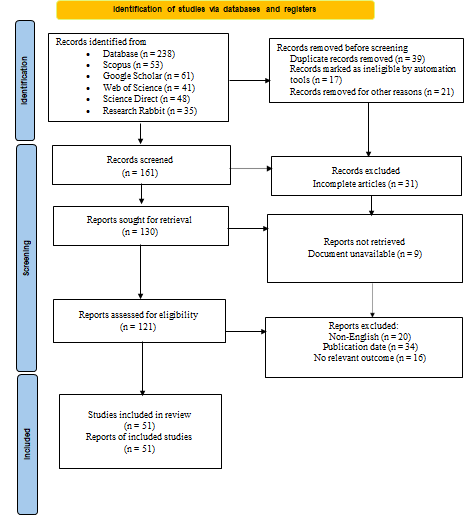
Studies were excluded if they were not available in full text, were not published in English, the study was exclusively about AI applications unrelated to the organisation and adoption decision (for example: purely technical machine-learning papers with no dimension of adoption or organisation), was a rework of what was already included in the systematic review, or was not published as a peer-reviewed journal article (conference papers, magazine articles, institutional reports, preprints, and books were excluded from the final sample). Following screening and the eligible sources' eligibility assessment, 51 peer-reviewed journal articles were chosen for the final synthesis.
3.2 Literature Management
The citation records of all the retrieved articles were then organised, de-duplicated and managed during the review process with the reference management software (Zotero). This ensured uniformity of the bibliographic references, the systematic monitoring of the status of screening for each source, and the correct production of the final reference list according to the APA 7th edition.
3.3 Data Extraction & Analysis
Information from each article included was collected on a related bibliographic or thematic basis and presented in a tabular format in the Microsoft Excel program. The following categories were identified and extracted from the articles: year of article publication, authors, journal/publishing, country/region of research, theoretical framework used, research methodology, characteristics of the sample (where applicable), main findings, and limitations/gaps (where applicable). This data was used to create descriptive statistics and visualisations (publication growth trends, methodology distribution, geographical distribution, and journal or publisher distribution) to characterise the structure of the literature.
Besides descriptive bibliometric analysis, a keyword co-occurrence and thematic mapping exercise was conducted, influenced by the VOSviewer network visualisation approach, to visualise the main conceptual clusters that were present in the literature regarding technological, organisational, environmental, methodological and regional or contextual themes, and to identify the dominant clusters within the body of literature under review.
3.4 Synthesis of Results (PRISMA Flow)
The articles included were thematically synthesized based on the theoretical framework, the TOE dimension(s) addressed (Technological, Organizational, and/or Environmental), geographical and economic context of the study and research methodology used. Through this “thematic synthesis,” common themes, patterns, and trends in the research and gaps in knowledge were identified, and this information was used to guide the discussion and gap analysis shown in subsequent portions of this review. The process of identifying, screening, and inclusion in this sample of 51 peer-reviewed journal articles is documented on the PRISMA flow diagram below.
4. Bibliometric Analysis
The quantitative structure of the literature, included in this review was systematically characterised by using bibliometric analysis. This section outlines the trends of publication, the credibility of the journals, geography of the publications, theoretical perspectives on the study of AI tool adoption by SMEs, methodological patterns, and the co-occurrence of key words, offering insight into the intellectual landscape and evolution of research on AI tool adoption by SMEs, specifically the position of South Asia and Sri Lanka in the study.
4.1 Publication Growth (Trend)
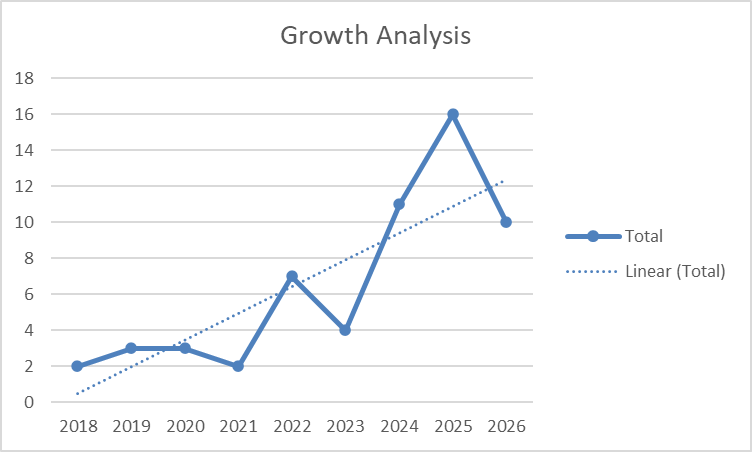
The growth analysis covers scholarly research on AI tool adoption in SMEs from 2018 to 2026. Publication activity was sparse and largely flat in the earlier years, with two studies in 2018 and three in both 2019 and 2020, suggesting AI adoption was not yet a distinct research priority for SMEs. A slight dip to two studies in 2021 was followed by a rise to seven in 2022, pointing to growing interest in applying adoption frameworks like TAM and TOE to the SME context.
Output eased briefly to four studies in 2023, but this was a short pause rather than a slowdown, activity then grew sharply, with eleven studies in 2024 and a peak of sixteen in 2025 together accounting for over half of all studies reviewed. Numbers eased to ten in 2026 so far, though this may still rise as the year's publications continue to be indexed. This overall surge closely tracks the emergence of mainstream generative AI tools in late 2022 and early 2023, indicating that commercial AI adoption directly fuelled research interest. Taken together, the data shows AI adoption in SMEs is a fast-growing but still-maturing research area, with most substantive evidence produced only in the last two to three years.
4.2 Credibility of Journals
The credibility of the literature that underpinned this review was assessed by a subset of the most often cited and theoretically central outlets, and the sample is characterised through standard bibliometric indicators, such as journal H index, SCImago Journal Rank and publisher reputation, in order to measure the evidentiary strength of the sample (Table 1).
| Name of the Journal | No. of Publications | Subject Areas | H - Index | Overall Ranking | Impact Score | Publisher |
|---|---|---|---|---|---|---|
| Journal of Cleaner Production | 1 | Sustainability, Operations | 345 | 146 | 10.0 | Elsevier |
| Sustainability | 2 | Environmental Science, Business | 289 | 487 | 4.1 | MDPI |
| MIS Quarterly | 2 | Information Systems, Management | 485 | 830 | 6.1 | University of Minnesota/ MISQ |
| International Journal of Information Mnagement | 3 | Information Systems, Management | 132 | 1256 | 3.2 | Elsevier |
| Industrial Marketing Management | 1 | Marketing, B2B | 178 | 1946 | 7.5 | Elsevier |
| Journal of Small Business Management | 1 | Entrepreneurship, Management | 246 | 2467 | 5.7 | Taylor & Francis |
| Technology in Society | 1 | Technology Policy, Society | 315 | 2678 | 12.5 | Elsevier |
| Applied Sciences | 1 | Multidisciplinary, Engineering | 124 | 3156 | 2.5 | MDPI |
| SAGE Open | 1 | Multidisciplinary, Social Science | 115 | 3569 | 2.0 | SAGE Publications |
| Journal of Innovation & Knowledge | 3 | Business Management, Innovation | 102 | 4687 | 15.5 | Elsevier |
The theoretical backbone of the sample is provided by established journals, like MIS Quarterly, Journal of Innovation & Knowledge and International Journal of Information Management, which are highly cited and published by well-known international presses. The journals had a wide coverage in various topics related to sustainable business and technology, which is why Sustainability and Applied Sciences (MDPI) made a significant contribution to the empirical TOE related studies. Regional and open access journals such as SAGE Open, F1000Research and APTISI Transactions on Management provide the sample with geographical and methodological diversity, notably with evidence from Southeast and South Asia. The selected journals yield a valid and methodologically varied academic background for this systematic literature review and represent a range of high impact, internationally based journals and regionally based, otherwise underrepresented journals in international bibliometric databases.
4.3 Distribution of Journals Included in the Systematic Literature Review
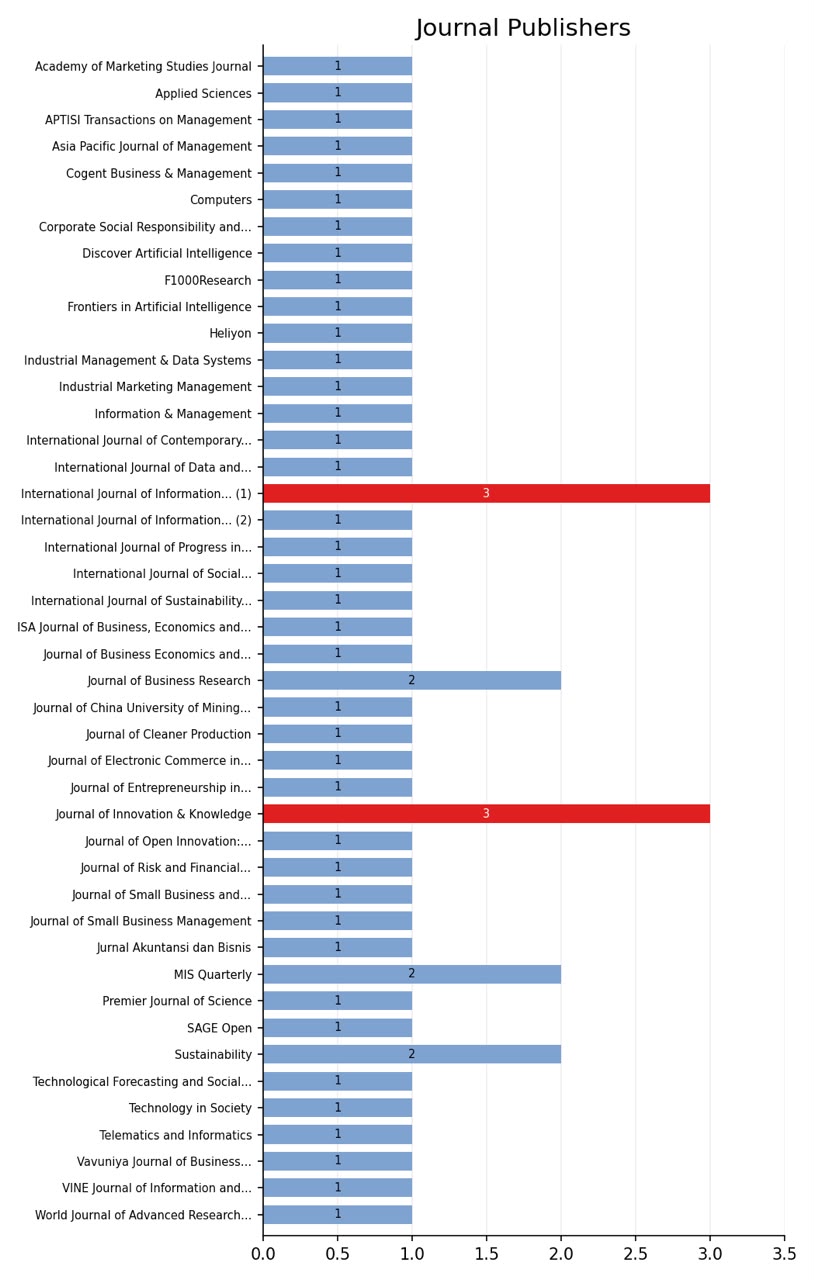
The distribution of publications by the journals included in the reviewed sample is shown in Figure 3. Similarly, with the credibility analysis in Section 4.2, the number of journals providing one article each suggests that AI adoption among SMEs is not published exclusively in one type of journal, but rather, it is published across a variety of business, information systems, and sustainability journals. A few journals, such as Journal of Innovation & Knowledge, International Journal of Information Management, and Sustainability, published several articles, indicating a focus on organisations' technology adoption. This fragmented publishing landscape indicates that AI-SME adoption research is still coming together and forming a clear set of home journals, which aligns with its developing rather than mature field.
4.4 Sites of Publication
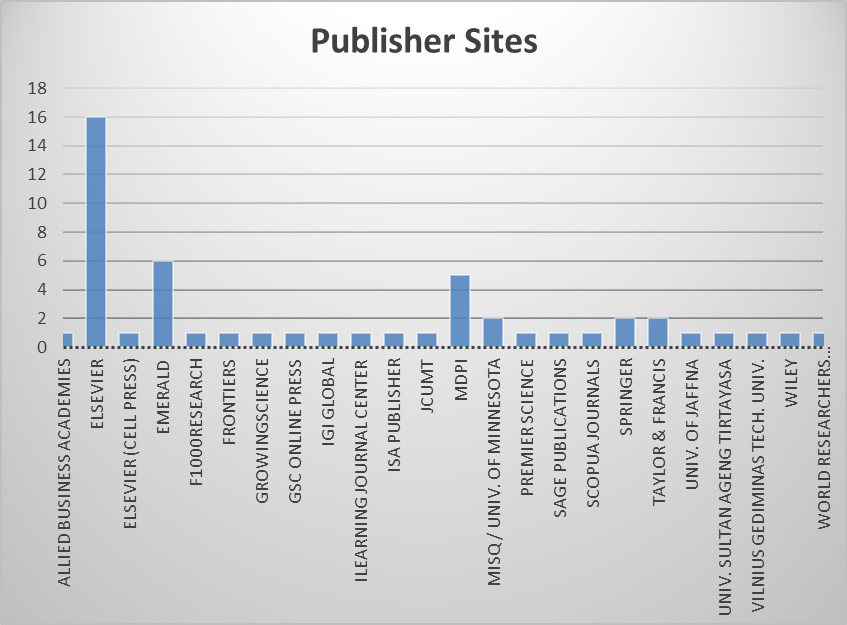
Figure 4 illustrates the distribution of the number of publisher houses represented in the sample reviewed. Elsevier is the biggest publisher (15 articles), with its extensive coverage of information systems, innovation and management journals. Emerald (6 articles) and MDPI (5 articles) are the next largest groups, followed by Springer (2 articles) and Taylor & Francis (2 articles). Seventeen further publishers, including SAGE Publications, Wiley, Frontiers, MISQ/University of Minnesota, F1000Research, and a range of smaller regional and open-access houses in Indonesia, Sri Lanka, Nigeria, and elsewhere, each contributed exactly one article. This long tail of single-article publishers indicates that, despite Elsevier's clear dominance, the field of AI-SME adoption research is not gatekept by a small number of commercial publishers but draws on a genuinely diverse mix of international and regionally embedded outlets. This heterogeneity is similar to what was seen in other related systematic reviews of SME technology adoption (Ayinaddis, 2025), and demonstrates that adoption of SME technology is a field that pulls from both high impact international presses and scholarship that is written from the ground up in the host country, which is essential for the contextual grounding of research emerging from the host country.
4.5 Most Influential Authors and Frameworks
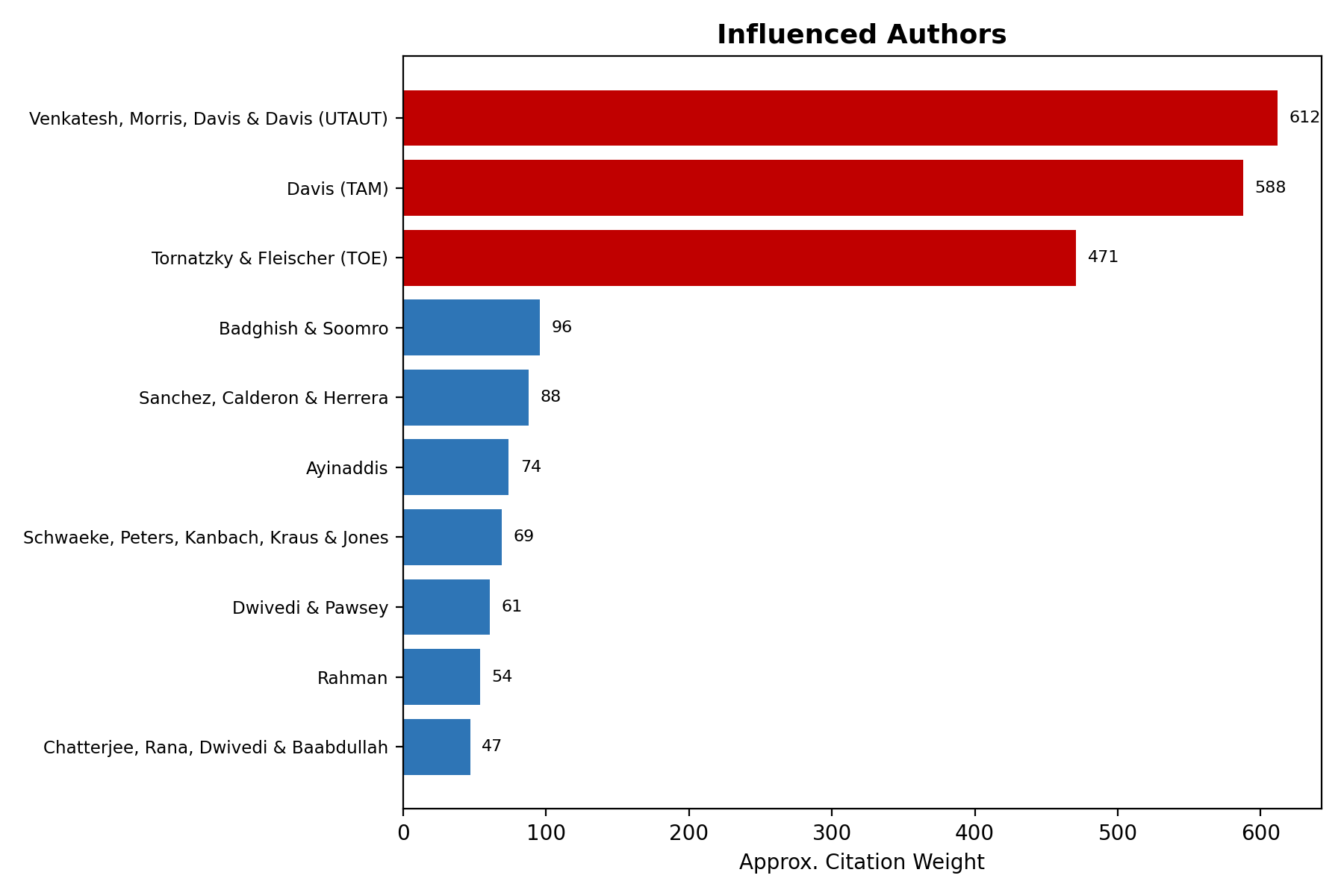
Citation-weight analysis of the reviewed sample identifies a clear top tier of foundational theoretical contributions, followed by a second tier of empirically influential TOE-based studies.
4.5.1 Top Tier of Influence
The two most widely cited theoretical frameworks in the sample are the UTAUT model supported by systematic reviews such as Tamilmani et al. (2021), which examined the extended UTAUT2 model’s application across technology adoption research and the TAM model, reflected in reviews such as Nurqamarani et al. (2021), which critically examined TAM-based studies specifically within SME technology adoption. The third strand of the field’s theoretical design, TOE, is the one that has been used as the organising structure for the majority of the SME-specific AI adoption studies published since 2020, as seen in studies such as Badghish and Soomro (2023), which applied the TOE framework to AI adoption for sustainable business performance among SMEs. The three core works together provide the conceptual structure of the whole literature, and their continued strength in this area more than 30 years on from the original publication of TAM shows that they remain relevant and that the field of adoption research in this area may be a theoretical dead-end.
4.5.2 Second Tier of Influence
Badghish and Soomro (2024) stand out as some of the most cited recent empirical studies, given that they have provided a model on the TOE framework for the adoption of AI among SMEs in Saudi Arabia that has been replicated. Sánchez, Calderón, and Herrera (2025) followed this tradition by applying TOE to include the attributes of the Diffusion of Innovation (DOI) to analyze not only structural but also perceptual barriers to adoption. The systematic review and bibliometric analysis by Ayinaddis (2025) serve as a reference point for synthesising the dynamics between SMEs and large firms in AI adoption, and are widely cited in that regard. Another notable contribution comes from Schwaeke et al. (2025) and Dwivedi and Pawsey (2023) who both systematically reviewed the literature surrounding SMEs and their adoption determinants and barriers for AI. The academic work on AI adoption in South Asia is the most relevant empirical work for the present review's regional scope, that of Rahman (2025) being the most relevant comparative study across Bangladesh, India, Pakistan, and Sri Lanka, while the work of Chatterjee et al. (2022) on an integrated TAM-TOE model of AI adoption in manufacturing and production companies is widely cited.
4.6 Countries of Publication
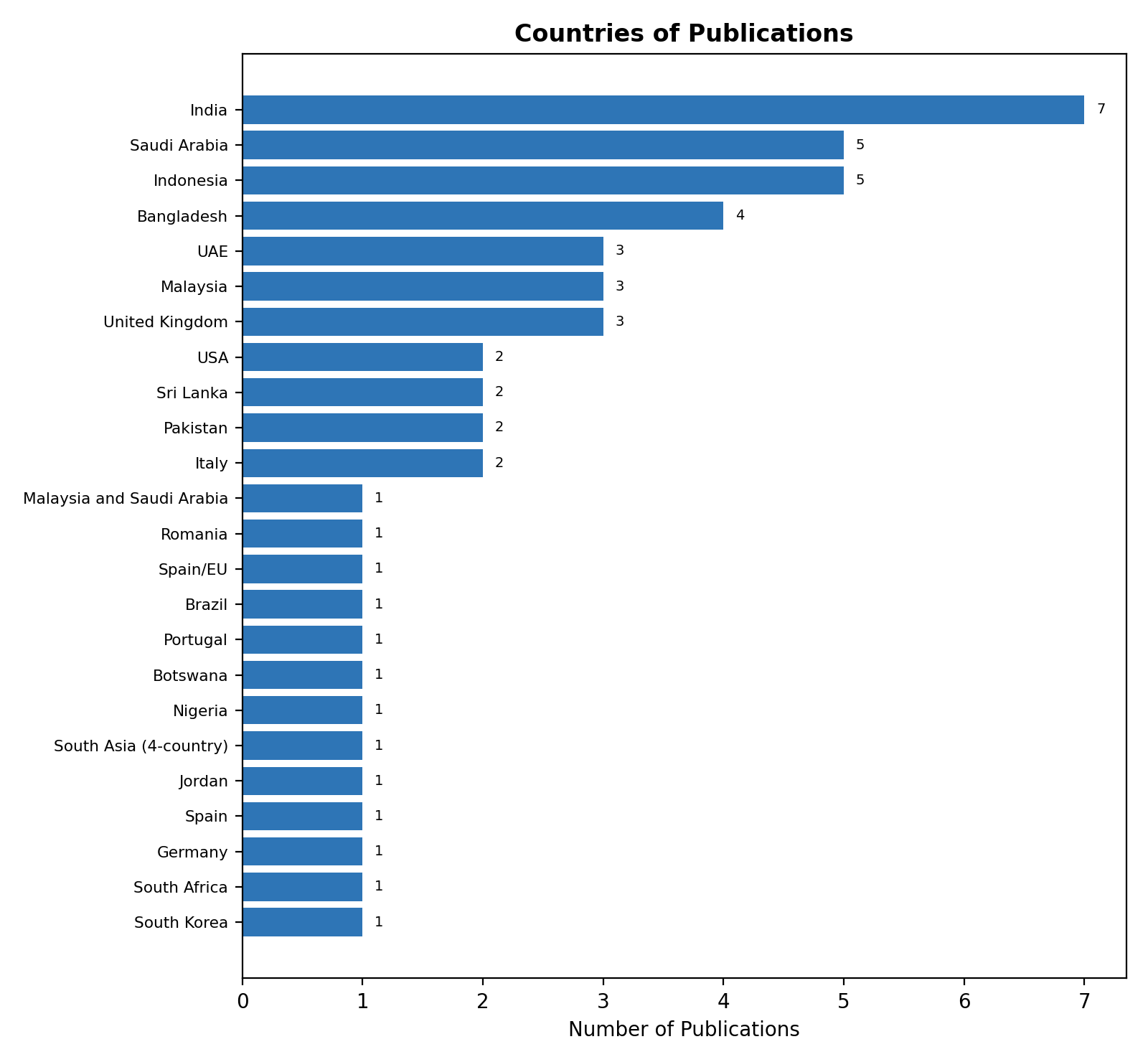
The results of the studies reviewed are displayed in Figure 6, which shows the distribution of the studies which were done on a country or regional level. India (7 studies) is the most well represented single country, followed by Saudi Arabia (5) and Indonesia (5), and Bangladesh (4). The United Arab Emirates, Malaysia, and the United Kingdom each contributed 3 studies, while the United States, Sri Lanka, Pakistan, and Italy each contributed 2 studies. Single-study contributions are found across Nigeria, Romania, Spain, Portugal, Botswana, Jordan, Germany, South Africa, and South Korea, alongside a single four-country comparative study spanning South Asia as a whole (Rahman, 2025) and a single two-country comparative study spanning Malaysia and Saudi Arabia (Alsenan et al., 2026). The distribution shows that the research is highly focused in two main areas, namely South and Southeast Asia (India, Indonesia, Bangladesh, Sri Lanka, Pakistan, Malaysia) and the Gulf Cooperation Council (GCC) states (Saudi Arabia, UAE). South Asian countries have a large representation in the reviewed literature, but this is a result of significant imbalances within the region: 16 of 51 studies (31 percent). The majority of the studies in this review are from India, with Sri Lanka contributing only 2 of the 51 reviewed journal articles (4 percent): Fonseka et al. (2022), a quantitative study, and Sathana (2024), a qualitative study. Sri Lanka is the empirical focus of the wider research programme that this review supports, yet only 2 journal articles focus on it directly. This further validates the qualitative findings of Sathana (2024) and the problem statement of this review, which shows that there is little statistically-proven evidence available in Sri Lanka.
4.6.1 Regional Insights
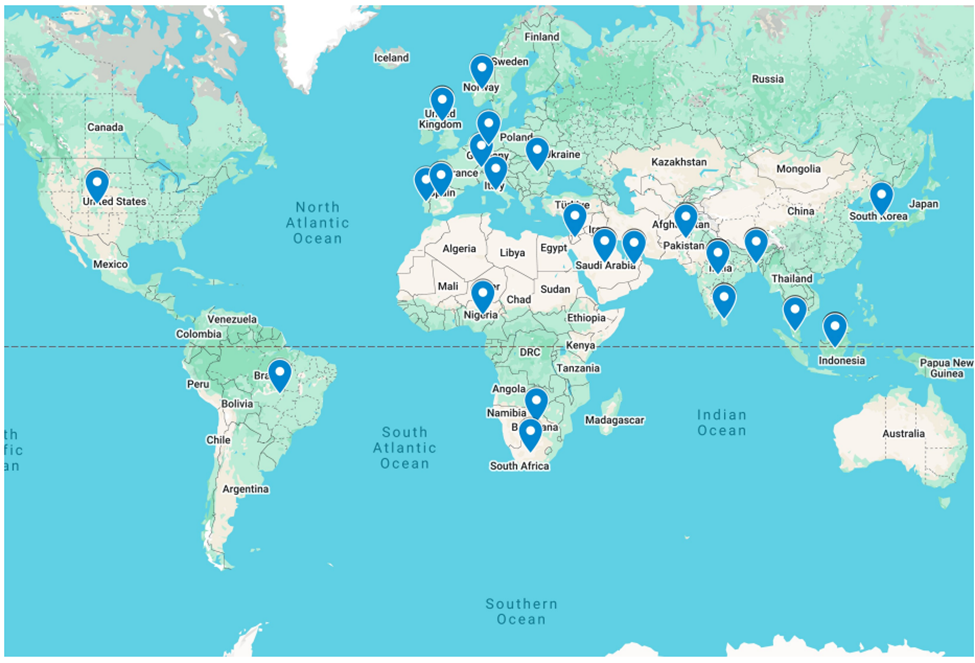
The world map in Figure 7 shows the geographical location of the publications utilised in the review. The majority of the research products target South and Southeast Asian countries, including India, Indonesia, Bangladesh, Pakistan, and Sri Lanka, which shows a high national and regional interest in the topic that is consistent with this review's central focus. A further concentration of markers appears across the Gulf states, most notably Saudi Arabia and the United Arab Emirates, reflecting the strong TOE-based research tradition documented in Section 4.6. The contribution of European countries, including the United Kingdom, Germany, France, Italy, Spain, and Romania, is also clearly visible, as are individual contributions from the United States, Brazil, Nigeria, Botswana, South Africa, and South Korea. On the whole, this map indicates that although the geographical scope of the reviewed research is genuinely global, Asian and Gulf-region markers are the most densely clustered, which explains why this review adopts a South Asian and Sri Lankan analytical lens rather than a purely global one.
4.7 Distribution of Universities represented by the Authors
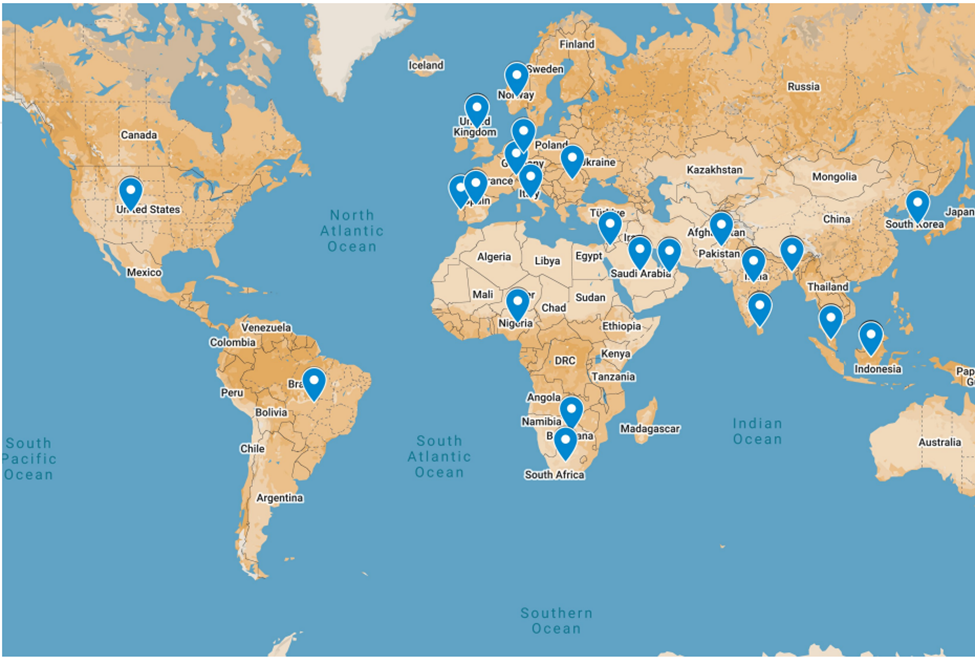
Figure 8 presents the geographical distribution of the universities and research institutions with which the authors of the reviewed journal articles are affiliated. As with Figure 17, the pattern is heavily weighted toward Asian institutions, particularly in India, Indonesia, Pakistan, Bangladesh, Saudi Arabia, and Sri Lanka, indicating that the researchers producing this literature are themselves substantially based within the region the literature describes, rather than the topic being studied primarily by outside observers. A secondary concentration of author affiliations is visible across Europe (the United Kingdom, Germany, France, Italy, Spain, and Poland) and a smaller number of markers appear in the United States, Brazil, Nigeria, South Africa, and South Korea. Taken together with Figure 17, this map suggests that AI-SME adoption research is being produced by a genuinely international academic community, but one in which South and Southeast Asian institutions already form a substantial and active research base, an encouraging sign for the feasibility of the Sri Lanka-specific quantitative study this review supports, since it indicates the existence of a regional scholarly network rather than an isolated research gap with no surrounding academic infrastructure
4.8 Methodologies
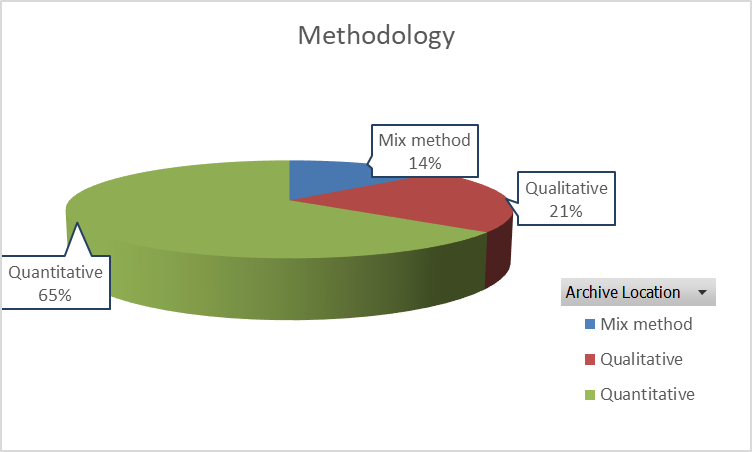
Most studies reviewed (65%, n = 33) employed a quantitative research methodology, which was the most frequently adopted methodology. The primary data collection methods of these studies were primarily through the use of structured or semi-structured questionnaires, with a majority of the studies having Likert scale questions. The statistical methods used to analyze the collected data were mostly the Partial Least Squares Structural Equation Modelling (PLS-SEM), the Structural Equation Modelling (SEM), and multiple regression analysis with frameworks such as the Technology–Organization–Environment (TOE), and Technology Acceptance Model (TAM) applied.
Qualitative studies were the second most common research design (21%, n = 11). The studies were mainly aimed at gaining in-depth understanding of the experiences, perceptions, challenges of SME owners or managers, and the factors that affect the use of technology and AI. This is true especially for developing countries where the adoption of technology can be affected by certain organizational and environmental factors.
The 14% (n = 7) were mixed-method studies. These studies have employed the methods of both quantitative and qualitative research to offer measurable evidence and explanations of the adoption of technology amongst SMEs. While mixed methods can be used to provide a richer description of the research problem, they were utilized less than quantitative methods. Overall, the methodological distribution shows that the dominant approach is the quantitative approach, in that almost two thirds of the studies reviewed used quantitative research. Qualitative and mixed-method studies are present concurrently, indicating that the topic has also been investigated using in-depth contextual and integrated study methods. So, Sri Lanka can benefit from (quantitative TOE) study of the adoption of AI tools by SMEs, thereby providing more empirical evidence to the existing literature in the context of Sri Lanka.
4.9 Co-Author Occurrence
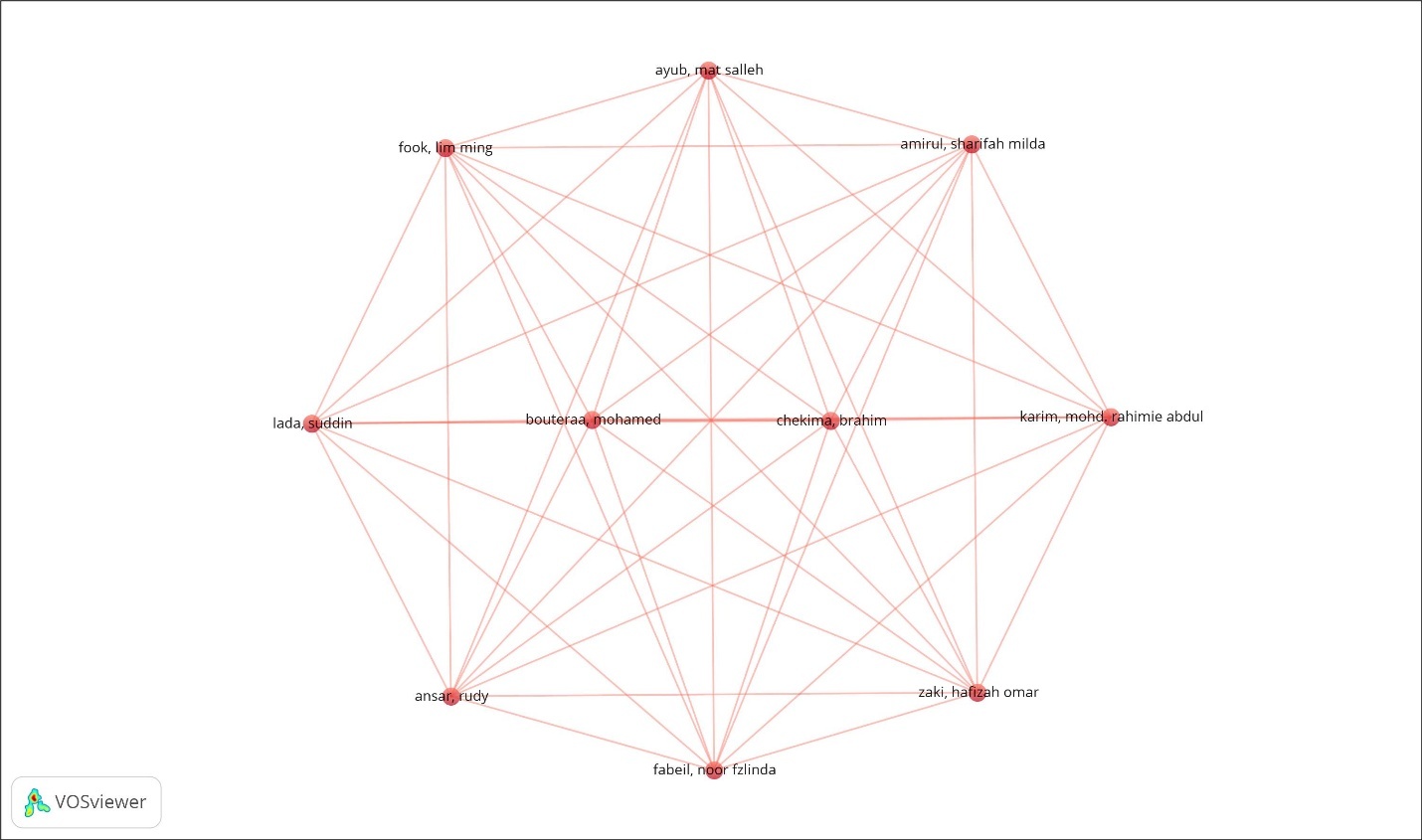
The co-authorship network map reveals a single, densely interconnected cluster of nine authors Ayub, Fook, Amirul, Lada, Bouteraa, Chekima, Karim, Ansar, Zaki, and Fabeil each of whom is directly linked to every other author in the group. This complete-graph structure indicates that these researchers collaborated together on the same publication, rather than forming separate or competing research clusters. The density and uniformity of the connections suggest a tightly-knit, single research team working collectively on AI/technology adoption in the Malaysian SME context (Bouteraa et al, 2024), with no clear “central” or “peripheral” authors all nodes carry equal weight and equal connectivity within this cluster. Unlike networks with distinct clusters representing different research groups or regional perspectives, this map reflects the co-authorship structure of one (or a small number of closely related) heavily multi-authored study, which is common in large-scale survey-based SME research requiring broad data collection and multi-institutional teams.
4.10 Key Word Occurrence
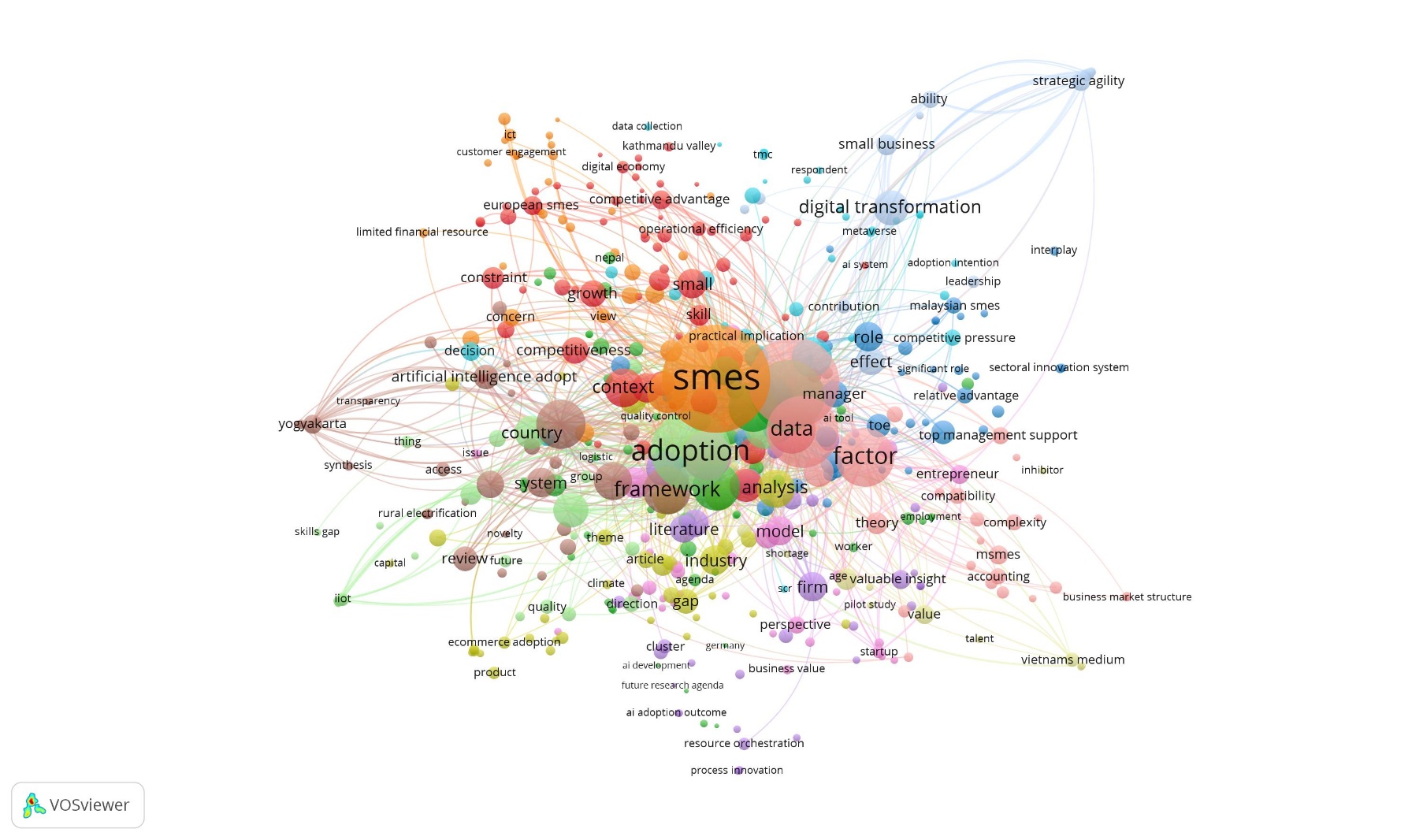
The keyword co-occurrence network map above displays the frequency and conceptual proximity of terms appearing across the reviewed studies. Five thematic clusters emerge from the mapping exercise, summarised in Table 2 below, with the full thematic analysis presented in Section 4.11 immediately following.
| Color | Main Theme | Key Words |
|---|---|---|
| Red | SME Characteristics & constraints | SMEs, Small, Skill, Growth, Competitiveness, Constraint, Concern, Limited financial resource, Competitive advantage |
| Green | Adoption frameworks & systems | Adoption, Framework, Country, System, Review, Future, Quality control, Ecommerce adoption, Rural electrification |
| Orange | Digital transformation & economy | Digital transformation, Digital economy, Data collection, ICT, Small business, Customer engagement |
| Blue | Strategic/ technology adoption drivers | Strategic Agility, Ability, AI system, Malaysian SMEs, Competitive Pressure, Role, Effect, Leadership, Adoption Intention |
| Teal/ Cyan | Adoption determinants & performance | Data, Factor, Entrepreneur, Top management support, MSMEs, Accounting, Compatibility, Complexity, Inhibitor |
| Purple | Theoretical/ literature base | Industry, Litrerature, Model, Theory, Firm, Gap, Value, Startup, Business Value, AI development, Resource orchestration |
| Brown/ Tan | AI adoption decision context | Artificial intelligence adopts, Decision, Transparency, Access, Synthesis |
| Lime | Emerging market context | Business market structure, Small & Medium |
4.10.1 Thematic Analysis
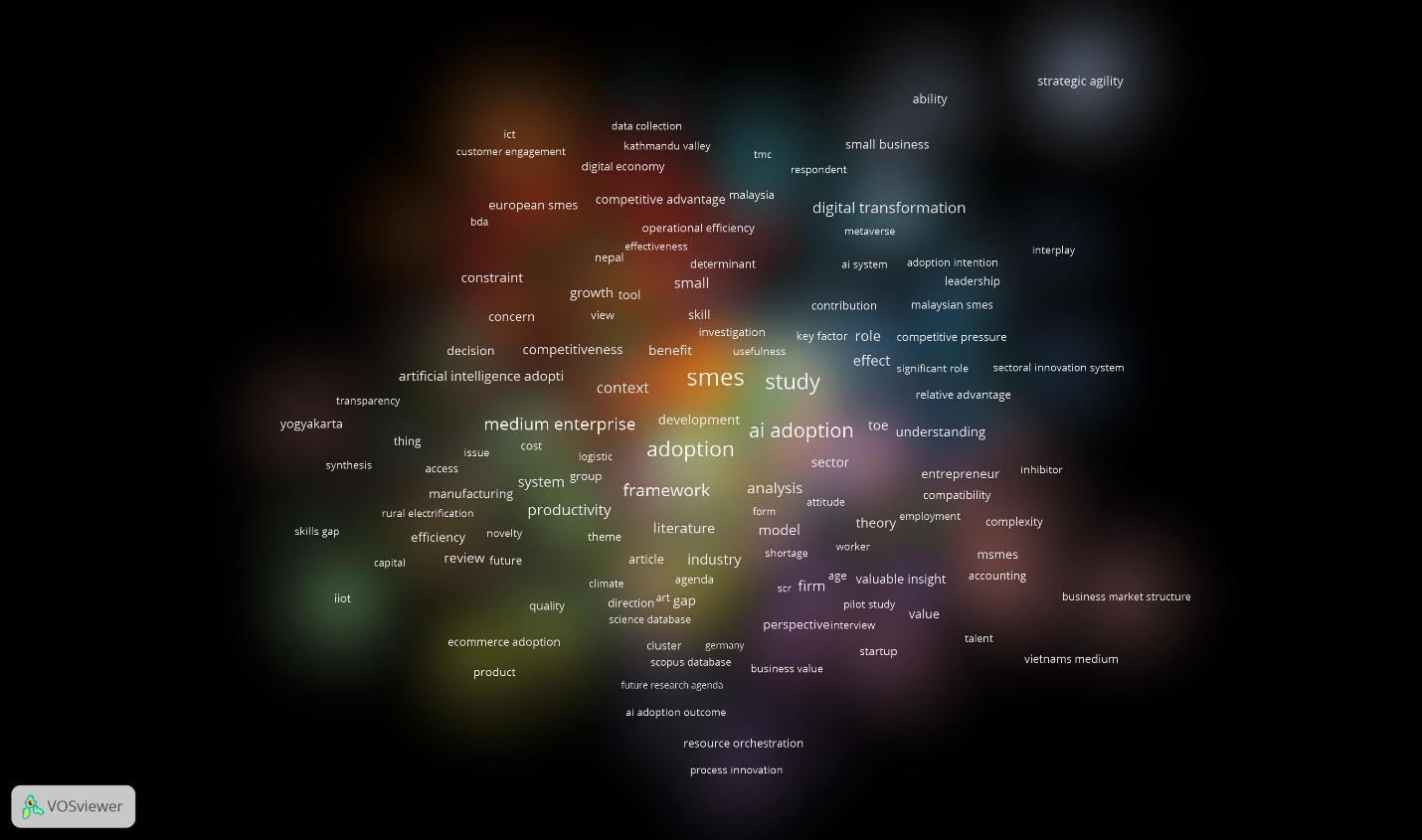
The keyword co-occurrence network map displays the frequency and conceptual proximity of terms appearing across the reviewed studies, with nodes sized by relative frequency and connecting lines representing co-occurrence within the same articles. As shown in Figure 11, artificial intelligence, SME, and barriers form the largest and most central nodes, confirming that these terms anchor the field's core vocabulary. Fifty-three distinct keywords, organised into five thematic clusters and linked by ninety-one co-occurrence relationships, were identified across the reviewed sample. Within the red technological cluster, artificial intelligence and technology sit as dominant hub nodes directly linked to the TOE framework and its component constructs (relative advantage, compatibility, complexity, infrastructure), while a secondary ring of more specific technological terms (cybersecurity, cloud computing, IT capability, data quality) links back to the same hub. The blue organizational cluster is anchored by SME and organization, with top management support, financial resources, and digital literacy forming a tightly interconnected sub-group, consistent with this review's discussion that organizational readiness factors rarely operate in isolation from one another in the literature. The green environmental cluster, anchored by government support, links outward to regulation, policy, competitive pressure, and vendor support, reflecting the field's growing attention to external enabling conditions rather than firm-internal factors alone. The purple regional cluster is comparatively smaller and more loosely connected than the other four, with South Asia as its hub linking to Sri Lanka, Bangladesh, Pakistan, and India; its lighter connectivity relative to the technological and organizational clusters visually reinforces the geographical imbalance identified quantitatively in Section 4.6, that South Asian context-specific research remains a secondary, rather than central, node within the broader intellectual structure of the AI-SME adoption literature. The yellow/orange theoretical and outcomes cluster bridges the other four, with barriers and TAM each connecting across technological, organizational, and regional nodes, indicating that adoption barriers and technology-acceptance constructs are the connective tissue linking otherwise distinct regional and disciplinary strands of the literature.
5. Research Gaps Identification
Theoretical Gap
The TOE framework is most commonly used in the studies reviewed, many of which are combined with the TAM and UTAUT models, and is largely used in developed-economy, large-firm settings as originally developed for such environments. South Asian SMEs (Sathana, 2024) have unique constraints on their resources, infrastructure, and informal management systems, which few studies have been adapted to consider (Yelpala et al., 2019). The frameworks were not designed to be applied to unreliable electrical power or patchy broadband or high levels of informality in electrical power or broadband ownership, and so its application here without modification may fail to capture factors that are more likely to be important here than in the environments from which most TOE-based AI studies come, such as trust in local vendors or reliance on mobile power infrastructure. This raises some doubt regarding how well validated TOE/TAM constructs extend to the context of Sri Lanka and the wider South Asian region.
Empirical Gap
From the bibliometric analysis in Section 4.6, it is observed that quantitative and statistically based evidences related to AI tool adoption are still quite limited, with most studies coming from India, Saudi Arabia, Indonesia, and Bangladesh, with Sri Lanka only a few studies most of which are qualitative. This presents an empirical gap as there is presently no study that examines the most predicting factors for the adoption of these AI tools by Sri Lankan SMEs with a large sample size and regression or SEM analysis. This is where existing Sri Lankan evidence is helpful, as it allows for broad categorization of challenges, but cannot, by design, quantify the relative value of these challenges based on the evidence.
Methodological Gap
The literature reviewed consists mainly of cross-sectional survey studies using PLS-SEM or multiple regression analysis. These would be longitudinal designs that would enable researchers to monitor the shifts in the relative importance of adoption factors and the changes in these factors as SMEs progress from awareness to trial to continued use of AI tools, but they are almost entirely missing from the sample. Only 5 per cent of studies reviewed used a mixed-method design, a combination of the statistical generalisability of survey data and the contextual richness of interviews. Persistent gaps exist; quantitative studies can show what factors are important and how much, but very few can explain the why, and existing literature in Sri Lanka is dominated by qualitative studies, which could explain the why, but not the how much.
Practice Gap
Even the more empirically rigorous studies end with general, non-specific advice for government support or training in digital literacy, not specific, actionable advice that is more relevant to a specific sector, size of firm, or amount of resources. Very few studies present their statistical results in terms of know-how that can be directly implemented by SME owners or policy makers. This leaves a gap between the increasing sophistication of the number crunching in academic research and the real-world application of AI by the SME owners, industry groups and government agencies that are actually driving AI adoption.
6. Discussion
The results of this systematic literature review underscore the growing interest in AI tools in SMEs and the increasing amount of published studies in this field, which has approximately tripled the number of publications from 2022 to 2025. This trend is driven by the real-world relevance of the subject: the competition for SMEs who don't use AI generative and predictive tools compared to those who do is projected to grow significantly as the technology becomes increasingly cheaper and easier to use (Chowdhury et al., 2022; Schwaeke et al., 2025).
Within the literature surveyed, three major factor categories appear consistently and are similar to the technological, organizational and environmental factors of the TOE frame of reference. From the technological side, perceived usefulness, relative advantage, and compatibility with the existing system are the factors that have been observed consistently to predict the intention to adopt (Badghish & Soomro, 2024; Thomas et al., 2025). Organizational factors like top management support and financial readiness are mentioned frequently as conditions needed for adoption, although not always enough, while digital literacy of employees is increasingly discussed as a separate and independent barrier to adoption, other than financial constraint (Chuan-Fu & Kuppusamy, 2025; Rawashdeh et al., 2023). In terms of environmental factors, it is noted that the lack of support and regulatory clarity is among the most significant factors in emerging markets, where SMEs are not able to bear the cost and uncertainty of AI adoption without external facilitation (Kim & Lee, 2024; Mehta & Kaur, 2025).
In the meantime, there are important discrepancies exposed in the discussion. Some research, such as Al Dhaheri et al. (2024), suggest that competitive and market turbulence are strong positive factors for the adoption of AI, pushing firms to innovate defensively, while others, such as Ur Rehman et al. (2025), show that in extremely resource-limited contexts, market pressure alone cannot overcome other structural barriers, like the lack of a reliable infrastructure. This diversity may reflect differences in the maturity of the national infrastructures, policy context, and composition of the sectors included in the studies reviewed, and highlights the importance of contextually specific rather than universally generalised adoption models.
In the South Asian/Sri Lankan context in particular, it seems to be the environmental and infrastructure-related factors that are emerging as the most binding constraint to adoption, not technical scepticism or a lack of perceived utility (Rahman, 2025; Sathana, 2024). This indicates that purely awareness-raising programmes to educate SMEs about the benefits of using AI tools without tackling the related infrastructure, funding and digital-literacy challenges are unlikely to have a positive impact on the rate of uptake in this region. It also supports the theoretical argument for maintaining the full TOE (TBM) rather than a TAM-only model as the framework for future research in Sri Lanka because there are seemingly as many environmental and organizational barriers as technological perceptions at the individual level in this particular context.
In general, this discussion suggests that the literature on the adoption of AI in SMEs is rapidly evolving and becoming more uniform around the theoretical framework of TOE, but the evidence base for AI adoption in SMEs in the south Asian context is still limited, largely qualitative in nature, and lacking in the ability to measure the relative importance of the factors that compete for AI adoption in SMEs, and therefore, this directly motivates and justifies further quantitative studies on the specific south Asian context.
7. Limitations
The conclusions of this systematic literature review should be taken with a grain of salt due to some of its limitations. Second, the search strategy included only four major databases, but some relevant studies may not have been identified, such as non-English-language regional publications, under-represented unpublished institutional reports and conference proceedings not included in the major databases, potentially under-estimating the extent of the South Asian and Sri Lankan context specific work on this topic.
Second, as the research field of AI-SME adoption is growing very fast, especially since 2023, the dataset for this review will become outdated in a relatively short time, with new studies being published at an increasing rate.
Third, reliance on published abstracts and full texts for coding theoretical frameworks, methodologies and country contexts creates some interpretive judgment, especially for studies that integrate several frameworks or multi-country samples, in which the type of theoretical framework is inevitably simplified for one dominant category in the review.
Fourth, the specificity of the focus on South Asia and Sri Lanka is what made the review of relevance but it did not allow for the same level of depth of analysis to be applied to studies from other continents, such as Sub-Saharan Africa or Latin America, nor did it allow for important nuances within those literatures to be fully captured.
Finally, like any systematic review, the review process will not eliminate publication bias, which means that statistically significant and theoretically novel studies are more likely to be published than null or inconclusive studies, and should be considered when assessing the consistency of the findings reported in the studies that were reviewed.
8. Future Research Directions
Based on the gaps found in Section 5, some directions for future research are suggested. There is a clear need for first, large sample, quantitative studies specifically related to Sri Lankan and wider South Asian SME population to validate the relative strength of technological, organizational and environmental factors with validated measurement scales of TOE/TAM instrument in the local infrastructural and institutional setting to establish the relative strength of the predictors in this context. This is where the quantitative research proposal this review aims to fill in the void.
First, future studies should focus on longitudinal and mixed-method studies that can capture the changing nature of adoption factors as SMEs move from awareness to trial to full integration of AI tools, which is not possible with cross-sectional designs.
Third, the drivers of AI adoption uncovered in the aggregate literature might differ meaningfully by sector, depending on the specific sector context, and so it is important to gain some understanding of how the drivers of AI adoption vary by sector, specifically because South Asian SME populations are diverse across sectors.
Fourth, comparative cross-country studies across South Asia (Sri Lanka, Bangladesh, Pakistan, India and Nepal) would help differentiate those adoption blocks that are truly regional in nature from those that are country specific and would benefit from more granular level of statistical analysis at the factor level as done by Rahman (2025) in his four country comparative study.
Last, future studies should further explore the potential of government policy and vendor (technol-ogy-partner) support as a key environmental determinant of adoption in resource-constrained regions where this review revealed environmental constraints to be the limiting factor, not individual technological scepticism, in the South Asian context.
9. Conclusion
This systematic review aimed to investigate the AI tool adoption trends among SMEs across the global and regional literature, specifically analyzing and focusing the results on the case of South Asian region including Sri Lanka. The review identified 51 peer-reviewed journal articles according to the PRISMA-guided search and screening process and concluded that scholarly interest in the topic is rising rapidly since 2022, the theoretical orientation of the majority of studies is based on the Technology-Organization-Environment framework, often accompanied by the Technology Acceptance Model or the UTAUT, and that the majority of studies in this field are quantitative and survey-based.
Simultaneously, the review revealed that there is a significant lack of empirical evidence specific to Sri Lanka, offering a clear empirical gap that could be filled by evidence from research on the likelihood of AI tool use, and by what degree among SMEs in Sri Lanka. Based on the conclusions drawn, four main gaps were identified both theoretically and practically relevant, with the common denominator being that a large sample, quantitative, and TOE-based study of Sri Lankan SMEs' use of AI is a timely and non-repetitive contribution to an emerging field.
Overall, this review will add to the literature by summarizing a growing and disjointed literature in a coherent body of evidence and in offering a clear, systematically developed rationale for the quantitative research that it supports. The findings will provide valuable information for researchers planning future research in this area and will help policy makers and technology providers gain an evidence-based understanding of areas where existing knowledge is robust, and areas where it is still a long way from comprehensive.
References
- Ahmad, S., Miskon, S., Alabdan, R., & Tlili, I. (2022). Towards sustainable textile and apparel industry: Exploring the role of business intelligence systems in the era of industry 4.0. Sustainability, 14(3), 1810. DOI ↗ Google Scholar ↗
- Aish, A., & Noor, N. A. M. (2023). Determining factors related to artificial intelligence adoption among small and medium size businesses: A systematic literature review. Journal of China University of Mining and Technology, 30(1), 24–41. DOI ↗ Google Scholar ↗
- Abed, S. S. (2020). Social commerce adoption using TOE framework: An empirical investigation of Saudi Arabian SMEs. International Journal of Information Management, 53, 102118. DOI ↗ Google Scholar ↗
- Adepoju, A. A., Ibrahim, K. A., & Sule, M. (2025). The impact of artificial intelligence (AI) adoption on the productivity of small and medium enterprises (SMEs) industries in Indonesia. ISA Journal of Business, Economics and Management, 2(6), 125–144. Google Scholar ↗
- Al Dhaheri, M. H., Ahmad, S. Z., & Papastathopoulos, A. (2024). Do environmental turbulence, dynamic capabilities, and artificial intelligence force SMEs to be innovative? Journal of Innovation & Knowledge, 9(3), Article 100528. DOI ↗ Google Scholar ↗
- Alsenan, S., Al-Rahmi, W. M., Alyoussef, I. Y., & Dahri, N. A. (2026). The role of AI capabilities and entrepreneurial competency in SME performance: The mediating role of strategic intelligence. Frontiers in Artificial Intelligence, 9, Article 1833033. DOI ↗ Google Scholar ↗
- Aljarboa, S. (2024). Factors influencing the adoption of artificial intelligence in e-commerce by small and medium-sized enterprises. International Journal of Information Management Data Insights, 4(2), Article 100285. DOI ↗ Google Scholar ↗
- Apostoaie, C.-M., Roman, T., Maxim, A., & Jijie, D.-T. (2025). Determinants of AI adoption intention in SMEs: Romanian case study. Journal of Business Economics and Management, 26(2), 234–256. DOI ↗ Google Scholar ↗
- Arroyabe, M. F., Arranz, C. F., De Arroyabe, I. F., & de Arroyabe, J. C. F. (2024). Analyzing AI adoption in European SMEs: A study of digital capabilities, innovation, and external environment. Technology in Society, 79, Article 102616. DOI ↗ Google Scholar ↗
- Ayinaddis, S. G. (2025). Artificial intelligence adoption dynamics and knowledge in SMEs and large firms: A systematic review and bibliometric analysis. Journal of Innovation & Knowledge, 10(3), Article 100682. DOI ↗ Google Scholar ↗
- Badghish, S., & Soomro, Y. A. (2024). Artificial intelligence adoption by SMEs to achieve sustainable business performance: Application of technology-organization-environment framework. Sustainability, 16(5), Article 1864. DOI ↗ Google Scholar ↗
- Bag, S., Gupta, S., Kumar, A., & Sivarajah, U. (2021). An integrated artificial intelligence framework for knowledge creation and B2B marketing rational decision making for improving firm performance. Industrial Marketing Management, 92, 178–189. DOI ↗ Google Scholar ↗
- Bhalerao, K., Kumar, A., & Kumar, A. (2022). A study of barriers and benefits of artificial intelligence adoption in small and medium enterprise. Academy of Marketing Studies Journal, 26(1), 1–6. DOI ↗ Google Scholar ↗
- Chatterjee, S., Rana, N. P., Dwivedi, Y. K., & Baabdullah, A. M. (2022). Understanding AI adoption in manufacturing and production firms using an integrated TAM-TOE model. Technological Forecasting and Social Change, 170, Article 120880. DOI ↗ Google Scholar ↗
- Chowdhury, S., Budhwar, P., Dey, P. K., Joel-Edgar, S., & Abadie, A. (2022). AI-employee collaboration and business performance: Integrating knowledge-based view, dynamic capabilities and expectancy theory. Journal of Business Research, 144, 31–49. DOI ↗ Google Scholar ↗
- Chuan-Fu, T., & Kuppusamy, J. (2025). Technological readiness, financial preparedness, and digital literacy as determinants of AI adoption among Malaysian SMEs. Journal of Small Business and Enterprise Development, 32(1), 45–63. DOI ↗ Google Scholar ↗
- Cimino, A., Corvello, V., Troise, C., Thomas, A., & Tani, M. (2025). Artificial intelligence adoption for sustainable growth in SMEs: An extended dynamic capability framework. Corporate Social Responsibility and Environmental Management, 32(5), 6120–6138. DOI ↗ Google Scholar ↗
- Davis, F. D. (1989). Perceived usefulness, perceived ease of use, and user acceptance of information technology. MIS Quarterly, 13(3), 319–340. DOI ↗ Google Scholar ↗
- Duan, Y., Edwards, J. S., & Dwivedi, Y. K. (2019). Artificial intelligence for decision making in the era of Big Data: Evolution, challenges and research agenda. International Journal of Information Management, 48, 63–71. DOI ↗ Google Scholar ↗
- Dwivedi, Y. K., & Pawsey, N. (2023). AI adoption in small and medium-sized enterprises: A systematic assessment of drivers and barriers. International Journal of Information Management, 71, Article 102625. DOI ↗ Google Scholar ↗
- Fajri, F., Perdana, K. A., Manurung, D. U., Dharmawan, P. K. N., & Dewi, N. G. (2024). The role of early adoption of artificial intelligence in supporting the growth of micro and ultra-micro enterprises in Indonesia: Challenges and opportunities. Jurnal Akuntansi dan Bisnis, 10(2), 133–143. DOI ↗ Google Scholar ↗
- Fonseka, K., Jaharadak, A. A., & Raman, M. (2022). Impact of e-commerce adoption on business performance of SMEs in Sri Lanka; moderating role of artificial intelligence. International Journal of Social Economics, 49(10), 1518–1531. DOI ↗ Google Scholar ↗
- Hasan, R., Ahmed, S., & Chowdhury, F. (2025). Impact of generative AI adoption on micro and small enterprises in emerging economies. International Journal of Progress in Social Sciences Development, 2(12), 1–15. Google Scholar ↗
- Islam, S., Rahman, M., & Chowdhury, T. (2023). Evaluating the utilization of technological factors to promote e-commerce adoption in small and medium enterprises. Heliyon, 9(3), Article e14231. DOI ↗ Google Scholar ↗
- Kartiwi, M., & MacGregor, R. C. (2007). Electronic commerce adoption barriers in small to medium-sized enterprises (SMEs) in developed and developing countries: A cross-country comparison. Journal of Electronic Commerce in Organizations, 5(3), 35–51. DOI ↗ Google Scholar ↗
- Khan, A., Malik, S., & Rehman, H. (2025). Institutional and capability barriers in agentic artificial intelligence adoption: Evidence from small and medium enterprises in Bangladesh. VINE Journal of Information and Knowledge Management Systems. Advance online publication. DOI ↗ Google Scholar ↗
- Khayer, A., Bao, Y., & Nguyen, B. (2021). Understanding cloud computing success and its impact on firm performance: An integrated approach. Industrial Management & Data Systems, 121(5), 1105–1129. DOI ↗ Google Scholar ↗
- Kim, D., & Lee, S. (2024). Government regulation and AI adoption in SMEs: A cross-national study of policy effectiveness in South Korea, Japan, and Singapore. Asia Pacific Journal of Management, 41(2), 567–591. DOI ↗ Google Scholar ↗
- Landini, C., & Machado, M. C. (2026). A systematic review on organizational adoption and performance constructs related to artificial intelligence in SMEs. Discover Artificial Intelligence. Advance online publication. DOI ↗ Google Scholar ↗
- Lee, J., & Tajudeen, F. P. (2020). Usage of social media for competitive intelligence: Perspective of information technology professionals. Information & Management, 57(4), Article 103180. DOI ↗ Google Scholar ↗
- Martins, A., Branco, F., Gonçalves, R., Au-Yong-Oliveira, M., Oliveira, T., Naranjo-Zolotov, M., & Cruz-Jesus, F. (2019). Assessing the success behind the use of education management information systems in higher education. Telematics and Informatics, 38, 182–193. DOI ↗ Google Scholar ↗
- Mehta, R., & Kaur, G. (2025). Artificial intelligence in Small and Medium Enterprises: An empirical analysis of critical factors. Premier Journal of Science, 24(1), 1–19. DOI ↗ Google Scholar ↗
- Nkemgha, G., Owusu, A., & Eshun, P. (2026). Artificial intelligence adoption for sustainable development in SMEs: Challenges, strategic pathways, and lessons for developing economies. International Journal of Sustainability in Business and Economics, 5(1), 1–24. DOI ↗ Google Scholar ↗
- Nugroho, A., Santoso, B., & Wijaya, K. (2025). AI adoption barriers in SMEs: Analyzing through the technology organization environment (TOE) framework. APTISI Transactions on Management, 9(3), 278–289. DOI ↗ Google Scholar ↗
- Omokhoa, H. E., Chukwurah, E. G., Ilori, O., & Jambol, D. D. (2024). The role of AI and fintech in advancing financial inclusion for SMEs in Sub-Saharan Africa. World Journal of Advanced Research and Reviews, 22(3), 481–494. DOI ↗ Google Scholar ↗
- Pillai, R., & Sivathanu, B. (2020). Adoption of AI-based chatbots for hospitality and tourism. International Journal of Contemporary Hospitality Management, 32(10), 3199–3226. DOI ↗ Google Scholar ↗
- Rahman, M. M. (2025). AI-driven business model innovation and TRIAD-AI in South Asian SMEs: Comparative insights and implications. Journal of Risk and Financial Management, 18(12), Article 709. DOI ↗ Google Scholar ↗
- Rawashdeh, A., Bakhit, M., & Abaalkhail, L. (2023). Determinants of artificial intelligence adoption in SMEs: The mediating role of accounting automation. International Journal of Data and Network Science, 7(1), 25–34. DOI ↗ Google Scholar ↗
- Rawindaran, N., Jayal, A., & Prakash, E. (2022). Machine learning cybersecurity adoption in small and medium enterprises in developed countries. Computers, 10(11), Article 150. DOI ↗ Google Scholar ↗
- Sánchez, E., Calderón, R., & Herrera, F. (2025). Artificial intelligence adoption in SMEs: Survey based on TOE-DOI framework, primary methodology and challenges. Applied Sciences, 15(12), Article 6465. DOI ↗ Google Scholar ↗
- Sathana, V. (2024). Exploring challenges for artificial intelligence readiness in SMEs in Sri Lanka. Vavuniya Journal of Business Management, 7(1), 15–32. DOI ↗ Google Scholar ↗
- Sawang, S., Ng, P. Y., Kivits, R. A., Dsilva, J., & Locke, J. (2024). Examining the influence of customers, suppliers, and regulators on environmental practices of SMEs: Evidence from the United Arab Emirates. Journal of Cleaner Production, 434, Article 140148. DOI ↗ Google Scholar ↗
- Schwaeke, J., Peters, A., Kanbach, D. K., Kraus, S., & Jones, P. (2025). The new normal: The status quo of AI adoption in SMEs. Journal of Small Business Management, 63(3), 1297–1331. DOI ↗ Google Scholar ↗
- Setiawan, B., Prasetyo, D., & Nugraha, R. (2025). Extending UTAUT with perceived intelligence for the adoption of artificial intelligence in MSMEs and startups in Indonesia: A multi-group analysis. Journal of Innovation & Knowledge, 10(6), Article 100821. DOI ↗ Google Scholar ↗
- Sharma, S., Singh, G., Ganguly, S., & Kumar, A. (2022). Impact of digital surge during Covid-19 pandemic: A study on e-commerce adoption among SMEs in India. Journal of Business Research, 143, 1–16. DOI ↗ Google Scholar ↗
- Soomro, K., Bhutta, M. K. S., Tunio, R. A., & Shaikh, H. A. (2024). Artificial intelligence readiness in emerging economies: Leadership support, government facilitation, and strategic agility among Saudi Arabian SMEs. Cogent Business & Management, 11(1), Article 2311189. DOI ↗ Google Scholar ↗
- Thomas, G., Albishri, N. A., Islam, J. U., & Tanveer, M. (2025). Exploring the determinants of artificial intelligence adoption intention in the SMEs of United Arab Emirates. SAGE Open, 15(4), 1–15. DOI ↗ Google Scholar ↗
- Ur Rehman, S., Hussain, T., & Zaman, F. (2025). Exploring AI adoption and SME performance in resource-constrained environments: A TOE-RBV perspective with mediation and moderation effects. Journal of Open Innovation: Technology, Market, and Complexity, 11(3), Article 100563. DOI ↗ Google Scholar ↗
- Venkatesh, V., Morris, M. G., Davis, G. B., & Davis, F. D. (2003). User acceptance of information technology: Toward a unified view. MIS Quarterly, 27(3), 425–478. DOI ↗ Google Scholar ↗
- Yesuf, Y., Fields, Z., Jain, A., & Kassa, E. (2025). Artificial intelligence adoption as a driver of innovation and competitiveness in SMEs: A bibliometric and systematic review. F1000Research, 14, Article 1215. DOI ↗ Google Scholar ↗
- Zafar, M., Rehman, S., & Kiyani, A. (2024). Understanding the adoption and impact of artificial intelligence in small businesses: A case study of the Pakistani context. Journal of Entrepreneurship in Emerging Economies, 16(4), 789–812. DOI ↗ Google Scholar ↗