Abstract
This study analyzes a local potential based inclusive community empowerment model implemented through the Srikandi Makmur Sejahtera microenterprise program in Merah Mata Village, Banyuasin I District, Banyuasin Regency. A case study approach was used, supported by descriptive quantitative analysis. Data were collected through focus group discussions, interviews, observation, production records, activity documentation, and program reports. The main participants were 12 women, with additional beneficiaries from women in socioeconomically vulnerable situations and older people. The 2024–2025 interventions included needs assessment, product diversification, galangal processing training, production equipment, a product gallery, digital marketing, halal and home-industry food certification, exhibitions, and packaging rebranding. In 2025, each member produced an average of 120 packages of galangal chips and 80 packages of galangal floss per month. At IDR 10,000 per package and production costs equal to 20% of turnover, net income reached IDR 1,600,000 per member per month, 33.33% above the 2024 figure of IDR 1,200,000. The program also created post-harvest work for 15 older people and socioeconomically vulnerable women, who earned approximately IDR 600,000 per person per month. Social changes included collective work routines, clearer roles, stronger skills and confidence, and broader market networks. Inclusive empowerment was strongest when capacity building, productive assets, legal compliance, market access, and adaptive support for vulnerable groups were integrated into a single intervention chain.
Keywords
inclusive empowerment vulnerable women microenterprise local potential galangal-based products Srikandi Makmur Sejahtera
Introduction
Women’s economic empowerment cannot be assessed only by the number of participants, training sessions, or assistance packages delivered. More substantive change occurs when women gain resources, decision-making capacity, and economic and social outcomes that were previously beyond their reach. Kabeer (1999) conceptualizes empowerment through the relationship among resources, agency, and achievements. This perspective positions women as actors with access, voice, control, and benefits rather than merely as production labor.
Rural women often face limited skills, information, capital, mobility, time, and market access, partly because of domestic responsibilities. These barriers are more pronounced among women in socioeconomically vulnerable situations, homemakers with limited education, and older people. Gender-aware entrepreneurship research therefore considers family, social, and institutional environments instead of treating individual women as the source of business constraints (Ahl, 2006; Brush et al., 2009).
Merah Mata Village has a strong galangal commodity base. Before downstream processing was developed, most galangal was sold as a raw commodity, leaving limited added value within the village. Srikandi
Makmur Sejahtera was established to connect this local potential with women’s economic empowerment through galangal chips, galangal floss, galangal dumplings, and other food products. The core group comprises 12 women and extends benefits to vulnerable groups through post-harvest tasks adapted to participants’ capacities.
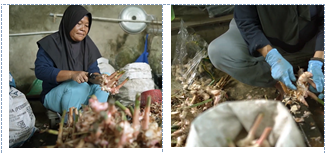
The program was implemented as a sequence of interventions rather than a one-off activity. Activities in 2024 included development and diversification focus group discussions, downstream-product training, equipment for galangal floss and dumplings, construction of a product gallery, and digital marketing training. In 2025, support continued through halal and home-industry food certification, exhibitions, and packaging rebranding. This study examines how these linked interventions relate to production, income, capacity, vulnerable-group participation, and prospects for independence.
The objectives are to: (1) describe the empowerment process; (2) measure changes in production and income; (3) analyze the inclusion of women and vulnerable groups; (4) identify changes in capacity, institutions, and networks; and (5) formulate a replicable local potential based inclusive empowerment model.
Literature Review
Women’s empowerment and agency
Empowerment is the process through which people previously denied the ability to make strategic life choices acquire that ability. Kabeer (1999) distinguishes resources as enabling conditions, agency as the capacity to act and decide, and achievements as outcomes. Income gains must therefore be interpreted alongside skills, confidence, control over earnings, and participation in decision-making.
Women’s entrepreneurship and social inclusion
A gender-aware framework links the individual, family, enterprise, social environment, and institutions (Brush et al., 2009). Ahl (2006) cautions against framing women themselves as the problem and calls for attention to structural barriers. In Indonesia, competencies, leadership, self-efficacy, digitalization, financial literacy, and access to finance contribute to the performance and sustainability of women-owned enterprises (Setyaningrum et al., 2023; Lestari et al., 2025). Women’s groups can also connect local knowledge and social capital with external resources, provided that participation extends beyond instrumental roles into planning and decision-making (Ameridyani et al., 2025; Harianto & Listyani, 2025).
Methods
The research used a qualitative case study supported by descriptive quantitative analysis. The unit of analysis was the Srikandi Makmur Sejahtera program in Merah Mata Village, Banyuasin I District, South Sumatra. The principal participants were 12 women members. Supporting informants included group leaders, program facilitators, company and village representatives, marketing actors, and vulnerable beneficiaries involved in post-harvest work.
Data were collected through focus group discussions, interviews, production observation, production and income records, and program documentation. Economic data were checked against production volume, selling price, the stated production-cost proportion, number of members, and production period. Social data were analyzed through changes in activities, division of roles, interaction, skills, confidence, networks, and member change stories.
Turnover was calculated as units sold multiplied by the selling price. Net income was set at 80% of turnover after deducting the reported 20% production cost. Percentage change was calculated as divided by the before value and multiplied by 100. Nurkholifa’s story was used as a Most Significant Change example while distinguishing group-production income from her total personal income (Dart & Davies, 2003).
The study has no comparison group; therefore, observed changes cannot be attributed entirely to the program. Vulnerability categories also require identity matching to prevent double counting among the 15 post-harvest workers, four vulnerable or low-knowledge homemakers, and six older people.
Results
| 2024 | Kampung Laos development FGD | Development constraints and needs identified |
| 2024 | Product diversification FGD | Plan for women’s participation and group strengthening |
| 2024 | Galangal chips and floss training | Twelve members gained downstream-processing skills |
| 2024 | Galangal floss production equipment | Stove, gas, oven, spinner, and production capital provided |
| 2024 | Galangal dumpling production equipment | Wok, ingredients, containers, and supporting tools provided |
| 2024 | A 3 × 2 meter Kampung Laos gallery | Product display and promotion space established |
| 2024 | Digital marketing training | Group digital-promotion capacity strengthened |
| 2025 | Halal and home-industry food certification | Basic product certification obtained |
| 2025 | Exhibition participation | Products promoted and government networks expanded |
| 2025 | Packaging rebranding | Packaging renewed to strengthen consumer confidence |
Changes in production and income
In 2024, each member produced an average of 90 packages of galangal chips and 60 packages of galangal floss per month. At IDR 10,000 per package, monthly turnover was IDR 1,500,000 per member. After deducting production costs of 20%, or IDR 300,000, net income was IDR 1,200,000 per member per month. In 2025, production increased to 120 packages of chips and 80 packages of floss per member per month. Turnover reached IDR 2,000,000 and net income after the 20% cost deduction reached IDR 1,600,000 per member per month.
| Galangal chips per member per month | 90 packages | 120 packages | Up 30 packages or 33.33% |
| Galangal floss per member per month | 60 packages | 80 packages | Up 20 packages or 33.33% |
| Total products per member per month | 150 packages | 200 packages | Up 50 packages or 33.33% |
| Turnover per member per month | IDR 1,500,000 | IDR 2,000,000 | Up IDR 500,000 or 33.33% |
| Production costs at 20% | IDR 300,000 | IDR 400,000 | Increased with production scale |
| Net income per member per month | IDR 1,200,000 | IDR 1,600,000 | Up IDR 400,000 or 33.33% |
| Net income of 12 members per month | IDR 14,400,000 | IDR 19,200,000 | Up IDR 4,800,000 |
| Annual group net income | IDR 172,800,000 | IDR 230,400,000 | Up IDR 57,600,000 |
The 33.33% increase indicates that stronger skills, productive assets, certification, packaging, and market access coincided with production growth. Causality should nevertheless be interpreted cautiously because the study did not use a comparison group or isolate market demand, input prices, and individual work intensity.
Participation of vulnerable groups
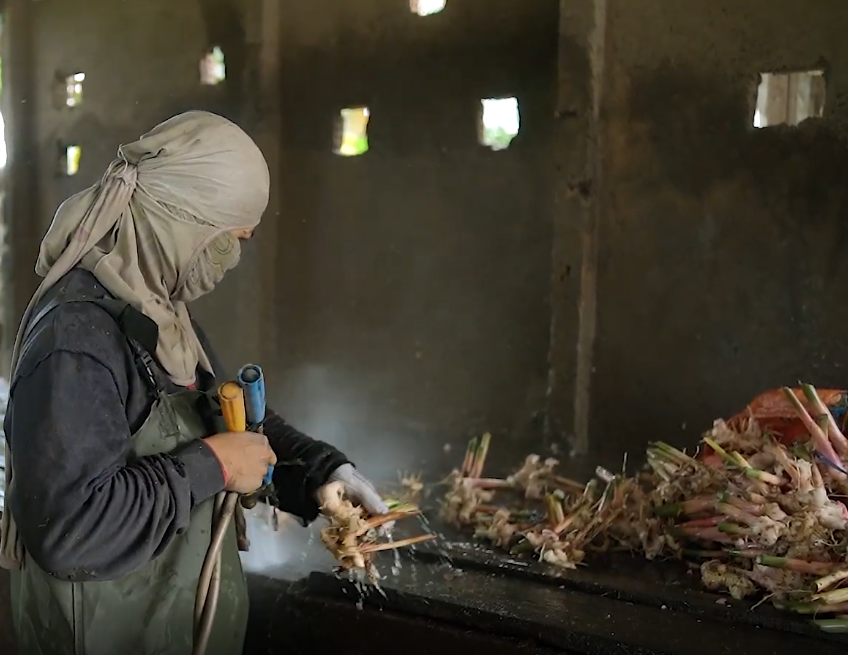
The program extended benefits beyond the 12 core members. Fifteen older people and socioeconomically vulnerable women cleaned harvested galangal and earned approximately IDR 600,000 per person per month, equivalent to IDR 9,000,000 collectively per month or IDR 108,000,000 per year. Additional mapping identified four vulnerable women categorized as homemakers with limited knowledge. Before the program, they had no additional skills, worked mainly in the domestic sphere, had approximately primary to junior-secondary education, and had limited access to information. They subsequently received downstream-processing and basic business training.
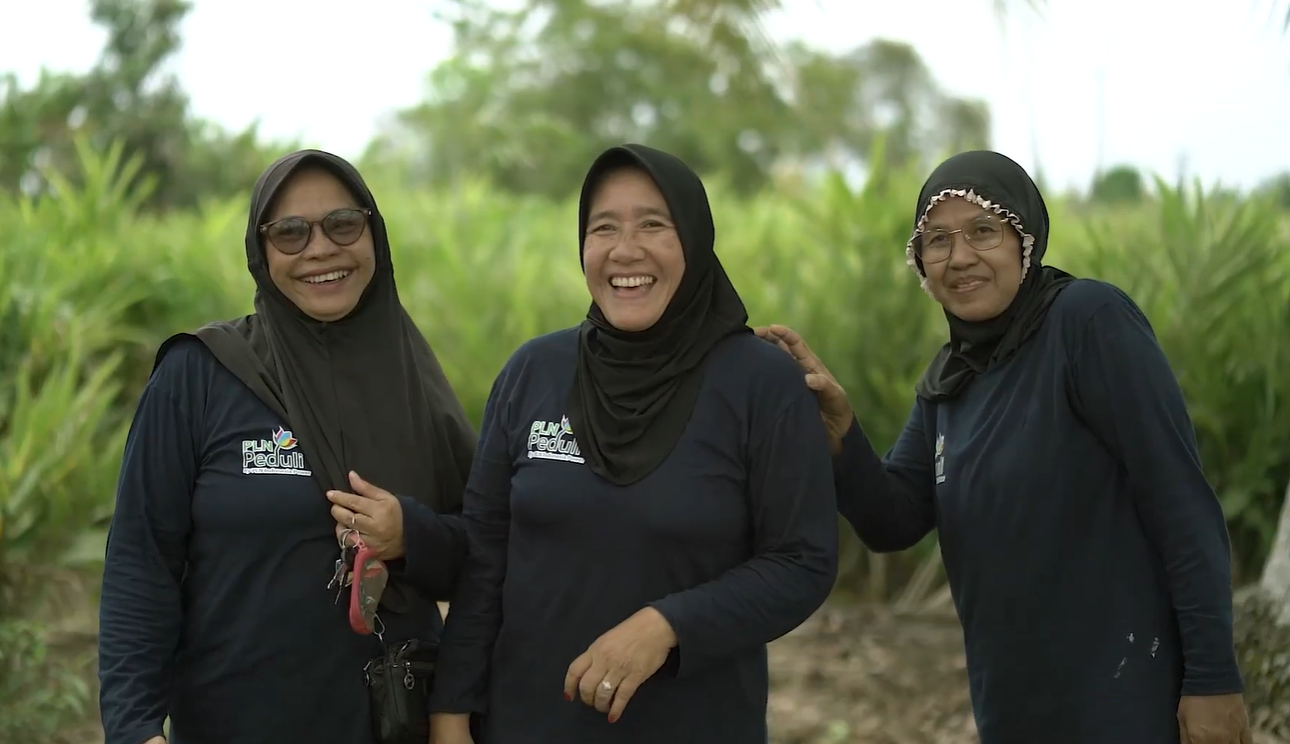
The mapping also identified six older people with physical limitations. Previously dependent on family members and excluded from economic activity, they were later involved in light tasks such as sorting and packaging. This adaptive division of labor reflects an inclusive approach because roles were matched to beneficiaries’ capacities.
| Target Group | Total | Vulnerability | Outcomes |
| Core Srikandi members | 12 people | Limited access to skills, production, and markets | Participated in production and earned net income |
| Older/vulnerable post-harvest workers | 15 people | Limited access to regular work | Additional income of about IDR 600,000/person/month |
| Vulnerable or low-knowledge homemakers | 4 people | Limited skills and information | Downstream-product and basic business training |
| Older people with physical limitations | 6 people | Dependent on family members | Participated in light sorting and packaging |
Social and institutional changes
Production created a collective work routine through schedules, role allocation, production coordination, packaging, and quality checks. These processes strengthened group cohesion, organization, interpersonal communication, and shared responsibility. Participation in exhibitions, digital marketing, and interaction with village government and the cooperative service broadened the group’s social networks. Halal and home-industry food certification and improved packaging increased market readiness. However, independence cannot be inferred from equipment and certification alone; it also requires financial records, working capital, repeat markets, leadership regeneration, and the ability to sustain production without full company support.
Most Significant Change of Nurkholifa
Nurkholifa joined downstream-product training in 2024 and subsequently became a member of Srikandi Makmur Sejahtera. Before the program, she relied on unstable dumpling sales of approximately IDR 750,000 per month. After joining, she gained business-development and sales-management skills, access to collective activities, and peer support. Her total personal income increased to approximately IDR 2,500,000–3,400,000 per month.
Using IDR 3,000,000 as a representative value, the increase from IDR 750,000 equals 300%. The lower bound of IDR 2,500,000 represents a 233.33% increase, while the upper bound of IDR 3,400,000 represents 353.33%. This total personal income is not identical to the IDR 1,600,000 monthly net income from group production because it may also include dumpling sales and other sources. The most significant changes were greater income stability, improved ability to meet daily needs, group support, and the capacity to finance her child’s education.
Discussion
From access to resources to economic achievements
The intervention chain illustrates the relationship among resources, agency, and achievements. Training, equipment, the gallery, certification, packaging, and networks constituted resources. Role allocation, work routines, marketing, and sales management created space for agency. Higher production and income, improved skills and networks, and greater economic stability were achievements. This pattern is consistent with Kabeer (1999), although individual control over income and the depth of participation in decisions still require measurement.
Inclusion through adaptive role allocation
The participation of vulnerable women, homemakers with limited knowledge, and older people shows that benefits were not confined to members able to undertake full production roles. Cleaning, sorting, and packaging offered different physical and skill requirements. This supports multidimensional empowerment for marginalized women (Harianto & Listyani, 2025). Inclusion should still be assessed through income distribution, occupational safety for older people, voice in group decisions, and pathways into higher-value roles.
Strengthening the local value chain
The program transformed galangal from a primary commodity into value-added products. Production growth of 33.33% occurred alongside improvements in certification, packaging, the product gallery, exhibitions, and digital marketing. The finding highlights the value of an intervention chain extending from production to markets and aligns with evidence on competencies, digitalization, literacy, and access in strengthening women-owned enterprises in Indonesia (Setyaningrum et al., 2023; Lestari et al., 2025).
Inclusive empowerment model
| Key Area | Baselinese | Intervations | Expected Outcomes |
| Identification | Galangal potential and barriers facing women | Needs and diversification FGDs | Updated profiles of members and vulnerable groups |
| Capacity | Production, enterprise, and marketing | Product and digital-marketing training | Members independently operate core processes |
| Assets | Production equipment and gallery | Equipment and 3 × 2 m gallery | Recorded use and maintenance |
| Quality and compliance | Standards, certification, and packaging | Certification and rebranding | Consistent quality and active permits |
| Markets and networks | Exhibitions, digital channels, and government | Promotion and public-sector connections | Repeat orders and diverse market channels |
| Adaptive inclusion | Roles matched to ability | Production, cleaning, sorting, and packaging | Equitable and safe benefits for vulnerable groups |
| Graduation | Capital, leadership, records, and innovation | Not yet fully measured | Group operates without full external support |
Conclusion and Recommendations
Srikandi Makmur Sejahtera represents an inclusive empowerment model combining local potential, capacity building, productive assets, certification, marketing, and adaptive role allocation. In 2025, net income reached IDR 1,600,000 per member per month, 33.33% above the 2024 level of IDR 1,200,000. Annual group net income rose from IDR 172,800,000 to IDR 230,400,000. The program also created post-harvest employment for 15 older people and socioeconomically vulnerable women, each earning approximately IDR 600,000 per month.
The impact extended beyond income. Collective routines, role allocation, stronger skills and confidence, wider networks, and Bu Nurkholifa’s change story demonstrate social strengthening. Claims of independence nevertheless require further evidence on control over income, actual costs, repeat markets, working capital, leadership regeneration, and the ability to sustain the enterprise without full company support.
Match beneficiary identities to prevent double counting across the 15 post-harvest workers, four vulnerable homemakers, and six older people.
Maintain production and financial records for each member, separating turnover, actual costs, net income, and other income sources.
Measure access, participation, control, benefits, equality, and independence through individual interviews with all members.
Establish working-capital and equipment-maintenance funds from an agreed share of group profit.
Strengthen repeat markets through purchasing agreements, digital channels, the gallery, exhibitions, and government partnerships.
Define measurable graduation indicators for phasing down, phasing out, and phasing over.
References
- Ahl, H. (2006). Why research on women entrepreneurs needs new directions. Entrepreneurship Theory and Practice, 30(5), 595–621. DOI ↗ Google Scholar ↗
- Ameridyani, A., Tokito, M., & Saizen, I. (2025). Towards community-driven rural development: Path of women group in empowering rural women’s capacities and role in rural development. World Development Perspectives, 39, 100700. DOI ↗ Google Scholar ↗
- Brush, C. G., de Bruin, A., & Welter, F. (2009). A gender-aware framework for women’s entrepreneurship. International Journal of Gender and Entrepreneurship, 1(1), 8–24. DOI ↗ Google Scholar ↗
- Dart, J., & Davies, R. (2003). A dialogical, story-based evaluation tool: The Most Significant Change technique. American Journal of Evaluation, 24(2), 137–155. DOI ↗ Google Scholar ↗
- Harianto, S., & Listyani, R. H. (2025). Empowering marginalised women in rural Indonesia: A multifaceted approach. International Journal of Sociology and Social Policy, 45(9–10), 959–980. DOI ↗ Google Scholar ↗
- Kabeer, N. (1999). Resources, agency, achievements: Reflections on the measurement of women’s empowerment. Development and Change, 30(3), 435–464. DOI ↗ Google Scholar ↗
- Lestari, E. D., Kurniasari, F., Pratiwi, P. Y., Thilaga, S., & Ooi, B. W. (2025). Empowering women entrepreneurs: The role of financial literacy, inclusion, and access in enhancing MSE’s performance and sustainability via women development program in Indonesia. Cogent Business & Management, 12(1), 2593078. DOI ↗ Google Scholar ↗
- Setyaningrum, R. P., Norisanti, N., Fahlevi, M., Aljuaid, M., & Grabowska, S. (2023). Women and entrepreneurship for economic growth in Indonesia. Frontiers in Psychology, 13, 975709. DOI ↗ Google Scholar ↗